It holds 89 terms in one alphabetical table, each with a short definition, the official citation where the term comes from a law, and the page that covers the term in full.
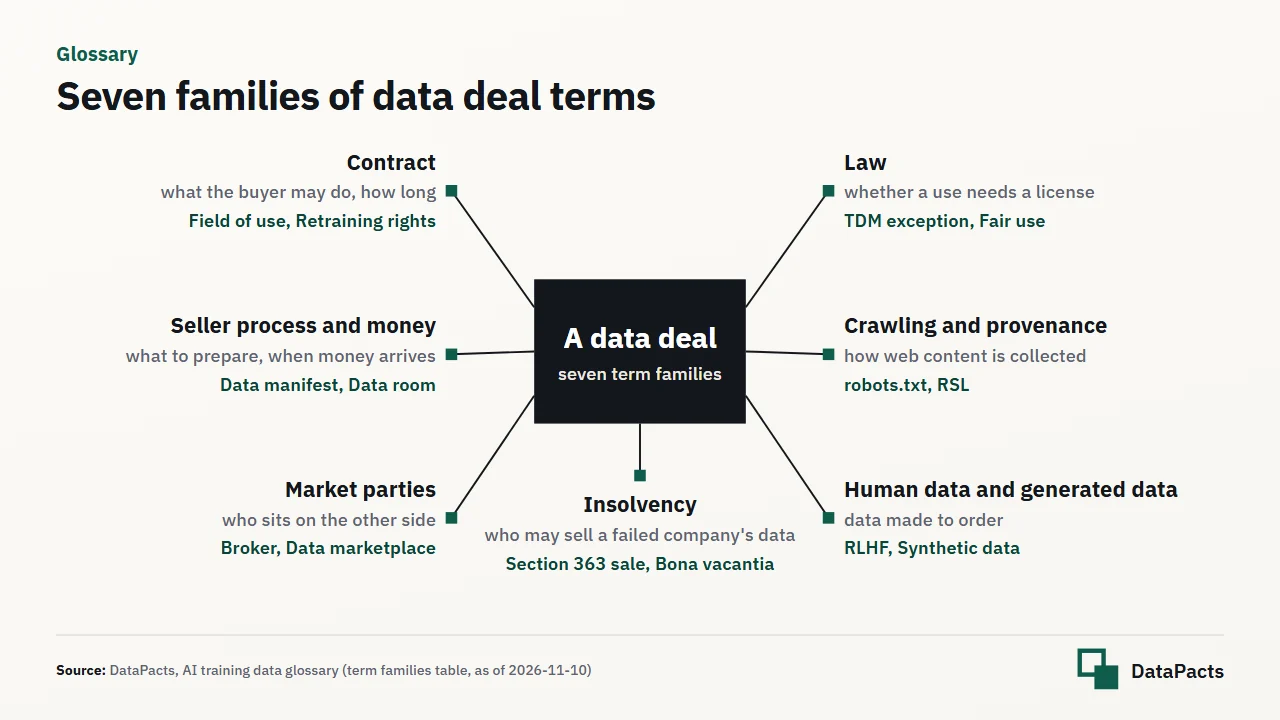
The entries cover the vocabulary of AI training data licensing in seven families: contract clauses, the seller process, market parties, law, crawling and provenance, human data and insolvency. The machine-learning sense of "training data", such as training and test sets, and general AI terms are not covered.
What the Glossary Covers and How Each Entry Is Built
Each entry gives one short definition, the official citation where the term comes from a law, and the page that covers the term in full. Terms are sorted alphabetically, each with a fixed anchor.
Each row holds four elements:
- Definition: one or two plain sentences, written for the holder's side and the developer's side alike.
- Citation or example: for a legal term, the instrument, the article or section and its date, such as Article 4(3) of Directive (EU) 2019/790 or 11 U.S.C. 332; for a contract term, a clause from a published agreement.
- Owner page: the page that covers the term in full. A term without its own page says so and points to the related entry in the same table.
- Status: whether the owner page is published. A page in preparation appears as plain text, and its link activates on publication.
Contract examples come from terms that companies publish themselves, such as the micro1 Data License Master Terms, last updated 2026-11-08. Insolvency examples come from court dockets, among them the Spirit Airlines data sale in Bankr. S.D.N.Y. 25-11897 (SHL), which the court had not approved as of 2026-11-09.
Terms A to Z
The table lists every term alphabetically, each with a stable anchor so other pages and readers can link straight to it. It is as of 2026-11-10, and the company terms quoted in it were checked on 2026-11-09.
A · B · C · D · E · F · G · H · I · J · L · M · N · O · P · R · S · T · U · V · W
| Term | Definition | Citation or example | Owner page | Status |
|---|---|---|---|---|
| Agent trajectory | A recorded sequence of the actions, tool calls and screens of an AI agent or a person completing a computer task. Trajectories are licensed as training data for computer-use and agent models. | definition only | agent trajectory data | published |
| AI crawler | An automated client that fetches web pages for an AI company, to collect training data, build a search index or answer a user's request. Operators publish a separate user agent for each purpose. | OpenAI: GPTBot (training), OAI-SearchBot (search), ChatGPT-User (user requests), checked 2026-11-09 | AI crawlers | published |
| AI training preference signal | A machine-readable statement that content may not be used for AI training. The current proposal, with the token __usage_ai-training, is an individual Internet-Draft, not an IETF standard. |
draft-kelley-aipref-training-preference-signal-00, published 2026-10-30, expires 2027-05-03 | no own page | on this page |
| All-party consent | A rule under which every party to a confidential call or conversation must consent before it is recorded. US federal law needs one party's consent, which matters before call recordings are licensed. | Cal. Penal Code 632(a); federal one-party rule 18 U.S.C. 2511(2)(d) | all-party consent rules | published |
| Anonymization | Processing after which a person can no longer be identified by any means reasonably likely to be used. Anonymous data falls outside the GDPR; data that can still be re-linked is only pseudonymized. | Regulation (EU) 2016/679, Recital 26; applies from 2018-05-25 | anonymization | published |
| Assignment for the benefit of creditors | An out-of-court wind-down in which a company assigns its assets, data included, to an assignee who sells them and pays the proceeds to creditors. | Delaware Uniform ABC Act, 10 Del. C. ch. 73A; old 10 Del. C. 7381-7387 repealed effective 2026-06-10 | assignment for the benefit of creditors | in preparation |
| Audit right | The licensor's right to verify that the licensee uses, stores and deletes the licensed data only as the contract allows, through records or inspections agreed in advance. | micro1 master terms s.4.2 leave audit to the Order Form, checked 2026-11-09 | audit rights | in preparation |
| Bona vacantia | The UK rule under which property of a dissolved company, data and data rights included, passes to the Crown unless the company is restored to the register. | Companies Act 2006 s.1012; restoration within 6 years, ss.1024(4), 1030(4) | bona vacantia | in preparation |
| Broker | A sell-side adviser that represents a data holder in a licensing or sale process for a fee or commission. A broker handles the sale and never acquires the data itself. | definition only | data licensing brokers | published |
| Chain of rights | The documented sequence of grants, from creator to current holder, showing that each party had the right to pass on what it licensed. Buyers check it before signing. | definition only | chain of rights | in preparation |
| Clawback | A contract term requiring the licensor to refund fees already received, for example when delivered data does not match its description. See Revenue share for the other payment terms. | micro1 master terms s.4.3: clawback if the Data Manifest is materially inaccurate, checked 2026-11-09 | see Revenue share | on this page |
| Clean room | A controlled environment in which a buyer runs tests or queries on a holder's data without receiving a copy. It is the no-copy form of a sample. | definition only | see Sample | on this page |
| Collective licensing | Licensing in which a collecting society or collective licenses the works of many rightholders at once and distributes the payments among them. Several collectives now offer licenses aimed at AI developers. | CLA Generative AI Solution, CCC AI Systems Training License, STIM AI license, PLAI by GEMA (programs checked 2026-11-09) | collective licensing | in preparation |
| Common Crawl | A nonprofit open archive of the web, released as numbered crawls and used as a source in many training corpora. | Latest crawl CC-MAIN-2026-43: 2026-10-05 to 2026-10-18, 2.16 billion pages, announced 2026-10-21 | Common Crawl | published |
| Computational data analysis | Singapore's copyright exception for copying works for computational data analysis. It requires lawful access to the works, and a contract term that excludes it is void. | Copyright Act 2021 (Act 22 of 2021) ss.243-244, in force 2021-11-21; s.187(1)(c) | computational data analysis in Singapore | in preparation |
| Consumer privacy ombudsman | A person appointed in a US bankruptcy case when the debtor proposes to sell personally identifiable information against its own privacy policy. The ombudsman reports to the court and does not cover employee data. | 11 U.S.C. 332, appointed at least 7 days before the sale hearing; 11 U.S.C. 363(b)(1) | see Section 363 sale | on this page |
| Copyright policy (AI Act) | The policy every provider of a general-purpose AI model must keep to comply with EU copyright law, including identifying and respecting TDM rights reservations. The open-source exemption does not remove it. | Regulation (EU) 2024/1689 Art. 53(1)(c), applies from 2025-08-02; Art. 53(2) | see Training content summary | on this page |
| Data Act | The EU regulation on access to and sharing of data generated by connected products and related services. It also sets an unfairness test for data contract terms between businesses. | Regulation (EU) 2023/2854, applies from 2025-09-12; Art. 13 | Data Act | published |
| Data buyer | The party that takes a license to, or ownership of, data for AI training, such as an AI developer, a data vendor or an enterprise. Intermediaries that only handle a sale are not buyers. | definition only | who buys AI training data | published |
| Data inventory | A list of the records a company holds, the systems they sit in, their volume and date range, prepared before any approach to buyers and used to write the data manifest. | definition only | data inventory | published |
| Data labeling | Adding labels, ratings, transcriptions or other annotations to raw data so it can be used for training. Labeling is done by vendors, contributors on platforms or the developer's own staff. | definition only | data labeling companies | published |
| Data licensing agreement | A contract that grants defined rights to use data for a purpose, period and territory while the licensor keeps ownership. Master terms with an order form per dataset are one common structure. | micro1 Data License Master Terms (updated 2026-11-08) s.1.2: nonexclusive, perpetual, sublicensable grant | AI data licensing agreements | published |
| Data licensing deal | An announced or filed agreement under which a holder licenses content or data to an AI developer, recorded with its parties, date, stated scope and source. A value appears only where a party has stated it. | Training stated: Axel Springer, FT, the Google and Reddit deal; training excluded: Le Monde and Perplexity (2025-05-14) | AI data licensing deals | published |
| Data manifest | A written description of a dataset, covering its sources, fields, volumes, date ranges and rights, that a seller shares before the data itself so a buyer can assess and price it. | micro1 Order Form with Data Manifest (master terms, checked 2026-11-09) | data manifest | published |
| Data marketplace | A platform on which data holders list datasets and licensees take licenses to them, usually for a commission on each transaction. The marketplace handles the transaction; the licensee is the buyer. | definition only | AI training data marketplaces | published |
| Data monetization model | The commercial form a data deal takes: a license, an outright sale, a revenue share or data-as-a-service delivery. The model decides who keeps ownership and how payment flows. | definition only | data monetization models | published |
| Data partnership program | A buyer's standing, published offer to license data from companies, usually with an application form, eligibility rules and stated terms. | Turing Project Lazarus: revenue share, nothing upfront, 6-month exclusive license to Turing, checked 2026-11-17 | data partnership programs | published |
| Data provenance | The documented origin, rights and processing history of a dataset, from collection through every transfer and transformation, which shows whether a buyer may use the data. | Data Provenance Standards (Data & Trust Alliance, 2024-07-09): 22 metadata fields in 3 standards | data provenance | published |
| Data room | An access-controlled online repository in which a seller shares contracts, consents, policies and sometimes samples with a prospective buyer during due diligence, usually under an NDA. | definition only | data room | in preparation |
| Database right | The EU sui generis right protecting a database built with substantial investment, separate from any copyright in its contents. | Directive 96/9/EC Art. 10: 15 years from 1 January after completion; substantial new investment restarts the term | EU database right | in preparation |
| Datasheet | A structured document describing how a dataset was created, what it contains, how it was processed and which uses it suits, following the "Datasheets for Datasets" proposal. | "Datasheets for Datasets", first arXiv version 2018-03-23 | dataset documentation | in preparation |
| De-identification | Removing or transforming identifiers so that records can no longer be linked to a person under a named legal standard. The contract should name which standard applies. | 45 CFR 164.514(a)-(b); Cal. Civ. Code 1798.140(m) | de-identification | published |
| Deemed acceptance | A contract term under which delivered data counts as accepted unless the buyer rejects it within a set period. | micro1 master terms s.1.3: 30 business days; its data-partnerships page says 30 days (both checked 2026-11-09) | deemed acceptance | in preparation |
| Deletion clause | A duty to delete or return licensed data at a set point, such as termination. A deletion duty covers the data, not necessarily models already trained on it. | Labelbox Prism kill clause: deletion within 30 days; "Models already trained on the data cannot be unlearned" (checked 2026-11-09) | deletion clauses | in preparation |
| Derivatives | Anything made from licensed data, such as annotations, models, weights, outputs and synthetic data, and the clause that decides who owns it. | micro1 master terms s.2.2: licensee owns derivatives and models, checked 2026-11-09 | ownership of derivatives | in preparation |
| Display license | A license to show content, such as summaries or excerpts with links, inside an AI product's answers, without a right to train models on it. | Display only or training not stated: TIME, Guardian, Getty; training excluded: Le Monde and Perplexity (2025-05-14) | no own page | on this page |
| Due diligence | The checks a buyer runs before signing, on rights, consents, privacy and data quality, and the checks a seller runs on the buyer's identity, intended use and security. | definition only | due diligence | published |
| Egocentric video | First-person video recorded from a head- or chest-worn camera while a person performs tasks, used to train robotics and physical AI models. | definition only | egocentric video | published |
| Employee notice | Informing staff, and where the law requires it consulting employee representatives, before a company licenses their messages, documents or other work records as training data. | definition only | employee notice | published |
| Exclusive license | A license under which the licensor may not license the same data to anyone else within the agreed scope, territory and period. Exclusivity is negotiated and priced as a separate term. | Labelbox Prism: exclusive by default (checked 2026-11-09); Turing Project Lazarus: exclusive to Turing for the first 6 months after signing (checked 2026-11-17) | exclusive data licenses | published |
| Expert demonstration (SFT data) | Worked examples written by domain experts, such as lawyers or physicians, that show a model the desired answer to a task. They are used for supervised fine-tuning. | definition only | expert demonstrations | in preparation |
| Extended collective licensing | Collective licensing whose effect extends to rightholders who are not members of the collecting society. Those rightholders may exclude their works at any time. | Directive (EU) 2019/790 Art. 12(1), 12(3)(c) | see Collective licensing | on this page |
| Fair use | The US defense that permits some unlicensed uses of copyrighted works, decided case by case on four statutory factors. | 17 U.S.C. 107; Thomson Reuters v. ROSS, 3d Cir. No. 25-2153, affirmed 2026-09-29, rehearing petition filed 2026-11-03 (as of 2026-11-09) | fair use | published |
| Field of use | A clause limiting the purposes for which the licensee may use the data, for example training one named model, and excluding every other use. | Tempus and Pathos: "for the sole purpose of" training the Foundation Model (Tempus 10-K, fiscal 2025) | field of use | in preparation |
| General-purpose AI model | The AI Act category for a model trained on large amounts of data that performs a wide range of tasks. Its providers must keep a copyright policy and publish a training content summary. | Regulation (EU) 2024/1689, in force 2024-08-01; Chapter V obligations from 2025-08-02 | see Training content summary | on this page |
| Google-Extended | A robots.txt product token, not a separate crawler, that controls whether Google uses crawled content for Gemini training and grounding. Google states it has no effect on Search inclusion or ranking. | Google crawler documentation, checked 2026-11-09 | Google-Extended | published |
| GPAI Code of Practice | The voluntary EU code for providers of general-purpose AI models. Its copyright chapter commits signatories, among other measures, to use crawlers that follow robots.txt. | Copyright chapter published 2025-07-10, Measure 1.3 (robots.txt per RFC 9309) | no own page | on this page |
| GPTBot | OpenAI's crawler for content that may be used to train its generative AI foundation models. OAI-SearchBot (search) and ChatGPT-User (user requests) are separate agents. | OpenAI bot documentation, checked 2026-11-09 | GPTBot | published |
| HIPAA Safe Harbor | A US method for de-identifying health information by removing 18 listed identifiers. Data de-identified this way, or by expert determination, falls outside the HIPAA Privacy Rule. | 45 CFR 164.514(b); 45 CFR 164.502(d)(2) | HIPAA Safe Harbor | in preparation |
| Human data | Data produced by people working for or through AI developers and vendors, such as ratings, preference comparisons, demonstrations, evaluations and expert tasks, as opposed to existing records. | definition only | human data | published |
| Indemnity | A promise by one party to cover the other's losses from defined claims, such as third-party rights or privacy claims, usually paired with warranties on the data. | micro1 master terms s.8.1: licensor indemnity, checked 2026-11-09 | indemnities | in preparation |
| Intermediary | Any party between a data holder and a buyer, such as a broker, marketplace, aggregator or referral page, that handles a sale without taking the data for itself. | definition only | selling through an intermediary | published |
| Introducer | An adviser, liquidator, investor or other person who refers a data holder to a buyer, in some programs for a referral fee that the buyer pays. | definition only | introducers | published |
| Japan Article 30-4 | Japan's copyright exception for uses not aimed at enjoying a work, such as data analysis, with a proviso that excludes uses that unreasonably prejudice the owner's interests. | Copyright Act (Act No. 48 of 1970) Art. 30-4, current text by Act No. 30 of 2018, in force 2019-01-01 | Japan Article 30-4 | published |
| Legitimate interest | The GDPR legal basis for processing that is necessary for a legitimate interest of the controller or a third party, unless the person's interests or fundamental rights override it. | Regulation (EU) 2016/679 Art. 6(1)(f), applies from 2018-05-25 | legitimate interest | published |
| Liability cap | The upper limit on what one party can owe the other under the contract, often a multiple of the fees, with carve-outs negotiated separately. | micro1 master terms s.7.2: 3x fees, checked 2026-11-09 | liability caps | in preparation |
| Model collapse | Loss of quality and diversity when models are trained recursively on data generated by earlier models. It is one argument for the continued value of human-made data. | Shumailov et al., Nature 631, 755-759, online 2024-07-24 | model collapse | in preparation |
| NDA | A confidentiality agreement signed before a seller shares samples, a data manifest or data room access, limiting what the recipient may do with the information. | definition only | NDAs | published |
| No-prior-grant warranty | The licensor's promise that it has not already granted rights, such as an exclusive license, that conflict with the new license. It matters when a seller talks to several buyers in parallel. | definition only | no-prior-grant warranties | published |
| Non-exclusive license | A license that leaves the licensor free to license the same data to other licensees at the same time. | micro1 master terms s.1.2: nonexclusive grant, checked 2026-11-09 | see Exclusive license | on this page |
| Order form | A short document signed under master terms that names the dataset, price, delivery and special terms of one deal. Term sheets and letters of intent can precede it. | micro1 Order Form with Data Manifest, checked 2026-11-09 | order forms | in preparation |
| Pay per crawl | A model in which a site owner charges AI crawlers for each request through an intermediary, which answers unpaid requests with HTTP 402 Payment Required. | Cloudflare pay per crawl: closed beta, one price per zone, Cloudflare as Merchant of Record (docs 2026-07-28, checked 2026-11-09) | pay per crawl | published |
| Perpetual license | A license with no end date. The term, termination and survival clauses decide what the licensee may still do with the data and models later. | micro1 grant perpetual (s.1.2); Defined.ai agreement s.8(a) "until terminated" vs its FAQ "perpetual" (checked 2026-11-09) | perpetual licenses | in preparation |
| Personal data | Under the GDPR, any information relating to an identified or identifiable natural person. Names, account identifiers, messages and voice recordings in company data can all qualify. | Regulation (EU) 2016/679, in force 2016-05-24, applies from 2018-05-25 | GDPR and personal data | published |
| Personally identifiable information (US bankruptcy) | The Bankruptcy Code's definition of personally identifiable information, limited to data that individuals provide for personal, family or household purposes. Employee data falls outside it. | 11 U.S.C. 101(41A) | see Section 363 sale | on this page |
| Platform opt-out | An account setting on a platform that lets a user stop, or allow, use of their content for AI training. Settings differ in their default and in whether any payment follows. | YouTube third-party training setting: off by default; YouTube does not facilitate payments (checked 2026-11-09) | platform opt-out settings | published |
| Pseudonymization | Replacing direct identifiers with codes or tokens. The data stays personal data under the GDPR if additional information can re-link it to a person, even when another party holds that information. | EDPB Guidelines 01/2025, consultation version, no final version as of 2026-11-09 | see Anonymization | on this page |
| Retraining rights | Whether the licensee may keep, use or retrain models built on the licensed data after the license ends or the data is deleted. | micro1 master terms s.4.4: deletion within 120 days, no duty to delete or retrain models (checked 2026-11-09) | retraining rights | published |
| Revenue share | Payment as a share of what the buyer earns from the data, instead of or on top of an upfront fee. It moves part of the price risk to the seller. | Turing Project Lazarus: revenue share, nothing upfront (checked 2026-11-09) | revenue share and other payment terms | published |
| Rights audit | A check of whether the holder owns or controls every right it wants to license: copyright, customer and user contracts, employee and privacy consents, and third-party terms. | definition only | rights audit | published |
| Rights reservation (TDM opt-out) | A rightholder's statement that its works may not be mined under the EU commercial text and data mining exception. For content made publicly available online, the reservation must be machine-readable. | Directive (EU) 2019/790 Art. 4(3), in force 2019-06-06 | TDM opt-out | published |
| RL environment | A simulated software setting, such as a replica of a web app or a coding task, in which a model takes actions and receives a reward signal for reinforcement learning. | definition only | RL environments | published |
| RLHF | Reinforcement learning from human feedback: people compare or rate model outputs, the ratings train a reward model, and the reward model steers further training. | Anthropic HH-RLHF paper, arXiv 2204.05862, submitted 2022-04-12 | RLHF data | published |
| robots.txt | A file at a site's root in which the site states which crawlers may fetch which paths. It is a request that compliant crawlers honor, not binding law by itself. | RFC 9309 (2022): caches should not be kept longer than 24 hours | robots.txt for AI crawlers | published |
| RSL (Really Simple Licensing) | An open standard for machine-readable AI licensing terms declared in robots.txt or an RSL file, with license types from free and attribution to subscription, usage-based, purchase and collective. | RSL 1.0 specification; RSL Collective paid license (royalties per generated result, rates not published) and attribution license, checked 2026-11-09 | see Pay per crawl | on this page |
| Sample | A small extract of a dataset, or test access to it, that lets a buyer judge quality before signing. A clean room is the form in which no copy changes hands. | definition only | samples and clean rooms | published |
| Section 29A (UK) | The UK copyright exception for copying works for text and data analysis for non-commercial research only. Contract terms that try to override it are unenforceable. | CDPA 1988 s.29A, inserted by S.I. 2014/1372, in force 2014-06-01; s.29A(5) | Section 29A | published |
| Section 363 sale | A court-approved sale of estate property in a US bankruptcy case, which can include customer and employee data. Selling consumer data against a privacy policy needs an ombudsman and court findings. | 11 U.S.C. 363(b)(1); Spirit Airlines data, Bankr. S.D.N.Y. 25-11897 (SHL): sale not approved as of 2026-11-09 | US bankruptcy data sales | published |
| Stalking horse bid | The first bid agreed with the debtor before an auction, which sets the floor for competing bids and is often protected by a break-up fee. | Character.AI, Bankr. D. Del. 26-11603 (BLS), Doc 15 (2026-10-13): assets exclude end-user data, training data and models; sale hearing proposed for 2026-11-24 | data assets in insolvency | published |
| Sublicensing | The licensee's right to pass licensed data, or rights in it, on to others such as affiliates, customers or contractors, and the conditions on each onward transfer. | micro1 grant sublicensable through multiple tiers (s.1.2), checked 2026-11-09 | sublicensing | in preparation |
| Synthetic data | Data generated by models or simulations instead of collected from people or the world. Synthetic data derived from personal data is outside the GDPR only if it is anonymous. | Regulation (EU) 2016/679, Recital 26 | synthetic data | published |
| TDM exception | A statutory exception allowing text and data mining of lawfully accessed works without a license. Its scope, beneficiaries and opt-out differ by country. | Directive (EU) 2019/790 Arts. 3 and 4; CDPA s.29A; Japan Art. 30-4; Singapore ss.243-244 | TDM exceptions | published |
| TDMRep | The TDM Reservation Protocol, a way to declare a text and data mining reservation in machine-readable form. It is a W3C Community Group report, not a W3C Standard. | W3C Community Group Final Report, 2024-05-10 | TDMRep | in preparation |
| Teleoperation data | Recordings of people steering robots remotely, capturing what the robot sees and the commands it receives, used to train robot policies by imitation. | definition only | teleoperation data | published |
| Trade secret | Confidential business information that has commercial value because it is kept secret. Licensing it for training depends on confidentiality terms that keep it secret. | Directive (EU) 2016/943 (transposition 2018-06-09); Defend Trade Secrets Act, 18 U.S.C. 1836, 1839 (2016-05-11) | trade secrets | in preparation |
| Training content summary | The public summary of training content that providers of general-purpose AI models publish on the AI Office template. Licensed data appears only as Yes or No plus modality, never as a dataset list. | Regulation (EU) 2024/1689 Art. 53(1)(d); template C(2025) 8311 of 2025-12-05 | training content summary | published |
| User-initiated fetcher | An agent that fetches a page because a user asked an AI product to read it, not to build a training set. Operators state that robots.txt may not fully apply to such requests. | ChatGPT-User, Perplexity-User, Meta-ExternalFetcher, Amzn-User (operators' pages, checked 2026-11-09) | see AI crawler | on this page |
| Valuation | An estimate of what a dataset is worth to buyers, built from comparable deals, the cost of recreating the data and its expected use in training. | definition only | valuation | published |
| Withholding tax | Tax a payer deducts from license payments to a foreign licensor. US payers withhold 30 % on royalties to foreign corporations unless a tax treaty reduces the rate. | 26 U.S.C. 1442(a), 881(a) | withholding tax | published |
Rows that say "see" point to the entry in this table that holds the fuller treatment. Legal citations name the instrument, the article or section and its date, and company examples are that company's own published terms.
Seven Term Families, From Contract Clauses to Insolvency
The terms fall into seven families, and each answers a different question in a data deal: what the contract allows, how the sale runs, who the parties are, which law applies, how web content is collected, how human data is produced and what happens in insolvency.
The table assigns each of the 89 terms to exactly one family, as of 2026-11-10.
Contract and seller-process terms decide what a holder gives away and when it is paid, while market-party terms decide who is on the other side of the deal. Law terms decide whether a use needs a license at all, and crawling terms decide whether a website's content is collected without one.
Human-data terms describe data made to order rather than licensed from records a company already holds. Insolvency terms apply when the holder is a bankrupt estate or a dissolved company, where a court, an assignee or the Crown controls the sale.
Pairs of Terms That Are Often Confused
Eight pairs of terms are often used as if they meant the same thing, and the difference usually decides price, risk or legality. The table separates each pair, as of 2026-11-10.
| Pair | What separates them | Source |
|---|---|---|
| License vs sale | A license grants defined use rights while the licensor keeps ownership; a sale transfers ownership | micro1 Data License Master Terms s.1.2 (checked 2026-11-09) |
| Exclusive vs non-exclusive | Exclusive bars other licenses within the scope; non-exclusive leaves the holder free to license again | Labelbox Prism FAQ (checked 2026-11-09); Turing Project Lazarus (checked 2026-11-17) |
| Anonymization vs pseudonymization | Anonymous data cannot be linked to a person by means reasonably likely to be used; pseudonymized data can be re-linked and stays personal data | GDPR Recital 26; EDPB Guidelines 01/2025 |
| Training vs display license | A training license allows model training; a display license allows showing content in answers only | Le Monde (2025-05-14); publisher deal announcements |
| TDM exception vs fair use | A statutory exception, with an opt-out for commercial mining in the EU, vs a US defense decided case by case | Directive (EU) 2019/790 Arts. 3, 4; 17 U.S.C. 107 |
| robots.txt vs TDMRep | A crawler access request vs a protocol for declaring a rights reservation | RFC 9309 (2022); W3C CG report 2024-05-10 |
| Broker vs buyer | A broker handles a sale for the holder; a buyer takes the license or ownership | this glossary's definitions |
| Settlement vs license fee | A court-approved settlement resolves claims over past use; a license fee buys a right to use | Bartz v. Anthropic, N.D. Cal. 3:24-cv-05417, Dkt. 680 (2026-07-20) |
Three pairs decide legality. Anonymous data falls outside the GDPR under Recital 26, while pseudonymized data that additional information can re-link stays personal data, the position of EDPB Guidelines 01/2025, which had no final version as of 2026-11-09. A TDM exception is a statutory permission, with a machine-readable opt-out for commercial mining under Article 4(3) of Directive (EU) 2019/790, whereas US fair use under 17 U.S.C. 107 is a defense decided case by case: on 2026-09-29 the Third Circuit held in Thomson Reuters v.
ROSS (No. 25-2153) that ROSS's use of 2,243 Westlaw headnotes was not fair use, and a rehearing petition was pending as of 2026-11-09. A robots.txt file under RFC 9309 asks crawlers to stay away, whereas TDMRep, a W3C Community Group report of 2024-05-10 and not a W3C Standard, declares a rights reservation.
Three pairs decide price and risk, and two concern parties and money. A license grants use while the licensor keeps ownership, and a sale ends the holder's control.
Labelbox Prism licenses are exclusive by default, and Turing states that its Project Lazarus license is exclusive to Turing for the first 6 months after signing, during which Turing may license the same record to more than one lab (checked 2026-11-17).
Le Monde stated on 2025-05-14 that its agreement with Perplexity excludes training, which makes it a display arrangement rather than a training license.
A broker or other intermediary handles a sale and never acquires the data, so it is not a buyer. The Bartz v. Anthropic settlement, finally approved on 2026-07-20, resolves claims over past use and is not a price for a license.
How Entries Are Sourced, Cited and Dated
Every legal term is cited to the official text with its date, and every example is taken from a docket, a filing, a statute or the named company's own page.
Company examples quote that company's own published terms with the date they were checked, 2026-11-09 for each company example in the table. They show how a clause is drafted, never a recommendation.
A definition changes when its cited source changes, such as an amended statute, a new docket entry or a revised term page, and the "as of" date of the table moves with it. DataPacts explains how we source, date and check every figure, including how readers can report an error in any entry.
From a Definition to the Full Page: Seller Guide, Law, Cases, Sources and Prices
A definition answers what a term means; the seller guide, the law hub, the case tracker, the sources page and the price page answer what it means for a deal. Each covers a group of terms from the table in full:
- How to sell or license company data: the complete seller guide, step by step, from data inventory to payment.
- AI training data law by jurisdiction: the law behind the legal terms, country by country.
- AI copyright lawsuits over training data: the rulings and settlements behind terms such as fair use.
- How AI companies get training data: crawling, licensing, users, humans and synthetic data.
- AI training data prices: what buyers pay per unit, each figure with its stating party and date.
Frequently Asked Questions
Is a data broker the same as a data buyer?
No: a data broker handles a sale for the data holder and never acquires the data itself. The buyer is the party that takes the license or ownership, such as an AI developer or a data vendor. Marketplaces, aggregators and referral pages are intermediaries in the same sense. See Broker.
Does robots.txt stop AI training on a website?
robots.txt asks crawlers not to fetch pages, but it is not binding law by itself. RFC 9309 defines the format, and AI developers name their training crawlers, such as GPTBot, so that sites can address them. Operators of user-initiated fetchers, such as ChatGPT-User, state that robots.txt may not apply to them. See robots.txt.
What does "retraining rights" mean in a data license?
Retraining rights decide whether a licensee may keep using, or retrain, models built on licensed data after the license ends. Deleting the data does not by itself remove a trained model. The micro1 Data License Master Terms, checked 2026-11-09, require deletion within 120 days but set no duty to delete or retrain models. See Retraining rights.
Is licensing data the same as selling it?
No: licensing grants defined rights to use data while the holder keeps ownership, and selling transfers ownership. A license can be limited by field of use, term, territory and exclusivity, and the holder can license the same data again unless the license is exclusive. A sale ends the holder's control. See Data licensing agreement.
Is this glossary legal advice?
No, this glossary is general information, not legal advice. Each legal entry names its statute, regulation or court decision and the date of the text it cites. The effect of a term in a given contract or jurisdiction depends on facts that a definition cannot assess, so a specific deal needs advice from a lawyer qualified in the relevant jurisdiction.