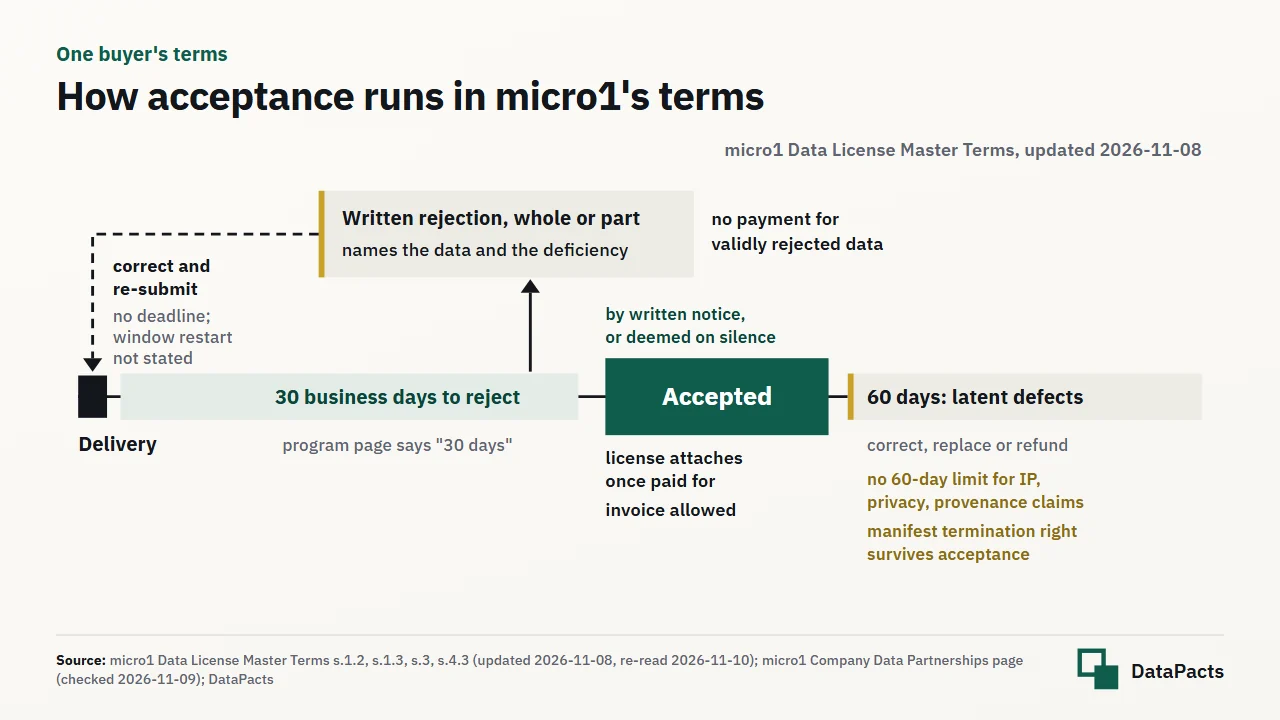
The published master-terms example cited here is micro1's Data License Master Terms (last updated November 8, 2026, re-read November 10, 2026): 30 business days to reject by written notice, then deemed acceptance, then 60 days for latent defects.
Acceptance decides when the license attaches and when the seller may invoice, which matters in any AI training data licensing deal. Declining a license with unacceptable acceptance terms is a valid outcome.
Each term names its source and date; see how DataPacts sources, dates and checks every figure.
What an Acceptance Clause Decides in an AI Data License
An acceptance clause settles five questions: what the data is tested against, how long the buyer may test, how it rejects, what the seller may do about a rejection, and what silence means.
- Standard: the written description and the review (micro1 s.1.1, s.1.3).
- Window: the period in which the buyer may reject.
- Notice: what a rejection must say.
- Cure: how the seller corrects and delivers again.
- Silence: deemed acceptance, latent defects, the license and the invoice.
Formats and transfer mechanics belong to delivering licensed data to an AI buyer.
Acceptance Terms in Published AI Data Programs and Contracts
Among the programs cited here, only micro1 publishes master terms with a full acceptance mechanism; the others state an acceptance step only as the event that triggers payment. The table compares each published term, as of 2026-11-10.
| Party (role) | Document | Review or rejection window | Effect of silence | What acceptance triggers | Source and check date |
|---|---|---|---|---|---|
| micro1 (buyer) | Data License Master Terms, updated 2026-11-08 | 30 business days after delivery; written, reasoned notice; whole or part (s.1.3) | deemed accepted | license attaches with payment (s.1.2); invoice after written notice of acceptance or deemed acceptance (s.3) | micro1.ai/legal/data-license-master-terms, re-read 2026-11-10 |
| micro1 (buyer) | Company Data Partnerships page | "30 days to review and approve" | not stated | "We pay in full within 30 days of acceptance"; FAQ: within 30 days of invoicing | micro1.ai/data-partnerships, 2026-11-09 |
| Centific (buyer program) | Enterprise Data page | sign-off on a sample pack before payment | not stated | payment after acceptance, with audit trail | centific.com/enterprise-data, 2026-11-09 |
| Nyne (data vendor that delivers to AI labs) | data-partnerships page | not stated | not stated | paid once the dataset is delivered and accepted | nyne.ai/data-partnerships, 2026-11-09 |
| Patronus AI (buyer program) | program page | full review up to 30 days | not stated | payment "Direct, on acceptance" | data.patronus.ai, 2026-11-09 |
| Polyshares (buyer program) | home and FAQ | not stated | not stated | Net 30 to 60 once data is approved, shared and anonymized | polyshares.com, 2026-11-09 |
| No acceptance step stated: Labelbox Prism (upfront fee at signing), Mercor (wire on delivery) | program pages | not stated | n/a | payment at signing or on delivery | prism.labelbox.com; mercor.com/data, 2026-11-09 |
Each term is the stating party's own wording; the signed order form can change it.
micro1's program page says "30 days to review and approve" against 30 business days in the terms, and both are shown unresolved. The license clause matrix sets acceptance beside the other published clauses.
What the Buyer Tests Delivered Data Against
Delivered data is tested against the written description agreed before delivery, and in micro1's terms the review covers quality, accuracy and usability without a published metric. micro1 delivers "the data described in the Data Manifest", defined as the licensor's written description approved by the licensee, including sources, types, volumes and specifications (s.1.1 and definitions), and all data is subject to review "including as to quality, accuracy and usability" (s.1.3).
None of the published terms cited here sets a numeric threshold. The description itself is covered under data manifest for AI buyers.
Centific states that the owner anonymizes the data and signs off on a sample pack, with payment after acceptance (checked November 9, 2026).
Patronus AI states that it makes a written offer after a sample and reviews the full delivery for up to 30 days (checked November 9, 2026).
A passed sample does not bind acceptance of the full delivery, a point covered under samples and proving data quality.
Rejection Windows and What a Valid Rejection Notice Contains
A rejection window is the period after delivery in which the buyer must reject, and micro1's is 30 business days, roughly six calendar weeks at five business days a week, not 30 days. Under s.1.3 (re-read November 10, 2026) a valid rejection is a notice that meets four conditions:
- It is written.
- It identifies the affected Data.
- It describes the deficiency in reasonable detail.
- It may reject the delivery in whole or in part.
Patronus AI states up to 30 days of review and micro1's program page says 30 days, both checked November 9, 2026.
Cure After Rejection: Correction, Re-submission and Replacement
Cure means the seller fixes rejected data and delivers it again, and micro1's terms require commercially reasonable efforts to correct the deficiency and promptly re-submit, with no deadline stated (s.1.3, re-read November 10, 2026).
The terms do not say whether the 30-business-day window restarts for re-submitted data. A seller can ask for a fixed cure period and a fresh, shorter window; no published term has one.
The same terms hold four different cure regimes. Re-submission after rejection has no deadline and applies only if the buyer does not terminate.
If a partial rejection leaves the rest no longer reasonably usable, the buyer may reject all data and terminate with no cure period (s.1.3). Termination for breach allows a 10-day cure (s.4.1). Termination for a materially inaccurate Data Manifest comes with no cure period (s.4.3).
Deemed Acceptance: When Silence Counts as Approval
Deemed acceptance treats delivered data as accepted when the rejection window closes without a valid notice, so silence favors the seller. micro1's s.1.3 reads that if the licensee does not give timely notice, the data is deemed accepted (re-read November 10, 2026).
Latent Defects Found After Acceptance
A latent defect is a quality problem that was not visible at review, and micro1 allows such claims within 60 days after acceptance.
The claim must relate solely to a latent defect in technical quality or a material non-conformity with the Data Manifest, and the licensor's sole obligation is, at its option, to correct or replace the affected data or refund the proportionate amount paid.
The 60-day limit does not apply to claims on intellectual property, privacy, consents, provenance or fraud (s.1.3, re-read November 10, 2026).
The Buyer Right That Outlasts Acceptance
Acceptance does not end the buyer's remedies for a wrong description: under micro1's s.4.3, a materially inaccurate or misleading Data Manifest lets the buyer terminate even after deemed acceptance.
The right rests on the licensee's good-faith determination, takes effect on immediate written notice with no cure period, and brings a refund of amounts paid and no license on the data (re-read November 10, 2026).
How Acceptance Gates the License Grant and the Invoice
In micro1's master terms acceptance is the gate for both sides: the license does not attach before it, and the seller may not invoice before it.
- The license attaches to a portion of the data only once it is accepted or deemed accepted and paid for, and none attaches to rejected or unpaid data (s.1.2).
- No payment is owed for data validly rejected (s.1.3).
- The seller may invoice only after the licensee gives written notice that the data is accepted, or after the data is deemed accepted under s.1.3 (s.3).
- Undisputed amounts are paid within the period stated in the order form after a conforming invoice (s.3).
micro1's program page gives two payment phrasings, within 30 days of acceptance and within 30 days of invoicing (checked November 9, 2026).
The intermediaries Corpus Bridge (for example 50 percent on signature, 50 percent on delivery) and Data Licensing Advisors state milestone payments by buyers (checked November 9, 2026). Timing and milestones are covered under when and how AI data buyers pay.
Acceptance Terms Under the EU Unfair-Terms Rule for Data Contracts
Under the EU Data Act, a term unilaterally imposed on another enterprise that gives the imposing party the exclusive right to decide whether supplied data conforms to the contract is always unfair and not binding.
The rule sits in Regulation (EU) 2023/2854, Art. 13(1) and 13(4), and Chapter IV applies to contracts concluded after 2025-09-12 (Art. 50). Details sit under EU Data Act and AI training data.
A term counts as unilaterally imposed if the other party could not influence it despite trying to negotiate (Art. 13(6)).
Whether a given acceptance clause falls under Art. 13(4) depends on how it was agreed and is not assessed here.
Commission Recommendation (EU) 2026/2394, published on November 6, 2026, sets non-binding model contractual terms for data access and use; its acceptance wording is not described here. The Article 13 test is covered under unfair terms in B2B data licences.
Acceptance Asks With and Without a Published Precedent
Sellers can ask for tighter acceptance terms, and the table separates asks that a published term already grants from asks that none grants. The table compares each ask with the cited terms, as of 2026-11-10.
| Seller ask | Published precedent | Source |
|---|---|---|
| fixed rejection window | yes: micro1 30 business days | micro1 s.1.3, 2026-11-10 |
| silence counts as acceptance | yes: micro1 deemed acceptance | micro1 s.1.3, 2026-11-10 |
| written notice that names the data and the deficiency | yes: micro1 s.1.3 | micro1 s.1.3, 2026-11-10 |
| no payment risk on accepted data beyond a short latent-defect period | partly: micro1 60 days, correct, replace or refund as sole remedy, but IP, privacy and provenance claims and the s.4.3 manifest right fall outside | micro1 s.1.3 and s.4.3, 2026-11-10 |
| numeric acceptance criteria (error rate, coverage) | none in the published terms cited here | none |
| fixed cure deadline and a fresh, shorter window for re-submitted data | none: micro1 states "promptly", no window rule | micro1 s.1.3, 2026-11-10 |
| payment on delivery instead of acceptance | yes, outside micro1: Mercor on delivery; Labelbox upfront at signing | Mercor and Labelbox pages, 2026-11-09 |
| cure period before a manifest-based termination | none: micro1 s.4.3 "no cure period" | micro1 s.4.3, 2026-11-10 |
Such asks are negotiated and no public figure shows their effect on price, a topic covered under negotiating an AI data licensing deal.
Agreeing to an Acceptance Clause: Benefits, Risks, Downsides and Alternatives
An acceptance clause with a short window and deemed acceptance gives the seller a date after which the data counts as accepted, and the price of agreeing is the buyer's broad right to reject before then. The wider question is covered under should you sell or license your data.
Benefits
- A fixed window that ends in deemed acceptance (micro1 s.1.3).
- Payment and license tied to a known event (s.1.2 and s.3).
- A written, reasoned notice instead of a bare refusal.
Risks
- Rejection on "quality, accuracy and usability" with no published metric.
- Open-ended re-submission with no stated deadline.
- A manifest termination right that survives acceptance (s.4.3).
Downsides
- Money waits for acceptance, unlike programs that pay on delivery or at signing.
- Latent-defect exposure lasts 60 days, and longer for IP, privacy and provenance claims.
Alternatives
- Negotiate the asks in the table above.
- Choose a buyer that pays on delivery or upfront, as Mercor and Labelbox state.
- Evaluate in the seller's own environment before any transfer.
- Do not license the data at all.
Options outside the contract are laid out under alternatives to selling data to AI labs.
How the Acceptance Clause Works With the Other Clauses of the License
Acceptance is read with the data description, the warranties, the payment clause and the term, because each sets what a rejection costs the seller. The whole set is covered under every clause of an AI data licensing agreement.
Related clause pages:
- Indemnities and warranties in AI data licenses
- Liability caps in AI data licenses
- License term and perpetual licenses
- Deletion, return and machine unlearning clauses
- Governing law, arbitration and disputes, for a rejection dispute
Process steps:
- Term sheets, order forms and LOIs, where the order form sets payment periods
- Evaluating an offer for your data
- How long an AI data licensing deal takes
No Acceptance Step in a Court-Supervised Sale
A sale out of bankruptcy can replace acceptance with an as-is transfer: Spirit Airlines' form of bill of sale for de-identified data provides payment contemporaneous with delivery and an as-is disclaimer including non-infringement. The form (In re Spirit Aviation Holdings, Inc., No. 25-11897 (SHL), Bankr.
S.D.N.Y., Dkt. 1463) is not approved as of November 9, 2026, with the hearing adjourned to November 17, 2026 (Dkt. 1779). The wider topic is covered under data assets in insolvency, and the sale under Spirit Airlines' data archive sale.
Information, Not Legal Advice
This page explains published terms and public rules for information and is not legal advice for a specific agreement.
Terms and Programs Cited on This Page
The terms above come from each party's own documents, checked on November 9, 2026, unless another date is shown.
- Centific, a paying program: Centific profile
- Corpus Bridge, an intermediary that places data
- Data Licensing Advisors, an intermediary that places data
- Labelbox Prism, a paying program: Labelbox Prism profile
- Mercor, a paying program: Mercor data buyer profile
- micro1, a paying program: micro1 data buyer profile and micro1 Data License Master Terms clause by clause
- Nyne, a data vendor that delivers to AI labs
- Patronus AI, a paying program: Patronus AI profile
- Polyshares, a paying program
- Other programs are listed under company data partnership programs.
Frequently Asked Questions
What is a data acceptance clause?
A data acceptance clause sets what delivered data is tested against, how long the buyer may reject it, how it rejects, and what happens if it stays silent.
What is deemed acceptance of delivered data?
Delivered data counts as accepted when the rejection window ends without a valid notice. micro1's master terms apply it after 30 business days (re-read November 10, 2026).
How long does an AI buyer have to reject delivered data?
micro1's terms give 30 business days. Its program page says 30 days, and Patronus AI states up to 30 days of review (checked November 9, 2026).
Does a buyer pay for data it rejects?
Not under micro1's master terms. No payment is owed for data validly rejected, and no license attaches to rejected or unpaid data (re-read November 10, 2026).