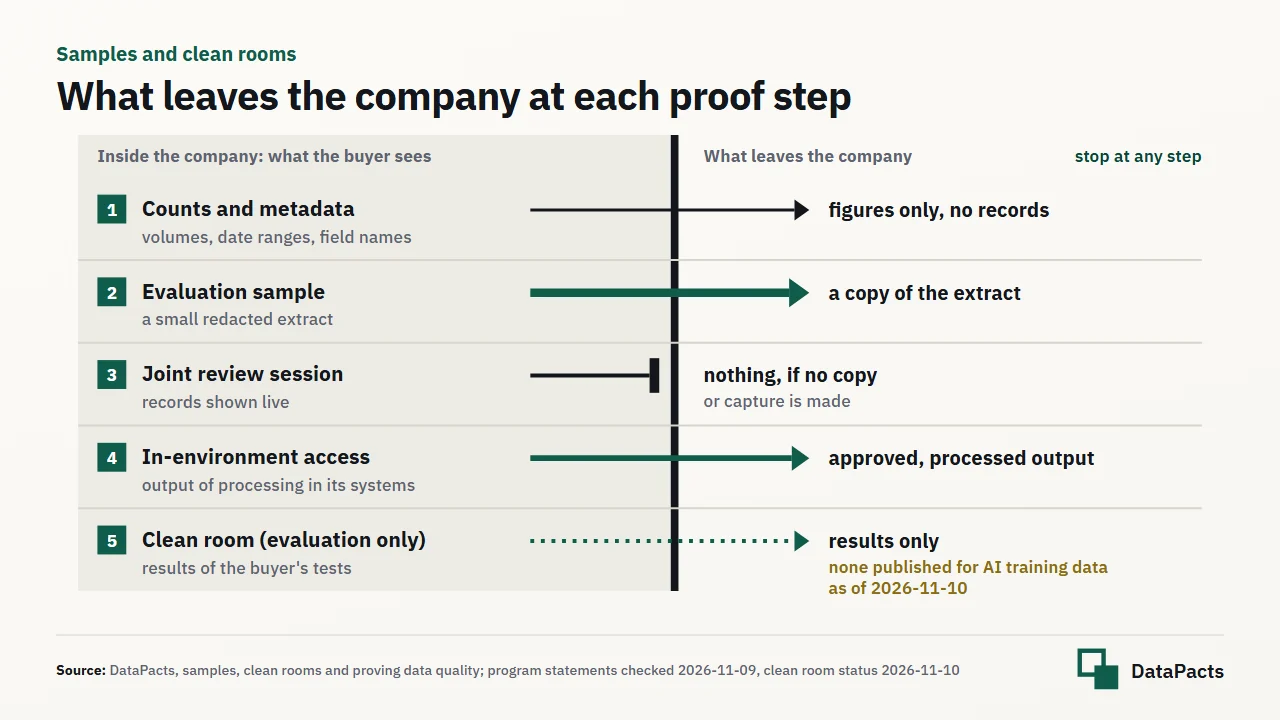
Turing states that it asks for rough volumes per system first, and Patronus AI that it reviews a sample under NDA (both checked November 9, 2026).
Each step discloses more than the last, and a seller can stop at any step. The steps are part of AI training data licensing for a company holding data, and sharing no sample at all is a valid outcome.
Fact-check note: every program statement on this page is dated and sourced as described in how we source, date and check every figure.
What a Buyer Needs to See Before It Prices Company Data
A buyer looks for three things a description cannot prove: that the records are what the seller says, that they are dense enough to train on, and that they carry the features its acceptance rules require.
Mercor states that its Software Company listing wants code written by people, with tests that run, and lists code mostly written by AI tools as not a fit (checked November 9, 2026).
Mercor also states that its Call Center or BPO listing wants consent that covers reuse and each speaker on a separate channel (checked November 9, 2026). Polyshares states "We do not pay for a record we have not seen" (checked November 9, 2026), which is the buyer's side of the same point.
The data manifest states what the dataset is, and a sample or supervised access shows whether the statement holds.
Five Ways to Prove Data Quality, Ordered by What Leaves the Company
Five methods cover every proof step named on the program pages cited here, from figures that reveal no record to supervised access that releases only results. The table compares them by what the buyer sees and what leaves the company (as of 2026-11-09, each program statement checked 2026-11-09, least disclosure first).
| # | Method | What the buyer sees | What leaves the company | Programs that name it | Source |
|---|---|---|---|---|---|
| 1 | Counts and metadata | volumes per system, date ranges, field names, file types | figures only, no records | Turing: rough volumes per system; Marin Data: records map and ownership check | lazarus.turing.com; marindata.ai |
| 2 | Evaluation sample | a small redacted extract | a copy of the extract | Patronus AI: sample under NDA; Turing: a small slice on a sampling request; Marin Data: de-identified sample; Grepped: buyer samples under NDA; Polyshares: reads a sample to price | data.patronus.ai; lazarus.turing.com; marindata.ai; grepped.ai; polyshares.com |
| 3 | Joint review session | records shown live by the seller | nothing, if no copy or capture is made | Ooak Data: joint evaluation under one hour; pre.dev: 30-minute call to review samples | ooakdata.com/partner; pre.dev/labs |
| 4 | In-environment access | output of processing run inside the seller's systems or over a read-only connection | approved, processed output | Centific; Mercor Connect; Magma; Scale AI | centific.com; mercor.com/data; magmahq.ai; scale.com |
| 5 | Clean room (evaluation only) | results of tests the buyer runs; no records | results only | none published for AI training data as of 2026-11-10 | none |
Most programs combine two methods. Data rooms hold documents for review rather than records for testing, and their layout is covered under setting up a data room for an AI data licensing deal.
Designing an Evaluation Sample: Which Records, How Many, How Redacted
An evaluation sample works only if it represents the full set: the same sources, periods and record types, redacted to the same standard as the delivery. The selection covers every source and period in scope, typical and difficult records alike, and nothing chosen only because it looks good.
No buyer cited here publishes a sample size for company archives. The one public figure is Stack Overflow's sample dataset of 1,000 Q&A pairs (checked November 9, 2026). SpeechData.ai, David AI and Midcentury offer samples of datasets they sell to AI developers (checked November 9, 2026), and run no seller program.
Redaction follows the delivery standard and is never cleaner. AfterQuery states a re-identification test before delivery and that "no process removes all risk on its own" (checked November 9, 2026). The standards themselves are covered under PII removal and de-identification.
Two Kinds of Sample: The Buyer's Evaluation Copy and the Seller's Approval Pack
Program pages use the word sample for two different things: an extract the buyer evaluates before it offers, and a processed pack the seller checks before anything is delivered. Four programs describe the seller's side (checked November 9, 2026):
- Centific states that the company anonymizes and signs off on a sample pack.
- Endless states that the seller reviews representative samples before use; Endless takes a license and licenses on to labs.
- Ooak Data states that the seller reviews a sample.
- Pewter, a broker, states that the owner approves the sample and terms.
The approval pack is a quality check on the buyer's processing, and the same records can serve as both kinds at different stages. SuperAnnotate describes an assessment, a sample review and valuation, that works as an evaluation sample.
Sample Terms in Writing: Evaluation Only, Deletion and No Training
Seven programs publish how they treat a sample, and only three say in writing that it may be used for evaluation alone or must be deleted if no deal follows.
The table compares what each party states about its own sample (as of 2026-11-09, alphabetical, each statement checked 2026-11-09). Intermediaries place data with buyers and do not acquire it themselves.
| Party | Role | When the sample is shared | What the party states about the sample | If no deal | Source |
|---|---|---|---|---|---|
| AfterQuery | buyer program (legal name not published) | after a mutual NDA and questionnaire | sample review; re-identification test before delivery | not stated | afterquery.com/data-partnerships |
| Grepped | marketplace (Grepped AI, Inc.) | after evaluation and price | buyer samples under NDA | not stated | grepped.ai |
| Marin Data | intermediary (broker; places data with labs) | weeks 2 to 3, after the records map | mutual NDA and de-identified sample | not stated | marindata.ai |
| Origin Lab | buyer program | after review, with read-only code access | license for AI training only, not reselling or republishing | working copies deleted with written confirmation if either side passes | originlab.ai/indie; originlab.ai/ip-holders |
| Patronus AI | buyer (RL-environment builder) | after details are submitted; reviewed in 5 business days | sample under NDA; samples only for evaluation | material deleted with written confirmation | data.patronus.ai |
| PIXTA AI | dataset listing service (buyer and provider contract directly, Art. 2.1(4)) | before a purchase | samples may be used only to evaluate suitability and not as training data (Art. 2.1) | not stated | pixta.ai/term |
| Turing Project Lazarus | licenses records on to labs (license to Turing exclusive for the first 6 months) | after an online mutual NDA and volumes per system | a small sample slice on a sampling request; QA review within 5 business days | not stated | lazarus.turing.com |
A no-training term matters because micro1's Data License Master Terms s.4.4 impose no duty to delete or retrain Licensee Materials (checked November 9, 2026). A written sample term covers these points:
- Purpose limited to evaluating suitability.
- No training, fine-tuning or resale of the sample.
- Named recipients and a review period.
- Deletion with written confirmation if no deal follows.
- No promise about the full set beyond what the contract says.
The confidentiality agreement is covered under NDAs before sharing data with an AI buyer.
Clean Rooms and In-Environment Access: Testing Without a Copy
A clean room lets a buyer run tests on data it never receives, which suits proving quality but not delivering training data.
In advertising, a clean room runs approved queries on combined data and shows only aggregates; training needs the records, so a clean room can prove quality but cannot deliver a license. No program cited here publishes an evaluation-only clean room as of November 10, 2026.
Programs publish in-environment access instead, where processing runs on the seller's side and only approved output leaves. The table compares six routes (as of 2026-11-09, alphabetical, each cell the party's own statement checked 2026-11-09). These are extraction and processing routes, not clean rooms.
| Party | Role | Access route stated | What leaves | Source |
|---|---|---|---|---|
| Centific | buyer program (Centific Global Solutions, Inc.) | read-only connection to in-scope systems; background extraction; exclusions enforced in extraction code; "You license your data. You never hand it over." | anonymized data after sample pack sign-off | centific.com/enterprise-data |
| Magma | marketplace (Magma Intelligence Inc.) | read-only encrypted connection limited to approved scope | data Magma packages for labs | magmahq.ai |
| Mercor Data Monetization | buyer program | Connect: automated extraction and de-identification; "No AI lab buyer or third-party vendor ever sees your raw data" | anonymized dataset | mercor.com/data |
| Pangea | marketplace (Digital Knights SARL) | read-only GitHub, GitLab or Bitbucket connection; grading and scrubbing | batches to buyers | pangea.ai/code-licensing/companies |
| Replay | buyer program (legal entity not stated) | isolated environment per engagement | only de-identified data | replay.ai |
| Scale AI Data Partnerships | buyer program | anonymization inside the company's environment before extraction; on-premises or VPC options | packages that pass per-package approval gates | scale.com/data-partnership |
Questions to ask of any route are who connects, what leaves and who approves it. Mercor reported unauthorized access through compromised LiteLLM versions, with breach dates of March 24 and March 30, 2026 filed with the California Attorney General. Access controls and breach risk are covered under security during an AI data sale.
What a Sample Does Not Settle: Price, Acceptance and the Full Delivery
A sample moves a deal from description to offer, but the buyer still tests the full delivery against the contract.
Patronus AI states a written offer after the sample and a full review of up to 30 days and Polyshares prices from the sample (all checked November 9, 2026). Review windows and buyer checks belong to due diligence in an AI data deal.
Acceptance is a separate test on the full delivery. micro1's Data License Master Terms s.1.3 give 30 business days to reject, else the data is deemed accepted (terms last updated November 8, 2026), while its data-partnerships page states 30 days to review and approve (checked November 9, 2026).
A passed sample does not bind the buyer to accept a different delivery, and a sample cleaner than the archive creates exactly that mismatch.
An offer built on a sample is compared term by term in evaluating an offer for your data.
Sharing a Sample: Benefits, Risks, Downsides and Alternatives, Including Not Selling
A sample is the first point at which real records leave the company, so it earns a firm offer at the cost of disclosure that cannot be taken back.
Benefits
- A written offer instead of a range: Patronus AI states a written offer after the sample, and Polyshares prices from it.
- Acceptance rules, such as human-written code, tested early.
- The seller learns what the buyer values in the records.
Risks
- A retained or leaked copy, as the Mercor incident above shows for one buyer.
- Use beyond evaluation where the terms are silent.
- Weaker trade-secret status without confidentiality terms: SI 2018/597 reg. 2 (in force June 9, 2018) requires reasonable steps to keep a secret, and 18 U.S.C. 1839(5) (in force May 11, 2016) covers disclosure by one under a duty of secrecy.
Downsides
- Staff time to select, redact and review the extract, repeated if each buyer wants its own.
Alternatives
- Not selling or licensing at all.
- Counts and a joint session only, with no copy.
- An in-environment program, or one source first.
The full range, including keeping the data, is set out under alternatives to selling data to AI labs.
Where Samples Sit in the Process to Sell or License Company Data
Samples belong to step eight of the seller process, after the data manifest and NDA and before due diligence and negotiation. The full sequence is in the guide to sell or license company data to AI companies, and the steps in order are:
- Data inventory for an AI data sale
- Rights audit
- PII removal and de-identification
- How much company data is worth to AI companies
- Choosing a buyer for your data
- The data manifest
- NDAs before a sample or data room
- Samples (this page)
- Due diligence, with the data room set up separately
- Negotiating an AI data licensing deal
- Delivering licensed data to an AI buyer
Samples From a Closed or Insolvent Company
In a closed or insolvent company the person who controls samples is the trustee, administrator or remaining officer, and court-supervised sales name the de-identification standard before any data moves. In the Spirit Airlines case the Bill of Sale form (Dkt. 1463) names Tonic.ai as Deidentification Agent and the standard of Cal.
Civ. Code 1798.140(m), plus 45 CFR 164.514 for health data; the Google LLC successful bid is not approved as of November 9, 2026, with a hearing on November 17, 2026 (Dkt. 1779). The route for such companies is covered under selling data from a shut-down or defunct company.
Program Pages Cited on This Page
The sample steps, terms and access routes above come from these programs' own pages, each checked November 9, 2026.
- AfterQuery
- Centific
- Endless
- Grepped
- Magma
- Marin Data
- Mercor (Mercor data buyer profile)
- micro1 (micro1 data buyer profile)
- Ooak Data
- Origin Lab
- Pangea
- Patronus AI
- Pewter
- PIXTA AI
- Polyshares
- pre.dev
- Replay
- Scale AI
- Stack Overflow
- SuperAnnotate
- Turing Project Lazarus (Turing Project Lazarus profile)
Cross-program views are in company data partnership programs, AI data partnership program terms compared and who buys AI training data.
Frequently Asked Questions
What is a data sample in AI data licensing?
A data sample is a small, redacted extract of the records on offer that a buyer reviews to judge quality and fit before making a written offer. It is shared under confidentiality and evaluation-only terms.
What is a data clean room in AI data licensing?
A data clean room is a controlled environment where a buyer tests data without receiving a copy. It can prove quality, but training needs the records, so no published AI data program cited here uses one for delivery. No program cited here publishes a clean room price.
Can a buyer train a model on a sample?
Only if the terms allow it. PIXTA AI's terms limit samples to evaluating suitability, and Patronus AI states that samples are used only for evaluation (both checked November 9, 2026).
How large should a data sample be?
No buyer cited here publishes a size for company archives. Stack Overflow's public sample is 1,000 Q&A pairs, and coverage of every source and period in scope matters more than size.
Does approving a sample mean the buyer has accepted the data?
No, acceptance is tested on the full delivery. micro1's master terms give 30 business days to reject.
The mechanics are covered under acceptance, rejection and deemed acceptance of delivered data.