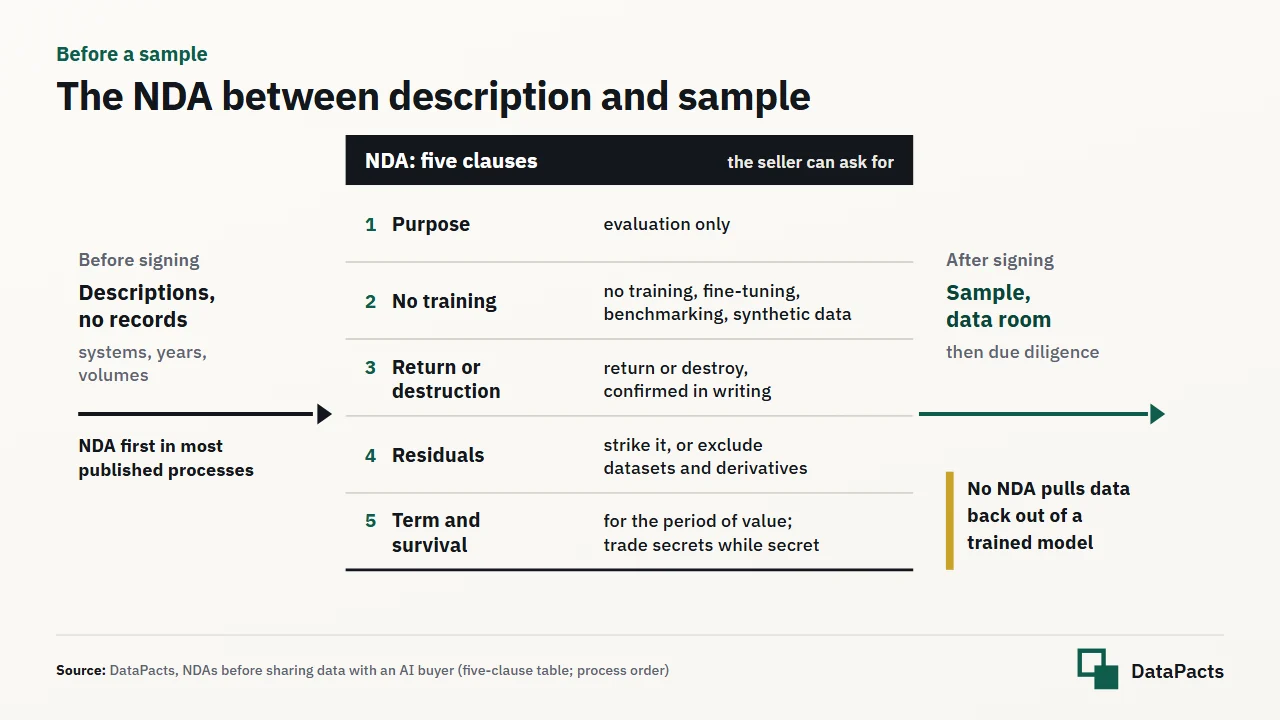
It is usually the first signed document in AI training data licensing processes that publish their steps, and its protection depends on five clauses: purpose, no training, return or destruction, residuals and term.
Turing and Patronus AI each state an NDA before any sample (checked November 9, 2026). No NDA can pull data back out of a trained model, and keeping the data unshared is a valid choice.
What an NDA Does Before a Data License, and What It Cannot Do
The NDA governs the weeks before a license exists: what the buyer may see, what it may do with it, and what happens if no deal follows.
It is separate from the license and the order form, and it grants no right to train on anything shared. Statutory secrecy protection also leans on it, because reasonable steps to keep information secret are part of what a UK trade secret is (SI 2018/597, reg. 2).
An NDA protects the seller's information, not the duties the seller owes its own customers, which still apply, and it cannot reverse training once data has reached a model. Customers' own protection comes from customer consent and confidentiality clauses.
When Published Buyer and Intermediary Processes Ask for an NDA
Most published intake processes put the NDA before any sample, and several call it mutual. The table lists thirteen parties as of 2026-11-09, each from its own published process.
| Party | Role (as the party describes it) | When the NDA comes | Form stated | Source and check date |
|---|---|---|---|---|
| Abaka AI (Project Reborn) | acquires code and company data | before sensitive exchange | not stated | abaka.ai/pages/project-reborn, 2026-11-09 |
| AfterQuery | acquires company data | with the questionnaire, before sample review | mutual | afterquery.com/data-partnerships, 2026-11-09 |
| Avelence | seller-side adviser | before sharing a de-identified copy | mutual | avelence.com, 2026-11-09 |
| Centific | acquires enterprise data (data vendor) | required, before the sample pack | mutual | centific.com/enterprise-data, 2026-11-09 |
| DataVendor | marketplace | at self-serve signup, pre-checked | mutual | docs.datavendor.ai, 2026-11-09 |
| Grepped | marketplace | buyers sample under NDA | not stated | grepped.ai, 2026-11-09 |
| Halluminate | RL-environment builder | no NDA stated; intake asks for no confidential information | none stated | halluminate.ai/data-partnerships, 2026-11-09 |
| Handshake AI | acquires company data | NDA in the process | not stated | joinhandshake.com blog, 2026-11-09 |
| Marin Data | broker paid by AI labs | weeks 2 to 3, with a de-identified sample | mutual | marindata.ai, 2026-11-09 |
| Patronus AI | RL-environment builder | for the sample, reviewed in 5 business days | not stated | data.patronus.ai, 2026-11-09 |
| Regulr | sell-side adviser paid by the buyer | before the first call | not stated | regulr.ai, 2026-11-09 |
| Troveo | marketplace licensing on the owner's behalf | between Troveo and the lab | seller not a party | troveo.ai/content-owners, 2026-11-09 |
| Turing Project Lazarus | sells records on the company's behalf | online, after intake, before samples | mutual | lazarus.turing.com, 2026-11-09 |
Each entry is the party's own published process; the NDA text itself is not published by any of them.
No party in the table publishes its NDA text, so clause content is negotiated each time. Halluminate asks for no confidential information before contact. The full process of each of the company data partnership programs sits on its own page.
Mutual or One-Way: Who Signs and Who Is Bound
Who signs decides who is bound, and a mutual form protects both sides' information, not only the data.
Mutual NDAs in Intake Processes
Turing, AfterQuery, Centific, Marin Data and Avelence each state a mutual NDA in their published process (checked November 9, 2026). Turing places it online after intake, AfterQuery pairs it with a questionnaire, Centific requires it before a sample pack, and Marin Data and Avelence place it with a de-identified copy.
A mutual form also binds the seller to the counterparty's pricing and process information, which matters when several counterparties are compared.
When an Intermediary Signs With the AI Developer Instead of You
An intermediary that places data with labs may hold the NDA with the lab itself, leaving the seller outside that agreement. Troveo states it licenses to AI labs on the owner's behalf under NDA, and Grepped states its buyers sample under NDA (checked November 9, 2026).
The seller should ask who the counterparty of each NDA is and whether its terms pass through, a question that belongs to selling direct or through a broker.
Click-Through NDAs With Pre-Checked Boxes
Some platforms present the NDA as a box to tick at signup, and the box may already be ticked.
DataVendor states its self-serve signup has the vendor accept a Mutual NDA, a Vendor Platform Access Agreement, a DPA and a Vendor Data Sharing Agreement through pre-checked boxes (checked November 9, 2026), so each document needs reading before upload.
Five Clauses That Decide What a Pre-Sample NDA Protects
Five clauses decide whether an NDA protects a data sample: purpose, training, return, residuals and term. The table compares them as of 2026-11-09.
| Clause | What the seller can ask for | Published example | Source and date |
|---|---|---|---|
| Purpose limitation | use only to decide whether to license | Patronus AI: samples only for evaluation; PIXTA: samples to evaluate suitability | data.patronus.ai, 2026-11-09; pixta.ai/term, version 2025-03-03 |
| No training | no training, fine-tuning, benchmarking or synthetic data from shared material | PIXTA Art. 2.1: not as training data; Labelbox: trained models "cannot be unlearned" | pixta.ai/term, version 2025-03-03; prism.labelbox.com/faq, 2026-11-09 |
| Return or destruction | return or destroy on request or at the end of talks, written confirmation, backups addressed | Patronus AI: deleted with written confirmation if no deal; Proximal MSA s.6.4: return, not deletion | data.patronus.ai, 2026-11-09; proximal.ai/msa, version 2026-07-06 |
| Residuals | strike, or exclude datasets and derived material | Proximal MSA s.8.3: retains "learnings, improvements, optimizations, or model training" | proximal.ai/msa, version 2026-07-06 |
| Term and survival | survival for the period of value; trade secrets while secret | micro1 s.2.3: 3 years after termination, trade secrets indefinitely | micro1.ai/legal/data-license-master-terms, version 2026-11-08 |
Examples come from program terms, license terms and a vendor contract, not from published NDAs; each shows how the clause can be written.
Purpose Limitation: Evaluation Only
The purpose clause limits use of everything shared to deciding whether to license the data, and anything else is a breach.
Patronus AI states samples are used only for evaluation, and PIXTA's terms (last updated March 3, 2025) limit samples to evaluating suitability. The seller should name the purpose in one sentence and cover affiliates, contractors and advisers.
No Training on Shared Material or Anything Derived From It
Because the receiving party trains models, the NDA should say plainly that nothing shared may be used to train, fine-tune or benchmark a model or to generate synthetic data.
PIXTA Art. 2.1 states samples may not be used as training data, and a purpose clause alone may be read narrowly, so an express exclusion closes the gap. Sample size and setting belong to samples, clean rooms and proving data quality.
Labelbox states "Models already trained on the data cannot be unlearned" (Prism FAQ, checked November 9, 2026), so a breach after training is not cured by deleting the sample. Whether any AI buyer's own NDA contains an express no-training clause is not public.
Return or Destruction When Talks End
The NDA should require the buyer to return or destroy all shared material and copies when talks end or on request, and to confirm it in writing.
Patronus AI states material is deleted with written confirmation if no deal follows, while Proximal's Master Development Services Agreement, a vendor contract in which the customer supplies materials (last updated July 6, 2026, s.6.4), provides return, not deletion, which shows the two are different promises.
Backups need an express answer, as micro1's Data License Master Terms (last updated November 8, 2026, s.4.4) show by excluding backups from deletion and giving written confirmation on request; that is a license clause, used here as a drafting example. Deletion after a signed license is covered under deletion, return and machine unlearning clauses.
The Residuals Clause and Why It Matters More With AI Buyers
A residuals clause lets the recipient use whatever its people retain in memory from confidential material, which is an exception to the NDA's non-use duty. The seller can ask to strike it, or to exclude datasets, records and anything derived from them.
With AI buyers the retained learnings can be a model. Proximal's Master Development Services Agreement, a vendor contract and not an AI buyer's NDA, lets Proximal retain "learnings, improvements, optimizations, or model training" (s.8.3) (version of July 6, 2026).
No published record shows a residuals clause in an AI buyer's NDA, and enforceability is outside this page.
Term and Survival of the Confidentiality Duty
The term should outlast the period in which the data has value, and confidentiality for trade secrets should last as long as they stay secret. micro1's Data License Master Terms keep confidentiality for 3 years after termination and indefinitely for trade secrets (s.2.3, last updated November 8, 2026).
Claim windows differ: the Defend Trade Secrets Act allows three years from discovery (18 U.S.C. 1836(d)), and Directive (EU) 2016/943 sets a limitation period of not longer than 6 years (Art. 8(2)). No published norm for NDA length in data deals exists.
What to Hold Back Until the NDA Is Signed
Before the NDA, share descriptions, not records: what systems, years and volumes exist, without content. Marin Data and Avelence share a de-identified sample or copy under a mutual NDA, and Centific states "You license your data. You never hand it over." (checked November 9, 2026).
The description layer is the data manifest. Inspecting records comes later, in a data room, once the NDA is signed.
What the Law Adds Behind an NDA in the US, EU, UK and Japan
Trade secret statutes in all four jurisdictions back up an NDA, and Japan's protects shared data even when it is not secret. The table compares the provisions as of 2026-11-09.
| Jurisdiction | Instrument and provision | What it adds to an NDA | In force | Source |
|---|---|---|---|---|
| United States (federal) | Defend Trade Secrets Act, 18 U.S.C. 1839(5); 1836(d) | disclosure by one who acquired the secret under a duty of secrecy is misappropriation; claims within three years of discovery | 2016-05-11 | govinfo.gov |
| European Union | Directive (EU) 2016/943, Art. 4(4); Art. 8(2) | use is also unlawful by one who knew or ought to have known the secret came from an unlawful use or disclosure; limitation not longer than 6 years | transposition by 2018-06-09 | publications.europa.eu |
| United Kingdom | Trade Secrets (Enforcement, etc.) Regulations 2018, SI 2018/597, reg. 2 | a trade secret includes information subject to reasonable steps to keep it secret | 2018-06-09; reg. 2 wording amended 2026-10-01, definition unchanged | legislation.gov.uk |
| Japan | Unfair Competition Prevention Act, Art. 2(7) | protects shared data with limited access, provided as a business to specific persons and managed electronically, even if not secret | in force (text checked 2026-11-09) | laws.e-gov.go.jp |
The UK definition makes reasonable steps part of what a trade secret is, so a signed NDA is evidence as well as a contract. Under the US statute, the NDA is the written record of the duty of secrecy whose breach is misappropriation.
Japan's Art. 2(7) reaches shared data even when it is not secret. Each regime is compared under trade secrets and confidential information in AI data licensing.
Confidentiality Running the Other Way: Keeping the Seller's Name Out
A seller may also want its own identity kept from end buyers, and some intermediaries offer that.
HUMXN states its buyers are bound by confidentiality and the company is never named, and Ooak Data states buyers receive the cleaned dataset under a code name (both checked November 9, 2026). The seller should ask whether the NDA covers the fact of the talks themselves.
Signing an NDA Before Sharing Data: Benefits, Risks, Downsides and Alternatives
An NDA makes sharing a sample safer, but it does not make it safe, and sharing nothing is always an option.
Benefits:
- A contractual duty with a remedy, on top of the statutes.
- Evidence of reasonable steps.
- Evaluation-only and deletion commitments, as Patronus AI and PIXTA state.
Risks:
- Training cannot be reversed once a model has seen the data.
- Residuals or learnings clauses let retained knowledge leave with the recipient.
- An intermediary's NDA with a lab may not bind that lab toward the seller.
- Pre-checked click-through terms go unread.
Downsides:
- Legal review costs money and time.
- Enforcement depends on detecting misuse.
- A mutual NDA binds the seller too.
Alternatives:
- Share only a manifest or description.
- Share a de-identified sample.
- Keep data in place with read-only access, as Centific describes.
- Do not share or license at all.
Declining to share is a valid outcome, and the other paths are set out in alternatives to selling data to AI labs, including not selling.
Where the NDA Sits in the Process to Sell or License Company Data
The NDA comes after choosing whom to talk to and before any sample, data room or diligence. In the process to sell or license company data to AI companies, it is the gate before showing the data.
- Choosing a buyer for your data, the previous step.
- Running several AI data buyers in parallel.
- Describing a dataset without handing it over.
- The NDA, this page.
- Proving data quality without sharing the data.
- Setting up a data room.
- Due diligence in an AI data deal, the next step.
- Term sheets, order forms and LOIs.
- Negotiating an AI data licensing deal.
- AI data licensing agreements.
Not Legal Advice, and What This Page Leaves to Other Pages
This page explains NDA clauses for information and is not legal advice; a lawyer in the seller's jurisdiction should review any NDA before it is signed. Statute detail lives on the pages for the Defend Trade Secrets Act, the EU Trade Secrets Directive and the United Kingdom rules for licensing data for AI training.
Program Pages, Terms and Statutes Cited on This Page
The examples above come from these published pages and statutes, each checked on November 9, 2026, unless a version date is given.
- AI training data marketplaces (DataVendor, Grepped, HUMXN, Troveo)
- Handshake AI data buyer profile
- Labelbox Prism buyer profile
- micro1 data buyer profile
- Patronus AI buyer profile
- PIXTA AI vendor profile
- Proximal RL environment builder profile
- Turing Project Lazarus profile
Frequently Asked Questions
Do I need an NDA before sending a data sample to an AI company?
Published processes put one before the sample: Turing states an online mutual NDA and Patronus AI a sample under NDA (checked November 9, 2026). Without one, statutory protection is weaker.
Can an AI company train on a sample shared under an NDA?
Only if the NDA allows it, so write an express no-training clause, as PIXTA's terms do for samples.
What is a residuals clause in an NDA?
It is an exception letting the recipient use what its people remember from confidential material. With AI buyers, ask to strike it or to exclude datasets and anything derived from them.
How long should an NDA last when licensing data?
No published norm exists for data deals. micro1's license keeps confidentiality three years after termination and indefinitely for trade secrets (version of November 8, 2026).