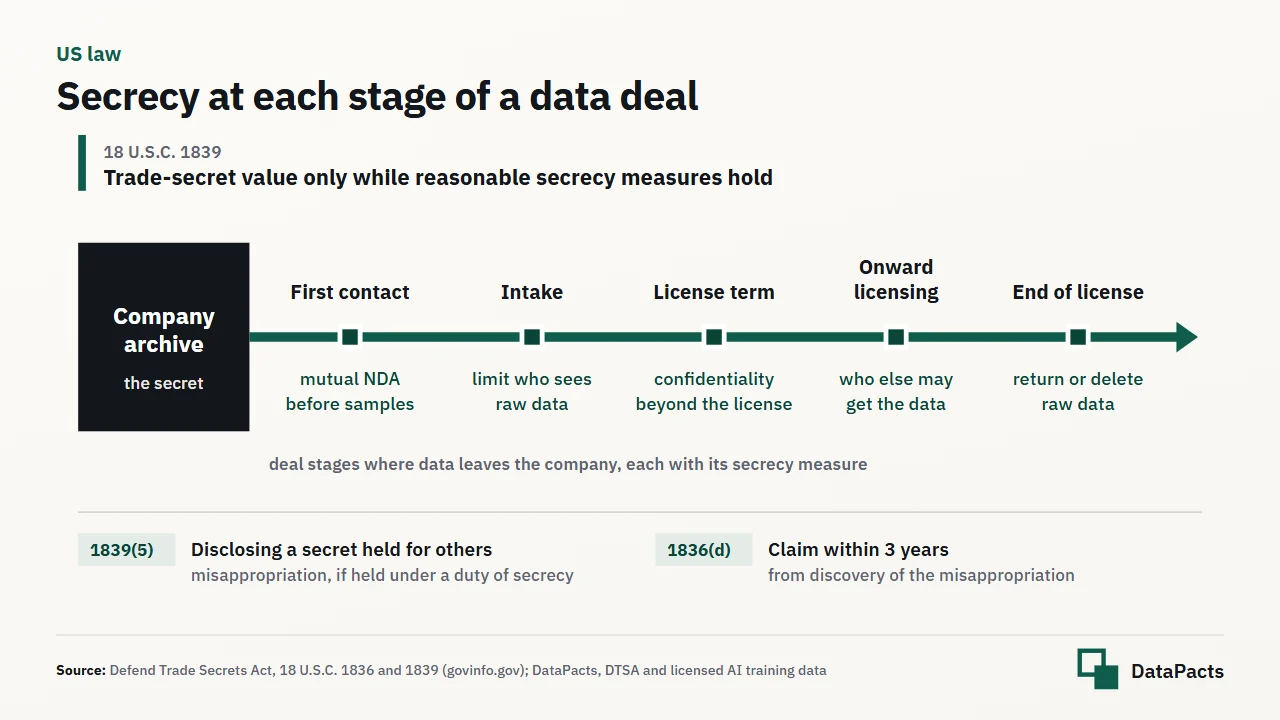
Status is given as of November 9, 2026. A company licensing data meets three rules: protection lasts only with reasonable secrecy measures, disclosing secrets held for others is misappropriation, and claims run 3 years from discovery.
This page reads the statute from the side of the company licensing data, as part of AI training data licensing. The statute is read here for what it adds to a contract, since the contract is where most of the secrecy of a licensed dataset is actually kept.
The DTSA Provisions a Data Seller Meets, at a Glance
Five rules of the DTSA reach a company licensing data for AI training, and the table gives each one's section, its effect on a deal and its status as of 2026-11-09.
| Provision | Citation | What it means in a data deal | In force | Status | Source |
|---|---|---|---|---|---|
| Enactment and codification | Pub. L. 114-153; 18 U.S.C. 1836, 1839 | the federal trade secret statute that applies to company datasets | 2016-05-11 | in force | govinfo.gov sec1836 |
| Secrecy condition | 18 U.S.C. 1839(3)(A) | a data archive keeps trade-secret value only with reasonable secrecy measures, such as license confidentiality | 1996-10-11 (added by Pub. L. 104-294; the DTSA amended only 1839(3)(B)) | in force | govinfo.gov sec1839 |
| Misappropriation by disclosure | 18 U.S.C. 1839(5) | disclosure by one who acquired the secret under a duty to maintain secrecy | 2016-05-11 | in force | govinfo.gov sec1839 |
| Limitation | 18 U.S.C. 1836(d) | 3 years from discovery, or from when it should have been discovered with reasonable diligence; continuing misappropriation is a single claim | 2016-05-11 | in force | govinfo.gov sec1836 |
| Exemplary damages | 18 U.S.C. 1836(b)(3)(C) | up to 2x the damages awarded for willful and malicious misappropriation | 2016-05-11 | in force | govinfo.gov sec1836 |
The sections below follow a deal: secrecy before and during the license, then other parties' secrets, then deadlines.
When a Dataset Licensed for AI Training Keeps Trade Secret Status Under the DTSA
A company's data archive keeps its trade-secret value under the DTSA only while the company keeps reasonable secrecy measures, and in a data deal the main measure is the confidentiality written into the license (18 U.S.C. 1839).
Licensing is not itself a loss of status. The license has to carry the secrecy forward to the buyer, so a seller reads each clause on use, access and onward transfer as a secrecy measure as well as a commercial term.
The full statutory definition of a trade secret sits in 18 U.S.C. 1839, and this page applies only its secrecy-measures condition to a data deal. It does not set out the other elements of the definition, and it makes no claim about how long protection lasts.
Reasonable Secrecy Measures at Each Stage of a Data Deal
Secrecy has to hold at every stage where data leaves the company: first contact, sample, delivery, onward licensing and the end of the license. The table lists one published example for each stage, as of 2026-11-09, and each value is the program's own claim, listed by deal stage and not as a recommendation.
| Deal stage | Secrecy measure | Published example (claim, checked 2026-11-09) | Source |
|---|---|---|---|
| First contact | mutual NDA before records or samples are shared | Turing Project Lazarus: online mutual NDA comes first | lazarus.turing.com |
| Intake and processing | limit who sees raw data | Mercor Data Monetization: "No AI lab buyer or third-party vendor ever sees your raw data" | mercor.com/data |
| License term | confidentiality that outlasts the license | micro1 Data License Master Terms s.2.3: 3 years after termination, indefinitely for trade secrets | micro1.ai/legal/data-license-master-terms |
| Onward licensing | who else may receive the data | micro1 s.1.2: nonexclusive, perpetual, sublicensable through multiple tiers | micro1.ai/legal/data-license-master-terms |
| End of license | return or deletion of raw data | micro1 s.4.4: raw data deleted at the earlier of 120 days after delivery completes or termination; no duty to delete or retrain models | micro1.ai/legal/data-license-master-terms |
The NDA signed before any sample is the first measure, and its clauses are set out under NDAs before sharing data with an AI buyer.
How a Perpetual, Sublicensable Data License Tests Secrecy
A license that lets the buyer pass data on through several tiers and keep what it trains spreads the data further than the company that holds the secret controls. micro1's Data License Master Terms (last updated 2026-11-08, checked 2026-11-09) grant a worldwide, royalty-free, fully paid-up, nonexclusive, irrevocable, perpetual license that is sublicensable through multiple tiers and attaches after acceptance and payment (s.1.2).
Under the same terms micro1 owns derivatives, models, weights, outputs and synthetic data (s.2.2). Raw data is deleted at the earlier of 120 days after delivery completes or termination, and there is no duty to delete or retrain models built on accepted and paid-for data (s.4.4). Confidentiality survives for 3 years after termination and indefinitely for trade secrets (s.2.3).
Whether a secret survives inside a model the buyer keeps is a question the license answers, not the statute, and the page on retraining and model retention rights after a license ends covers the contract terms.
Passing On Other Parties' Secrets: Misappropriation Under 18 U.S.C. 1839(5)
Under 18 U.S.C. 1839(5), misappropriation includes disclosure of a trade secret by a person who acquired it under a duty to maintain its secrecy, so a company that licenses records holding a customer's or partner's secrets can be liable to them.
The rule has applied since 2016-05-11, and delivery to an AI buyer is a disclosure whatever the price.
Such secrets sit in more places than a seller expects: customer files, partner documents and third-party data licensed in under terms. Each of these arrived with a duty of secrecy, and the duty stays with the record when it is copied into a training set.
A dataset built from support tickets, shared project files or licensed feeds can therefore hold secrets that belong to someone else, and the seller does not hold the right to release them.
The same record can be the seller's own secret and another party's secret at once, and the second status limits what the seller may license. A rights audit before the license is the step that finds them.
The customer contract side, including consent and confidentiality clauses, is covered under customer consent and confidentiality clauses before licensing data.
Vendor Terms That Declare Data a Trade Secret: A Freight Rate Example
Some data vendors write the trade-secret claim into their own terms. DAT Solutions, LLC (DAT Freight & Analytics), a load board and freight-rate data vendor, states in its Terms and Conditions (last updated 2026-07-30, checked 2026-11-09) that its freight rates are trade secrets (s.9) and prohibits AI training on its data (s.5.2.3).
A company that holds such data under license holds it under a duty of secrecy, so under the rule above it stays out of any training data license. The statements are DAT's own claims about its terms, not a reading of the statute.
The example shows that a trade-secret label can come from the data's original owner and travel with the data into the next company's archive, so the terms under which a dataset arrived are part of the review before it is offered to an AI buyer.
Claim Deadline and Damages: Three Years From Discovery, Exemplary Damages up to Twice
A DTSA claim must be brought within three years after the misappropriation is discovered or, by the exercise of reasonable diligence, should have been discovered (checked 2026-11-16), and a continuing misappropriation counts as a single claim (18 U.S.C. 1836(d)).
For a seller the clock matters when a buyer or sublicensee later uses data beyond the license, because the period runs from discovery of the use and not from delivery.
A seller who finds an unlicensed use therefore records the date of discovery, since the three years are counted from that date. Where the use continues, the statute treats it as one claim and not as a new claim for each day.
For willful and malicious misappropriation, the court may award exemplary damages of up to two times the damages awarded (18 U.S.C. 1836(b)(3)(C)). The exemplary amount is a ceiling tied to the damages awarded, so it is not a fixed sum. This page does not describe injunctions, other damages measures or other remedies.
Training Data as the Developer's Secret: The AB 2013 Challenge
AI developers also invoke trade secrecy, but for their side of the deal: X.AI LLC's constitutional challenge to California's AB 2013 training data transparency law includes trade secret arguments, and the law stays in force while the appeal is pending.
AB 2013 has applied since 2026-01-01 and requires developers of generative AI to post a high-level summary of their training datasets, including whether data was purchased or licensed.
The district court denied a preliminary injunction, and the appeal is pending in the Ninth Circuit as No. 26-1591, with amicus briefs filed on 2026-07-22 and no decision found as of 2026-11-09. The defendant is the Attorney General of California.
For a seller, the developer's summary can show that licensed data was used, whatever the outcome of the case.
The two positions are different: the seller relies on secrecy to protect what it hands over, while the developer relies on it to withhold what it trained on. What developers publish about licensed data is set out under California AB 2013 training data transparency.
Relying on the DTSA When Licensing Data: Benefits, Risks, Downsides and Alternatives, Including Not Licensing
The DTSA can protect a licensed dataset, but only as far as the company's secrecy measures reach, and keeping data in-house or not licensing it at all remain valid choices. The four lists below set the statute's reach against its limits, as of 2026-11-09.
Benefits:
- a federal statute covers a dataset the company keeps secret (18 U.S.C. 1836, 1839);
- confidentiality survives indefinitely for trade secrets in at least one published license (micro1 s.2.3);
- the claim window runs from discovery, not from delivery (1836(d)).
Risks:
- liability to customers and partners for disclosing their secrets (1839(5));
- third-party vendor data whose terms bar AI training, as in DAT's s.5.2.3;
- a developer's AB 2013 summary showing that licensed data was used.
Downsides:
- secrecy depends on recipients through sublicensing tiers the seller does not choose (micro1 s.1.2);
- models trained on the data survive after raw data is deleted (micro1 s.4.4);
- the statute does not undo a disclosure once it is made.
Alternatives:
- license only data that holds no third-party secrets;
- negotiate terms that limit sublicensing, without any promised outcome;
- share samples only under an NDA;
- not selling or licensing at all.
The full range of alternatives to selling data to AI labs sits on its own page, including not licensing.
Beyond the DTSA: Secrecy Rules Abroad, Other US Law and the Seller Process
The DTSA is the US federal layer, and the same deal can meet secrecy rules in other countries and other federal statutes.
The UK Trade Secrets (Enforcement, etc.) Regulations 2018 (SI 2018/597, reg. 2) make reasonable steps to keep information secret part of the definition, in force since 2018-06-09. Directive (EU) 2016/943 Art. 4(4) reaches onward use of unlawfully obtained secrets and Art. 8(2) limits claims to no more than 6 years, with transposition due 2018-06-09. Japan's Unfair Competition Prevention Act Art. 2(7) protects shared data with limited access even when it is not secret.
A company with buyers or staff in several countries reads these rules side by side with the DTSA, since each sets its own condition for protection.
The United States AI training data law page places the DTSA among the other federal and state rules.
- Rules outside the US: the jurisdiction overview.
- Reasonable steps in the UK definition: the UK rules for licensing data for AI training.
- Shared data with limited access: the Japanese rules for licensing data for AI training.
- The four regimes compared: trade secrets and confidential information in AI data licensing.
- Directive 2016/943 in depth: the EU Trade Secrets Directive and licensed datasets.
- The developer-side case: X.AI v. Bonta, claims, rulings and status.
- Controlled technical data: export controls and licensing technical data to AI buyers.
- Individuals and their employer's secrets: AI training work next to a day job.
- Finding others' secrets in the archive: the rights audit before licensing data.
- Testing data without handing it over: samples and clean rooms.
- Trade secrets of a trading business: operating companies licensing their data.
- The decision before any license: should you sell or license your data to AI companies.
- The steps of a sale: sell or license company data to AI companies.
How This Page Is Sourced and Dated
Every rule here cites the US Code section on govinfo.gov, a court filing or the program's own published terms, with the date it was checked. The methodology page explains how we date every rule. This page is general information about the Defend Trade Secrets Act, not legal advice for any specific deal.
Frequently Asked Questions
What is the Defend Trade Secrets Act, and what is a DTSA claim?
The Defend Trade Secrets Act of 2016 (Pub. L. 114-153) is the US federal trade secret statute at 18 U.S.C. 1836 and 1839, in force since May 11, 2016. A DTSA claim is a claim of misappropriation, which includes disclosure by someone bound to secrecy.
How does the DTSA define a trade secret?
The definition sits in 18 U.S.C. 1839. For a data archive the condition that decides most deals is that the company keeps reasonable secrecy measures, such as confidentiality in the license.
Is data licensed for AI training a trade secret?
It can be, while the company keeps it secret by contract. Developers separately argue that their training data is secret in X.AI LLC v. Bonta, which is pending on appeal as of 2026-11-09.
How long does a company have to bring a DTSA claim?
Three years from discovery, or from when reasonable diligence would have discovered it. A continuing misappropriation is a single claim (18 U.S.C. 1836(d)).