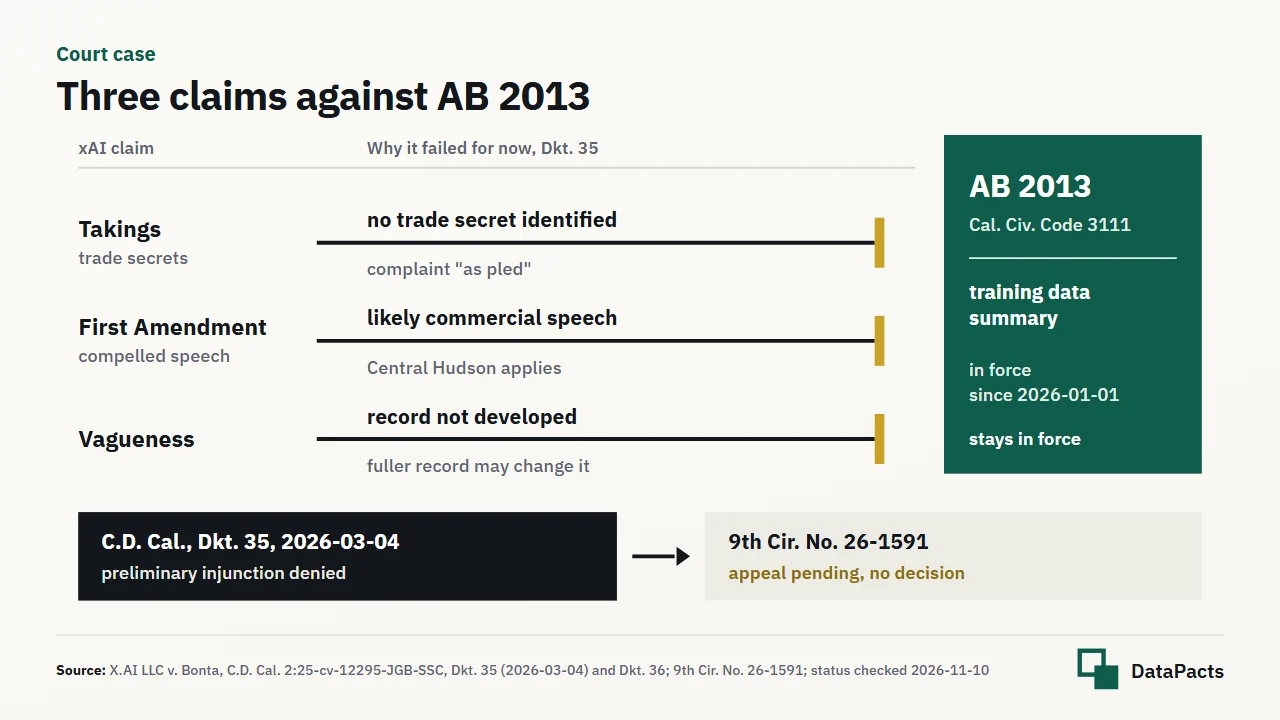
The case matters to the wider market because the disclosure it targets covers where AI developers get their data.
As of November 10, 2026, the district court has denied a preliminary injunction (2026-03-04), the appeal is pending in the Ninth Circuit as No. 26-1591 with no decision, and AB 2013 remains in force.
This page is part of the independent reference on AI training data licensing. DataPacts is not affiliated with any party or amicus and gives no legal advice.
Every date and quotation on this page comes from the court documents, and how figures are sourced and dated is set out on the methodology page.
X.AI v. Bonta at a Glance: Court, Dockets, Parties and Status
The case is paused in the district court while the Ninth Circuit reviews the denial of a preliminary injunction, and no court has ruled on the merits. The table gives the case facts as of 2026-11-10.
| Field | Value | Source |
|---|---|---|
| Case | X.AI LLC v. Rob Bonta, in his official capacity as Attorney General of the State of California | Dkt. 36 caption; DktEntry 12 |
| Court | U.S. District Court, C.D. Cal., Western Division (Los Angeles); appeal to the U.S. Court of Appeals for the Ninth Circuit | Dkt. 36; DktEntry 12 |
| Dockets | 2:25-cv-12295-JGB-SSC; 9th Cir. No. 26-1591 | Dkt. 35; Dkt. 40 |
| Judge | Jesus G. Bernal, U.S. District Judge | Dkt. 35 |
| Filed | 2025-12-29 (Dkt. 1) | Dkt. 35; Dkt. 36 |
| Plaintiff | X.AI LLC, the developer of Grok (its 2026-09-21 training-content summary names the provider as SpaceXAI LLC, formerly xAI LLC) | Dkt. 35; Grok 4.7 summary |
| Claims | Takings Clause (trade secrets); First Amendment (compelled speech); vagueness | Dkt. 35 |
| Ruling | preliminary injunction denied 2026-03-04 | Dkt. 35 |
| District status | stayed pending appeal by joint stipulation (2026-03-16) | Dkt. 36 |
| Appeal status | pending; no decision as of 2026-11-10 | Ninth Circuit docket; ca9.uscourts.gov opinions |
| Law challenged | AB 2013, in force 2026-01-01 | amicus brief, DktEntry 28.1; Dkt. 35 |
What X.AI Claimed Against California's Disclosure Law
X.AI claimed that AB 2013 violates the Fifth Amendment's Takings Clause by forcing out trade secrets without compensation, violates the First Amendment by compelling content- and viewpoint-based speech, and is unconstitutionally vague.
The challenge is as-applied, not facial, which means xAI asks the court to bar enforcement against itself and does not ask to strike the statute down for everyone. The Governor signed AB 2013 in September 2024.
AB 2013, in force since 2026-01-01, requires developers of generative AI systems available to Californians to post a high-level summary of their training datasets (Cal. Civ. Code 3111, as quoted in Dkt. 35). What the statute requires is set out on the page on training data transparency rules.
On the trade secret claim, xAI alleged that the sources, sizes and cleaning methods of its datasets are valuable and non-public (Complaint paragraphs 28-29 and 45 to 52, as summarized in Dkt. 35).
The viewpoint argument rests on the statute's three exemptions, for security and integrity, aircraft operation and national security systems of federal entities. On December 30, 2025, xAI published what it called a "high-level, limited disclosure that does not reveal its trade secrets".
X.AI v. Bonta Docket Entries, December 2025 to September 2026
Twelve entries trace the case from complaint to the pending appeal: eight in the district court and four in the Ninth Circuit. The table lists them as of 2026-11-10.
| Date | Court and entry | Entry | What it decided or reported | Source |
|---|---|---|---|---|
| 2025-12-29 | C.D. Cal. Dkt. 1 | Complaint | three claims against AB 2013 | C.D. Cal. docket copy |
| 2026-01-16 | Dkt. 22 | Motion for preliminary injunction | asks to bar enforcement against xAI | Dkt. 35 |
| 2026-02-02 | Dkt. 30 | Attorney General's opposition | commercial speech defense | Dkt. 35 |
| 2026-02-23 | Dkt. 32 | Hearing minutes | oral argument; supplemental filing ordered | Dkt. 32 |
| 2026-02-27 and 2026-03-02 | Dkt. 33, Dkt. 34 | Supplemental statements | enforcement position; xAI response | Dkt. 35 |
| 2026-03-04 | Dkt. 35 | Order denying preliminary injunction | standing found; no likely success on any claim | Dkt. 35 |
| 2026-03-16 | Dkt. 36 | Joint stipulation to stay pending appeal | answer due 30 days after mandate | Dkt. 36 |
| 2026-03-17 | Dkt. 40 | Ninth Circuit time schedule notice | appeal docketed as No. 26-1591 | Dkt. 40 |
| 2026-04-03 | 9th Cir. DktEntry 12 | Order on extension | opening brief due 2026-05-14, answering brief 2026-06-15 | DktEntry 12 |
| 2026-07-15 | DktEntry 20 | Answering brief (Attorney General) | asks the court to affirm | DktEntry 20 |
| 2026-07-22 | DktEntry 28.1, 36.2 | Amicus briefs supporting California | one from a coalition, one from Minderoo | amicus briefs |
| date not stated | DktEntry 49 | xAI reply brief | argues likely success on all three claims | DktEntry 49 |
The March 4, 2026 Order Denying a Preliminary Injunction
Judge Jesus G. Bernal denied xAI's motion for a preliminary injunction on March 4, 2026 (Dkt. 35), finding that xAI had not shown a likelihood of success on any of its three claims.
The court first held that xAI had standing, because the Attorney General's office said it "cannot comment on whether or when" it would pursue enforcement and so did not disavow it.
The motion was filed on 2026-01-16 (Dkt. 22), opposed on 2026-02-02 (Dkt. 30), argued on 2026-02-23 and followed by two supplemental statements on enforcement.
Likelihood of success is the threshold factor, so the court did not reach irreparable harm, the balance of equities or the public interest. The order is a preliminary ruling, not a judgment on the merits.
Why the Trade Secret Theory Failed at This Stage
The court held that xAI had not identified any dataset, dataset size or cleaning method that differs from its competitors', so it could not show that AB 2013 reaches a trade secret at all.
Trade secret data can be property under the Takings Clause (Ruckelshaus v. Monsanto, 467 U.S. 986 (1984)), but the complaint "trades in frequent abstraction and hypotheticals", and the order calls xAI's approach "generalizations and hypotheticals".
The court measured the claim against the California definition (Cal. Civ. Code 3426.1(d)) and the federal definition (18 U.S.C. 1839(3)). The federal definition and its use for licensed datasets are covered on the page on the Defend Trade Secrets Act.
The ruling rests on the complaint "as pled", so a more specific pleading could change the analysis. The court also said that, hypothetically, datasets could be trade secrets, so the order is no ruling that training data never qualifies.
Commercial Speech and Intermediate Scrutiny: The First Amendment Ruling
The court treated AB 2013 as a content-based rule that is likely commercial speech, which means intermediate scrutiny under Central Hudson (447 U.S. 557 (1980)) rather than strict scrutiny, and found that xAI had not shown it was likely to win under that test.
Under Pharm. Rsch. & Mfrs. of Am. v. Stolfi, 153 F.4th 795 (9th Cir. 2025), a direct disclosure rule is content-based and gets strict scrutiny unless it is commercial speech.
The court distinguished NIFLA, Riley and X Corp. v. Bonta because AB 2013 carries no government script and asks for no opinion on a contested topic.
The Attorney General defended the rule as commercial speech (Dkt. 30), and the court agreed on that point for now. The court found commercial speech because the disclosure informs actual or potential transactions in the AI model market.
It declined to apply Zauderer (471 U.S. 626 (1985)) and applied Central Hudson, and it found the viewpoint argument not controlling at this stage.
The court said xAI "has demonstrated a distinct possibility of prevailing on the merits under Central Hudson", but not a likelihood. That is the open point on which the appeal turns.
Vagueness and the Undeveloped Record
The vagueness claim failed for now because the term "high-level summary" is followed by a precise, if non-exhaustive, list of topics, and xAI's own complaint uses "dataset" without difficulty.
The court said that questions about "training" versus "development" data and about licensed or incorporated systems need a fuller record, and that evidence may change the result.
The Ninth Circuit Appeal (No. 26-1591): Briefing and Status as of November 10, 2026
The appeal is pending: as of November 10, 2026 the Ninth Circuit has issued no decision in No. 26-1591, and AB 2013 stays in force while it is heard. xAI filed its notice of appeal on 2026-03-16 under 28 U.S.C. 1292(a)(1), and the Ninth Circuit docketed it on 2026-03-17.
Under a joint stipulation of 2026-03-16, the district proceedings are stayed pending the appeal, and the Attorney General's answer to the complaint is due 30 days after the mandate. The issue on appeal, as xAI's mediation questionnaire frames it, is whether the district court erred in finding no likely success.
The briefing record runs as follows. The schedule order of 2026-04-03 set the opening brief for 2026-05-14 and the answering brief for 2026-06-15, and the dates were later extended on motion.
The Attorney General's answering brief is dated 2026-07-15 (DktEntry 20). Amicus briefs supporting California followed on 2026-07-22 (DktEntry 28.1, and DktEntry 36.2 from Minderoo). xAI's reply brief (DktEntry 49) argues likely success on all three claims.
Only the filings listed in the table are described here, and no oral argument date is stated in the sources checked, and the next event is a decision or an argument calendar notice.
What the Case Means for Companies Whose Data Trains AI Models
For a company that licenses data to AI developers, the case decides whether the public will keep learning that a developer used purchased or licensed data, and whether a developer can call its data sources a trade secret.
AB 2013's topics include whether datasets were purchased or licensed and who their sources or owners are (Dkt. 35, quoting Cal. Civ. Code 3111(a)(1) and (6)). The full rule set is covered on the page on AB 2013 training data transparency in California.
xAI's complaint itself used licensing as its example: a developer might "license datasets containing a wide range of images from sources like Getty Images or Adobe Stock" (Complaint paragraph 48, quoted in Dkt. 35). This is xAI's hypothetical, not a disclosed deal, and no licensor is named in the order.
The court also quotes the legislative purpose of the rule, which is to let Californians "make informed decisions about the AI systems they purchase and engage with" (Assembly committee analysis of 2024-04-30, quoted in Dkt. 35).
An amicus brief supporting California came from a coalition whose brief describes its members as licensors of archives, images, voice and business data. The brief argues that a licensing market needs visibility into what was used, and that is the brief's argument, not a finding of the court.
For a licensor, the practical point is narrow: as long as AB 2013 stands, a developer's summary can say whether its data was purchased or licensed, and the case decides whether that disclosure survives a challenge.
Whatever the Ninth Circuit decides, a developer that serves the EU also files a training-content summary under the EU AI Act Article 53 training data summary rules.
Where X.AI v. Bonta Sits Among Other Training-Data Cases
X.AI v. Bonta is the only case in the tracker in which an AI developer, as plaintiff, challenges a disclosure law rather than defending a claim over the data it used.
Every tracked case is listed in the case tracker of AI copyright lawsuits over training data. The table lists two related cases as of 2026-11-09.
| Case | Court and docket | Status | Source |
|---|---|---|---|
| Authors and Publishers v. xAI and SpaceX (Cambronne, Chicken Soup for the Soul, Cognella) | N.D. Cal. 5:26-cv-13187-SVK, 3:26-cv-13188, 3:26-cv-13189 | complaints filed 2026-11-04; no ruling | N.D. Cal. complaint |
| In re Otter.AI Privacy Litigation | N.D. Cal. 5:25-cv-06911-EKL | motion to dismiss granted in part and denied in part 2026-08-13; ECPA, CIPA, BIPA and UCL claims proceed | govinfo |
The Otter case is the other California training-data dispute on this tracker, but it is a privacy case against a vendor, not a challenge to a disclosure law, and the two share only the state of California. Separately, how xAI acquires training data is covered on its buyer profile.
More About X.AI v. Bonta
Decided Versus Pending
Only the preliminary-injunction motion has been decided; the merits, the appeal and AB 2013's validity are open.
- Decided: standing was found; the injunction was denied on all three claims (2026-03-04); the district proceedings are stayed by stipulation.
- Pending: the Ninth Circuit decision; the Attorney General's answer to the complaint; any merits ruling or trial.
This page is information, not legal advice.
Frequently Asked Questions About X.AI v. Bonta
Did xAI win its lawsuit against AB 2013?
No court has ruled on the merits. The preliminary injunction was denied on 2026-03-04 and the appeal is pending as of 2026-11-10.
Is AB 2013 blocked while the appeal is pending?
No, AB 2013 is not blocked. It has been in force since 2026-01-01 and no court has enjoined it.
Is X.AI v. Bonta the same case as X Corp. v. Bonta?
No, they are different cases. X Corp. v. Bonta, 116 F.4th 888 (9th Cir. 2024), concerned a social media content-moderation report law, and Dkt. 35 distinguishes it.
Did xAI publish an AB 2013 disclosure?
Yes, xAI published one on 2025-12-30. xAI describes it as high-level and limited, and says it reveals no trade secret.
Did the court decide that training data is not a trade secret?
No, the court did not decide that. It held that xAI had not identified a trade secret with particularity at this stage and accepted that datasets could hypothetically qualify.