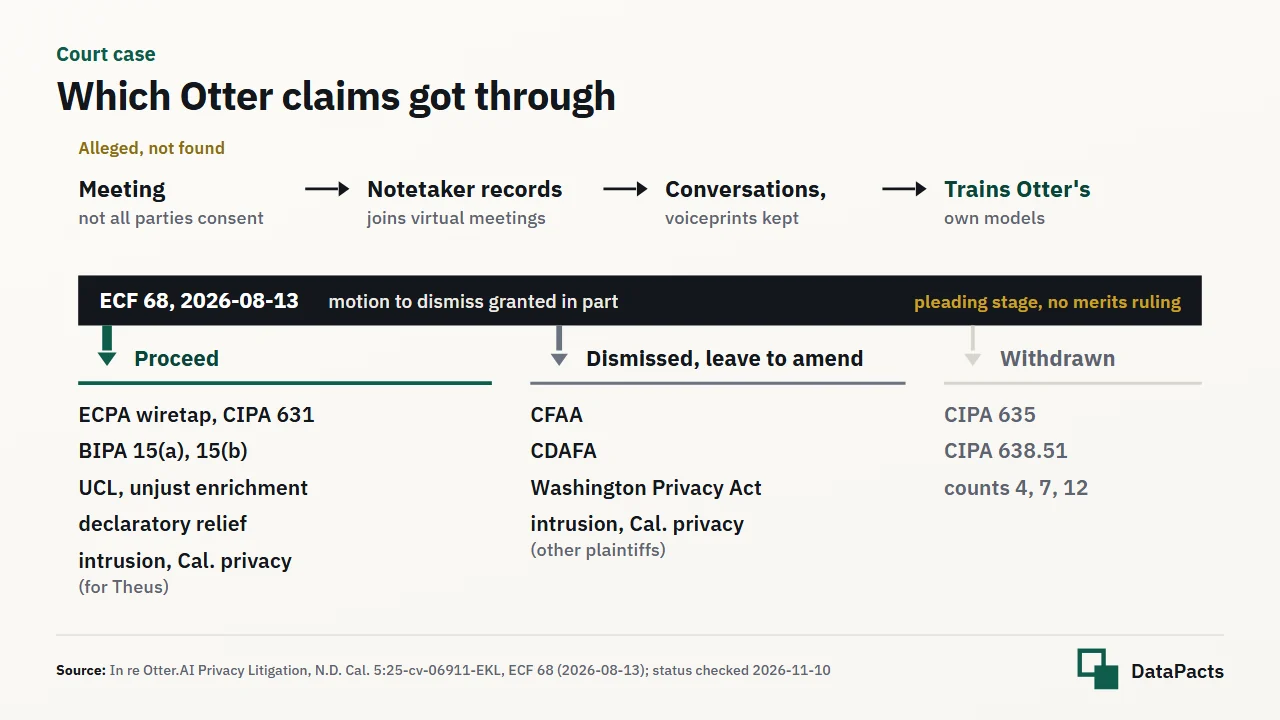
The defendant is Otter.ai, Inc., a meeting-transcription company, so the case is a court record about a vendor that allegedly trained on recordings it captured.
As of November 10, 2026, the case is pending. On August 13, 2026 the court let the federal wiretap, California eavesdropping and Illinois biometric claims proceed and dismissed others with leave to amend.
Every statement here about recording or training is an allegation, not a finding. This page is part of the independent reference on AI training data licensing. DataPacts is not affiliated with any party, files no claims and gives no legal advice.
In re Otter.AI Privacy Litigation at a Glance: Court, Docket, Parties and Status
The case is at the pleading stage: claims have been tested for legal sufficiency, and no court has decided whether Otter recorded or trained unlawfully. The table gives the case facts as of 2026-11-10.
| Field | Value | Source |
|---|---|---|
| Case | In re Otter.AI Privacy Litigation (lead case Brewer v. Otter.ai) | ECF 68; govinfo party list |
| Court | U.S. District Court, N.D. Cal., San Jose | govinfo |
| Docket | 5:25-cv-06911-EKL | ECF 68 |
| Judge | Eumi K. Lee | ECF 68 |
| Filed | August 2025 | case record |
| Plaintiffs | Justin Brewer, Riley Dolan, Jasper Pierson Walker, Emily Ryan, Chaka Theus, Michael Walker, Nadine Winston (California, Illinois, Washington) | govinfo party list |
| Defendant | Otter.ai, Inc., Mountain View, California | govinfo; otter.ai Terms of Service (effective 2025-09-19) |
| Latest ruling | 2026-08-13, motion to dismiss granted in part (ECF 68) | ECF 68 |
| Status | pending; no merits ruling, class certification or settlement on record | case record as of 2026-11-09, ECF 68 re-checked 2026-11-10 |
Every figure and date on this page comes from the court record and the statutes it applies, and how figures are sourced and dated is set out on the methodology page.
What the Plaintiffs Allege About the Otter Notetaker and Model Training
The plaintiffs allege that the Otter notetaker joined and recorded virtual meetings without the consent of all participants, and that Otter kept the conversations and voiceprints and used them to train its speech-recognition and machine-learning models.
The claims fall into five groups. Federal law supplies the Electronic Communications Privacy Act (ECPA, the Wiretap Act) and the Computer Fraud and Abuse Act (CFAA).
California supplies the California Invasion of Privacy Act (CIPA, sections 631 and 632), the Comprehensive Computer Data Access and Fraud Act (CDAFA), the constitutional right of privacy and the Unfair Competition Law (UCL).
Illinois supplies the Biometric Information Privacy Act (BIPA, sections 15(a) and 15(b)), and Washington supplies the Washington Privacy Act. The common-law claims are intrusion upon seclusion and unjust enrichment, and the plaintiffs also seek declaratory relief.
This is a training-data case and not only a recording case because the alleged use for model training is what the plaintiffs plead as Otter's own commercial purpose. Otter.ai, Inc. is named in its Terms of Service, effective September 19, 2025, as the company behind the notetaker.
In this record it is a vendor and a defendant, not a buyer of licensed data. The plaintiffs allege that the training used their own speech and voice, and the record describes no license or data sale.
Seven Plaintiffs From Three States in One Consolidated Case
Justin Brewer's suit leads the case, and six more plaintiffs (Riley Dolan, Jasper Pierson Walker, Emily Ryan, Chaka Theus, Michael Walker and Nadine Winston) are consolidated with it, from California, Illinois and Washington.
On September 11, 2025, Winston v. Otter.ai (No. 25-cv-07712-VKD) was referred to Judge Lee to decide whether it relates to Brewer v. Otter.ai. The states matter because each state's statute (CIPA, BIPA, the Washington Privacy Act) is pleaded by plaintiffs from that state.
The page names plaintiffs only as the court record names them and gives no residence per person beyond the three states. Because the cases involve different plaintiffs and different statutes, the order treats the claims count by count rather than as one block, and that is why the outcome table below runs claim by claim.
Otter.AI Docket Entries, 2025 to 2026
Three dated entries carry the case from filing to the first ruling: the August 2025 complaint, the September 2025 referral of the Winston case and the order of August 13, 2026. The table lists them as of 2026-11-10.
| Date | Entry | What it decided or recorded | Source |
|---|---|---|---|
| 2025-08 (day not stated) | Complaint, Brewer v. Otter.ai | suit filed | govinfo package |
| 2025-09-11 | Referral order | Winston v. Otter.ai, 25-cv-07712-VKD, referred to Judge Lee to decide relation to Brewer | govinfo, USCOURTS-cand-5_25-cv-06911-0 |
| 2026-08-13 | ECF 68, order granting motion to dismiss in part | claims proceed in part; leave to amend within 14 days, response 21 days later | govinfo, USCOURTS-cand-5_25-cv-06911-1 |
Docket entries after ECF 68 are not recorded here as of 2026-11-10.
The August 13, 2026 Order: Which Otter Claims Proceed
Judge Eumi K. Lee granted Otter's motion to dismiss in part on August 13, 2026 (ECF 68): the ECPA, CIPA, BIPA, unjust enrichment, UCL and declaratory-relief claims proceed, while the CFAA, CDAFA and Washington Privacy Act claims were dismissed with leave to amend.
The table gives the outcome for each claim as of 2026-08-13, with the count number where the case record numbers it.
| Claim | Statute | Count | Outcome in ECF 68 | Source |
|---|---|---|---|---|
| Wiretap | ECPA, 18 U.S.C. 2511 | 1 | proceeds | ECF 68 |
| Computer fraud | CFAA, 18 U.S.C. 1030(a)(2)(C) and (a)(4) | 2 | dismissed, leave to amend | ECF 68 |
| Intrusion upon seclusion | common law | 3 | proceeds for Theus; dismissed with leave as to Brewer, Ryan, Dolan | ECF 68 |
| Eavesdropping and recording | CIPA, Cal. Penal Code 631 and 632 | 8 | proceeds (on 631) | ECF 68 |
| CIPA 635 | Cal. Penal Code 635 | 9 | withdrawn, dismissed without prejudice | ECF 68 |
| CIPA 638.51 | Cal. Penal Code 638.51 | 10 | withdrawn, dismissed without prejudice | ECF 68 |
| Computer data access | CDAFA | 11 | dismissed, leave to amend | ECF 68 |
| Constitutional privacy | California Constitution | 13 | proceeds for Theus; dismissed with leave as to Brewer, Ryan | ECF 68 |
| Biometric privacy | BIPA, 740 ILCS 14/15(a) and 15(b) | 15, 16 | proceeds | ECF 68 |
| Recording consent | Washington Privacy Act, RCW 9.73.030 | 17 | dismissed, leave to amend | ECF 68 |
| Unjust enrichment | common law | 5 | proceeds | ECF 68 |
| Unfair competition | UCL | 14 | proceeds | ECF 68 |
| Declaratory relief | declaratory judgment | 6 | proceeds | ECF 68 |
| Other withdrawn counts | not stated | 4, 7, 12 | withdrawn, dismissed without prejudice | ECF 68 |
A motion-to-dismiss ruling assumes the allegations are true and only tests whether each claim is pleaded, so it decides nothing about what Otter did. The plaintiffs were given 14 days to amend and Otter 21 days after that to respond.
Why the Wiretap Claims Against Otter Survived
The federal wiretap claim turns on the party exception in 18 U.S.C. 2511(2)(d), which allows recording by a party or with one party's prior consent unless the interception is for the purpose of a criminal or tortious act, and the plaintiffs plead training Otter's models as that purpose.
The ECPA claim (Count 1) proceeds. Under California law, CIPA section 632 bars recording a confidential communication without the consent of all parties, and the CIPA claim (Count 8) proceeds on section 631. The statute is covered on the page on California's recording and privacy rules.
Survival means that the issue goes forward, not that it is decided. A vendor that uses recordings for its own training may be treated as a third-party eavesdropper rather than as a tool of the meeting host, and that is the question the claims raise. The order does not decide it on the merits.
For anyone who sells or licenses recordings, the useful reading is narrower: the party exception is not automatic, because the purpose of the recording is part of the test, and a purpose of building the vendor's own models is exactly what the plaintiffs plead to defeat it.
Voiceprints and the Otter BIPA Claims Under Sections 15(a) and 15(b)
The Illinois plaintiffs' biometric claims proceed: they allege that Otter captured their voiceprints without the written notice and written release that 740 ILCS 14/15(b) requires and without the retention schedule section 15(a) requires.
Section 15(b), as the order quotes it, bars collecting, capturing, purchasing or receiving through trade a biometric identifier without written notice of purpose and term and a written release.
What is at stake under the statute is set out on the page on Illinois BIPA and AI training data.
Under BIPA as of 2026-11-10, liquidated damages are USD 1,000 per negligent and USD 5,000 per intentional or reckless violation, section 15(c) bars selling or profiting from biometric identifiers, and Public Act 103-0769, effective August 2, 2024, makes repeated collection from one person by one method a single violation.
The plaintiffs plead biometric law alongside the wiretap claims because the alleged training used voiceprints as well as the recorded conversations.
Otter Claims Dismissed With Leave to Amend and Claims Withdrawn
Five claims were dismissed with leave to amend: the CFAA claim on both of its theories (18 U.S.C. 1030(a)(2)(C) and 1030(a)(4)), the CDAFA claim, the Washington Privacy Act claim, and the intrusion and California constitutional privacy claims of some plaintiffs.
Intrusion upon seclusion (Count 3) fell as to Brewer, Ryan and Dolan, and California constitutional privacy (Count 13) as to Brewer and Ryan, while both proceed for Theus.
The Washington Privacy Act claim (Count 17) rests on RCW 9.73.030, whose subsection (1) makes it unlawful to record private communications without the consent of all participants. Counts 4, 7, 9 (CIPA 635), 10 (CIPA 638.51) and 12 were withdrawn and dismissed without prejudice.
Where the Otter Case Stands as of November 10, 2026
As of November 10, 2026, the case is pending with no merits ruling, no class certification and no settlement on record, and the latest recorded decision is the order of August 13, 2026.
- Decided: the surviving claims are adequately pleaded; five claims were dismissed with leave to amend; five counts were withdrawn; the amendment and response deadlines were set.
- Still open: whether an amended complaint was filed and what it says; Otter's response; class certification; any finding on recording or on training.
A later docket entry may change this status, and entries after ECF 68 are not recorded on this page.
The dates that follow from the order, 14 days for the plaintiffs and 21 days after that for Otter, mean that an amended complaint and a response were due in the weeks after August 13, 2026, but this page does not state whether either was filed.
What the Otter Case Signals to Holders of Call and Meeting Recordings
The Otter claims are aimed at a vendor that trained on recordings it captured, not at a company licensing its own archive, but the same statutes reach anyone who passes recordings to an AI buyer without the consent those statutes require.
For companies holding recorded calls, the case is one reason a call archive needs a consent check before any licensing talk, set out on the page on selling call recordings for AI training.
Federal law makes it a separate violation to disclose or use the contents of a communication while knowing it was unlawfully intercepted (18 U.S.C. 2511(1)(c) and (d)), so selling a recording does not cure a failed consent test.
Consent to record is also not the same question as consent to train, and the second is what the Otter plaintiffs put at issue as an allegation. A holder that obtained recordings for transcription or quality purposes cannot assume that the same consent covers a license to an AI buyer.
For companies holding meeting recordings and notetaker transcripts, the case shows the claims a licensed archive could draw, as set out on the page on selling meeting recordings and transcripts for AI training.
Where the Otter Case Sits Among Other Recording and Privacy Cases
The Otter case is one of the privacy and biometric suits in the tracker, beside the copyright suits that make up most of it. Every tracked case is listed in the case tracker of AI lawsuits over training data. The table lists two related privacy cases as of 2026-11-09.
| Case | Court and docket | Status | Source |
|---|---|---|---|
| In re Google Cloud Contact Center AI Privacy Litigation (page to follow) | N.D. Cal. 3:23-cv-05437-RFL | 2026-10-22: Verizon, Uber and Discover callers compelled to arbitration (Dkt. 140); Home Depot callers' CIPA 631(a) claims dismissed with leave to amend by 2026-11-12 (Dkt. 141) | govinfo |
| In re Clearview AI, Inc. Consumer Privacy Litigation (page to follow) | N.D. Ill. 1:21-cv-00135; 7th Cir. 25-1673 | settlement approved 2025-03-20; approval vacated and remanded by the 7th Cir. on 2026-07-13 (Doc. 69) | govinfo; 7th Cir. opinion |
The consent rules for recording calls and meetings by jurisdiction are covered on the page on call and meeting recording consent rules.
More About the Otter.ai Lawsuit
Frequently Asked Questions About the Otter.ai Lawsuit
What is the Otter.ai lawsuit about?
Meeting participants allege that Otter's notetaker recorded meetings without all-party consent and trained models on the conversations and voiceprints. The case is N.D. Cal. 5:25-cv-06911-EKL, and these are allegations.
Has the court found that Otter recorded meetings unlawfully?
No. The order of 2026-08-13 only held that some claims are adequately pleaded, and the allegations remain unproven. A court has not found that any recording or training was unlawful.
Is there an Otter.ai settlement or claim form?
No settlement is on record as of 2026-11-10. There is no claim process, and DataPacts files no claims.
Does the case decide whether recordings can be used to train AI?
Not yet. The Otter order tests pleading only. In a separate case, the Google contact center order of 2026-10-22 held that training use is not a CIPA 631(a)(3) claim without a predicate violation.