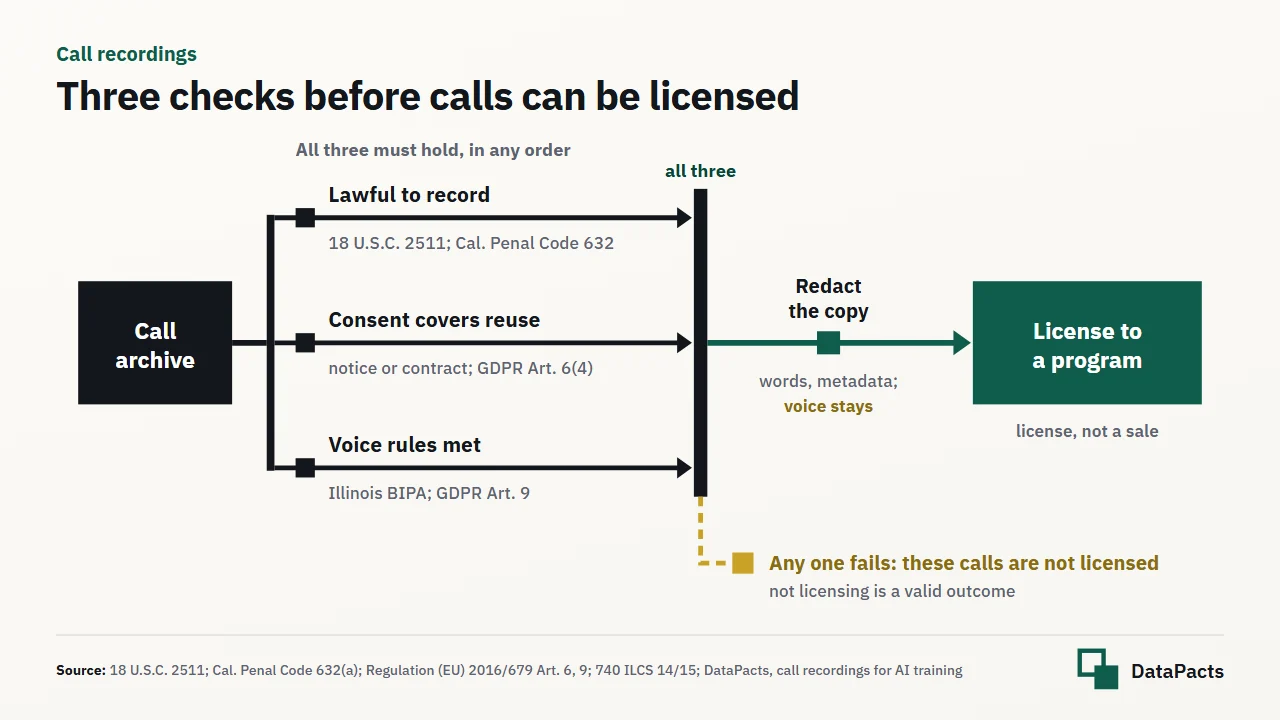
Mercor states USD 20,000 to 250,000 per company for a call-center archive of 1,000 or more hours with consent that covers reuse (checked November 9, 2026), and no closed call-recording deal with a value is on record.
This page covers contact-center calls, phone sales and dialer recordings and conversation-intelligence archives within AI training data licensing. Not licensing is a valid outcome.
The DataPacts Editorial Team explains how we source, date and check every figure.
Can a Company License Its Recorded Calls for AI Training?
Yes, where the company holds the recordings, the callers' consent covers reuse, and the archive is large enough: Mercor's call-center listing asks for 1,000 or more hours recorded with consent that covers reuse.
Holders are contact centers, outsourcers, telesales teams and any company with recorded support or sales lines; Mercor names companies with 50 to 5,000 agents. A vendor that handles calls for a client usually recorded them for that client.
Programs license rather than buy: Data Licensing Advisors states that licenses are typically limited to model training and evaluation with the seller keeping ownership, and Pangea.ai states a non-exclusive license for a set use and term. The full list of data types AI companies buy shows where calls sit among the others.
What Makes a Call Archive Usable as Training Data
Acquirers that publish requirements ask for real, consented conversations in volume, with each speaker on a separate channel, and reject scripted read speech.
The table lists the traits Mercor states on its call-center listing as of 2026-11-10 (checked 2026-11-09, re-read 2026-11-10 unchanged); it rests on one acquirer's listing because no other program publishes call-specific requirements.
| Trait | What the listing states | Why it matters to the holder | Source |
|---|---|---|---|
| Consent | "Recorded calls with consent that covers reuse"; recordings without consent "not a fit" | consent to record alone does not qualify | Mercor listing feed |
| Volume | "1,000+ hours of recordings" | small archives fall below the listing | Mercor listing feed |
| Audio layout | "Each speaker on a separate channel" | mono recordings mix caller and agent | Mercor listing feed |
| Speech type | scripted read speech "not a fit" | real conversations, not read prompts | Mercor listing feed |
| Size of holder | 50 to 5,000 agents | the listing targets contact centers and outsourcers | Mercor listing feed |
| Languages and markets | India, France and francophone markets, Latin America, U.S. Hispanic markets, Japan | multilingual archives match the stated preference | Mercor listing feed |
| Systems named | Five9, Genesys, NICE, Talkdesk, Amazon Connect, Twilio | where the archive is exported from | Mercor listing feed |
These are the requirements of one listing, not a market standard. Mercor's other listings and program terms are set out in the Mercor data buyer profile.
Programs and Intermediaries That Name Call Recordings
Seven company data programs name call recordings, call transcripts or sales conversations among the data they take, and they differ in role: some license the data themselves, some handle it on the company's behalf.
Three roles appear: a data vendor that takes a license itself, an intermediary that never acquires the data, and a program run by a human-data platform. The table lists the seven in alphabetical order as of 2026-11-10 (terms are claims, checked 2026-11-09).
| Program | Role | Call data it names | Stated terms (claims, checked 2026-11-09) | Source |
|---|---|---|---|---|
| Aba Compute, Business Data Licensing for AI | intermediary, finds the buyer | call transcripts, sales records | USD 300K to 800K "Illustrative estimate in USD, not an offer"; holder can exclude named buyers; deletion does not reverse completed training | abacompute.com/data-licensing |
| Data Licensing Advisors, seller-side advisory | broker, handles; never takes custody | call recordings | success fee from proceeds, percentage not published; licenses typically limited to model training and evaluation; seller keeps ownership | datalicensingadvisors.com |
| Mercor, Call Center or BPO listing | program of a human-data platform | recorded customer conversations | USD 20,000 to 250,000 per company, "Depends on hours and languages" | Mercor listing feed |
| Mode data partnership program | data vendor, "buys the filtered copy" | calls and transcripts | "could be worth $100K to $5M", indicative; about three months to payment | data.mode.inc |
| Pangea.ai company data licensing | marketplace, licenses on the company's behalf | call recordings | deal size "around $100K to $2M"; non-exclusive; set use and term; company keeps ownership | pangea.ai |
| Polyshares data licensing | data vendor, licenses directly | call recordings | "Typically $100K to $2M"; Net 30 to 60; no fee; "defined term" on its home page vs "Perpetual exclusive license" in its track record | polyshares.com |
| Replay data licensing | data vendor, relicenses to labs | sales conversations | upfront cash plus perpetual revenue share; only de-identified data; sold only to frontier AI and data labs | replay.ai |
Two vendors sell finished conversational speech datasets and run no program for data holders: David AI and SpeechData.ai. They compete for an acquirer's budget but are not acquirers of a company's archive.
Brokers and advisers take a success fee from the seller, and the percentage is unpublished; the page on AI data licensing brokers and sell-side advisers lists them with fees as published.
What Recorded Calls Are Worth: Stated Ranges, No Closed Deal on Record
No closed call-recording deal with a value is on record; the only call-specific figure is Mercor's stated range of USD 20,000 to 250,000 per company, which it says depends on hours and languages (checked November 9, 2026).
Mercor states a referral base of USD 30,000 plus a USD 10,000 fast-signing booster for the same listing, and the base sits above the listing's USD 20,000 minimum deal (checked November 9, 2026).
The other ranges cover whole companies, with calls as one data type among many, and are not call prices.
Mode states USD 100K to 5M as "could be worth", Polyshares USD 100K to 2M, Pangea.ai around USD 100K to 2M, and Aba Compute USD 300K to 800K as an "Illustrative estimate in USD, not an offer" (all checked November 9, 2026); none is averaged.
SpeechData.ai sells finished speech datasets at USD 60 to 95 per hour of audio "depending on language" and lists call center data as a service without a price (checked November 16, 2026).
That is a dataset sale price, not what a holder is paid, and no per-hour price paid to a holder is on record. Valuation methods are covered under what company data is worth to AI companies.
Consent to Record Is Not Consent to License
A call recorded lawfully can still be unlawful to license: the recording rules decide whether the call could be taped, and a second consent, or another legal basis, decides whether it can be reused for training.
US federal law needs one party's consent unless the call is intercepted for a criminal or tortious purpose (18 U.S.C. 2511(2)(d)), and disclosing contents known to be unlawfully intercepted is itself a violation (2511(1)(c)-(d)). California requires all parties' consent to record a confidential communication (Cal.
Penal Code 632(a)). Germany, Austria and Switzerland punish passing on a non-public recording made without consent (§ 201 StGB, § 120 StGB Austria, Art. 179bis and 179ter StGB Switzerland). This is information, not legal advice.
Mercor requires consent that covers reuse. Under Regulation (EU) 2016/679 (applies from May 25, 2018), each disclosure of personal data to a buyer needs an Art. 6 basis and an Art. 6(4) compatibility test for reuse.
The rules for each place sit on the page for call and meeting recording consent rules by jurisdiction.
Calls a Vendor Recorded for Another Business
Calls a contact-center vendor handles for a client were usually recorded under the client's notice, so the client's privacy statement, not the vendor's, decides what callers agreed to.
In the Google Cloud Contact Center AI case (N.D. Cal. 3:23-cv-05437-RFL), callers allege that Contact Center AI recorded calls with Home Depot, Verizon, Uber and Discover and could use them to improve its models.
On October 22, 2026, the Verizon, Uber and Discover callers were sent to arbitration (Dkt. 140), and the Home Depot callers' claims were dismissed with leave to amend by November 12, 2026 (Dkt. 141): two accountholders consented through Home Depot's privacy statement, a third caller did not, and none alleged the intent Section 631(a) requires. The case is not decided on the merits, as of November 10, 2026.
The claims, rulings and status are tracked on the page for the Google Cloud Contact Center AI privacy litigation. A vendor reads the client contract and the client's notice before offering any calls.
Agents and Sales Reps Are Speakers Too
Every recorded call also carries the voice of an employee, so an archive license is also a use of staff data.
Employee notice rules apply in addition to caller consent. The steps are covered under employee notice and consent when licensing.
Voices on a Call as Biometric Identifiers
A voice on a recording becomes a biometric identifier when a voiceprint is taken from it, and Illinois requires a written release before anyone collects or buys one.
Under 740 ILCS 14/15(b), written notice of purpose and term and a written release come before collecting, capturing, purchasing or receiving a biometric identifier, and 15(c) bars selling, leasing, trading or profiting.
Damages are USD 1,000 for a negligent and USD 5,000 for an intentional or reckless violation, and since August 2, 2024 (P.A. 103-0769) repeated collection from one person by one method counts as one violation.
Virginia (Va. Code 59.1-575) and Washington (RCW 19.375) exclude audio recordings from their biometric definitions. GDPR Art. 9(1) treats biometric data used to identify a person as special-category data that needs an Art. 9(2) exception plus an Art. 6 basis.
In In re Otter.AI Privacy Litigation (N.D. Cal. 5:25-cv-06911-EKL), plaintiffs allege that voiceprints were used to train speech models, an allegation only.
The statute's text and case law are set out under Illinois BIPA and AI training data.
Redacting Calls Before Delivery: Transcripts, Audio and Metadata
Redaction for a call archive works on three layers: what is said (names, account and payment details read aloud), the call metadata (numbers, timestamps, agent IDs), and the voice itself, which no text redaction removes.
Stated de-identification routes (all checked November 9, 2026):
- Mercor states it covers extraction, anonymization and transfer costs and that no AI lab buyer or third-party vendor ever sees raw data.
- Mercor's digital-health listing asks for "the ability to de-identify audio and text".
- Mode states it exports and de-identifies the agreed copy.
- Polyshares states that a specialist PII partner anonymizes the data.
- Replay licenses only de-identified data, and Aba Compute states delivery through a de-identification partner or the buyer's controlled environment.
Methods for each layer are covered under PII removal and de-identification before licensing.
Separate channels let each speaker be handled on its own, which is editorial reasoning, not a program rule. The voice stays a potential identifier under BIPA and GDPR Art. 9.
Sales Call Archives: Prospects, Conversation-Intelligence Tools and CRM Links
Sales calls differ from support calls in who is on the line: prospects at other companies who never became customers and never saw the seller's customer notice.
Prospects, partners and three-way calls widen the group whose consent matters.
Sales calls live in dialers and conversation-intelligence platforms. Gong's terms (last updated June 2026) give 30 days after termination to request an export (s. 9.4), so a company leaving the tool exports first. Replay names "sales conversations" and Aba Compute names "call transcripts" and "sales records" (both checked November 9, 2026).
Calls are tied to contact and deal records, which are covered on the page for selling CRM records for AI training.
Licensing Call Recordings: Benefits, Risks, Downsides and Alternatives, Including Not Licensing
An archive of consented calls can earn from recordings a company already keeps, but calls recorded under a narrow notice cannot be fixed after the fact, and delivered recordings rarely come back.
Benefits:
- An existing asset meets stated demand: Mercor lists a USD 20,000 to 250,000 range (checked November 9, 2026).
- Mercor states it bears de-identification cost.
- Data Licensing Advisors and Pangea.ai state that ownership is kept.
Risks:
- Disclosing unlawfully intercepted calls is itself a violation, as is passing on non-public recordings in Germany, Austria and Switzerland.
- Illinois BIPA damages run per person.
- Mercor reported breach dates of March 24 and March 30, 2026 to the California Attorney General.
Downsides:
- No call-specific price exists beyond one listing range.
- A license can read as perpetual or exclusive: Polyshares shows "defined term" on its home page and "Perpetual exclusive license" in its track record.
- Deletion does not reverse completed training, as Aba Compute states.
Alternatives:
- License de-identified transcripts only, as Replay states.
- License a consented subset or a sample first.
- Refresh notices so future calls carry reuse consent.
- Not license at all, as set out in the decision page on whether to sell or license your data.
Calls Next to Meetings, Voice and Speech Data, and the Seller Steps
This page covers recorded calls a company holds; neighboring data types have their own pages.
Neighboring pages:
- Meeting recordings and transcripts
- A person's own voice as a licensed asset
- Speech corpora and audio sold in bulk
- Support tickets and chat transcripts
- The contact-center industry view
- Exporting from call recorders
Seller steps for calls:
- Read the complete seller guide for the whole process.
- Confirm who owns the recordings and what callers agreed to.
- Agree the license using every clause of a licensing agreement.
- Check how payment works under upfront, milestones and revenue share.
Frequently Asked Questions
Can a call center sell its call recordings to AI companies?
Yes, as a license, if callers' consent covers reuse and the client contract allows it. Mercor targets 50 to 5,000 agents (checked November 9, 2026). Other terms are compared in program terms compared, dated.
How much are call recordings worth to AI companies?
Mercor states USD 20,000 to 250,000 per company, depending on hours and languages (checked November 9, 2026), and no closed deal value is on record. The range is a claim, not a price paid. Other data types are priced in AI training data prices per hour and record.
Does "this call may be recorded" cover AI training?
Not by itself. The October 22, 2026 order in the Google Contact Center AI case found consent through Home Depot's privacy statement only for Home Depot accountholders, and dismissed with leave to amend; it is not a final ruling.
Does removing names make a call recording anonymous?
No, because the voice can still identify the speaker. BIPA and GDPR Art. 9 treat voice-based identification as biometric. The legal effect is set out under anonymization vs pseudonymization.
Advisers and agents can use the introducer form.