This page covers in-house contact centers, BPOs and telesales operations and the records they keep. Mercor states a call center and BPO listing sized at 50 to 5,000 agents, checked 2026-11-09, and not licensing is a valid outcome. Call center data licensing is one part of AI training data licensing.
DataPacts Editorial Team checked the program pages, rules and court records cited here on 2026-11-09 and 2026-11-10, following how we source, date and check every figure.
What a Contact Center or BPO Holds That AI Buyers Ask For
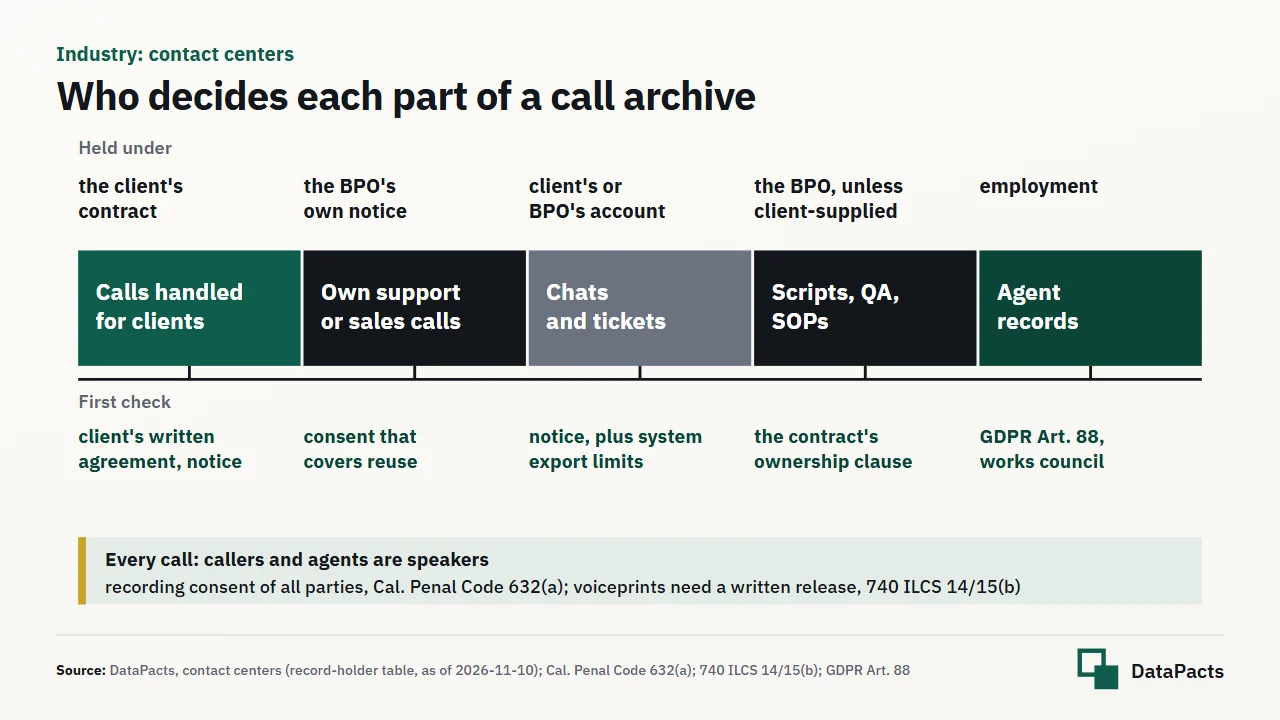
A contact center holds five kinds of records that AI buyers name or that ride along with them: calls handled for clients, its own calls, chat transcripts and tickets, its own scripts and quality records, and agent records, and each sits under a different holder and rule.
The table compares who usually holds each kind, as of 2026-11-10; the holder column is editorial.
| Record | Usually held under | What decides licensing first | Source |
|---|---|---|---|
| Calls handled for a client | the client's program and contract; recorded under the client's notice | the client's written agreement and the client's notice to callers | CCAI order Dkt. 141 (govinfo.gov) |
| The operator's own support or sales calls | the operator's own notice | consent that covers reuse, which Mercor asks for | Mercor listing feed |
| Chat transcripts and tickets | the client's or the operator's help-desk account | the same notice question, plus the export limits of the system | Intercom help center |
| Scripts, QA scorecards, SOPs and training material | the operator, unless the client supplied them | the contract's ownership clause | none (editorial) |
| Agent records in calls and QA data | employment | staff rules: GDPR Art. 88, works councils | EUR-Lex; gesetze-im-internet.de |
Mercor states that it wants "Recorded calls with consent that covers reuse; 1,000+ hours of recordings; Each speaker on a separate channel" (checked 2026-11-09, re-read 2026-11-10). Archive traits and call terms sit on the page for call recordings and sales calls for AI training.
Whose Records Are They: the BPO, Its Clients or the Callers
Three parties have a claim on a BPO's call archive: the client whose customers called, the callers and agents whose voices and details it holds, and the BPO that recorded and stores it.
Under Cal. Penal Code 632(a), as quoted in Dkt. 140 of the case below, recording needs the consent of all parties, and a BPO's client privacy policies decide that consent.
The BPO's own scripts, QA scorecards and training material belong to it unless the client supplied them or the contract says otherwise.
The Client's Notice Decides What Callers Agreed To
In the Google Cloud Contact Center AI case, the court looked to the client's privacy statement to decide whether callers consented. Plaintiffs allege in N.D. Cal. 3:23-cv-05437-RFL that Contact Center AI recorded customer-service calls with Home Depot, Verizon, Uber and Discover and could use them to improve its models.
On 2026-10-22 the court compelled the Verizon, Uber and Discover callers to arbitration and stayed the case as to them (Dkt. 140), and dismissed the Home Depot callers' Section 631(a) claims with leave to amend by 2026-11-12, finding among other grounds that accountholders consented through Home Depot's privacy statement (Dkt. 141); the status is as of 2026-11-09 and is not a final ruling.
A BPO therefore reads each client's notice and contract before it offers that client's calls. The litigation is tracked on Google Cloud Contact Center AI privacy litigation.
Processor Terms and Client Confidentiality Clauses
Where an EU client's callers are on the line, the BPO usually processes their data under a processor contract, and GDPR Art. 28(3)(g) and (h) require it to cover deletion or return at the end of the service and audits.
Under Art. 82(4) and (5), each controller or processor involved is liable for the entire damage, with recourse against the others; the Regulation applies from 2018-05-25.
The processor contract and the client's written consent decide what the BPO may do with the calls beyond the service. Client confidentiality clauses usually cover customer records, so the BPO asks the client in writing first, as set out under customer consent and confidentiality clauses before licensing.
Programs That Name Both Calls and Support Records
Four company data programs name contact-center records as such: Data Licensing Advisors, Pangea and Polyshares list both call recordings and support tickets, and Mercor runs a listing for call centers and BPOs.
The table compares the records each names and the term it states, as of 2026-11-10, alphabetically; each value is the party's own statement, checked 2026-11-09 (Mercor's listing re-read 2026-11-10).
| Program | Role | Contact-center records named | Ownership or license term stated | Source |
|---|---|---|---|---|
| Data Licensing Advisors, seller-side advisory | intermediary (broker); never takes custody | call recordings, support tickets, email and messages, internal chat | seller keeps ownership; licenses typically limited to model training and evaluation; success fee from proceeds, percentage not published | datalicensingadvisors.com |
| Mercor, Call Center or BPO listing | program of a human-data platform | recorded calls with consent that covers reuse; 50 to 5,000 agents; platforms Five9, Genesys, NICE, Talkdesk, Amazon Connect, Twilio | Mercor covers extraction, anonymization and transfer costs; "No AI lab buyer or third-party vendor ever sees your raw data" | api.data.mercor.com listing feed; mercor.com/data |
| Pangea.ai, company data licensing | marketplace | call recordings, chat and email, support tickets | non-exclusive license for a set use and term; company keeps ownership | pangea.ai/data-licensing/company-data |
| Polyshares, data licensing | data vendor; licenses directly | call recordings, support tickets | home page "Defined material for a defined term"; track record "Perpetual exclusive license to the operational record" (both shown) | polyshares.com |
"Not stated" does not mean allowed. Intermediaries handle or license on a company's behalf and do not acquire data.
Polyshares' two statements read differently, one for a defined term and one perpetual and exclusive, so a seller reads the contract rather than the home page.
Programs that name support tickets or help-desk systems without calls are compared on the page for customer support tickets and chats for AI training.
Stated Ranges for Contact-Center Archives, and No Closed Deal on Record
No closed contact-center data deal with a value is on record; the only sector-specific figure is Mercor's stated range of USD 20,000 to 250,000 per company, which Mercor says depends on hours and languages (checked 2026-11-09, re-read 2026-11-10).
Mercor also states a referral base of USD 30,000 plus a USD 10,000 fast-signing booster, checked 2026-11-09, above the listing's USD 20,000 minimum.
Pangea's "around $100K to $2M" and Polyshares' "Typically $100K to $2M, paid by us to the company" are whole-company figures stated by the programs, checked 2026-11-09, not call prices, and are never averaged with Mercor's.
Other price points are set out under what company data is worth to AI companies.
Calls Taken Across States and Borders: Which Recording Rule Applies
A contact center that takes calls from several states or countries holds an archive recorded under several recording rules at once, and the strictest one reached by a call decides whether that call can be passed on.
Under 18 U.S.C. 2511(2)(d) one party's consent is the federal floor, but 2511(1)(c) and (d) make disclosing or using contents known to be unlawfully intercepted a violation, and Cal. Penal Code 632(a) requires the consent of all parties.
Germany (s.201 StGB), Austria (s.120 StGB) and Switzerland (Art. 179bis and 179ter StGB) criminalize recording or passing on a non-public recording without consent, and the ePrivacy Directive 2002/58/EC, in force 2002-07-31, requires consent for interception of call content in the EU.
An offshore BPO serving US or EU callers is reached through its callers; the "strictest rule" reading is editorial guidance, not a legal holding.
State and country rules are on call and meeting recording consent rules by jurisdiction.
Agents on Every Call: Staff Notice and Works Councils
Every recorded call carries an agent's voice, name and performance, so licensing a contact-center archive is also a use of staff data. GDPR Art. 88 lets member states and collective agreements set more specific employee rules, and Art. 88(2) asks for measures on transparency and workplace monitoring systems.
In Germany, BetrVG s.87(1) no. 6 gives the works council co-determination on technical devices designed to monitor conduct or performance, and under s.87(2) the conciliation board decides without agreement. WP248 rev.01 lists employees as vulnerable data subjects, so a second criterion makes a data protection impact assessment required in most cases.
Their application to licensing an archive is set out under employee data and AI training rules by jurisdiction.
Caller and Agent Voices as Biometric Data
A recorded voice becomes a biometric identifier once a voiceprint is taken from it, and Illinois requires a written release before anyone collects, buys or receives one. 740 ILCS 14/15(b) requires written notice of purpose and term and a written release before collecting, capturing, purchasing or receiving biometric identifiers, and 15(c) bars selling, leasing, trading or profiting from them.
Damages are USD 1,000 per negligent and USD 5,000 per intentional or reckless violation as of 2026-11-09, and Public Act 103-0769, effective 2024-08-02, treats repeated collection from one person by one method as one violation.
Virginia (Va. Code 59.1-575) and Washington (RCW 19.375) exclude audio or video recordings from their biometric definitions, while GDPR Art. 9(1), applying from 2018-05-25, makes biometric data for uniquely identifying a person special-category data. Both callers and agents are speakers.
The Illinois rule is on Illinois BIPA and AI training data.
Contact-Center Companies on the Vendor Side of AI Data
Some outsourcers sell AI data services rather than license their records, and TELUS Digital, a customer-experience and AI data services company, is one example on record.
TELUS International (Cda) Inc. reports FY2024 revenue of USD 2,658 million in its SEC filing, with TELUS as 24.7 % and Google as 14.3 % of revenue; no public program to buy company data was found, checked 2026-11-09.
TaskUs, Inc. is a listed outsourcing company that markets AI data services, and Claru names "data vendors and BPOs" among eligible partners, both checked 2026-11-09.
A BPO that serves AI labs keeps its clients' call records apart from its AI service work. The filings are covered in the TELUS Digital AI data vendor profile.
Benefits, Risks, Downsides and Alternatives for a Contact Center
Licensing can earn from recordings and transcripts a contact center already keeps, but most of its archive is usually its clients' to license, and not licensing is a valid outcome.
Benefits
- A stated program for the sector exists: Mercor states USD 20,000 to 250,000 per company for its listing, checked 2026-11-09.
- Mercor states that it covers extraction, anonymization and transfer costs, and Pangea states that the company keeps ownership.
Risks
- Disclosing contents known to be unlawfully intercepted is itself a violation under 18 U.S.C. 2511(1)(c) and (d).
- Illinois BIPA damages apply to voiceprints taken without a release, as set out above.
- A buyer's security incident: Mercor reported breach dates of 2026-03-24 and 2026-03-30 to the California Attorney General, and a lead docket exists as N.D. Cal. 3:26-cv-02821-WHO.
Downsides
- Client consent is needed client by client.
- Some licenses read perpetual or exclusive, as Polyshares' track record does.
- No closed price for a contact-center archive is on record.
Alternatives
- License only the operator's own scripts and process records, or a consented, de-identified subset.
- Refresh client notices so future calls carry reuse consent.
- Do not license at all; see alternatives to selling data, including not selling at all.
Where Contact-Center Licensing Meets Data Types, Other Industries and the Seller Steps
Contact centers share client-confidentiality questions with law firms and medical practices, and the industry pages set out how each sector's rule differs.
All sectors are listed under data licensing by industry, with law firms licensing data and medical practices licensing data the nearest neighbors on confidentiality. Carrier customer data is a separate topic, covered under telecom operators licensing data.
Scripts and playbooks fall under SOPs, playbooks and process documentation. Customer chat in a help desk differs from internal Slack or Teams chat, which is a separate data type.
- Check data sale readiness.
- Decide on whether to sell or license the data.
- Plan PII removal and de-identification before licensing.
- Review AI data licensing agreements.
This page is information, not legal advice.
Buyer, Case, Law and System Pages Named on This Page
Each program, case and rule above has or will have its own page with dates and sources.
Programs and vendors:
- Claru
- Data Licensing Advisors
- Dataset vendors and data labs
- Mercor, a human-data platform
- Pangea.ai, described as a marketplace
- Polyshares
Law and systems:
Frequently Asked Questions
Can a BPO license call recordings it made for a client?
Usually only with the client's written agreement, because the client's contract and privacy notice decide what callers agreed to, as the Google Contact Center AI order of 2026-10-22 shows (not a final ruling). A rights audit sorts the client's records from the BPO's own.
Do agents have to be told before their calls are licensed?
Agents are speakers on every call, so staff notice and, in Germany, works council rights apply alongside caller consent. The steps are set out under employee notice and consent when licensing.
Is a chat transcript licensed on the same terms as a call recording?
The holder question is the same, but a chat carries no voice, so no voiceprint arises. Names and account details in the text still need removal, and Intercom's dataset CSV export omits conversation content, as its help center states, checked 2026-11-09.