This page profiles 23 such companies, alphabetically, as a map of AI training data licensing on the vendor side. Every figure is the company's own claim or filing, checked 2026-11-09.
Eight of the 23 publish a route for outside data, and no seller has publicly confirmed an amount received. The licenses vendors grant their AI customers range from perpetual commercial rights to a ban on redistribution.
Each number carries its source and check date, and how we source, date and check every figure is set out in the methodology.
What Dataset Vendors and Data Labs Do
Unlike a marketplace or a broker, a vendor puts its own name on the dataset it sells and grants the license to the AI developer itself. A vendor buys data only where it pays holders or contributors, and most of the 23 pay nobody outside their own staff and contractors.
"Data lab" is Sieve's own description, which states a "data lab for real-world intelligence". In this directory the term covers companies that record or commission data to order, mostly first-person video and demonstrations of physical work.
The table contrasts the vendor model with five companies that are often called dataset vendors but sit in other categories (as of 2026-11-09, each as the company states it).
| Company | Type on record | What it handles, as stated | Category | Source |
|---|---|---|---|---|
| Defined.ai | marketplace | Data Partners earn licensing fees from marketplace sales, no percentage stated | company data programs | defined.ai |
| Protege | marketplace | non-exclusive license to Protege, revenue share "with each use" | company data programs | withprotege.ai; "with each use": Protege, 2026-01-07 |
| Shutterstock | publisher | licenses its library and metadata through Data, Distribution and Services | marketplaces | shutterstock.com |
| Troveo | marketplace | licenses on the holder's behalf, holder keeps ownership | marketplaces | troveo.ai |
| Wirestock | human-data platform | creators' licensed multimodal data | marketplaces | wirestock.io |
These five license content for others or publish their own libraries rather than sell datasets they collected, so they stay with AI training data marketplaces and their fees and the company programs.
Every Dataset Vendor and Data Lab on Record
The directory lists 24 vendors and data labs alphabetically, with the operator on record, the model each runs and whether it publishes a route for outside data.
It is as of 2026-11-09 and the 21 classified rows from before the GroundTruth row were checked that day; the GroundTruth row was checked 2026-11-17, and the sections below cover the other 23.
- "Model" is the class defined in the next section.
- "Takes data" means a published route for organizations or contributors, not proof that none exists elsewhere; "No program" and "No record" mean none was found on the pages checked.
- Shaip and DataOcean AI carry the name only, because no operator is confirmed.
| Vendor | Operator on record | Model | What it collects, licenses or sells | Takes data | Source |
|---|---|---|---|---|---|
| Asimov | not published | Capture lab | first-person video of physical tasks | Yes (businesses, collectors) | tryasimov.ai |
| Build AI | not published | Capture lab | egocentric video of factory and manual work | No program | build.ai |
| Claru | Reka AI Inc. (d/b/a Claru AI) | Capture lab | archive footage and point-of-view capture | Yes (organizations) | claru.ai |
| CloudFactory | CloudFactory Limited | Data services | human-in-the-loop data, AI platform | No program found | cloudfactory.com |
| DataOcean AI | not stated | not stated | not stated | not stated | n/a |
| David AI | David AI Labs, Inc. | Catalog | speech datasets | No program | withdavid.ai |
| ELRA / ELDA | European Language Resources Association | Distributor | language resources | Yes (providers) | elra.info |
| Gengo-Shigen-Kyokai (GSK) | Gengo-Shigen-Kyokai | Distributor | speech data, lexicons, text corpora | not stated | gsk.or.jp |
| Gradient Health | not stated | Healthcare | medical imaging, EHR, pathology reports | Yes (health organizations) | gradienthealth.io |
| GroundTruth | Batchnorm Technologies LLP | Data services | dataset creation and enrichment, annotation, egocentric video review; BFSI-Bench benchmark (200 questions; citation block lists CC-BY-4.0) | No program found | ground-truth.in |
| HistAI | HistAI Inc. | Catalog | pathology whole-slide images | No program | hist.ai |
| Human Archive | Human Archive, Inc. | Capture lab | first-person video, voice, depth and motion | Yes (adult contributors) | humanarchive.ai |
| Innodata | Innodata Inc. | Data services | training and post-training data, evaluation | No program found | innodata.com |
| Linguistic Data Consortium | not stated | Distributor | speech, text and lexical corpora | Yes (submissions portal) | ldc.upenn.edu |
| Mecka | Carbon Based Technology Corporation (d/b/a Mecka AI) | Capture lab | human demonstration data | No program | mecka.ai |
| Midcentury | Midcentury Labs Inc. | Capture lab | egocentric vision and UMI gripper data | No program | midcentury.xyz |
| Nexdata | NEXDATA TECHNOLOGY INC | Catalog | off-the-shelf and custom datasets | No record | nexdata.ai |
| PIXTA AI | PIXTA Inc. | Catalog | own and third-party vision, OCR, audio datasets | Yes (dataset providers) | pixta.ai |
| Shaip | not stated | not stated | not stated | not stated | n/a |
| Sieve | Sieve, Inc. | Capture lab | content libraries and recordings of physical work | Yes (organizations) | sieve.ai |
| SpeechData.ai | not stated (a Spirelight company) | Catalog | conversational, TTS and call-center speech | No program | speechdata.ai |
| TELUS Digital | TELUS International (Cda) Inc. | Data services | AI Data Solutions; contributor tasks | No program found | telusdigital.com |
| Unidata | Unidata L.L.C-FZ | Catalog | collection, labeling, pre-labeled datasets | No record | unidata.pro |
| XDOF | xdof, Inc. | Capture lab | teleoperation demonstrations | No program | xdof.ai |
Five Vendor Models: Catalog Sellers, Language-Resource Distributors, Capture Labs, Healthcare Platforms and Data-Services Firms
Vendors differ less in the data types they sell than in where the data comes from and who pays the people who make it. The 21 classified vendors fall into five models.
- Catalog sellers (6): sell datasets collected or licensed in advance, such as David AI's speech sets, HistAI's slides, Nexdata, PIXTA AI, SpeechData.ai and Unidata.
- Language-resource distributors (3): ELRA / ELDA, GSK and the Linguistic Data Consortium distribute corpora that providers supply, for fees or membership.
- Capture labs (8): record or commission new data, mostly first-person video; Asimov, Build AI, Claru, Human Archive, Mecka, Midcentury, Sieve and XDOF.
- Healthcare platforms (1): Gradient Health connects hospitals and imaging centers with developers.
- Data-services firms (3): CloudFactory, Innodata and TELUS Digital sell human-in-the-loop and data services next to datasets.
CloudFactory, Innodata and TELUS Digital are also labeling vendors. CloudFactory's home page shows no program to buy or license datasets, and Innodata and TELUS Digital publish none on the pages checked, as the page on data labeling companies and their data programs compares in full.
Where Vendors Get Their Data: Own Collection, Contributors and Licensed Archives
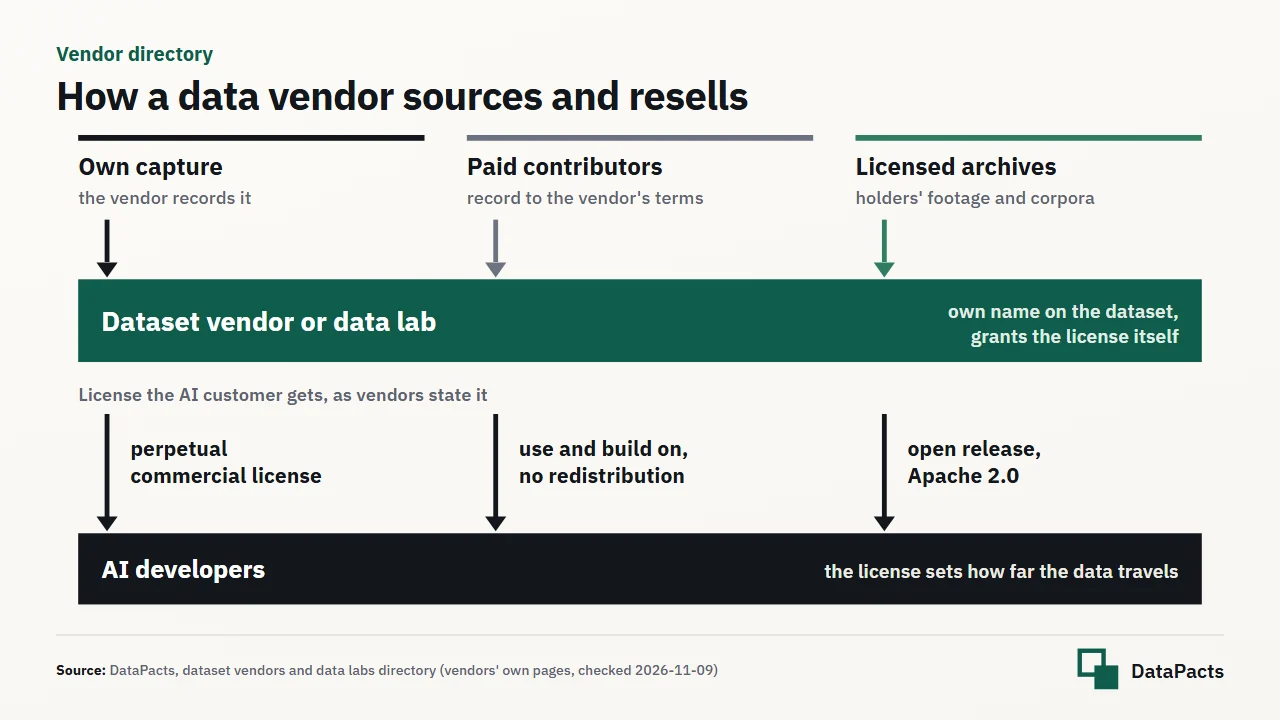
Three sources feed vendor catalogs: data the vendor records itself, data paid contributors record under the vendor's terms, and archives or corpora licensed in from holders.
For own capture, Mecka states capture fleets with its own multi-sensor hardware and an iPhone app, Build AI released Egocentric-10K (10,000 hours, 1.08 billion frames, 85 factories) under Apache 2.0 in 2025-08, and Midcentury states 2M+ hours across 50+ environments, all checked 2026-11-09.
Paid contributors supply the second source. Asimov pays approved collectors after quality assurance through Stripe Connect, Human Archive pays "payouts for submissions that we approve" through Stripe and Circle, and Claru states 34,000+ contributors in 70+ countries. TELUS Digital states payments to one million contributors in more than 118 countries in its FY2024 20-F.
Licensed archives are the third source. Claru takes licenses to owners' non-public footage, Sieve to organizations' content libraries, ELRA and LDC take provider submissions, PIXTA AI lists dataset providers' data, and Gradient Health shares revenue with hospitals. Capture by contributors themselves is covered on egocentric first-person video for AI and robotics training.
Which Vendors Take Data From Holders, and on What Stated Terms
Eight of the 23 vendors publish a route by which an organization or a person can supply data, and none publishes a fixed rate for a company's existing records. The table compares the eight routes as each vendor states them, as of 2026-11-09.
| Vendor | Who may supply | Payment as stated | License or ownership as stated | Not published | Source |
|---|---|---|---|---|---|
| Asimov | businesses with physical work; approved collectors | businesses: salaries covered while workers wear recording kit, dataset revenue share for larger partnerships (no percentage); collectors paid after QA via Stripe Connect, "payment not guaranteed" | contributor grant "worldwide, transferable, sublicensable, royalty-free, paid-up license"; deletion does not recall data already licensed | revenue-share percentage | tryasimov.ai |
| Claru | operators with visible-work staff; owners of non-public footage; data vendors and BPOs | archive licenses paid on signed license, net-15; capture paid weekly; "Typical first deal: $5K-$50K archive license, or $10-$120/hr capture rate by region and modality" (wording as on 2026-11-10) | non-exclusive training rights; partner keeps ownership; delivered content cannot be recalled from client copies | term, deletion | claru.ai |
| ELRA / ELDA | language-resource providers | compensation by contract, not quantified | provider grants ELRA a distribution license | rates | elra.info |
| Gradient Health | hospitals, health systems, imaging centers, research organizations | revenue share each time data is used; worked example USD 3M deal x 40 % share of studies x "typical" 20 % = USD 240,000 (Gradient's illustration) | not published beyond revenue share | license term | gradienthealth.io |
| Human Archive | adult contributors | "earn payouts for submissions that we approve" via Stripe and Circle; approval may be reversed | licensed to labs under agreements prohibiting re-identification; kept for the license duration; not recalled on account deletion | per-hour rate | humanarchive.ai |
| Linguistic Data Consortium | providers via a submissions portal | not stated | not stated | all provider terms | ldc.upenn.edu |
| PIXTA AI | dataset providers who warrant rights and, for personal information, written consent records (Art. 6.6) | listing, referral and other fees, including performance rewards, per a separate application form; no rate published (Art. 6.7); seller bears transfer charges | license set between buyer and seller; PIXTA not a party (Art. 2.1(4)) | fee rates | pixta.ai |
| Sieve | organizations that own or can license content; businesses whose teams do physical work | "Checks them, then pays"; no amount, rate or timing; "Referral rewards vary by partnership" | "You keep ownership"; scope in the agreement Sieve drafts | exclusivity, term | sieve.ai |
Apart from Gradient Health's illustrative 20 % and Claru's non-exclusive grant, none of the eight publishes a percentage, a term or an exclusivity rule that would let a holder price a deal in advance.
These routes differ from the company data partnership programs of single buyers, which state payouts and clauses that can be compared side by side.
No holder has publicly confirmed an amount received from any of these vendors as of 2026-11-09.
The License a Vendor Grants Its AI Customers
A vendor's customer license decides how far a holder's data travels once the vendor resells it: some grant perpetual commercial rights, others forbid redistribution, and two release data under Apache 2.0. The table lists 11 vendors, nine of which state a license or a fee, as of 2026-11-09, in the vendors' own words.
| Vendor | License the AI customer gets | Published fee to customers | Source |
|---|---|---|---|
| Build AI | Egocentric-10K under Apache 2.0 | none for the open release | huggingface.co |
| David AI | data license agreement, terms not published | not published | withdavid.ai |
| ELRA / ELDA | non-exclusive, non-transferable right to use, rework and build on; no redistribution; some providers allow product development, others research only | per a yearly schedule | elra.info |
| GSK | no selling, lending or distributing to third parties; credit resources and providers | non-members JPY 33,000 per resource; members JPY 5,500 for repeat use of a free resource in a fiscal year; shipping JPY 3,300; tax included | gsk.or.jp |
| HistAI | "full perpetual commercial license suitable for research and development" | H&E USD 5.00, 4.00, 3.00, 2.00 per slide by tier; IHC and other USD 40.00, 32.00, 27.00, 23.00 | hist.ai |
| Linguistic Data Consortium | for-profit members keep commercial rights to data acquired during membership; perpetual rights to data licensed in membership years | for-profit Standard USD 34,000, Subscription USD 40,000; not-for-profit Standard USD 2,400, Subscription USD 3,850 | ldc.upenn.edu |
| Mecka | not published | not published | mecka.ai |
| Midcentury | not published | not published | midcentury.xyz |
| PIXTA AI | set between buyer and seller; samples only to evaluate suitability, not as training data (Art. 2.1); Japanese law, Tokyo District Court (Art. 16) | set by each seller | pixta.ai |
| SpeechData.ai | "cleared for commercial use"; every speaker signed commercial-use consent | USD 60 to 95 per hour of audio; English (US) USD 90 | speechdata.ai |
| XDOF | ABC-130K under Apache 2.0 | none for the open release | xdof.ai |
The widest contrast lies between HistAI's and LDC's perpetual rights and GSK's ban on passing resources to third parties, with ELRA's non-exclusive, non-transferable right in between.
Mecka, Midcentury and David AI publish no license terms at all. Fee levels vary just as widely, and AI training data prices by unit compares them with other data types.
Funding, Listings and Ownership Changes Among Vendors
Vendor funding and ownership are known from two kinds of source: the companies' own announcements, which are claims, and securities filings.
David AI states a USD 5M seed led by First Round (2025-01-16), a USD 25M Series A led by Alt Capital (2025-05-22) and a USD 50M Series B led by Meritech (2025-10-08).
Mecka states a Series B of USD 60M led by Sequoia Capital (2026-10-07) and run-rate revenue over USD 100M as of June 2026, with USD 300M projected by year-end. XDOF names Thrive Capital, a16z, Spark Capital, Lux Capital and WndrCo as backers, without amounts.
Filings give firmer dates. Innodata's SEC exhibit reports Q3 2026 revenue of USD 95.6M, up 53 % year on year.
An SEC filing records that TELUS Corporation took TELUS Digital private at USD 4.50 per share, about USD 539M in aggregate, approved 2025-10-27 and closed 2025-10-31. PIXTA Inc. is listed on the Tokyo Stock Exchange Standard market under code 3416. Funding figures that appear only in press coverage are not stated.
Where a Vendor's Own Figures Disagree or Stay Unverified
Three vendors publish figures or names that a reader cannot take at face value, and DataPacts shows each as the vendor states it.
- HistAI: its site gives 300,000 whole-slide images as the headline, 212,000+ including 48,333 IHC slides in a February 2026 news item, and 9K+ and 112K on its Hugging Face listings.
- Claru: its privacy policy, effective 2026-10-15, names Reka AI Inc. (d/b/a Claru AI) as operator, and a link to the company that builds models under a similar name is not stated.
- Mecka: the round is called Series B on Mecka's own pages, and the name is taken only from there.
Breaches and complaints that only press coverage reports are not stated here; the page on data buyer incidents, dated and sourced records those that a filing or court record supports.
Benefits, Risks, Downsides and Alternatives of Licensing Through a Vendor, Including Not Licensing
A vendor can turn an archive or a workforce into revenue without the holder building buyer relationships, but the vendor then sets the license its own customers receive.
Benefits
- Claru states archive licenses paid on a signed license, net-15, with account review within 5 business days.
- Sieve states "You keep ownership", with scope set in the agreement it drafts.
- Gradient Health states revenue share each time data is used, with de-identification per DICOM PS3.15 2023a.
Risks
- A contributor grant can outlive deletion: Asimov's license is not recalled, Human Archive keeps approved recordings for the license duration, and Claru's delivered content cannot be recalled.
- Rights and consent warranties fall on the supplier: PIXTA AI requires consent records under Art. 6.6, and SpeechData.ai states speaker consent, so customer consent and confidentiality clauses have to be checked first.
- The vendor's customer license, not the holder's, governs reuse once data is resold.
- No operator is confirmed for Shaip and DataOcean AI.
Downsides
- No vendor publishes a fixed rate for existing records, so no price can be fixed in advance.
- Asimov states "payment not guaranteed" for collectors.
- No holder has publicly confirmed an amount received.
Alternatives
- A company data partnership program of a single buyer.
- A marketplace listing.
- A direct license to an AI lab.
- Not licensing at all, which is a valid outcome.
The choice between these routes is set out in the page on whether to sell or license data, including the case for keeping the data.
Where Vendors Sit Among Labs, Programs, Marketplaces, Brokers and the Seller Path
A vendor is one of several routes by which data reaches AI developers; the pages below cover the other buyer types and the seller's steps around a vendor deal. The parent page shows who buys AI training data across all categories, and the disclosure page explains how DataPacts is funded.
- Buyer types: frontier AI labs as data buyers and AI data licensing brokers and sell-side advisers.
- Choosing and selling: choosing a buyer for your data, how to sell a dataset, AI data licensing agreements and alternatives to selling data.
- Data types: robotics data for AI training, selling video for AI training, healthcare providers licensing data to AI, selling speech and audio data and medical imaging and pathology data.
- Datasets and builders: major AI training datasets and their licenses, dataset licenses for AI training and RL environment companies.
Questions About Dataset Vendors and Data Labs
What is an off-the-shelf dataset?
An off-the-shelf dataset is one a vendor has already collected and sells as is, such as SpeechData.ai's speech catalog or HistAI's slide cohorts, as opposed to data collected to order. Prices and licenses are set by the vendor.
Which AI data vendor is best?
No vendor is best for every holder or developer; fit depends on the data type, the license and whether the vendor takes outside data at all. DataPacts does not rank vendors.
Do dataset vendors buy data from companies?
Some do: Claru, Sieve and Gradient Health publish routes for organizations, while most catalog vendors publish none. Terms are in the routes table above.
Can I work for an AI data lab as a contributor?
Some data labs pay individuals to record, such as Asimov and Human Archive. Contributor pay is compared on the page about AI training jobs and platforms.