Most dataset "sales" are licenses of a copy: DataVendor states that "a sale licenses your assets for a commercial use rather than transferring them" (checked 2026-11-09).
Commissions stated for public listings on that date run from 3 % (AWS Data Exchange public offers) to 30 % (Datarade's commission-only plan), and vendors list buyer prices such as USD 60 to 95 per hour of speech. Not selling is a valid result.
Selling a dataset is one route within AI training data licensing.
DataPacts Editorial Team checked each platform term here against the platform's own page on November 9, 2026; the page on how we source, date and check every figure sets out the rules.
What Selling a Dataset Means: A Finished Product, Usually Licensed Rather Than Handed Over
A dataset is a bounded, documented collection the holder can copy to several buyers, which sets it apart from an operating company's working records licensed once through a company data program. It has a fixed scope, a format and documentation, while company records are placed through programs that set their own terms.
On the platforms read for this page, a sale grants a license. DataVendor states that the buyer's entitlement survives the vendor unpublishing the listing, and FileYield states that its listings can take the form of a sale, a lease, an exclusive or non-exclusive grant, time-limited or perpetual (checked 2026-11-09).
The seller may sell again unless the grant is exclusive. Sales of consumer profiles for marketing are not covered. The difference between a license and an outright sale is set out among the AI data monetization models.
Seven Steps to Sell a Dataset
Selling a dataset takes seven steps, and the first three decide whether any channel will accept it. The table lists each step with a published requirement, as of 2026-11-09.
| Step | What it decides | Example of a published requirement | Source |
|---|---|---|---|
| 1. Confirm rights and consent | whether any channel will accept the dataset | Datarade: provider must hold rights; unanonymized personal data and illegally scraped data prohibited | providers.datarade.ai/apply |
| 2. Clear personal data | which channels stay open | AWS Data Exchange: no data identifying any person outside the Extended Provider Program | AWS Data Exchange documentation |
| 3. Describe the dataset | what a buyer can judge without a copy | ELRA provider description forms; Datasheets for Datasets template, first posted 2018-03-23 | elra.info; arxiv.org/abs/1803.09010 |
| 4. Fix the grant | exclusivity, duration, use, resale | Defined.ai agreement "until terminated" against its FAQ "perpetual" | defined.ai |
| 5. Choose the channel | who signs with the AI developer | the channel table below | this page |
| 6. Set or accept a price | who sets it | seller (Datarade), buyer (aitrainer.work) | as listed |
| 7. List, deliver, get paid | terms that outlast the sale | PIXTA: samples for evaluation only | pixta.ai/term |
Confirm the Dataset Is Yours to Sell
Every channel asks the seller to warrant that it holds the rights to the data and the consent of the people in it, and several refuse personal data outright. Each of the following states its gate (checked 2026-11-09):
- aitrainer.work: the seller must own the asset or hold written permission from each contributor.
- AWS Data Exchange: no data identifying any person unless the provider is in the Extended Provider Program.
- Datarade: legally registered businesses only, no individuals; the provider must hold the rights, and unanonymized personal data and illegally scraped data are prohibited.
- Defined.ai: data must be ethically sourced, with consent, documentation and the right to commercialize it for AI training.
- PIXTA AI: sellers warrant lawful acquisition and rights (Art. 6.6, last updated 2025-03-03), including the consent of individuals for cross-border transfer, and keep written consent records available.
A dataset built from customer records or scraped pages meets these gates with the least certainty. Signed speaker consent is a selling point: SpeechData.ai states that every speaker signed explicit commercial-use consent. A full rights audit comes before any listing.
Describe the Dataset So a Buyer Can Judge It Without a Full Copy
A buyer judges a dataset from its description and a sample, so the description is written before any listing and the full copy stays with the seller until a license is signed. A listing or catalog form usually asks for six things, which are this reference's grouping and not a published standard:
- content and modality;
- volume and time span;
- collection method and consent basis;
- personal-data status;
- format and delivery;
- the license offered.
ELRA states that a provider fills in description forms before granting it a distribution license, and David AI states that it sends samples after a use-case call (checked 2026-11-09). PIXTA's terms allow samples only to evaluate suitability, not as training data (Art. 2.1). The research template is Datasheets for Datasets (arXiv, 2018-03-23).
The fields buyers expect are set out in the data manifest guide.
Fix the Grant Before the Price
The license decides what a buyer pays for, so exclusivity, duration, permitted use and resale are fixed before a price is named. Four decisions recur in the published terms (checked 2026-11-09):
- Exclusivity: Defined.ai's Supplier Program states no exclusivity and no minimums (s.3.5), while FileYield lists exclusive and non-exclusive forms as negotiable.
- Duration: Defined.ai's Data License Agreement (effective 2022-11-30) states that its term runs "until terminated" (s.8(a)), and its FAQ states that the license agreement is perpetual; HistAI states a "full perpetual commercial license".
- Permitted use: ELRA states that some providers allow product development and others research only, and that users get a non-exclusive, non-transferable right with no redistribution.
- Resale: Defined.ai's customer license is non-sublicensable and non-transferable (s.1(a)), and GSK bars selling, lending or distributing a resource to third parties.
On termination the Defined.ai agreement requires the customer to delete, destroy or return all copies and certify this in writing (s.8(c)). The price and lock-in of exclusive and non-exclusive data licenses are compared on their own page.
Where a Dataset Can Be Sold: Four Channels Compared
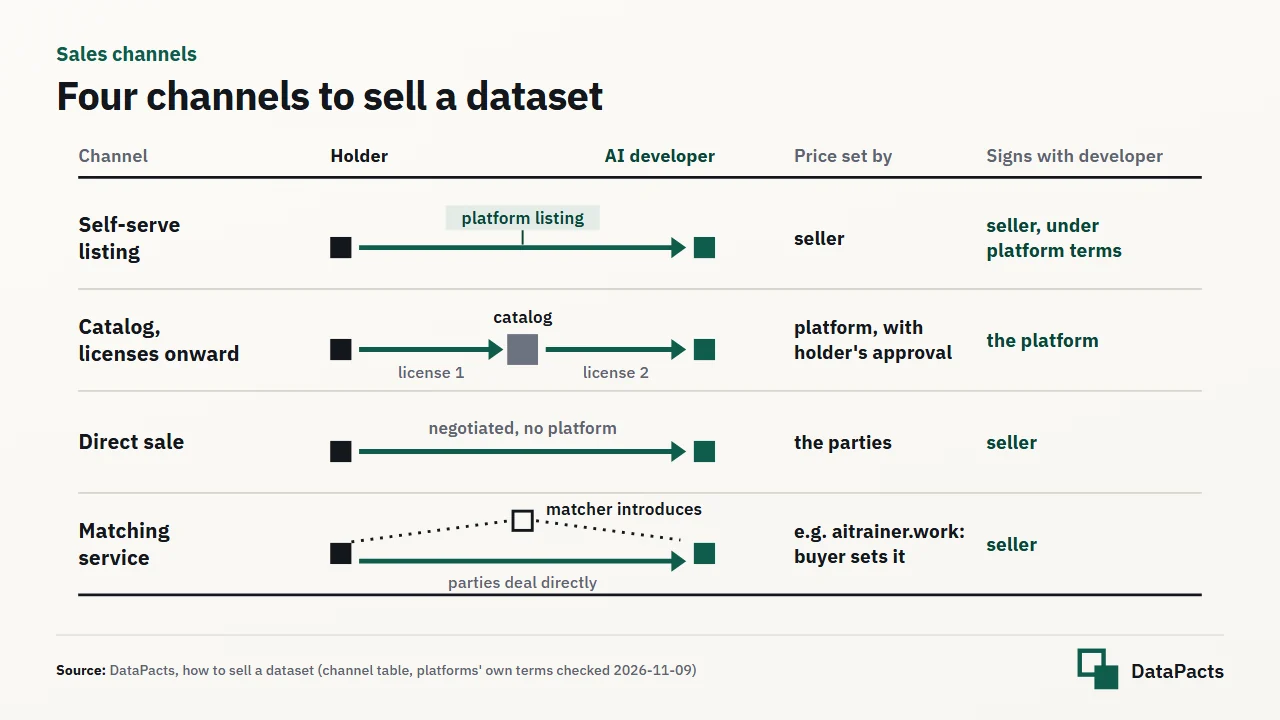
The four channels differ in who sets the price, what the platform keeps and who signs with the AI developer. The table compares them as of 2026-11-09; every value is the named platform's own statement.
| Channel | Examples | Who sets the price | What the platform keeps, as stated | Who signs with the AI developer | Source |
|---|---|---|---|---|---|
| Self-serve listing | AWS Data Exchange; Datarade; DataVendor; FileYield; Mozilla Data Collective; Opendatabay; PIXTA AI; Snowflake Marketplace | seller | AWS 3 % on public offers (effective 2024-01-05); Datarade 30 % on the commission-only plan; DataVendor 20 % at withdrawal; FileYield "free" listing vs 8 % seller and 6 % buyer; Mozilla Data Collective no platform fee stated (it says uploaders keep 100 % of revenue); Opendatabay 30 % sliding to 5 %; PIXTA no rate published; Snowflake no fee stated | seller, under platform terms | each platform's fee or terms page, checked 2026-11-09 |
| Catalog that licenses onward | Defined.ai; ELRA; Linguistic Data Consortium; Protege | platform, with the holder's approval at Defined.ai; ELRA fee schedule | no percentage published (Defined.ai, Protege); provider compensation by contract (ELRA) | the platform | defined.ai; withprotege.ai; elra.info; ldc.upenn.edu |
| Direct sale | negotiated with the AI developer; form shown by David AI and SpeechData.ai | the parties | none | seller | withdavid.ai; speechdata.ai |
| Matching service | aitrainer.work | buyer | buyer-paid fee on completed deals, amount not disclosed | seller | aitrainer.work/sell |
Platforms, catalogs and matching services place or license data; none of them is the AI buyer.
Self-Serve Listings Where the Seller Stays the Licensor
On a self-serve listing the seller publishes the dataset, sets its own price and terms, and the platform keeps a fee or commission on each sale.
Headline terms (checked 2026-11-09): AWS Data Exchange states a 3 % listing fee on public offers, effective 2024-01-05, with monthly disbursement less fees; Datarade states a commission-only plan at USD 0 a year plus 30 %; DataVendor states that it keeps 20 % of vendor earnings, assessed only at withdrawal; Opendatabay states a commission of 30 % on sales of USD 1 to 100, sliding to 5 % at USD 250,001 and above (schedule effective 2026-10-06).
Mozilla Data Collective (compensated datasets launched 2026-07-29) states that uploaders keep 100 % of revenue, PIXTA sets fees in a separate application form with no rate published, and Snowflake states no fee.
FileYield's own pages disagree: one states "Listing on FileYield is free", another states rates of 8 % for sellers and 6 % for buyers. Full schedules, eligibility and payouts are compared in AI training data marketplaces with their fees compared.
Catalogs and Platforms That License the Dataset Onward
A catalog takes a license from the dataset's holder and licenses the data onward to its own customers, so the holder signs with the platform and never with the AI developer.
Defined.ai states that any business generating or aggregating audio, video, image, text or multimodal data can apply as a Data Partner, that licensing fees come from marketplace sales on terms the partner approves, and that several partners earn over USD 1 million a year (release of 2026-01-27).
Protege states a worldwide, royalty-free, non-exclusive license to itself (s.1.1) and "revenue share payouts to data partners with each use".
The language-resource distributors work the same way. ELRA states that providers grant it a distribution license and are compensated by contract, and the Linguistic Data Consortium runs a submissions portal for providers and sells membership to buyers. None of these catalogs publishes the share the holder receives.
Selling Directly to an AI Developer
A direct sale is a negotiated agreement between the holder and the AI developer, with no platform fee and no published terms to fall back on.
The form is visible in vendors that sell their own datasets: David AI states that access runs through a data license agreement whose terms are not published, and SpeechData.ai sells conversational speech under a license cleared for commercial use. Vendors are profiled under dataset vendors and data labs.
Without a platform, the holder carries buyer search, drafting, delivery and collection.
Matching Services That Introduce a Dataset to Buyers
A matching service takes a description of the dataset, shows buyers whose criteria fit and leaves the deal to the parties, and it is paid by the buyer, the seller or both. aitrainer.work states that the seller describes the asset without uploading it, sees matching buyers and deals directly, that the "buyer sets price", and that "most repos don't sell at all" (checked 2026-11-09).
It states that some buyers pay it a fee when a referred seller completes a deal, with no amount disclosed. It is an intermediary, not a buyer, and fee models are compared in the directory of AI data licensing brokers and sell-side advisers.
Pricing a Dataset: Who Sets the Price and What Listed Datasets Cost
Who sets a dataset's price depends on the channel: the seller on self-serve listings, the platform with the holder's approval in a catalog, the parties in a direct sale and the buyer in a matching service.
Mozilla Data Collective states that the provider sets price and license, Defined.ai states that terms are approved by the partner, and aitrainer.work states "buyer sets price" (checked 2026-11-09).
The table shows buyer-side list prices as of 2026-11-09, per hour of speech, per slide or per resource.
| Seller or distributor | What is sold | Stated price | What the data's provider receives | Source |
|---|---|---|---|---|
| GSK (Gengo-Shigen-Kyokai) | language resources (speech, lexicons, text) | JPY 33,000 per resource for non-members, taxes included | not stated | gsk.or.jp/en/service |
| HistAI | pathology whole-slide images | H&E USD 5.00 / 4.00 / 3.00 / 2.00 per slide; IHC and other USD 40.00 / 32.00 / 27.00 / 23.00, by volume tier | not described | hist.ai |
| Linguistic Data Consortium | membership access to its speech and text catalog | for-profit Standard USD 34,000, Subscription USD 40,000 | not stated | ldc.upenn.edu |
| SpeechData.ai | conversational speech datasets | USD 60 to 95 per hour of audio; English (US) USD 90 per hour, 1,500 hours, 150 speakers | speaker pay not disclosed | speechdata.ai |
These are prices charged to buyers by vendors and distributors. ELRA and GSK do not state what providers receive, so a list price is not the holder's income.
No seller has publicly confirmed an amount received through any marketplace. Pricing a company archive is a valuation question, and the public price points for each data type sit among AI training data prices per hour, image and record.
Listing Terms That Outlast the Sale
Several terms keep binding the seller after a dataset is sold or a listing is removed, and they are set before the first sale. The published examples are these (checked 2026-11-09):
- Surviving entitlement: DataVendor states that a buyer's entitlement survives the vendor unpublishing the listing.
- Access after termination: Protege's existing licensees keep access for 12 months, and academic licensees for 3 years (s.7.2).
- Non-circumvention, audit and notice: Defined.ai's Supplier Program states a 12-month non-circumvention duty after the term, an audit at most once a calendar year on 15 business days' notice, and 60 days' notice to terminate for convenience.
- Samples: PIXTA allows samples only for evaluation (Art. 2.1) and is not a party to the contract between buyer and seller.
- No escrow: FileYield states that the parties handle payment, delivery and personal data themselves.
Payout timing on marketplaces follows the buyer's payment: AWS Data Exchange states monthly disbursement less fees, and Snowflake states that Stripe pays after it receives the consumer's payment. The mechanics are covered in when and how AI data buyers pay.
Selling a Dataset: Benefits, Risks, Downsides and Alternatives, Including Not Selling
Selling a dataset can earn from the same copy more than once, but each sale spreads the data further and none can be undone once a model is trained.
Benefits
- A non-exclusive grant lets the seller license the same copy again (Defined.ai Supplier Program, Protege non-exclusive license).
- On self-serve listings the seller sets the price (Datarade, Mozilla Data Collective).
- Catalogs do the buyer search (Defined.ai Data Partners).
Risks
- Open-ended licenses: Defined.ai's customer license is perpetual by its FAQ and HistAI states a perpetual commercial license.
- Surviving entitlement and access after termination (DataVendor, Protege).
- Warranty exposure: sellers warrant rights and consent (Datarade, PIXTA).
- Platforms whose own fee pages disagree (FileYield).
Downsides
- Commissions of 3 % to 30 % on public listings (checked 2026-11-09).
- Catalog shares are unpublished (Defined.ai, Protege).
- Many listings never sell: aitrainer.work states that most repos do not sell at all.
- A 12-month non-circumvention duty at Defined.ai.
Alternatives, including not selling
- A company data program for operating records.
- Research-only distribution, which some ELRA providers choose.
- Open release of the dataset.
- Keeping the dataset for internal use.
- Not selling at all.
No path has a deadline. The paths outside a sale are compared in alternatives to selling data to AI labs.
Where Selling a Dataset Sits in the Process to Sell or License Company Data
Selling a dataset follows the same seller process as licensing company data, with the channel choice replacing the search for a single program buyer. The full sequence is in the guide to sell or license company data to AI companies, and the steps before and after the channel are:
- Data inventory
- PII removal and de-identification
- Samples and clean rooms
- NDAs before sharing data
- Evaluating an offer for your data
- Negotiating an AI data licensing deal
- AI data licensing agreements
- Delivering licensed data to an AI buyer
- Tax on data licensing income
Selling a Dataset as an Individual
People who hold their own photos, recordings or writing sell them through contributor apps and creator programs rather than dataset listings, several of which admit organizations only.
DataVendor admits organizations only and Datarade registered businesses only. Where individuals selling their own data for AI training start is covered on their own page; sales of consumer profiles for marketing are outside this reference.
Platforms, Catalogs and Vendors Cited on This Page
Each term above is the named platform's own statement, checked November 9, 2026. Related references: who buys AI training data, company data partnership programs and AI data partnership payouts and program terms compared.
Named: aitrainer.work, AWS Data Exchange, Datarade, DataVendor, David AI, Defined.ai, ELRA, FileYield, GSK, HistAI, Linguistic Data Consortium, Mozilla Data Collective, Opendatabay, PIXTA AI, Protege, Snowflake Marketplace and SpeechData.ai.
Frequently Asked Questions
Where can I sell a dataset?
A dataset for AI training can be sold on a self-serve listing such as AWS Data Exchange, Datarade or Opendatabay, through a catalog such as Defined.ai, directly to an AI developer or through a matching service. Each platform states its own commission, from 3 % on AWS Data Exchange public offers to 30 % at Datarade's commission-only plan.
How much can a dataset sell for?
No public figure shows what sellers receive; vendors list buyer prices such as USD 60 to 95 per hour of speech (SpeechData.ai, checked 2026-11-09). Pricing an archive is a question of what company data is worth to AI companies.
Do I still own a dataset after selling it?
Usually yes: the platforms read grant a license to a copy, and DataVendor states a sale licenses rather than transfers the assets (checked 2026-11-09). An exclusive grant or an outright transfer, agreed in a direct sale, changes this.
Can I sell a dataset built from scraped web data?
Datarade prohibits illegally scraped data and every channel requires the seller to warrant its rights, so scraped content needs a rights check first (checked 2026-11-09). The rules behind whether web scraping for AI training is legal differ by jurisdiction.
This page is information, not legal advice.