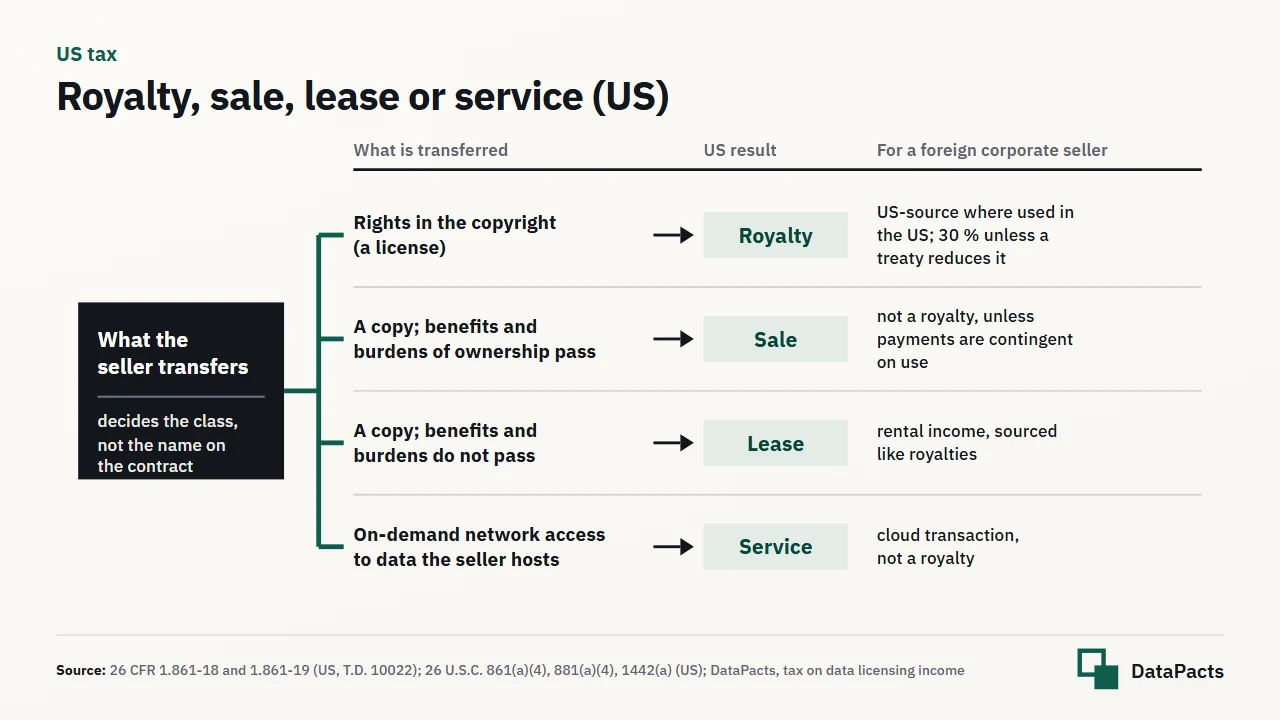
Which applies depends first on whether the deal is a royalty, a sale, a lease or a service, and then on where seller and buyer sit.
This page sets out the instruments behind AI training data licensing income. As of November 9, 2026, a US-source royalty to a foreign corporation faces 30 % withholding unless a treaty reduces it, and an EU business customer usually accounts for VAT under the reverse charge.
DataPacts Editorial Team checked every statute and rate here against its primary source on November 9, 2026; the page on how we source, date and check every figure sets out the rules.
Four Tax Questions Every Data License Payment Raises
Four questions decide the tax on a data deal: what the payment is, where it is sourced, whether VAT or GST applies, and whether the buyer withholds tax at source. The table compares each question with its governing instrument, as of 2026-11-09.
| Question | What decides it | Instrument | Covered | Source |
|---|---|---|---|---|
| What is the payment? | what is transferred: copyright rights, a copy, access, know-how | 26 CFR 1.861-18; 1.861-19 | here | ecfr.gov |
| Where is it sourced? | place of use; billing address for sales of copies | 26 U.S.C. 861(a)(4); 1.861-18(f)(2) | here | uscode.house.gov; ecfr.gov |
| Does VAT or GST apply? | customer status and location | Directive 2006/112/EC Arts. 44, 196; VATA 1994 s.7A | here, with depth on the VAT child page | legislation.gov.uk |
| Does the buyer withhold? | payer's country, category, treaty | 26 U.S.C. 1442(a); ITA 2007 s.906; ITA (Canada) s.212 | withholding child page | uscode.house.gov; legislation.gov.uk |
Royalty, Sale, Lease or Service: How a Data Deal Is Characterized
Tax law classifies a data deal by what is transferred, not by the name on the contract, so a document called a license can still be taxed as a sale or a service. micro1's master terms grant a "worldwide, royalty-free, fully paid-up" license (s.1.2, checked 2026-11-09), but that wording describes the grant, not the tax category.
US Rules for Digital Content and Cloud Access
Two US regulations, 26 CFR 1.861-18 and 1.861-19 (T.D. 10022, applicable to tax years beginning on or after January 14, 2025), sort a dataset deal into a copyright license, a sale or lease of a copy, a service, or know-how. The table shows the result for a foreign corporate seller, as of 2026-11-09.
| What the seller transfers | US classification | Consequence for a foreign corporate seller | Source |
|---|---|---|---|
| rights in the copyright (license) | royalty | US-source where used in the US; 30 % unless a treaty reduces it | 26 CFR 1.861-18 |
| a copy, with benefits and burdens of ownership passing | sale | not a royalty, unless payments are contingent on use | 1.861-18(f)(2); 26 U.S.C. 881(a)(4) |
| a copy, without benefits and burdens passing | lease | rental income, sourced like royalties under 861(a)(4) | 1.861-18(f)(2) |
| on-demand network access to data the seller hosts | service (cloud transaction) | not a royalty; downloads for storage and use excluded | 1.861-19(b) |
License Fee or Sale of the Dataset: Why the Structure Changes the Tax
A sale paid as a share of each later use is treated like a royalty for a foreign corporate seller, because 26 U.S.C. 881(a)(4) reaches gains from selling copyrights to the extent they are contingent on use or disposition.
Turing states "Nothing upfront" and pays every time the record sells, while Labelbox Prism states an upfront fee at signing plus a revenue share on downstream use (both checked November 9, 2026). The use-contingent share is the part 881(a)(4) addresses.
For the seller, 26 U.S.C. 1221(a)(3) excludes a copyright held by the taxpayer whose personal efforts created it from capital assets, and 26 U.S.C. 1235 covers patents only, never data.
On the buyer's side, a purchased information base is a section 197 intangible amortized ratably over 15 years (197(a), 197(d)(1)(C)(ii)), while separately acquired copyrights are excluded (197(e)(4)). The commercial choice between AI data monetization models comes before the tax one.
How UK and Canadian Law Treat Payments for Information
UK and Canadian tax law name payments for information as royalties, which places many data licenses inside the royalty rules rather than beside them.
ITA 2007 s.907(1) includes in intellectual property "any information concerning industrial, commercial or scientific experience", and s.906(5) makes the payer deduct income tax at the basic rate, 20 %. Canada's Income Tax Act s.212(1)(d)(ii) reaches the same information, taxed at 25 % under Part XIII.
Where Data License Income Is Sourced
A US royalty is sourced where the data is used, so training in the United States makes the license income US-source even when the seller is abroad. 26 U.S.C. 861(a)(4) treats royalties for use in the United States of copyrights, secret processes and like property as US-source.
Sales of a copy follow another rule, because 1.861-18(f)(2) deems an electronic sale to occur at the purchaser's billing address. The layers are set out for selling data to AI companies from outside the US.
VAT and GST on Cross-Border Data Licenses
VAT on a data license is charged where the customer is, and for a business customer the customer usually accounts for it, not the seller. The table compares five customer cases, as of 2026-11-09, with EU texts as consolidated in 02006L0112-20250414.
| Customer | Rule | Who accounts for VAT | Source |
|---|---|---|---|
| business in another EU Member State | Art. 44: where the customer is established | customer, reverse charge (Art. 196) | legislation.gov.uk/eudr/2006/112 |
| business outside the EU | Art. 44 | outside EU VAT | legislation.gov.uk/eudr/2006/112 |
| consumer in the EU, electronically supplied | Art. 58(c); intra-EU threshold in Art. 59c(1)(c) | supplier | eur-lex.europa.eu |
| consumer outside the EU, licenses or information | Art. 59(a),(c) | outside EU VAT | legislation.gov.uk/eudr/2006/112 |
| UK seller, business customer abroad | VATA 1994 s.7A(2): where the recipient belongs | outside UK VAT | legislation.gov.uk/ukpga/1994/23 |
Business Buyers: Customer Location and Reverse Charge
A license to a business is supplied where the customer has established its business, under Article 44 of Council Directive 2006/112/EC, and Article 196 makes that customer pay the VAT when the supplier is not established in its Member State.
In the UK, VATA 1994 s.7A(2) supplies services to a business recipient where it belongs, and HMRC publishes Notice 741A on the place of supply of services (last updated 2022-09-29). Directive (EU) 2025/516, in force since 2025-04-14, sets Digital Reporting Requirements from 2030-07-01.
Consumer Buyers and Electronically Supplied Services
Sales to consumers follow different articles, and a dataset made available online can be an electronically supplied service taxed where the consumer lives. Annex II(3) lists the making available of databases, and Article 58(c) taxes such services where the consumer is.
The intra-EU threshold in Article 59c(1)(c) is EUR 10,000 as of 2026-11-09. Implementing Regulation (EU) No 282/2011, Article 7(1), requires delivery over the internet, essentially automated with minimal human intervention, and its Annex I lists online data warehousing and online information generated from customer data input.
The consumer rules matter mainly where a dataset is sold to consumers, for example through a marketplace.
US State Sales Tax on Information Services
The United States has no federal VAT, and some states tax information services instead, with their own exemptions. Texas exempts 20 % of the total charge for information services from October 1, 1999 (34 Tex. Admin. Code 3.342(b)). State treatment is set out in VAT and sales tax on data licensing.
Tax a Foreign Buyer Takes Before It Pays
A buyer paying a royalty across a border often must deduct tax before the money leaves, so the seller receives the price minus that tax unless a treaty or a form reduces it. Rates by payer country:
- United States: 30 % of US-source royalties paid to a foreign corporation (26 U.S.C. 1442(a)).
- United Kingdom: income tax at the basic rate, 20 % (ITA 2007 s.906(5)).
- Canada: 25 % Part XIII tax (Income Tax Act s.212(1)(d)).
A Form W-8BEN-E is valid from signing to the last day of the third succeeding calendar year. AWS Data Exchange states that non-US providers give a W-8, a VAT or GST registration number and US bank details or a Hyperwallet account (checked November 9, 2026).
Rates, forms and treaty tables sit with withholding tax on data license payments.
Treaty Relief: How the Income Code Changes the Rate
A tax treaty can cut US withholding on a royalty to zero, but the rate depends on whether the payment counts as know-how (income code 10) or copyright (income code 12). The table compares selected rates, as of 2026-11-09, alphabetically; check the limitation-on-benefits clause and the treaty text before relying on a rate.
| Seller's country | Code 10 (know-how, other industrial) | Code 12 (copyright) | Source |
|---|---|---|---|
| Croatia | 30 % (no treaty in force) | 30 % | IRS Table 1 |
| Egypt | 30 % | 15 % | IRS Table 1 |
| Germany | 0 % | 0 % | IRS Table 1 |
| Hungary | 30 % (treaty terminated) | 30 % | IRS Table 1 |
| Israel | 15 % | 10 % | IRS Table 1 |
| Italy | 8 % | 0 % | IRS Table 1 |
| Korea | 15 % | 10 % | IRS Table 1 |
| United Kingdom | 0 % | 0 % | IRS Table 1 |
| No treaty | 30 % | 30 % | IRS Table 1 |
Italy moves from 8 % under code 10 to 0 % under code 12, and Egypt from 30 % to 15 %.
Croatia has no treaty in force, with Treaty Document 119-2 transmitted to the Senate on 2026-09-14. Hungary's treaty was terminated effective 2023-01-08 and ceased to have effect for withholding from 2024-01-01. Taiwan's H.R. 33 passed the House on 2025-01-15 and was referred to Senate Finance on 2025-01-16, with no later action and no law.
FDDEI and Reporting Forms for US Sellers
A US C-corporation that licenses data to foreign buyers can deduct 33.34 % of its foreign-derived deduction eligible income for tax years beginning after December 31, 2025, under 26 U.S.C. 250 as amended by Pub.
L. 119-21. The same section excludes income and gain from the sale or other disposition of intangible property for dispositions after June 16, 2025 (250(b)(3)(A)(i)(VII)), so the structure of the deal decides whether the deduction survives.
A US payer reports royalties of USD 10 or more in box 2 of Form 1099-MISC, against a general threshold of USD 2,000 for tax years beginning after 2025 (as of 2026-11-09). The table lists the main forms and rules.
| Form or rule | What it does | Value | Source |
|---|---|---|---|
| Form W-8BEN-E | foreign entity claims treaty rate | valid to the last day of the third succeeding calendar year | irs.gov/instructions/iw8bene |
| Form 1042-S | payer reports US-source payments to foreign persons | 2026 forms due 2027-03-15 | irs.gov/publications/p515 |
| Form 1099-MISC box 2 | payer reports royalties to US persons | from USD 10 | irs.gov/instructions/i1099mec |
| Backup withholding | applies when required taxpayer details are missing | 24 % | irs.gov |
Benefits, Risks, Downsides and Alternatives of Each Tax Structure
No structure is tax-neutral: a license keeps US seller incentives and treaty royalty rates in play, while a sale or a service moves the deal into other rules.
Benefits
- The 33.34 % foreign-derived deduction for US C-corporations (26 U.S.C. 250).
- Treaty rates of 0 % for some countries (IRS Table 1).
- Reverse charge for EU business buyers (Art. 196).
Risks
- 30 % where no treaty applies, as for Croatia and Hungary.
- Use-contingent sale payments taxed like royalties (881(a)(4)).
- A wrong income code on the W-8BEN-E.
Downsides
- Forms and reporting (1042-S, 1099-MISC).
- Per-use payments spread income across tax years.
- VAT duties on consumer sales (Art. 59c(1)(c)).
Alternatives
- A one-time sale of a copy (1.861-18(f)(2)).
- Hosted access as a service (1.861-19(b)).
- A marketplace that collects tax details.
- Not licensing or selling the data at all.
Tax is one input to the question of should you sell or license your data at all.
Tax Questions to Settle Before Signing
Six tax questions belong in writing before signing, because the answers change what the seller actually receives.
- Which category does the payment fall under in 26 CFR 1.861-18 or 1.861-19?
- Where will the data be used?
- Which party withholds, at what rate and on which income code?
- How is VAT treated, and which party accounts for it?
- Which forms does each party file?
- Who bears the tax withheld if the rate is wrong?
The answers go into the tax and payment clauses of the AI data licensing agreement.
Where Tax Sits in the Process to Sell or License Company Data
Tax is settled in the contract and paid after delivery, so it follows negotiation and payment and comes before the obligations that continue after the sale. The full sequence to sell or license company data to AI companies runs as follows:
- Negotiating an AI data licensing deal
- When and how AI data buyers pay
- Tax on data licensing income (this page)
- After the sale
Some sellers conclude the tax work is not worth it; see the alternatives to selling data to AI labs, including not selling.
Revenue Recognition Is a Separate Question
When license income is booked as revenue is an accounting question with its own standards, and the answer can differ from the tax year in which the income is taxed. Recognition and disclosure are covered in accounting for data licensing revenue.
Individuals, Contributors and Tax Preparers
People selling their own data, contributors paid for training tasks and tax preparers holding client returns each meet different rules from a company licensing its records.
Individuals are covered in tax on selling your own data for AI training, where 26 U.S.C. 1221(a)(3) excludes self-created works from capital assets. Contributors are covered in taxes for AI training contributors.
For preparers, 26 U.S.C. 7216(a) makes knowing or reckless disclosure or use of return information a misdemeanor, punishable by a fine of up to USD 1,000, up to one year in prison, or both (as of 2026-11-09), set out under IRC section 7216 and in what accounting and tax firms licensing data to AI may not include.
Frequently Asked Questions
Is data licensing income a royalty?
Often, but not always: a license of copyright in a dataset produces a royalty, while a sale of a copy or hosted access can be a sale or a service under 26 CFR 1.861-18 and 1.861-19.
Do I charge VAT when licensing data to a US AI company?
An EU seller licensing to a business customer outside the EU charges no EU VAT under Article 44, because the supply takes place where the customer is established. A UK seller reaches the same result under VATA 1994 s.7A(2).
Is income from selling data taxed?
Yes: a company's license or sale income is taxable income, and a buyer abroad may withhold tax before paying it.
The US 30% rule and treaty rates by country are set out separately.
This page is information, not tax advice; consult a tax adviser before signing.