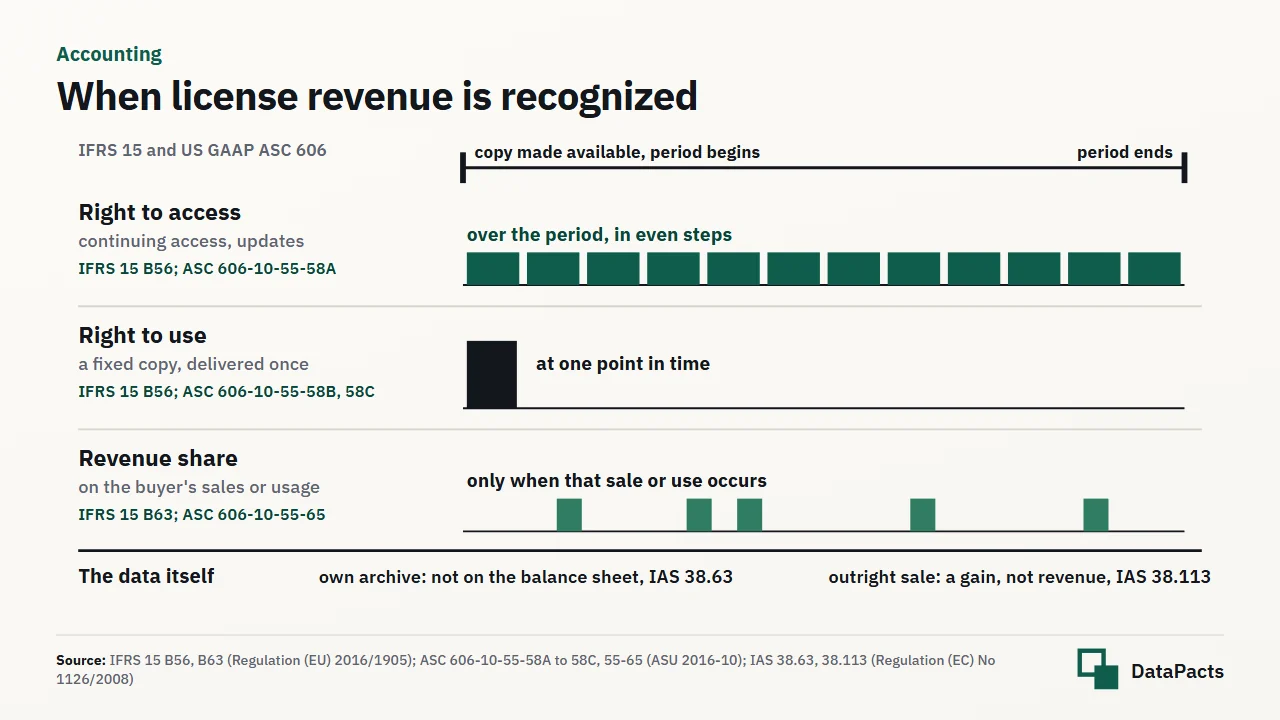
A share of the buyer's later sales or usage waits until that sale or use occurs. Reddit states a ratable policy, while Getty Images states that data deals typically bring a greater portion of revenue recognized in an accelerated manner.
An archive a company built itself is usually not on the balance sheet, because IAS 38.63 bars recognition of internally generated customer lists and similar items. This page sets out the accounting side of AI training data licensing for the seller, and not selling or licensing at all remains a valid outcome.
This page is checked against the standards texts and the licensors' own filings, as described in how we source, date and check every figure.
Which Standards Govern Data License Revenue and Data Assets
Four sets of rules decide how a data license appears in the accounts: the licensing guidance of IFRS 15 and ASC 606 for revenue, and IAS 38 and ASC 350 for the data as an asset.
The five-step revenue model sits behind both, but the license guidance is the part that decides data deals. The table lists the paragraphs recorded for this page, as of 2026-11-09.
| Standard | Paragraph | Rule as recorded | Applies to | Source |
|---|---|---|---|---|
| IFRS 15 (Regulation (EU) 2016/1905; in force 2018-01-01) | B56 | right to access over time; right to use at a point in time | seller revenue | legislation.gov.uk |
| IFRS 15 | B58 | sets three criteria for a right to access | seller revenue | legislation.gov.uk |
| IFRS 15 | B63 | sales- or usage-based royalty recognized at the later of the sale or usage and satisfaction | seller revenue | legislation.gov.uk |
| ASC 606 (per ASU 2016-10, April 2016) | 606-10-55-58A, 55-58B | right to access over time; right to use at a point in time | seller revenue | storage.fasb.org |
| ASC 606 | 606-10-55-58C | no revenue before a copy is made available and the license period has begun | seller revenue | storage.fasb.org |
| ASC 606 | 606-10-55-59, 55-60, 55-62, 55-63 | functional versus symbolic IP | seller revenue | storage.fasb.org |
| ASC 606 | 606-10-55-65 | sales- or usage-based royalty exception | seller revenue | storage.fasb.org |
| IAS 38 (Regulation (EC) No 1126/2008) | 38.63 | internally generated customer lists and similar items not recognized | seller asset | legislation.gov.uk |
| IAS 38 | 38.113 | derecognition gain not classified as revenue | seller sale | legislation.gov.uk |
| IAS 38 | 38.25 | probability criterion always met for separately acquired intangibles | buyer asset | legislation.gov.uk |
| ASC 350-40 (ASU 2025-06, September 2025) | 350-40-25-12 | internal-use software capitalization threshold; effective for annual periods beginning after 2027-12-15 | buyer software | storage.fasb.org |
| ASC 350-30, ASC 610-20 | no number stated | paragraph text not read | buyer asset, seller sale | n/a |
Right to Access or Right to Use: When License Revenue Is Recognized
The nature of the promise decides timing: a right to access is satisfied over time and a right to use at a point in time (IFRS 15 B56; ASC 606-10-55-58A and 55-58B, per ASU 2016-10). The three sections below take the two outcomes and the difference between the two frameworks in turn.
Right to Access: Revenue Spread Over the License Period
When the buyer receives continuing access to data the licensor keeps updating, revenue is spread over the license term. Reddit's FY2025 10-K states that licensing revenue is generally recognized ratably over the license period, which it describes as a right to access, and its January 2024 licenses were delivered through continuous API access.
Ratable recognition means the income of a multi-year license appears in even steps while the cash may follow a different schedule. The contract terms and counterparty position behind the figures are set out in Reddit's AI data licensing deals with Google and OpenAI.
Right to Use: Revenue When the Data Is Made Available
A license to a fixed copy of a dataset, delivered once, is recognized when the copy is made available and the license period has begun, not over the term (ASC 606-10-55-58C).
Getty Images states in its FY2025 10-K, in both the 2025 and 2024 discussions, that data access and licensing agreements typically result in a greater portion of revenue being recognized in an accelerated manner.
Point-in-time recognition makes reported license revenue lumpy. Shutterstock's 10-Q for the third quarter of 2026 reports Data, Distribution, and Services revenue of USD 15,823 thousand against USD 65,668 thousand a year earlier, a fall of 76 %, and ties recognition to delivery timing. No figure on this page is a forecast for any company.
How US GAAP and IFRS Classify a Data License Differently
US GAAP sorts licensed intellectual property into functional and symbolic IP, while IFRS 15 asks whether three criteria for a right to access are met.
Under ASC 606-10-55-59 to 55-63, symbolic IP licenses are a right to access and functional IP licenses are a right to use unless the 55-62 criteria are met; IFRS 15 B58 sets the three criteria.
No standard text or filing recorded here classifies a dataset as functional or symbolic IP, or settles it under B58. Whether the buyer gets updates, continuing delivery or only a fixed copy are the terms to take to the auditor, as a question rather than an answer.
Revenue Shares and Usage-Based Fees Under the Royalty Exception
A share of the buyer's later sales or usage is recognized only when that sale or use occurs, or when the license obligation is satisfied if that is later (IFRS 15 B63; ASC 606-10-55-65). Three programs state share structures, in alphabetical order, each as its own statement checked November 9, 2026:
- Labelbox Prism states "an upfront licensing fee at signing plus a revenue share on downstream use".
- Replay states offers are "typically structured as an upfront cash payment plus a perpetual revenue share".
- Turing Project Lazarus states "Nothing upfront" and a payment every time the record sells, with the split not published.
In a combined structure the fixed fee follows the access or use analysis and the share follows the exception. A per-record fee follows deliveries, as in the Pathos order form of 2026-10-22 that prices each delivered record. No company data buyer publishes a split, so the percentage has to come from the contract itself.
Payment Timing Versus Revenue Timing
The date a buyer pays and the date the seller recognizes revenue are set by different rules, so cash can arrive before revenue or revenue before cash.
Reddit's S-1, filed 2024-02-22, reports USD 203.0 million aggregate contract value over two to three years for January 2024 licenses, with counterparties not named, and states that at least USD 66.4 million was expected to be recognized in 2024.
Nothing in the S-1 equates the schedule of cash with the revenue schedule. Triggers and timing of payment are set out in when and how AI data buyers pay.
Shutterstock reports USD 51.0 million of unbilled receivables for certain DD&S transactions as of 2026-09-30, which is revenue recognized before the invoice.
Tempus AI's 10-K for FY2025 reports USD 200 million in fees from Pathos over three years, including USD 50 million upfront paid as of April 2025, and says Pathos may pay up to 50 % in Series D preferred stock. No standard text or filing recorded here settles the treatment of a payment in shares.
Data on the Balance Sheet: Asset Treatment Under IAS 38 and US GAAP
A license changes the income statement, but whether the data itself sits on the balance sheet depends on how it was obtained. The three sections below take the seller's own archive, an outright sale and the buyer's side.
Internally Generated Data Archives Stay Off the Balance Sheet
Under IAS 38.63, internally generated customer lists and items similar in substance are not recognized as intangible assets, so a company's own operating records usually carry no book value. Price therefore comes from the market and not from the books, a point developed in how much company data is worth to AI companies.
US GAAP is named here without a paragraph number, because no ASC 350-30 text is recorded. Whether the cost of preparing a dataset for sale can be capitalized is not settled by any record here, since ASC 350-40 covers software.
Selling the Data Outright: Gains That Are Not Revenue
An outright sale that transfers the data, rather than licensing it, is a derecognition, and IAS 38.113 states the gain is net disposal proceeds less carrying amount and "shall not be classified as revenue".
Which standard applies to a sale of an archive that was never recognized, or to ordinary-course data sales, is not settled by any text recorded here, and no ASC 610-20 paragraph is cited. The choice between sale and license is covered in AI data monetization models.
How the Buyer Records a Purchased Data License
The buyer of a separately acquired data license meets the IAS 38 probability criterion by definition (IAS 38.25), so the seller's counterparty usually capitalizes what it pays.
Under US GAAP, ASC 350-40-25-12 as changed by ASU 2025-06 starts capitalization of internal-use software when management authorizes and commits to funding and completion is probable, for annual periods beginning after 2027-12-15, and covers software, not purchased datasets. Tax amortization on the buyer's side follows separate rules.
What Data Licensors Disclose in Their Financial Statements
Listed data licensors disclose a recognition policy, contract balances, remaining performance obligations and concentration, while the buyers usually stay unnamed. The table gives each filer's own statement, alphabetical by licensor, as of 2026-11-09. Private companies and national frameworks are outside the filings recorded here.
| Licensor | Filing | Disclosed item | As filed | Source |
|---|---|---|---|---|
| Getty Images | 10-K FY2025 (filed 2026-03-16) | recognition pattern | data access and licensing agreements "typically result in a greater portion of revenue being recognized in an accelerated manner" (2025 and 2024 discussions) | sec.gov gety-20251231 |
| Getty Images | 10-K FY2025 | revenue line | Other revenue (includes data access and licensing, music licensing and other items) is 5.6 % of revenue in 2025, 4.3 % in 2024, 1.9 % in 2023 | sec.gov gety-20251231 |
| S-1 (filed 2024-02-22) | contract value and expected recognition | January 2024 licenses: USD 203.0 million aggregate, two to three years, at least USD 66.4 million expected in 2024; counterparties not named | sec.gov reddits-1q423 | |
| 10-K FY2025 | recognition policy | generally ratably over the license period (right to access) | sec.gov rddt-20251231 | |
| 10-Q Q3 2026 | remaining performance obligations | USD 62.4 million, primarily long-term content licensing: USD 31.9 million in the remainder of 2026, USD 30.5 million in 2027 | sec.gov rddt-20260930 | |
| 10-Q Q3 2026 | concentration | "substantially all" licensing contract value from two partners "approaching the end of their respective current terms" | sec.gov rddt-20260930 | |
| Shutterstock | 10-Q Q3 2026 | unsatisfied performance obligations | USD 33.2 million, primarily data deals, expected over five years | sec.gov sstk-20260930 |
| Shutterstock | 10-Q Q3 2026 | contract balances | USD 51.0 million unbilled receivables for certain DD&S transactions | sec.gov sstk-20260930 |
| Tempus AI | 10-K FY2025 (filed 2026-02-24) | fees and form of payment | Pathos: USD 200 million over three years incl. USD 50 million upfront paid as of April 2025; Pathos may pay up to 50 % in Series D preferred stock | sec.gov tem-20251231 |
| Wiley | 8-K Ex. 99.1 (2024-06-13) | one-time project | USD 23 million content rights project recognized in fiscal Q4 2024; buyer not named | sec.gov wly-2024430xex991 |
| Wiley | 10-Q (six months to 2025-10-31) | third-party content | AI license revenue USD 34.9 million includes USD 15.7 million related to content licensed from other publishers | sec.gov jwa-20251031 |
Reported amounts and trends by company are collected in AI data licensing revenue in company filings.
Benefits, Risks, Downsides and Alternatives of Each Accounting Outcome
No accounting outcome is better by default: up-front recognition reports income early but leaves later periods empty, and ratable recognition smooths income but defers it.
Benefits
- Income lands in the delivery period for a right to use (ASC 606-10-55-58C).
- Ratable recognition gives predictable revenue and a disclosed backlog, as Reddit's remaining performance obligations show.
- A revenue share books no income that may never arrive.
Risks
- Revenue concentrates in few licensees, as Reddit's two partners show.
- Revenue falls when deliveries stop, as Shutterstock's third-quarter DD&S figures show.
- Unbilled receivables carry collection exposure.
Downsides
- Internally generated data has no book value to anchor a price.
- Classification of a dataset needs auditor sign-off.
- A listed licensor makes its backlog and concentration public.
Alternatives
- A one-time license of a fixed copy.
- A subscription with updates.
- A revenue share.
- Not selling or licensing at all.
The prior decision is whether to license in the first place, covered in should you sell or license your data.
Accounting Questions to Settle Before Signing a Data License
Six contract terms decide which accounting answer applies, and each can be written so the treatment is clear before signing.
- Whether the buyer receives a fixed copy or continuing access.
- Whether updates are promised.
- Whether the price is a fixed fee, a share or both.
- When the copy is made available, including acceptance (micro1 states 30 business days to reject, otherwise deemed accepted, in its Data License Master Terms updated 2026-11-08).
- Exclusivity and term.
- Whether consideration is paid in shares or payments flow back to the buyer, which no recorded text settles.
The clauses that carry these answers are in AI data licensing agreements.
Where Accounting Sits in the Process to Sell or License Company Data
Accounting follows the contract, delivery and payment, runs alongside tax, and continues for as long as a ratable license or a revenue share keeps producing income. The full sequence is in sell or license company data to AI companies, and the steps around this page are:
- Negotiating an AI data licensing deal
- Term sheets, order forms and LOIs
- Delivering licensed data to an AI buyer
- Payment and tax
- Board and shareholder approval
- After the sale
- Data licenses in an M&A sale
- How long an AI data licensing deal takes
A company that decides against a license can read alternatives to selling data to AI labs.
How Accounting Treatment Differs From Tax Treatment
The year a license fee is taxed can differ from the period in which it is recognized as revenue, and the tax rules, including withholding and the buyer's amortization of a purchased information base, are set out separately. Those rules are in tax on data licensing income.
Accounting Firms and Accounting Records as Data
This page covers how the seller books license income. Firms as data holders are covered in accounting and tax firms licensing data to AI, and ledgers and ERP records as a data type are covered in selling accounting, ERP and financial records.
Standards Cited on This Page and Their Limits
This page is information, not accounting advice; the treatment of a specific contract is a judgment for the company and its auditor. ASC 606 paragraphs are cited as read in ASU 2016-10, not from the Codification. No ASC 350-30 or ASC 610-20 paragraph is cited.
Frequently Asked Questions
How is data licensing revenue recognized?
Over the license period for a right to access and when the data is made available for a right to use, under IFRS 15 B56 and ASC 606-10-55-58A and 55-58B. Reddit states a ratable policy for its licensing revenue.
Is company data an intangible asset on the balance sheet?
Usually not when the company built it itself: IAS 38.63 bars recognition of internally generated customer lists and similar items, while a buyer of a separately acquired license usually records an asset. The buyer's side follows IAS 38.25.
Is revenue from a revenue share recognized upfront?
No: a sales- or usage-based share is recognized when the later sale or use occurs, under IFRS 15 B63 and ASC 606-10-55-65.