Eighteen programs and intermediaries name finance records (checked November 9, 2026), and Mercor states four whole-deal ranges between USD 25,000 and USD 900,000 (re-read November 10, 2026).
Finance records are one record type within AI training data licensing. No per-record price for them is on record, and a deal is a license of a copy, not an outright sale.
Program wording was checked on November 9, 2026 and Mercor's listings were re-read on November 10, 2026; how we source, date and check every figure explains the method.
Which Finance Records AI Buyers Ask For, and Which They Exclude
AI buyers ask for the records that show how finance work is done: general ledgers and billing data, reconciliations and close workflows, financial models and underwriting files, and deal, credit and portfolio records.
Handshake AI names financial models and underwriting workflows, micro1 names finance SOPs, reconciliations and reporting workflows, and Labelbox Prism names financial reasoning traces and finance workbooks (all checked November 9, 2026).
The table compares each record family with the programs that name it and the exclusion or rule that applies, as of 2026-11-10 (program wording checked 2026-11-09).
| Record family | Programs naming it, in their own words | Stated exclusion or rule that applies | Source |
|---|---|---|---|
| General ledgers, billing and accounting exports | general ledgers, CRM, billing and support desk in daily use (Mercor SaaS, paraphrased); "accounting and ERP exports" (Polyshares); "billing and operations" (Mode); "invoices and financials" (Data Licensing Advisors) | platform terms of the accounting software | api.data.mercor.com; polyshares.com; data.mode.inc; datalicensingadvisors.com |
| Reconciliations, close and reporting workflows | "finance SOPs, reconciliations, reporting workflows" (micro1) | none stated | micro1.ai |
| Financial models and underwriting workflows | "financial models, underwriting workflows" (Handshake AI); "financial models" (AfterQuery) | none stated | joinhandshake.com; afterquery.com |
| Finance workbooks and reasoning traces | "financial reasoning traces", "finance workbooks" (Labelbox Prism) | none stated | prism.labelbox.com |
| Deal, credit and portfolio records | data rooms, models and memos; credit agreements; portfolio reporting; de-identified wealth client records (Mercor Investment Firm) | not a fit: documents under NDAs that forbid licensing; GLBA and Regulation S-P apply to client records | api.data.mercor.com |
| Transaction, order and payment tables | "transaction, order, inventory or shipment tables" (Mercor Payments & Fintech) | owned by the transaction-records page | api.data.mercor.com |
| Payroll | Paychex named as a source (Handshake AI) | "never used" (AfterQuery) | joinhandshake.com; afterquery.com |
| Client tax returns and workpapers | "Tax returns with workpapers" (Mercor Accounting & Tax) | taxpayer consent, 26 CFR 301.7216-3 | api.data.mercor.com; ecfr.gov |
| Payment card and financial account data | no program asks for it | excluded unless the Order Form allows (micro1 s.5.7) | micro1.ai |
The records sit among the data types AI companies buy.
Mercor's investment listing calls a firm whose only records are its own operating finances "not a fit" (checked November 9, 2026). Buyers value records that carry decisions and workflows more than balances alone.
Acquirers and Intermediaries That Name Ledgers, ERP Exports and Finance Workflows
The companies that name finance records split into acquirers that take a license and pay the company, and intermediaries that look for a buyer and license or broker on the company's behalf.
The table compares them by the records they name and the condition each states, as of 2026-11-10, every value being the company's own statement checked 2026-11-09, in alphabetical order.
| Company (role) | Finance records named | Stated condition or exclusion | Source |
|---|---|---|---|
| Aba Compute (intermediary, finds a buyer) | "finance records" | 20+ full-time employees, 3+ years; deletion does not reverse completed training | abacompute.com |
| AfterQuery (licensee) | "finance records"; financial models | payroll, privileged legal material and credentials never used | afterquery.com |
| Avelence (seller-side adviser) | "finance" | fee agreed separately; no default system access | avelence.com |
| Centific (licensee) | "finance and accounting"; SAP, Workday | read-only connection; exclusions enforced in extraction code | centific.com |
| Corpus Bridge (broker) | QuickBooks, Xero, NetSuite, SAP, Shopify | seller pays a success fee, percentage not published | corpusbridge.com |
| Data Licensing Advisors (seller-side adviser) | "invoices and financials" | accounting, legal or healthcare organizations "Usually not a fit right now" (checked 2026-11-16) | datalicensingadvisors.com |
| Handshake AI (company data program) | "financial models, underwriting workflows"; NetSuite, QuickBooks, Paychex | Finance & insurance among 11 industries | joinhandshake.com |
| Labelbox Prism (data vendor) | "financial reasoning traces", "finance workbooks"; SAP | exclusive by default | prism.labelbox.com |
| Mercor (company data program) | general ledgers and billing; deal and credit files; transaction tables; tax workpapers | see the Mercor listings table below | api.data.mercor.com |
| micro1 (company data program) | "finance SOPs, reconciliations, reporting workflows" | payment card and financial account data excluded unless the Order Form allows (s.5.7) | micro1.ai; micro1 terms |
| Mode (data vendor) | "billing and operations" | home page: 10+ employees for accounting and finance firms | data.mode.inc |
| Nyne (licensee) | SAP among business systems | 20+ full-time U.S. W-2 employees; Nyne removes identifying details | nyne.ai |
| Pangea.ai (marketplace) | "finance and operations" | non-exclusive license; company keeps ownership | pangea.ai |
| Polyshares (acquirer, "paid by us to the company") | "accounting and ERP exports" | term wording differs across its own pages, both stated: "Defined material for a defined term" and "Perpetual exclusive license" | polyshares.com |
| Replay (licensee) | "financial records" | only de-identified data | replay.ai |
| Sell Business Data (seller-side adviser) | "ERP, WMS, CRM, accounting" | licenses one copy for a defined purpose | sellmybusinessdata.com |
| Sureform (platform that identifies buyers) | "CRM, ERP, accounting" | raw data deleted after processing | sureformhq.com |
| Troveo (marketplace, licenses on the seller's behalf) | QuickBooks, Stripe, NetSuite, Shopify; SAP, Dynamics | no OAuth access or install required | troveo.ai |
Programs that run a standing intake for company data are compared under company data partnership programs, which covers the other record types. The systems named come from each program's own list, not from the software vendors.
A cell reading "none stated" means no exclusion is published, not that the records are cleared, and an exclusion binds that program only.
Mercor's Finance Listings: Requirements, Exclusions and Stated Deal Ranges
Mercor publishes four listings that ask for finance records, and each states what it wants, what is not a fit and a deal range to the company that depends on volume and completeness. The table compares them as of 2026-11-10 (feed checked 2026-11-09, re-read 2026-11-10), in alphabetical order.
| Listing (published) | What Mercor asks for | Not a fit | Deal range to the company, Mercor states | Source |
|---|---|---|---|---|
| Accounting & Tax Firm (2026-10-17) | tax returns with workpapers across several entity types; several filing seasons; client documents that can be anonymized; tools QuickBooks, Xero, Sage Intacct, CCH, UltraTax, Lacerte, Drake, Bill.com | blank forms and templates; returns filed outside the United States | USD 25,000 to 865,000, "depends on client count and seasons" | listing feed |
| Investment Firm (2026-10-17) | closed-deal data rooms, CIMs, models and memos for the same deals; right to license once anonymized; 3+ years; nice to have: credit agreements, portfolio reporting, de-identified wealth client records | firms whose only records are their own operating finances; documents under NDAs that forbid licensing | USD 50,000 to 800,000, "depends on deal count and completeness" | listing feed |
| Payments & Fintech Company (2026-10-20) | years of transaction, order, inventory or shipment tables; 3 to 5+ years; consistent schema | none listed | USD 80,000 to 900,000 | listing feed |
| SaaS & Subscription Company (2026-10-17) | own production databases and a cloud warehouse; general ledgers, CRM, billing and support desk in daily use; 50 GB or more; tools incl. NetSuite and Stripe; included: finance, CRM, billing and support records | agencies holding their clients' databases; empty or barely used CRMs | USD 55,000 to 350,000, "depends on data volume and stack depth" | listing feed |
The program behind these listings is described in the Mercor data buyer profile.
Each range is a whole-deal figure, never a price per record or per gigabyte, and the four are not averaged. A fifth listing, for hedge funds and quant firms, asks for proprietary time series or trading code and excludes redistributed exchange feeds the firm does not own, so it belongs with market data.
An accounting firm weighing the Accounting & Tax listing finds the client-consent side in accounting and tax firms licensing data.
Accounting Software Terms That Limit What Leaves the Ledger
Records exported from accounting software stay subject to that software's terms, and the two sets on record limit AI training or reselling data taken from the service. The table compares the clauses as of 2026-11-10 (terms checked 2026-11-09).
| Platform (operator) | Clause on AI training or reselling data | Other clause a seller meets | Source |
|---|---|---|---|
| QuickBooks Online (Intuit Inc., SEC CIK 0000896878) | bars training or developing AI or ML models using information derived from the Platform without authorization; scope for the customer's own content is ambiguous (Section A version 02122026) | Intuit owns de-identified or aggregated data and may use it without restriction | intuit.com |
| Xero (Xero Limited, New Zealand company 1830488) | cl. 56: must not repackage, resell or sublicense any leads or data accessed through the services | cl. 62: data no longer available after termination, no read-only period stated; terms updated 2026-10-26, effective for current customers 2026-12-28 | xero.com |
| NetSuite, SAP, Sage Intacct, Stripe, Bill.com | not recorded | not recorded | n/a |
The terms bind the account holder, which may be the company's client, as with an accounting firm that keeps a client's books. Export mechanics differ by system and are compared under export rights by source system.
For NetSuite, SAP, Sage Intacct, Stripe and Bill.com no clause on AI training is recorded here, so the customer agreement is the place to check.
Confidential Figures in the Books: Customers, Suppliers, Prices and Margins
Finance records carry other companies' information, such as customer names and balances, supplier prices and contract terms, so a license can breach confidentiality duties the company owes them.
Mercor's investment listing excludes documents under NDAs that forbid licensing, and its SaaS listing excludes agencies that hold their clients' databases (both checked November 9, 2026). The duties are set out under customer consent and confidentiality clauses.
The company's own margins, pricing and cost structure also reach a licensee through general ledgers, a risk to weigh even where no third party's consent is needed.
Financial Privacy and Secrecy Rules for Finance Records
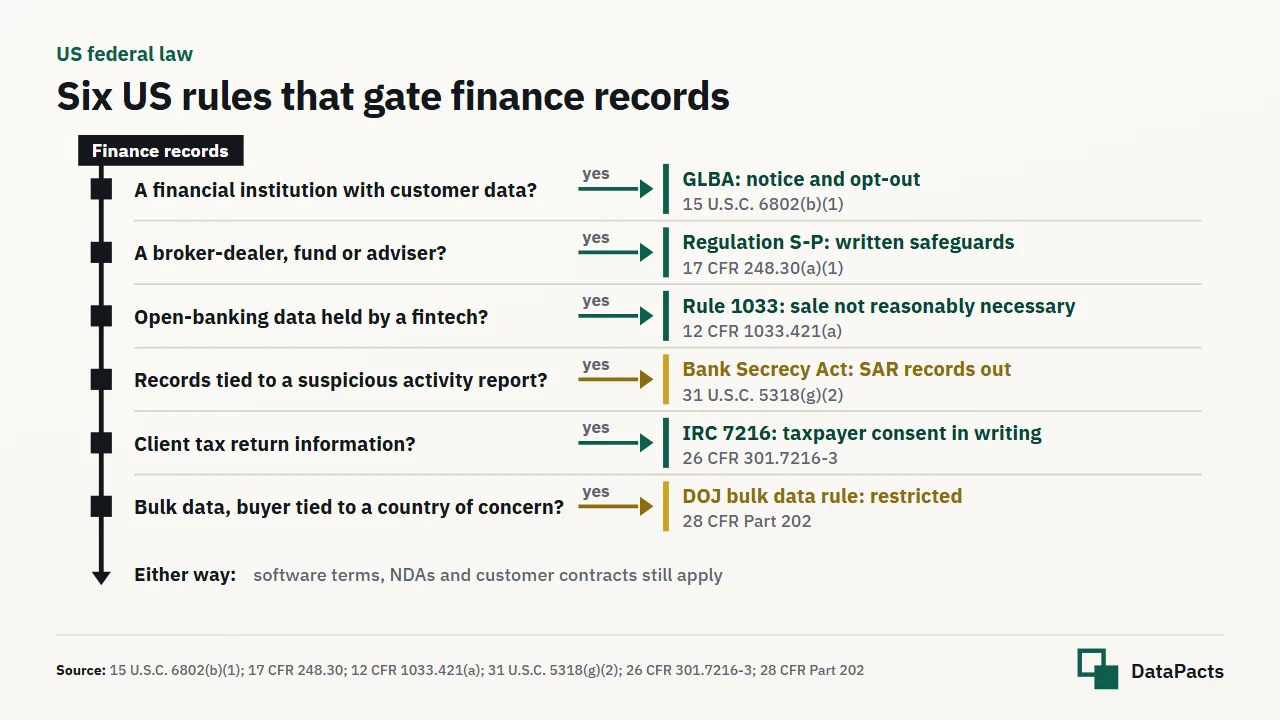
Six federal rules decide whether finance records about customers, clients or taxpayers may leave the company. This section is information, not legal advice, and cites US federal rules only.
GLBA, Regulation P and Reuse Limits on Nonpublic Personal Information
A financial institution must give customers notice and a chance to opt out before disclosing their nonpublic personal information to a nonaffiliated buyer, which includes an AI developer (15 U.S.C. 6802(b)(1), in force). Regulation P defines nonpublic personal information to include lists derived from personally identifiable financial information (12 CFR 1016.3).
A buyer that receives the data may reuse it only within the exception under which it was received, or as the original institution could lawfully disclose it (16 CFR 313.11). Aggregate or blind data without identifiers is not nonpublic personal information.
The FTC Safeguards Rule counts businesses such as tax preparation services as financial institutions (16 CFR 314.2), so a company outside banking can fall under the Act. The full rule is covered under GLBA and financial customer data.
Broker-Dealers, Advisers and Open-Banking Data: Regulation S-P and CFPB Rule 1033
Broker-dealers, investment companies and registered advisers must keep written safeguards for customer information under Regulation S-P (17 CFR 248.30(a)(1)), and a fintech holding open-banking data may not treat selling it as reasonably necessary (12 CFR 1033.421(a), eCFR text as of November 5, 2026).
The Regulation S-P amendments took effect on August 2, 2024, with compliance due December 3, 2025 for larger institutions and June 3, 2026 for smaller ones. Mercor's investment listing lists de-identified wealth client records as nice to have, and these rules decide whether they may be included.
Suspicious Activity Reports Under the Bank Secrecy Act
Records tied to a suspicious activity report stay out of any dataset, because the Bank Secrecy Act bars current and former officers, employees and contractors from telling anyone involved that the transaction was reported (31 U.S.C. 5318(g)(2), in force).
A bank or fintech building a dataset therefore carves SAR records, and any record that would reveal one, out of the set before delivery.
Client Tax Return Information Kept by Preparers
A company that prepares tax returns needs each taxpayer's written consent before licensing return information, including figures it derives from the return (26 CFR 301.7216-3 and 301.7216-1). The rule is covered under IRC Section 7216 and tax preparers.
Mercor's accounting listing asks for returns with workpapers (checked November 9, 2026), and the consent rule governs the returns a preparer would supply.
Bulk Personal Financial Data and Buyers Linked to Countries of Concern
Personal financial data about more than 10,000 US persons in 12 months is bulk data under the Justice Department's rule, which restricts transactions that give a country of concern access (28 CFR 202.205, effective April 8, 2025).
Replay states it licenses "not to foreign adversaries or through brokers" (checked November 9, 2026). Thresholds and foreign buyers are covered under the DOJ bulk sensitive data rule.
Preparing Finance Records for Delivery: Exclusions, De-identification and Exports
Most acquirers state what they will not take from finance systems and who removes identifiers before delivery, and those statements set the shape of a finance dataset (all checked November 9, 2026).
- micro1 excludes payment card and financial account data unless the Order Form allows it (Data License Master Terms s.5.7, updated November 8, 2026).
- AfterQuery never uses payroll, privileged legal material or credentials, and states that no process removes all risk of re-identification on its own.
- Replay takes only de-identified data.
- Centific connects read-only and enforces exclusions in its extraction code.
- Mercor covers extraction, anonymization and transfer costs, and Nyne states that it removes identifying details.
Exports come before termination: Xero cl. 62 makes data unavailable after termination with no read-only period stated, so an export has to be taken while the account is open.
Residual re-identification risk remains in any finance set that keeps dates, amounts and counterparties; methods are compared under de-identification before licensing.
Licensing Finance Records: Benefits, Risks, Downsides and Alternatives, Including Not Licensing
Licensing finance records can earn from history the company already keeps, but the records name customers and suppliers, rules attach to some of them, and a model trained on them cannot be untrained.
Benefits
- Mercor states ranges of USD 25,000 to 865,000 for accounting firms and USD 50,000 to 800,000 for investment firms (checked November 9, 2026), claims that depend on volume and completeness.
- The company keeps its records and licenses a copy: Sell Business Data states that it licenses one copy for a defined purpose.
- Mercor states that it covers extraction, anonymization and transfer costs.
Risks
- Disclosing customers' nonpublic personal information without notice and opt-out conflicts with 15 U.S.C. 6802(b)(1).
- QuickBooks Online terms bar training AI or ML models on information derived from the Platform without authorization (Section A version 02122026, checked November 9, 2026).
- A counterparty's security record matters: Mercor reported a security incident to the California Attorney General with breach dates March 24 and March 30, 2026.
Downsides
- Exclusions cut the set: micro1 s.5.7 removes payment card and financial account data, and AfterQuery removes payroll.
- Labelbox Prism states that licenses are exclusive by default and that trained models cannot be unlearned.
- Aba Compute states that deletion does not reverse completed training.
Alternatives
- License finance SOPs and reconciliation procedures without ledgers, as micro1 describes.
- License a non-exclusive, de-identified subset, as Pangea.ai describes.
- Choose a buyer that excludes foreign recipients, as Replay states.
- Weigh not licensing at all against the points above.
Not licensing keeps every right in the books and is a valid outcome.
Neighboring Finance Data Types and the Seller Steps for Ledgers
This page covers a company's own accounting, ERP and finance records; market data, transaction tables, bank customer files and tax returns each have their own page.
- Market and price data for exchange and price feeds.
- Transaction and order tables for payments and commerce.
- Bank and fintech sellers for customer files held by financial firms.
- Finance SOPs and playbooks for process documentation.
- Customer and sales records for CRM exports.
- Finance workbooks as documents for spreadsheets and drive files.
- ERP records in distribution for wholesale suppliers and rebates.
- Exporting NetSuite records for the NetSuite route.
- Exporting SAP records for the SAP route.
The seller steps for ledgers follow the general process:
- Read the complete seller guide for the order of work.
- Check records barred across sectors and remove them from the set.
- Compare every license clause before signing.
- Understand upfront, milestones, revenue share as payment structures.
Accounting for the license income in the seller's own books is a different topic, and the federal and state rules apply across record types.
Frequently Asked Questions
How much do AI companies pay for accounting or ERP data?
No per-record price for finance records is on record; Mercor states whole-deal ranges of USD 25,000 to 900,000 across its four finance listings (re-read November 10, 2026). These are program claims, not payments. See what company data is worth.
Can a company license its QuickBooks or Xero data for AI training?
The platform's terms decide first: QuickBooks Online bars AI or ML training on derived information without authorization, and Xero cl. 56 bars reselling data (checked November 9, 2026). Neither clause is a license. Export mechanics are covered under exporting QuickBooks records.
Does GLBA apply to a company that is not a bank?
It can: 16 CFR 314.2 counts businesses such as tax preparation services as financial institutions. Whether a company falls inside depends on its financial activities, and the customers' opt-out rights apply where the Act reaches.
Can payroll records be included in a finance data license?
Not with every program: AfterQuery never uses payroll, while Handshake AI names Paychex as a source (checked November 9, 2026). Each program sets its own exclusions. See why payroll stays out of most licenses.