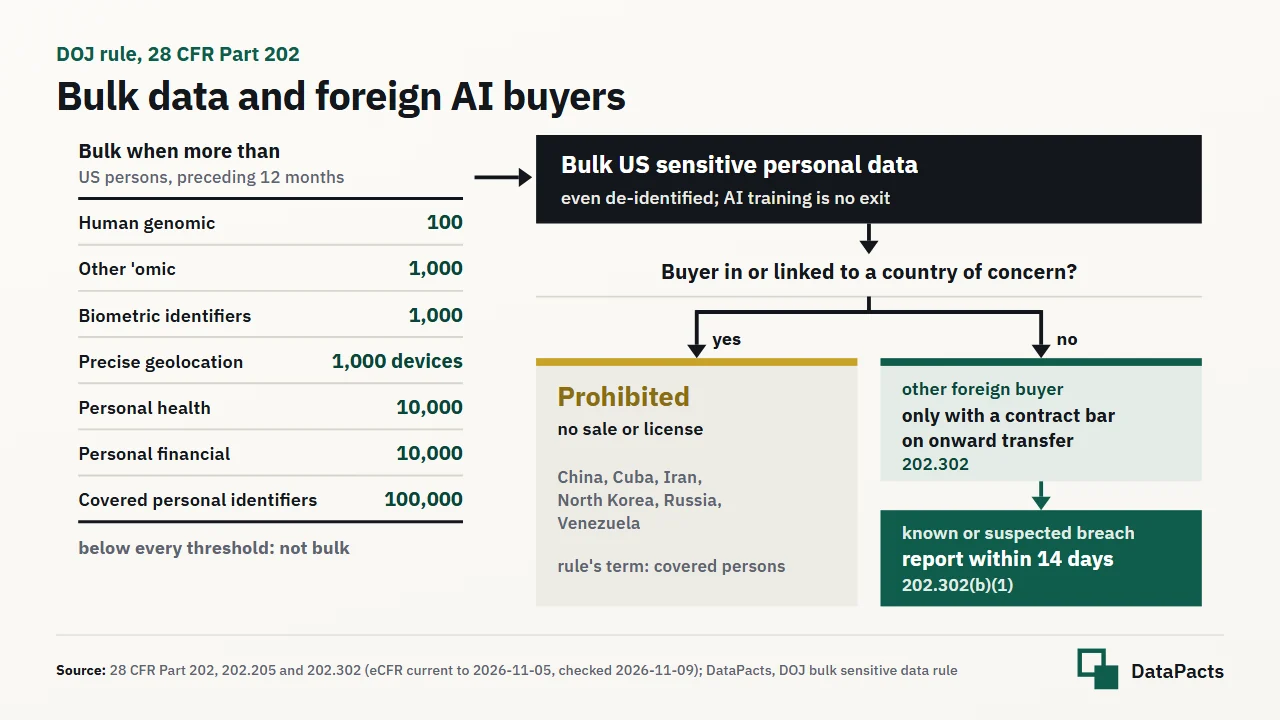
A training purpose does not change that: the rule's own example concerns an AI chatbot trained on bulk health data.
A sale to any other foreign buyer is allowed only with a contractual bar on onward transfer to those countries (202.302), as set out for AI training data licensing sellers below.
The thresholds start at more than 100 US persons for human genomic data and rise to more than 100,000 for covered personal identifiers. This page reads the rule for sellers of AI training data, status as of November 9, 2026.
DataPacts checks each rule on this page against the eCFR text and dates it; how we check every figure is explained on the methodology page.
The Rule in One Table: Citation, Dates, Countries and Duties
28 CFR Part 202 is a Department of Justice regulation in force since April 8, 2025, and the table gives its citation, dates, countries and the two duties a data seller meets first.
Table 1 compares the rule's identity, dates and seller duties, as of 2026-11-09.
| Item | Value | Section | Source |
|---|---|---|---|
| Official title | Preventing Access to U.S. Sensitive Personal Data and Government-Related Data by Countries of Concern or Covered Persons | 28 CFR Part 202 | ecfr.gov |
| Issuer and status | Department of Justice regulation; in force | Part 202 | ecfr.gov |
| Effective | 12:01 a.m. ET, 2025-04-08 | 202.216 | ecfr.gov |
| Compliance program date | 2025-10-06, for U.S. persons engaging in restricted transactions | 202.1001 | ecfr.gov |
| Countries of concern | China, Cuba, Iran, North Korea, Russia, Venezuela | Part 202 | ecfr.gov |
| Foreign buyers outside those countries | Data brokerage requires a contractual bar on onward transfer to countries of concern | 202.302 | ecfr.gov |
| Reporting | Known or suspected onward-transfer violations reported within 14 days | 202.302(b)(1) | ecfr.gov |
The sections below follow a seller's questions in order: who the buyer is linked to, how much data, and what the contract must say.
What 28 CFR Part 202 Prohibits When an AI Buyer Is Linked to a Country of Concern
A US company may not sell or license bulk US sensitive personal data to an AI buyer in or linked to a country of concern, whatever the price or the purpose (28 CFR Part 202, in force 2025-04-08).
"Linked to" is the wording used here; the rule's own term for such buyers is "covered persons", and this page does not define it. The restriction runs by data category and volume, not by whether the buyer trains AI.
The rule's own example concerns an AI chatbot trained on bulk health data, so training use is not an exit. The official title also covers US government-related data, which this page names and does not develop.
The Six Countries of Concern Named in the Rule
Six countries are countries of concern under 28 CFR Part 202, as of November 9, 2026.
- China
- Cuba
- Iran
- North Korea
- Russia
- Venezuela
The list sits in the regulation and changes only by amendment, so a seller re-checks it at signing.
Why De-identified Training Data Stays Inside the Rule
De-identifying or anonymizing a data set does not take it outside 28 CFR Part 202, because the rule covers bulk US sensitive personal data even when anonymized or de-identified.
A HIPAA de-identified health set or a CCPA-deidentified archive can therefore be cleared for a US buyer and still be barred for a buyer linked to a country of concern. The techniques and their legal effect sit on the de-identification pages, and the HIPAA page explains what HIPAA de-identification and AI training data rules clear.
Bulk Thresholds by Data Category Under Section 202.205
Data counts as bulk under section 202.205 when one category crosses its threshold, from more than 100 US persons for human genomic data to more than 100,000 for covered personal identifiers.
Table 2 compares the seven thresholds of 202.205 by data category, as of 2026-11-09 (eCFR, current to 2026-11-05, checked 2026-11-09).
| Data category | Bulk when more than | Unit, look-back | Section | Source |
|---|---|---|---|---|
| Human genomic data | 100 | US persons, any point in the preceding 12 months | 202.205(a) | ecfr.gov |
| Human 'omic data other than genomic | 1,000 | US persons, 12 months | 202.205(a) | ecfr.gov |
| Biometric identifiers | 1,000 | US persons, 12 months | 202.205(b) | ecfr.gov |
| Precise geolocation data | 1,000 | US devices, 12 months | 202.205(c) | ecfr.gov |
| Personal health data | 10,000 | US persons, 12 months | 202.205(d) | ecfr.gov |
| Personal financial data | 10,000 | US persons, 12 months | 202.205(e) | ecfr.gov |
| Covered personal identifiers | 100,000 | US persons, 12 months | 202.205(f) | ecfr.gov |
The lowest thresholds sit on genomic, other 'omic, biometric and geolocation data, so a small research or device data set can already be bulk. Genomic data as a data type has its own page on genetic and genomic data for AI training.
The 12-Month Look-Back Behind Each Threshold
Each threshold counts the US persons, or for geolocation the US devices, at any point in the preceding 12 months, so volume is measured over a year rather than per delivery.
Transactions are aggregated when they involve the same US person and the same foreign person, so a seller adds up a year of deliveries to that buyer in that category before deciding a data set is small (202.205).
Licensing to Other Foreign AI Buyers: The Onward-Transfer Clause in Section 202.302
Data brokerage with any foreign person, not only one linked to a country of concern, requires a contractual bar on onward transfer of the data to countries of concern (28 CFR 202.302).
"Data brokerage" is the rule's term, and this page records the duty rather than the definition. A license to a European, Japanese or other foreign AI buyer is therefore lawful only with that clause.
The clause belongs in the license next to the sublicensing and field-of-use terms, because a buyer that sublicenses worldwide (see the buyer statements below) must pass the bar down. The clause pages show AI data licensing agreements, clause by clause.
Reporting a Known or Suspected Onward Transfer Within 14 Days
A seller that learns of a known or suspected onward transfer in breach of that clause reports it within 14 days (28 CFR 202.302(b)(1)). The duty runs after signing, so a license needs a notice route from buyer to seller. To whom the report goes and its form are not stated here.
Effective Dates: April 8, 2025 and the October 6, 2025 Compliance Program Date
28 CFR Part 202 took effect at 12:01 a.m. Eastern Time on April 8, 2025 (202.216), and its compliance program date under 202.1001 was October 6, 2025, for U.S. persons engaging in restricted transactions (checked 2026-11-16).
Both dates are past, so every license signed today falls under the full rule. The text was checked on the eCFR on 2026-11-09, current to 2026-11-05, and what the compliance program must contain is not described here.
Where AI Data Buyers State Licensed Data Goes
Two AI data buyers state limits on where licensed company data ends up, and both statements are the buyers' own claims, checked on November 9, 2026.
Table 3 compares two buyers' own statements and contract terms on destination, in alphabetical order, as of 2026-11-09.
| Buyer | Statement on where licensed data goes | Contract terms recorded | Checked | Source |
|---|---|---|---|---|
| micro1 | Program page: data "licensed exclusively to labs and enterprises based in the U.S. and allied countries" | Data License Master Terms §1.2: non-exclusive, worldwide, royalty-free, irrevocable, perpetual, sublicensable | 2026-11-09 | micro1.ai/data-partnerships; micro1.ai/legal/data-license-master-terms |
| Replay | Sold only to frontier AI and data labs, "not to foreign adversaries or through brokers" | Only de-identified data licensed; upfront payment plus perpetual revenue share | 2026-11-09 | replay.ai; replay.ai/terms |
micro1's program page and its master terms point in different directions (US and allied countries versus a worldwide, sublicensable grant), so the written contract decides and a seller asks for the 202.302 clause in the contract itself.
Neither statement is a statement of compliance with Part 202. Replay has a Replay data buyer profile on this site, and the micro1 data buyer profile shows micro1's terms in full.
Benefits, Risks, Downsides and Alternatives for a Seller Facing a Foreign Buyer, Including Not Selling
28 CFR Part 202 leaves most foreign AI buyers open to a US seller, but it closes six countries and adds contract and reporting duties everywhere else, and licensing only to US buyers or not licensing at all remain valid choices.
Benefits
- Data below every 202.205 threshold is not bulk.
- Buyers not linked to a country of concern stay open with the 202.302 clause.
Risks
- De-identification does not clear the rule.
- A buyer's sublicensing can move data onward.
- The 14-day reporting duty applies after signing.
Downsides
- A year of volume counts toward each threshold.
- Contract work on onward-transfer terms is needed.
Alternatives
- License only to US buyers.
- License only categories below threshold.
- License to a foreign buyer whose contract carries the 202.302 bar.
- Not selling or licensing at all.
The choices are compared on the page about alternatives to selling data to AI labs, including not selling.
Beyond Part 202: Other US Rules and the Seller Process
28 CFR Part 202 is one federal layer, and the US page sets it beside copyright, sector privacy laws, trade secrets, export controls and twelve state laws.
The full set is on United States AI training data law, and the Protecting Americans' Data from Foreign Adversaries Act is a separate law that this page does not describe.
- AI training data law by jurisdiction: rules outside the US.
- Company data that cannot be licensed for AI training: every legal bar in one list.
- PII removal and de-identification before licensing data: de-identification techniques.
- Anonymization vs pseudonymization for AI training data: what anonymization achieves legally.
- Due diligence in an AI data deal: checking where the data ends up.
- Selling data to AI companies from outside the US: the other direction, non-US sellers.
- Choosing a buyer for your data: buyer selection by type.
- FTC rules on AI training data: the FTC layer.
- Privacy law and AI training data compared: privacy laws compared.
- Should you sell or license your data to AI companies: the decision before any foreign sale.
- Sell or license company data to AI companies: the steps of a sale.
- Export controls and licensing technical data to AI buyers: controlled technical data and foreign staff.
- Medical and clinical data for AI training: health data as a data type.
- China rules for licensing data for AI training: the buyer side in China.
How This Page Is Sourced and Dated
Every rule here cites 28 CFR Part 202 by section from the eCFR, checked on November 9, 2026. The methodology page explains how we source and date every rule. This page is general information about a federal regulation, not legal advice for any specific deal.
Frequently Asked Questions
Can a US company license data for AI training to a Chinese AI company?
Not with bulk US sensitive personal data. Since April 8, 2025, 28 CFR Part 202 prohibits it, even de-identified, above the 202.205 thresholds.
Does de-identifying data take it outside the DOJ bulk data rule?
No. The rule covers bulk US sensitive personal data even when anonymized or de-identified.
What counts as bulk data under the DOJ rule?
More than 100 US persons for genomic data. The other thresholds are 1,000 for other 'omic or biometric data or 1,000 devices for geolocation, 10,000 for health or financial data and 100,000 for identifiers, over 12 months.
Can a US company license data to an AI buyer in Europe or Japan?
Yes, if the license bars onward transfer to countries of concern. The seller also reports a known or suspected breach within 14 days.