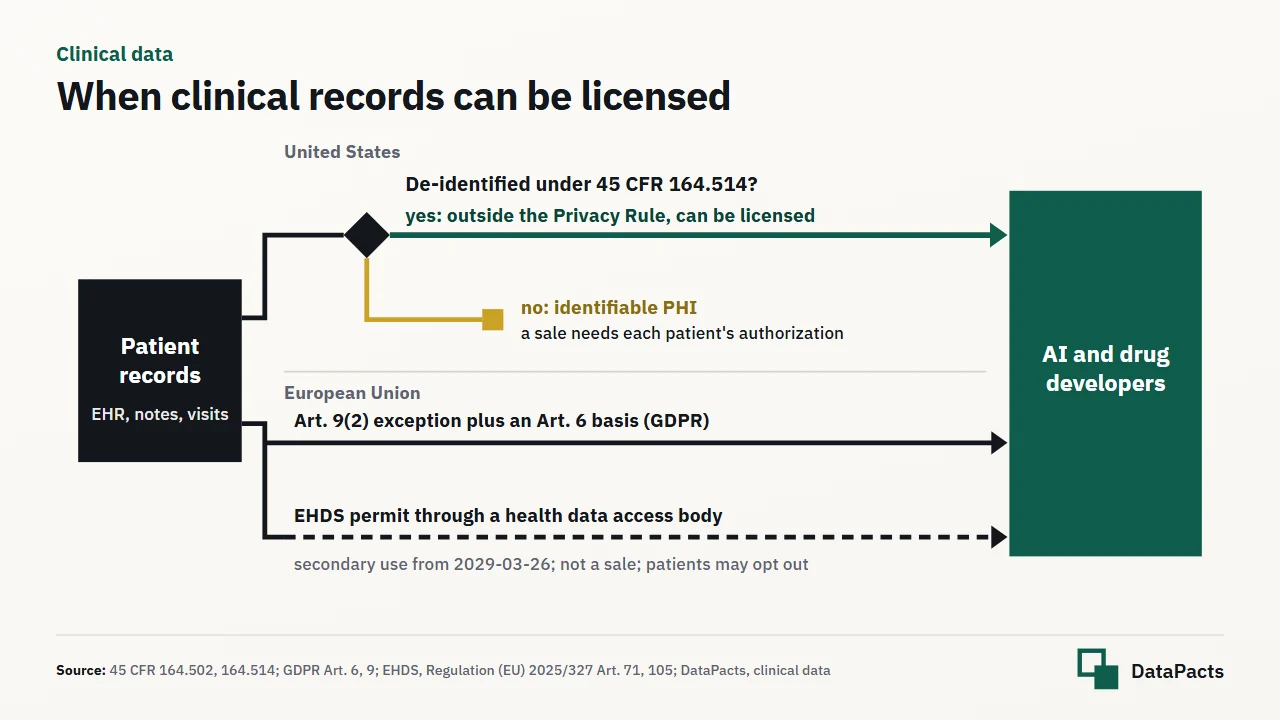
Tempus AI reports USD 200 million in data license fees over three years from one license dated April 2025 (Tempus 10-K FY2025), while HIPAA puts identifiable records outside a plain sale without each patient's authorization.
This page sets out, for clinical records in AI training data licensing, the kinds of data, who holds and acquires them, program terms, filed deals and prices, and the US and EU rules. No market price exists, and not licensing is a valid outcome.
The DataPacts Editorial Team checked the program pages, filings and rules cited here on 2026-11-09 and 2026-11-10, following how we source, date and check every figure.
What Counts as Clinical Data for AI Training
Clinical data for AI training covers six kinds of patient-level records: structured EHR fields, free-text clinical notes, diagnostic waveforms, recorded visits, multimodal disease records and exported or consumer health data.
The table compares the kinds of records, how the stating party describes each and who asks for it, as of 2026-11-10 (terms checked 2026-11-09).
| Kind of clinical data | What the stating party describes | Who asks for it (role) | Source |
|---|---|---|---|
| Structured EHR fields | visit notes, problem lists, medications, allergies, vitals and lab results in longitudinal records | Mercor (company data program); Gradient Health (intermediary) names EHR and clinical records | api.data.mercor.com; gradienthealth.io |
| Free-text clinical notes | "an EHR that holds free-text physician notes, not only structured fields"; clinical notes | Mercor; Shfa.ai (intermediary) | api.data.mercor.com; shfa.ai |
| Diagnostic waveforms | raw ECG, EEG or EMG files, not only images | Mercor imaging and diagnostics listing | api.data.mercor.com |
| Recorded visits and dictation | patient-clinician visits with consent covering secondary use, transcripts or clear audio; physician dictation speech and transcripts | Mercor digital health listing; Protege (via Shaip datasets) | api.data.mercor.com; shaip.com |
| Multimodal disease records | de-identified multimodal oncology records; 500,000 neurology records; multimodal patient-level data | Pathos AI and Bristol-Myers Squibb (licensing from Tempus); Gradient Health | Tempus 10-K, 10-Q; gradienthealth.io |
| Exported and consumer health data | EHR exports, FHIR, Apple Health | Shfa.ai | shfa.ai |
Imaging studies and genomic data are separate data types, named in the neighbors list below, and Mercor lists synthetic or sample charts as not a fit (checked 2026-11-09). The full list of data types AI companies buy shows where clinical records sit among the others.
Who Holds Clinical Data That AI Developers License
Clinical data reaches AI developers from four kinds of holders: clinical data companies that license their own de-identified records, providers and health systems, digital health companies, and dataset vendors.
Tempus AI, Inc. is a clinical data company that licenses its own records: it states more than 8.6 million de-identified patient records, over 1.6 billion clinical text pages used to train large language models and over 8 million records with imaging data (10-K FY2025, Tempus's figures, as of 2025-12-31). Its filings report licenses to Pathos AI and Bristol-Myers Squibb, set out below.
Providers and health systems hold the source records. Mercor states a size band of 10 or more clinicians or 2,500 or more patients for its medical practice listing (checked 2026-11-09). The provider's side, with routes, terms and steps, sits on the page for medical practices and healthcare providers licensing data.
Digital health companies hold recorded visits, and dataset vendors such as Shaip made de-identified EHR and physician dictation available through Protege (press release, 2025-03-04).
Epic describes models trained on de-identified Epic Cosmos data covering 118 million patients (paper v3, 2025-11-07), and Truveta states it is built with and owned by US health systems and lists AI training and validation as a use case (checked 2026-11-09).
Who Acquires Clinical Data, and Who Only Handles It
Clinical data is acquired by AI developers and drug developers that license it directly, by licensees and dataset vendors that build training sets, and is handled by intermediaries that license records on the holder's behalf.
Gradient Health, Protege and Shfa.ai handle records for holders and do not buy them.
The table lists each company's role for clinical data, alphabetical within a role, as of 2026-11-10 (terms checked 2026-11-09).
| Company | Role for clinical data | What it acquires or handles | Source |
|---|---|---|---|
| Bristol-Myers Squibb Company | drug developer, licensee under an SOW with Tempus | de-identified multimodal oncology records plus Lens access | Tempus 10-Q Q3 2026 |
| Pathos AI, Inc. | AI and drug developer, direct license from Tempus | oncology dataset for foundation model training; neurology records | Tempus 10-K, 10-Q |
| Mercor | company data program (licensee) | three health listings: medical practice, imaging center, digital health | api.data.mercor.com |
| micro1 (micro1 Inc.) | licensee | company data; PHI excluded unless the Order Form allows it (s.5.7) | micro1.ai/legal |
| BioStack (BioStack Platforms, Inc.) | dataset vendor and RL-environment builder | healthcare datasets and clinical simulation environments built from longitudinal patient records, sold to AI labs and biotech | getbiostack.com |
| HistAI (HistAI Inc.) | dataset vendor | pathology whole-slide images sold under a "full perpetual commercial license"; sourcing from hospitals not described | hist.ai |
| Gradient Health | intermediary, licenses on providers' behalf | imaging, EHR and pathology reports from hospitals, health systems and imaging centers | gradienthealth.io |
| Protege (Protege Health, Inc.) | intermediary (marketplace), licenses on providers' behalf | healthcare among its domains; Shaip datasets through its platform | withprotege.ai |
| Shfa.ai | intermediary, operator identity not confirmed | EHR exports, FHIR, clinical notes, Apple Health | shfa.ai |
How Clinical Data Programs De-identify, Pay and Keep Access
Clinical data programs differ on three points: who removes identifiers and by which method, whether pay is a fixed fee or a share of each use, and how long the acquirer keeps the data after the contract ends.
The table compares five programs by their own statements, alphabetical, as of 2026-11-10 (checked 2026-11-09 unless marked).
| Program | Who de-identifies, and how (stated) | Payment basis (stated) | After delivery or termination | Source |
|---|---|---|---|---|
| Gradient Health data partners | Gradient de-identifies: DICOM PS3.15 2023a metadata redaction, pixel scanning; its Ethics Board reviews research projects (checked 2026-11-16) | recurring revenue share each time data is used; Gradient's illustration: USD 3M x 40 % x "typical" 20 % = USD 240k | not published beyond the revenue share | gradienthealth.io/data-partners |
| Mercor Data Monetization and health listings | automated extraction and de-identification; records de-identifiable to HIPAA Safe Harbor or Expert Determination | fixed deal range per listing; wire after the anonymized dataset is delivered, "typically within 2-4 weeks of the signed agreement"; Mercor covers anonymization costs | license terms not stated on the page; "No AI lab buyer or third-party vendor ever sees your raw data" | mercor.com/data; api.data.mercor.com |
| micro1 Data License Master Terms | PHI excluded unless the Order Form allows it (s.5.7) | License Price in the Order Form (s.3) | perpetual, irrevocable, sublicensable license (s.1.2); deletion at the earlier of 120 days after delivery or termination, no duty to delete or retrain licensee materials (s.4.4) | micro1.ai/legal/data-license-master-terms |
| Protege data providers | not stated on the page | revenue share with each use; percentage not public | non-exclusive license to Protege (s.1.1); provider indemnifies (s.4.1); cap 2x fees in 12 months (s.6.2) with exclusions (s.6.3); licensee access 12 months, academic 3 years after termination (s.7.2) | withprotege.ai/provider-terms |
| Shfa.ai medical data licensing | connects in the client environment; de-identifies and red-teams; ships with evidence | "Medical facilities have been paid $300,000 to $3,000,000"; footer: "representative and potential outcomes only" (re-read 2026-11-10) | client approves every deal and sets terms | shfa.ai |
Each cell is the program's own claim as of 2026-11-09, and Gradient's USD 240k is its illustration, not a payout. Terms for these and other programs sit side by side as program terms compared, dated, across all data types.
Clinical Data Deals and Filings on Record
Almost every clinical data deal with a public value comes from one holder's filings: Tempus AI reports three licenses to drug developers in its 10-K and 10-Q.
In the 10-K FY2025, Tempus describes a license to Pathos AI of a de-identified multimodal oncology dataset "for the sole purpose of" training a foundation model. The two Q3 2026 orders, for neurology records and for oncology records, are filed in the 10-Q.
The table lists the clinical deals on record, with the value where a party has filed one, as of 2026-11-10, with the primary source for each.
| Parties | Date | What was licensed | Value on record | Source |
|---|---|---|---|---|
| Tempus AI, Inc. and Pathos AI, Inc. | 2025-04 | de-identified multimodal oncology dataset "for the sole purpose of" training a foundation model; Tempus receives a license to the model | USD 200 million in data license fees over three years, incl. USD 50 million upfront paid as of April 2025 (Tempus 10-K FY2025) | sec.gov tem-20251231 |
| Tempus AI, Inc. and Pathos AI, Inc. (Neuro Order Form) | 2026-10-22 | 500,000 de-identified neurology records, 100,000 a year over five years | up to USD 55.0 million: USD 50.0 million at USD 100 per delivered record plus USD 5.0 million for updates (Tempus 10-Q Q3 2026) | sec.gov tem-20260930 |
| Tempus AI, Inc. and Bristol-Myers Squibb Company (Onco SOW) | 2026-10-14 | de-identified multimodal oncology records plus Lens access and services | USD 137.5 million aggregate fixed payments through 2031-12-31 (Tempus 10-Q Q3 2026) | sec.gov tem-20260930 |
| Shaip and Protege | 2025-03-04 | de-identified EHR across specialties and physician dictation speech and transcripts via the Protege platform | no pricing disclosed | shaip.com press page |
Outside the Tempus filings, the figures on this page are programs' own statements.
How Clinical Data Is Priced: Per Record, Per Dataset or Revenue Share
No market price exists for clinical records; the figures on record are one filed per-record price, a few stated dataset ranges and one worked revenue-share example, each tied to its stating party.
- Per record: USD 100 per delivered neurology record in the Tempus and Pathos AI Neuro Order Form of 2026-10-22 (10-Q Q3 2026), one order and not a market price.
- Per dataset or fixed fee: Mercor states USD 80,000 to 820,000 for a medical practice, USD 80,000 to 620,000 for an imaging and diagnostics center and USD 100,000 to 900,000 for a digital health company (listings checked 2026-11-09).
- Revenue share per use: Gradient's illustration of USD 240k (checked 2026-11-09), and Protege's share with an undisclosed percentage.
HistAI's published USD 5.00 per H&E slide for 1 to 99 slides, falling to USD 2.00 at 10,000 or more (checked 2026-11-09), is a vendor's sale price to developers, not a payment to a hospital. The units do not convert, so no average is shown.
Dated price points for AI training data prices per record and other units place these figures beside other data types.
Health Privacy Rules for Clinical Data Licensing in the US and EU
US and EU health privacy rules decide whether clinical records can be licensed at all, and in what form.
United States: HIPAA in Brief, Part 2, State Health Laws and the DOJ Rule
Under HIPAA, a covered entity may license clinical data without patient authorization only once it is de-identified, because licensing identifiable PHI for a fee is a sale that needs each patient's authorization.
Covered entities may not sell PHI without authorization (45 CFR 164.502(a)(5)(ii)), the authorization must state the remuneration (164.508(a)(4)), and information de-identified under 164.514(a) and (b) is outside the Privacy Rule (164.502(d)(2); eCFR as of 2026-11-05). The rule in full is set out on the page for HIPAA and AI training data.
42 CFR Part 2 is a separate consent regime for substance use disorder records held by federally assisted programs, so HIPAA alone is not enough for those records.
Washington's My Health My Data Act (RCW 19.373, in force 2024-03-31) requires a signed valid authorization naming the buyer to sell consumer health data, including biometric data, and a violation is an unfair or deceptive act under chapter 19.86 RCW (19.373.090).
The DOJ rule, 28 CFR Part 202 (effective 2025-04-08), bars bulk US sensitive data, even anonymized or de-identified, from going to buyers in or linked to China, Cuba, Iran, North Korea, Russia or Venezuela.
The personal health data threshold is more than 10,000 US persons (202.205), and the rule's own example concerns an AI chatbot trained on bulk health data.
European Union: Article 9 Health Data and the EHDS Permit Route
In the EU, health data is a special category of personal data, so licensing it for AI training needs an Article 9(2) exception on top of an Article 6 basis (GDPR, Regulation (EU) 2016/679, applies from 2018-05-25). The exceptions are covered under special category data in AI training.
The European Health Data Space Regulation (EU) 2025/327, abbreviated EHDS, entered into force on 2025-03-25 and applies from 2027-03-26, with Chapter IV on secondary use applying from 2029-03-26 (Art. 105).
Secondary use may include training, testing and evaluation of algorithms, including AI systems (Art. 53(1)), and health data holders supply requested data to the access body within 3 months (Art. 60(2)).
Natural persons may opt out of secondary use at any time (Art. 71(1)). Access runs through health data access bodies and is never a direct sale by the holder, as set out for the European Health Data Space.
Licensing Clinical Data: Benefits, Risks, Downsides and Alternatives, Including Not Licensing
Licensing de-identified clinical records can earn from data a holder already keeps, but the holder carries re-identification and contract risk, and a delivered dataset usually stays with the acquirer.
Benefits
- Income from records already kept: Tempus's filings show license fees for a holder with records at scale.
- Recurring income: Gradient states a revenue share each time data is used (checked 2026-11-09).
- Lower preparation cost: Mercor states it covers anonymization costs (checked 2026-11-09).
Risks
- Re-identification: records not de-identified under 45 CFR 164.514 remain PHI, and selling them needs authorization.
- Foreign buyers: the DOJ rule reaches de-identified health data above 10,000 US persons.
- Indemnity: Protege's provider terms make the provider indemnify (s.4.1).
Downsides
- The dataset stays: micro1's terms grant a perpetual, irrevocable license (s.1.2) with no duty to delete licensee materials (s.4.4).
- Access after termination: Protege licensees keep access 12 months, academic users 3 years (s.7.2).
- No benchmark: the ranges are program claims, and Protege's percentage is not public.
Alternatives
- Train in-house or pool: Epic trained models on its own Cosmos data, and Truveta states it is built with and owned by US health systems.
- The EU permit route: EHDS access bodies from 2029-03-26, which is not a sale.
- A narrower de-identified subset of the records.
- Not licensing at all, a valid outcome; the page on whether to sell or license your data sets out the test.
None of these lists is advice, and the outcome depends on each holder's records, role and jurisdiction.
Neighboring Health Data Types and the Seller Steps for Clinical Records
This page covers patient-level clinical records; imaging studies, genomic data, dictated speech and clinician contributor work each have their own page.
- Medical imaging and pathology data: imaging studies and slides.
- Genetic and genomic data: genetic data and its consent rules.
- Speech and audio data: dictation and other speech.
- Biotech and life sciences labs: lab records rather than patient records.
- AI training jobs and platforms: clinician contributor work, not data licensing; DataAnnotation lists 133 roles including Medical 19 and Healthcare Ops 6 (as of 2026-11-09).
- DOJ bulk sensitive data rule: foreign buyers and the 10,000-person health threshold.
- Findata and the Secondary Use Act: Finland's aggregate-only rule for AI product development.
- AI data licensing revenue in company filings: Tempus and other filers.
The seller steps for clinical records:
- Read how to sell or license company data for the full process.
- Complete de-identification before licensing.
- Review AI data licensing agreements clause by clause.
- Check AI training data law by jurisdiction beyond the US and EU.
The rules section is information, not legal advice.
Frequently Asked Questions
How much do AI companies pay for medical data?
One filed per-record price exists: USD 100 per delivered neurology record in the Tempus and Pathos AI order of 2026-10-22 (10-Q Q3 2026). Mercor states USD 80,000 to 820,000 for a medical practice (checked 2026-11-09). No market price exists; see what company data is worth to AI companies.
Can patient data be used for AI training without consent?
Under HIPAA yes once the data is de-identified, because the Privacy Rule then no longer applies. Identifiable PHI needs an authorization stating payment. Part 2, Washington's Act, GDPR Article 9 and the EHDS opt-out follow different rules.
Which companies buy medical data for AI training?
Drug and AI developers such as Pathos AI and Bristol-Myers Squibb license clinical data from Tempus. Gradient Health, Protege and Shfa.ai handle records for holders and do not buy them. Compare who buys AI training data.
Is the European Health Data Space a way to sell health data?
No, secondary use runs through health data access bodies from 2029-03-26, with an opt-out, and is not a direct sale.