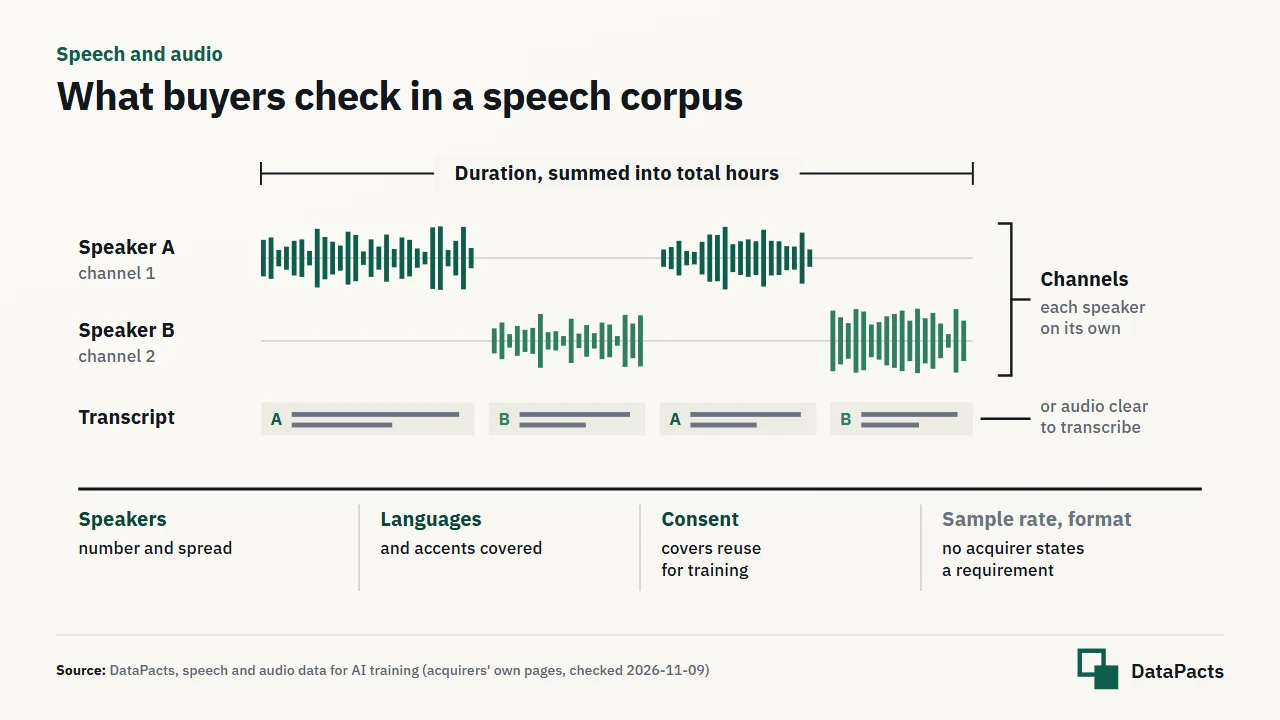
SpeechData.ai states USD 60 to 95 per hour of audio for its own datasets (checked 2026-11-09), a price paid by buyers, while no program on record publishes what it pays an organization per hour of speech. Buyers judge a corpus by hours, speakers, channels, transcripts, languages and consent.
This page covers organizations licensing recorded speech within AI training data licensing; a person's voice as a clone, call and meeting archives and music have their own pages, and not licensing is a valid outcome.
Every figure is the named party's own statement with its check date; how we source, date and check every figure describes the method.
Can You Sell Speech and Audio Recordings for AI Training?
Yes, if the seller owns the recordings or holds the rights to license them and every speaker consented to reuse for AI training; most deals license the corpus rather than sell it.
Demand is on the record: SpaceXAI LLC states in its Grok 4.7 training content summary (2026-09-21) that audio training data is "More than 1 million" hours. Free competition is large too: Common Voice Scripted Speech v27.0 is released under CC0 with 295 languages (2026-09-21).
Holders that fit include broadcasters, podcast networks, audiobook publishers and companies with dictation or interview archives, among the data types AI companies buy.
What Speech Corpora AI Developers Ask For
AI developers ask for natural conversation more than read text: two-speaker and multi-speaker conversations, multilingual and low-resource language audio, podcasts and audiobooks, wake-word and TTS recordings, and domain speech such as clinical dictation.
- Conversational speech: SpeechData.ai, David AI and Luel list it.
- Multilingual and low-resource audio: David AI (15+ languages), Luel and Sieve list it.
- Podcasts and audiobooks: Sieve lists both.
- Wake-word and TTS recordings: SpeechData.ai sells both.
- Clinical dictation: Shaip announced physician dictation speech through Protege on 2025-03-04.
- Transcriptions: Kled accepts them.
- General and niche audio: Defined.ai lists it.
Scripted read speech is not a fit for Mercor's call data listing. Companies that collect and resell speech corpora are covered as dataset vendors and data labs.
Dataset Specs Buyers Check: Hours, Speakers, Channels, Transcripts and Sample Rate
Buyers judge a speech corpus by six things: total hours, number and spread of speakers, channel layout, transcripts, language and accent coverage, and documented consent.
The table compares what acquirers state with examples on record (as of 2026-11-10; requirements checked 2026-11-09).
| Spec | What acquirers state, on their own pages | Example on record | Source |
|---|---|---|---|
| Total hours | Mercor call data listing: 1,000+ hours; publisher listing: hundreds of titles or hours | SpeechData.ai English (US): 1,500 hours; Switchboard-1 Release 2: about 260 hours | Mercor listing feed; speechdata.ai; catalog.ldc.upenn.edu |
| Speakers | not stated as a minimum | SpeechData.ai English (US): 150 speakers, catalog 7,250 native speakers; Switchboard: 543 speakers, about 2,400 conversations | speechdata.ai; catalog.ldc.upenn.edu |
| Channels | Mercor: each speaker on a separate channel | David AI: two-speaker and multi-speaker audio | Mercor listing feed; withdavid.ai |
| Transcripts | Mercor digital health listing: transcripts, or audio clear enough to transcribe, and ability to de-identify audio and text | Kled accepts transcriptions | Mercor listing feed; kled.ai |
| Languages and accents | Mercor publisher listing: multilingual content welcome | SpeechData.ai: 60 languages and dialects; Common Voice v27.0: 295 languages | speechdata.ai; mozilladatacollective.com |
| Consent | Mercor: consent that covers reuse; not a fit: recordings made without consent, scripted read speech | SpeechData.ai: every speaker signed explicit commercial-use consent | Mercor listing feed; speechdata.ai |
| Sample rate, bit depth, file format | not published by any acquirer on record | n/a | none |
No acquirer page on record publishes a sample-rate, bit-depth or file-format requirement, so the technical format is recorded per file.
A corpus is described before it is shared, with hours, speakers, languages, channels and consent basis in a data manifest describing a dataset.
Who Acquires Speech, and Who Only Distributes or Handles It
Speech reaches AI developers through five kinds of organizations: vendors selling their own corpora, distributors licensing corpora from providers, data labs licensing archives, marketplaces and intermediaries licensing on the holder's behalf, and contributor apps paying individuals per recording.
The table lists the organizations on record by role, alphabetical within a role (as of 2026-11-10; checked 2026-11-09).
| Organization | Role for speech | What it acquires, distributes or handles | Source |
|---|---|---|---|
| David AI (David AI Labs, Inc.) | vendor selling its own datasets; no data-holder program | two-speaker, multi-speaker, multilingual (15+ languages) and expert conversations | withdavid.ai |
| DataOcean AI | vendor; no attribute stated | n/a | none |
| SpeechData.ai | vendor selling its own datasets; no contributor program | conversational, TTS, wake-word and call-centre speech | speechdata.ai |
| Gengo-Shigen-Kyokai (GSK) | distributor of language resources | speech data, lexicons, text corpora | gsk.or.jp |
| Linguistic Data Consortium | distributor of licensed corpora; submissions portal for providers | speech, text and lexical corpora | ldc.upenn.edu |
| Sieve, Inc. | data lab licensing archives | podcasts, audiobooks, multilingual recordings among other content | sieve.ai |
| Defined.ai (DefinedCrowd Corporation) | marketplace and supplier program | audio among image, video and text datasets | defined.ai |
| Mozilla Data Collective | platform where providers set price and license | datasets from organizations, speech and language among them | mozilladatacollective.com |
| PIXTA AI (PIXTA Inc.) | marketplace listing third-party datasets | audio among computer vision, healthcare and OCR data | pixta.ai |
| Protege (Protege Health, Inc.) | intermediary, licenses on providers' behalf | audio and speech among health, video and spatial data | withprotege.ai |
| Kled AI (Nitrility, Inc.) | contributor app, licenses uploads | transcriptions, music, photos, video | kled.ai |
| Luel (Luel Inc.) | contributor tasks and dataset marketplace | conversational and low-resource language audio | luel.ai |
SpeechData.ai and David AI sell their own datasets and run no holder program. LDC and GSK distribute corpora to members and non-members.
Protege, Mozilla Data Collective, PIXTA AI and the Defined.ai marketplace handle or list datasets for holders; AI training data marketplaces compares their fees, eligibility and payouts.
Speech Licensing Terms by Program: Pay, Ownership and Exclusivity
Speech programs differ most on three terms: how the holder is paid, whether the holder keeps ownership and can license elsewhere, and what the licensee keeps after the deal ends.
The table compares each program's own stated terms (as of 2026-11-10; every value checked 2026-11-09).
| Program | Pay (stated) | Ownership, scope and exclusivity | After termination or deletion | Source |
|---|---|---|---|---|
| Defined.ai Data Partners and Supplier Program | licensing fees from marketplace sales; no revenue share percentage; claims USD 600K+ average partner revenue | no exclusivity, no minimums (Supplier GT&C s.3.5) | FAQ says "perpetual", data license agreement s.8(a) says "until terminated"; both stated | defined.ai |
| GSK language resource distribution | provider compensation not stated; buyers pay JPY 33,000 per resource (non-members) | buyers may not sell, lend or distribute to third parties | not stated | gsk.or.jp |
| Kled data contributor app | rewards in fiat at company discretion or third-party tokens, no guaranteed value | transferable, sublicensable, worldwide, perpetual, irrevocable license, exclusive for training third-party AI models | company may, but need not, delete on account deletion | kled.ai |
| LDC membership and licensing | provider pay not stated; buyers pay membership fees | for-profit members keep commercial rights to data acquired during membership | perpetual rights to data licensed in membership years | ldc.upenn.edu |
| Luel contributor tasks | USD 12 per hour (American English three-person conversations); USD 7.50 per hour (partner audio, five low-resource languages); payouts "processed daily" | not stated on contribute or marketplace pages | not stated | luel.ai |
| Mozilla Data Collective Compensated Datasets | "Own your data and keep 100% of revenue"; platform fee not stated | provider sets price and license | set by the provider | mozilladatacollective.com |
| PIXTA AI data provider listing | PIXTA charges sellers listing and referral fees, rates not published | buyer and seller contract directly; samples may not be used as training data (Art. 2.1) | not stated | pixta.ai/term |
| Protege data providers | revenue share with each use; percentage not public | worldwide, royalty-free, non-exclusive license to Protege (s.1.1); provider indemnifies (s.4.1) | licensees keep access 12 months after termination, academic licensees 3 years (s.7.2) | withprotege.ai/provider-terms |
| Sieve partners | "Checks them, then pays"; no amount or timing | "You keep ownership"; scope in Sieve's agreement | not published | sieve.ai/partners |
Kled's license is exclusive and perpetual for training third-party models, while Protege's is non-exclusive but leaves licensees access for 12 months after termination; the program terms compared, dated page sets them next to other data types.
What Speech Data Sells For, and What Holders Are Paid
No program publishes what it pays an organization per hour of speech; the public figures are what vendors and distributors charge buyers and what contributor apps pay individual speakers.
Each figure is the stating party's own claim (checked 2026-11-09), in its own unit and never converted.
- SpeechData.ai states USD 60 to 95 per hour of audio, with English (US) at USD 90 per hour; this is a sale price to buyers.
- LDC states for-profit membership of USD 34,000 (Standard) or USD 40,000 (Subscription), checked 2026-11-09; the year is not labeled.
- GSK states JPY 33,000 per resource for non-members.
- Luel states USD 12 per hour and USD 7.50 per hour (checked 2026-11-09) for contributor tasks, which is individual speaker pay.
- Defined.ai claims USD 600K+ average partner revenue (checked 2026-11-09), a marketing figure rather than a rate.
A sale price is not holder pay, and SpeechData.ai does not disclose speaker pay; the units differ, so no average exists. Other media sit in AI training data prices per hour.
Speech Deals, Filings and Training Summaries on Record
Few speech licenses publish terms: the records are one healthcare data deal, one company filing and one developer's AI Act training summary.
The table lists dated records that mention speech or audio (as of 2026-11-10).
| Record | Date | What it shows for speech | Value on record | Source |
|---|---|---|---|---|
| Shaip and Protege | 2025-03-04 | Shaip datasets, including physician dictation speech and transcripts, de-identified, offered through the Protege platform | no pricing disclosed | shaip.com (Shaip's announcement) |
| CuriosityStream Inc. 10-K FY2025 | filed 2026-03-12 | "hundreds of thousands of hours of video and audio" delivered to technology companies for AI training | content licensing revenue USD 33.233 million (2025) vs USD 7.798 million (2024), AI not split out | sec.gov |
| Grok 4.7 public summary of training content (SpaceXAI LLC) | 2026-09-21 | audio training data "More than 1 million" hours; commercial licenses declared for text and image only | n/a | media.x.ai |
| AI Act training summary template | GPAI obligations from 2025-08-02 | licensed datasets disclosed only as Yes/No per modality, audio included (Section 2.2.1) | n/a | ec.europa.eu |
| Common Voice Scripted Speech v27.0 | 2026-09-21 | open corpus, CC0, a little over 42,593 hours, 295 languages; Spontaneous Speech v5.0: 302 validated hours, 80 languages | free | mozilladatacollective.com |
The Grok 4.7 summary never presents its audio as licensed, and CuriosityStream's filing does not split AI training out of its revenue.
Under Article 53 of Regulation (EU) 2024/1689, general-purpose model providers publish a training summary whose template asks only Yes or No per modality, so the AI Act training data summary reveals audio use without any price or counterparty.
Clearing Recorded Speech Before You License It
Clearing speech means confirming speaker consent, biometric exposure and ownership before any file is shared.
Speaker Consent That Covers Reuse for Training
Every identifiable speaker needs to have agreed to reuse of the recording for AI training, not only to being recorded. Mercor states that its call data listing requires consent that covers reuse (checked 2026-11-09).
Consent to record differs from consent to train, and the call and meeting recording consent rules vary by jurisdiction.
Voiceprints, Children's Voices and Biometric Rules
A recording becomes biometric data when it is used to identify a speaker, and some laws then require a written release or bar selling it. This section is information, not legal advice.
The Illinois Biometric Information Privacy Act, 740 ILCS 14/15(b), requires written notice and a written release before collecting voice templates, and 15(c) bars selling or profiting from them; damages are USD 1,000 (negligent) or USD 5,000 (intentional or reckless) as of 2026-11-10, and P.A. 103-0769 (effective 2024-08-02) makes repeated collection from one person by one method a single violation.
In In re Otter.AI Privacy Litigation (N.D. Cal. 5:25-cv-06911-EKL, filed 2025-08), plaintiffs allege that conversations and voiceprints were used to train speech-recognition models; that is an allegation, not a finding.
GDPR Article 9(1) treats biometric data used to identify a person as special-category data, needing an Article 9(2) exception plus an Article 6 basis (applies from 2018-05-25). Texas CUBI as amended by HB 149 (in force 2026-01-01) exempts biometric identifiers used to train AI unless the system uniquely identifies a specific individual.
Under the COPPA Rule as amended in 2025 (effective 2025-06-23, compliance date 2026-04-22), a child's voice is personal information and disclosure to train AI needs separate verifiable parental consent under 312.5(a)(2). Illinois law is covered in detail under Illinois BIPA and AI training data.
Who Owns a Podcast, Broadcast or Archive Recording
A seller can license only recordings it owns or holds licensing rights to; guests, hosts, commissioned producers and music in a recording can each hold separate rights.
Music beds are a separate right from the speech on top of them. A rights audit of the recordings records who made each file and under what releases.
Licensing Speech Data: Benefits, Risks, Downsides and Alternatives, Including Not Licensing
Licensing a speech archive can earn from recordings that already exist, but consent gaps travel with the data and a model trained on it cannot be untrained.
Benefits
- Demand for conversational and low-resource audio is stated by David AI and Luel.
- Non-exclusive routes exist: Defined.ai's Supplier Program has no exclusivity and Protege's license is non-exclusive.
- Distributors and marketplaces handle buyers, and Mozilla Data Collective lets providers set price and license.
Risks
- Biometric and recording claims such as BIPA attach to speech that identifies speakers.
- Protege licensees keep access for 12 months after termination.
- Kled's perpetual, irrevocable, exclusive license for training third-party models cannot be withdrawn on its terms.
Downsides
- No published holder rate means the first price is a negotiation without a benchmark.
- Open corpora such as Common Voice are free under CC0.
- Preparation takes work: consent records, transcripts, de-identification.
Alternatives
- List the corpus on a marketplace where the provider sets its own price, as Mozilla Data Collective states.
- License a sample or subset first, which limits exposure.
- Release the corpus openly.
- Decide whether to sell or license data at all, because not licensing is a valid outcome.
Speech Next to Voice Clones, Calls, Meetings, Music and Recording Work
This page covers recorded speech licensed as a corpus; a person licensing their own voice as a clone, call-center and meeting archives, music, and paid recording work each have their own page.
A person's voice as a clone is a matter of identity and likeness, which selling your voice to AI covers; this page deals with many-speaker corpora held by organizations. Alignerr lists voice and audio data among its contributor work (checked 2026-11-09).
- Call recordings and sales calls: call-center and sales call archives
- Meeting recordings and transcripts: recorded meetings and their transcripts
- Licensing music for AI training: catalogs, labels and publishers
- Music as AI training data: music as a data type
- Multilingual and low-resource language data: language coverage beyond speech
- Mozilla Common Voice: the open speech corpus
- Biometric data in AI training: voiceprints under biometric law
- In re Otter.AI Privacy Litigation: the voiceprint training case
- AI training jobs and platforms: paid recording and rating work
For a holder who proceeds, the steps run as follows.
- Read the seller guide on how to sell or license company data.
- Prove corpus quality with samples and clean rooms.
- Run de-identification before licensing on transcripts and audio.
- Negotiate the AI data licensing agreements.
- Agree when AI data buyers pay: upfront, milestones or revenue share.
Frequently Asked Questions
How much is speech data worth per hour?
No program publishes a holder rate per hour of speech. SpeechData.ai's USD 60 to 95 per audio hour is a sale price to buyers (checked 2026-11-09), not holder pay. See what company data is worth to AI companies.
Can I license my podcast archive to AI companies?
Yes, if the holder owns the rights and guests agreed to reuse. Sieve lists podcasts and states that partners keep ownership (checked 2026-11-09).
What sample rate and format do speech datasets need?
No acquirer page on record publishes a sample-rate, bit-depth or file-format requirement (checked 2026-11-09). Technical format is recorded per file and the buyer's spec sheet or signed license governs.
Do AI buyers want exclusive rights to speech recordings?
Terms are mixed. Defined.ai and Protege state non-exclusive terms, Kled's license is exclusive and perpetual for training third-party models, and Sieve does not publish scope (checked 2026-11-09). See exclusive vs non-exclusive data licenses.