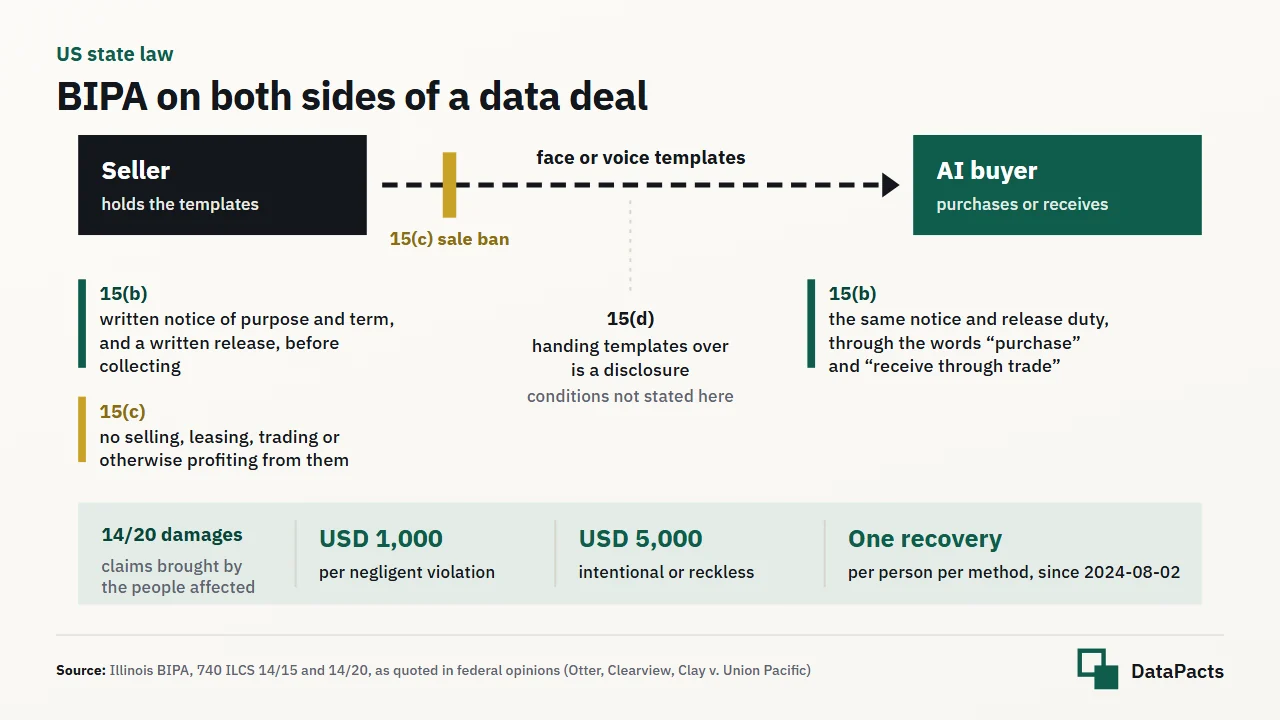
This page covers one statute, its 2024 amendment and five court records, with status as of 2026-11-09. The seller meets the release duty in 15(b) and the sale ban in 15(c), the buyer meets 15(b) through the words "purchase" and "receive through trade", and damages have counted people instead of scans since 2024-08-02. Illinois rules in AI training data licensing beyond BIPA are not covered here.
BIPA Provisions That Decide a Training Data Deal
Five parts of BIPA decide whether a training data deal can include biometric data, and the table gives each one's section, rule and the record it rests on, as of 2026-11-09.
| Section | Rule | What it means in a training data deal | Record it rests on | Source |
|---|---|---|---|---|
| 740 ILCS 14/15(b) | No collecting, capturing, purchasing or receiving through trade without written notice of purpose and term and a written release | The seller needs releases; the buyer acquiring templates needs them too | In re Otter.AI order, N.D. Cal. (quotes the section) | ilga.gov; govinfo.gov |
| 14/15(c) | No selling, leasing, trading or otherwise profiting from biometric identifiers or information | A license fee for templates falls under the ban | In re Clearview AI order, N.D. Ill. | ilga.gov; govinfo.gov |
| 14/15(d) | Disclosure rule (conditions not stated here) | Handing templates to a buyer is a disclosure | Clay v. Union Pacific, 7th Cir. (the amendment counts 15(d) violations) | ilga.gov; ca7.uscourts.gov |
| 14/20 | Liquidated damages USD 1,000 negligent, USD 5,000 intentional or reckless; since 2024-08-02 one violation per person per method (20(b), (c)) | Exposure is counted by people, not scans | Clay v. Union Pacific, 7th Cir., 2026-04-01 | ilga.gov; ca7.uscourts.gov |
| Contractor exemption (section number not stated) | Exemption read as work "in the course of" a government contract | Narrow; Payton's railroad contracts did not qualify | Payton v. Union Pacific, 7th Cir., 2026-09-30 | ca7.uscourts.gov |
The official text at ilga.gov could not be opened on 2026-11-09 or 2026-11-10, so each rule is cited through the federal opinion that quotes it, and the official page stays the reference.
Which Training Data BIPA Reaches: Face and Voice Templates
BIPA reaches training data that contains biometric identifiers or biometric information, such as the face geometry and voiceprints that facial recognition and speech models learn from.
Three court records show the range. Scraped face images for a facial recognition database led to the Clearview litigation, a face dataset built from Flickr photos led to Vance v.
IBM, and meeting voiceprints alleged to train speech models are part of the Otter case. This page says "face or voice templates", as those records do. The statutory definitions and any carve-out for photos or recordings are not stated here.
A photo, video or call archive is not automatically outside BIPA, so the holder checks whether templates were extracted or will be extracted by the buyer. Voice deals, payouts and likeness terms sit elsewhere, in the guide to selling your voice to AI.
Written Notice and Release Before Collecting or Buying Templates: Section 15(b)
Section 15(b) bars any private entity from collecting, capturing, purchasing or otherwise obtaining a person's biometric identifier or biometric information through trade unless it first gives written notice and obtains a written release.
As quoted in the Otter order (N.D. Cal. 5:25-cv-06911-EKL), the entity must give:
- written notice that the data is being collected or stored;
- written notice of the specific purpose and length of term;
- a written release from the person.
The words "purchase" and "receive through trade" put the AI buyer under the same duty, so a buyer asks for the releases and a seller without them has nothing it can hand over.
Staff timeclock data is the common case: Payton involved fingerprint scans of truck drivers. Whether the release may be electronic is not stated here. Notice to staff before internal data is licensed is covered in employee notice and consent when licensing internal communications.
The Section 15(c) Ban on Selling or Profiting From Biometric Data
Section 15(c) prohibits a private entity in possession of a biometric identifier or biometric information from selling, leasing, trading or otherwise profiting from it, as the federal court in the Clearview litigation described the provision.
A license fee for face or voice templates is a sale, lease or profit on its face. Whether a written release under 15(b) also permits a sale is not stated in the records read for this page and is not answered here.
Disclosure is a separate rule, 15(d), which the 2024 amendment counts as its own kind of violation, and its conditions are not stated here.
The practical result for a holder is to keep templates out of the licensed set, or to remove faces and voices before delivery. Data that cannot be licensed at all is listed in company data that cannot be licensed for AI training.
How a Buyer's License Terms Treat Biometric Identifiers
Buyers write the same caution into their contracts: micro1's Data License Master Terms exclude biometric identifiers unless the Order Form allows them (s.5.7, micro1's own terms, checked 2026-11-09).
Among other categories listed on the live page (checked 2026-11-10), section 5.7 excludes:
- protected health information;
- biometric identifiers;
- payment card or financial account data;
- data of children under 18;
- export-controlled information.
A seller reads the exclusion as a warranty it gives to the buyer. The exclusion clause and its indemnity are explained with the other clauses in AI data licensing agreements.
Damages After the 2024 Amendment: One Recovery per Person
BIPA sets liquidated damages of USD 1,000 per negligent violation and USD 5,000 per intentional or reckless violation (740 ILCS 14/20, as stated by the Seventh Circuit on 2026-04-01), and since August 2, 2024 collecting or disclosing one person's data again and again by the same method counts as a single violation with one recovery (740 ILCS 14/20(b) and (c), Public Act 103-0769).
Section 15 and 20(a) were not changed, so the duties stay the same and only the count changes. The table gives three scenarios for one collection method, as of 2026-11-09.
| Scenario | Rule | Maximum liquidated damages | Source |
|---|---|---|---|
| 1 person, negligent, one method, any number of scans | One violation, one recovery (20(b)) | USD 1,000 | ca7.uscourts.gov |
| 1 person, intentional or reckless, one method | One violation, one recovery | USD 5,000 | ca7.uscourts.gov |
| 1,000 people, negligent, one method | One recovery per person | USD 1,000,000 (1,000 x USD 1,000, derived) | ca7.uscourts.gov |
Illustration, not a prediction of any award; attorneys' fees and other relief are not shown.
In the third row, repeated scans of the same 1,000 people no longer multiply the total. People whose data was taken sue directly, as the class actions in the court-record table show.
Retroactivity: Clay v. Union Pacific (Seventh Circuit, April 2026)
The Seventh Circuit held on April 1, 2026 that the 2024 amendment is remedial and applies to cases pending when it took effect, so one recovery per person per method governs older suits too (Clay v. Union Pacific Railroad Co., Nos. 25-2185, 25-2761, 25-2762).
The appeal was consolidated with Willis v. Universal Intermodal Services and Gregg v. Central Transport, and the court reversed and remanded. The court is a federal appeals court, and this page makes no statement about Illinois state courts.
BIPA Court Records on Face, Voice and Damages, as of November 2026
Five court records apply BIPA to face or voice data or to the 2024 damages rule, and only the two Seventh Circuit appeals of 2026 and the Clearview appeal are decided as of 2026-11-09.
| Date | Court and docket | Matter | Outcome as stated in the record | Source | Status |
|---|---|---|---|---|---|
| 2026-09-30 | 7th Cir. No. 26-1946 | Payton v. Union Pacific Railroad Co. | Fingerprint scans of truck drivers 2013 to 2021; contractor exemption's "when working" read as "in the course of"; the railroad's contracts with Illinois and Metra were unrelated to intermodal freight; affirmed | ca7.uscourts.gov | Decided |
| 2026-08-13 (claims filed 2025-08) | N.D. Cal. 5:25-cv-06911-EKL | In re Otter.AI Privacy Litigation | Plaintiffs from California, Illinois and Washington allege voiceprints and conversations used to train speech models; BIPA 15(a) and (b) among the claims (allegation) | govinfo.gov | Pending |
| 2026-07-13 / 2025-03-20 | N.D. Ill. 1:21-cv-00135; 7th Cir. No. 25-1673 | Clearview AI Biometric Privacy Cases (In re Clearview AI, Inc. Consumer Privacy Litigation) | BIPA claims over scraped face images for a facial recognition database; equity-stake settlement approved 2025-03-20; approval vacated and remanded 2026-07-13 (Doc. 69) | courtlistener.com (Doc. 42); copy of the stamped opinion (Doc. 69) | Remanded |
| 2026-04-01 | 7th Cir. Nos. 25-2185, 25-2761, 25-2762 | Clay v. Union Pacific Railroad Co. (consolidated) | 2024 amendment remedial, applies to pending cases; one recovery per person per method; reversed and remanded | ca7.uscourts.gov | Decided |
| 2020-09-15 | N.D. Ill. 1:20-cv-00577 | Vance v. International Business Machines Corp. | BIPA 15(a) to (e) over the Diversity in Faces dataset from Flickr YFCC100M photos; Count Seven dismissed, the 15(a) count dismissed for lack of jurisdiction, motion denied on the rest; later status not checked | govinfo.gov | Later status not checked |
Statuses come from the dockets and change with each filing. Case names are captions only.
Vance is the only record about a training dataset as such: the 2020-09-15 order kept most counts over the Diversity in Faces set.
The Clearview settlement was approved on 2025-03-20 as an equity-stake settlement that the district court called "novel in the context of past BIPA settlements", and the Seventh Circuit vacated the approval on 2026-07-13 and remanded (No. 25-1673, Doc. 69).
The full record is on the tracker of AI lawsuits over training data, with rulings and settlements.
Benefits, Risks, Downsides and Alternatives for a Holder of Illinois Biometric Data, Including Not Selling
BIPA does not stop a company from licensing data that holds no face or voice templates, but templates bring a release duty, a sale ban and per-person damages, and licensing without them or not licensing at all remain valid choices.
Benefits
- Since 2024-08-02, exposure counts per person and method, not per scan.
- The rule applies to cases pending when it took effect (Clay, 2026-04-01).
- A set without templates falls outside the statute's object.
Risks
- Liquidated damages accrue per person, USD 1,000 or USD 5,000 (as of 2026-04-01).
- People whose data was taken bring class actions.
- A buyer's exclusion warranty is breached if templates are delivered.
Downsides
- Releases must exist before collection.
- A sale or profit on templates is barred by 15(c).
- Stripping faces and voices costs effort and removes value from the set.
Alternatives
- License the set with templates removed.
- License only non-biometric data such as text or documents.
- Wait for the remanded Clearview proceedings; their result is not predicted here.
- Do not sell or license at all. Other alternatives to selling data to AI labs are compared on their own page.
Beyond Illinois: Other States, Federal Rules and the Seller Process
Illinois is one state layer under federal law, and several other states treat biometric data differently. The United States AI training data law page compares Illinois with eleven other states.
Texas exempts biometric identifiers used to train AI unless the system uniquely identifies a specific individual (HB 149, in force 2026-01-01). Washington requires consent before selling biometric identifiers but leaves enforcement to the Attorney General and excludes photos and recordings (RCW 19.375).
A federal rule bars licensing biometric identifiers of more than 1,000 US persons to buyers linked to six countries of concern (28 CFR 202.205, from 2025-04-08).
- AI training data law by jurisdiction: the overview outside the US.
- California: CCPA/CPRA and AB 2013: the neighboring state rules on sale and recordings.
- DOJ bulk sensitive data rule: biometric thresholds for foreign buyers.
- Texas TRAIGA's AI-training biometric exemption: the Texas training exemption.
- Washington biometric law: consent before a biometric sale.
- Biometric data in AI training: BIPA beside GDPR Article 9.
- Voice and likeness rights in AI training data: likeness rights beyond biometrics.
- Call and meeting recording consent rules: recording consent for voice archives.
- Privacy law and AI training data compared: sensitive-data rules compared.
- PII removal and de-identification before licensing data: removing faces and voices before delivery.
- Should you sell or license your data to AI companies: the decision before any sale.
- Sell or license company data to AI companies: the steps of a sale.
How This Page Is Sourced and Dated
Every rule here cites 740 ILCS 14 by section and the court opinion that quotes it, with the date it was checked. The methodology page explains how we source, date and check every figure. This page is general information about Illinois law, not legal advice for any specific deal.
Frequently Asked Questions
Does BIPA apply to data used to train AI?
Yes, whenever the training set holds biometric identifiers or biometric information of people protected by BIPA, such as face geometry or voiceprints. Scraping face images and building a face dataset have both led to BIPA suits.
What does BIPA require before biometric data is collected or bought?
Written notice of collection, of the purpose and of the length of term, plus a written release, before anyone collects, buys or receives the data through trade (15(b)). Selling or profiting from the data is barred (15(c)).
What did the 2024 BIPA amendment change?
Since August 2, 2024, repeated collection or disclosure from one person by the same method is one violation with one recovery. The Seventh Circuit applied the rule to pending cases on April 1, 2026.
Which BIPA settlement involves AI training data?
The Clearview settlement over scraped face images. It was approved in 2025 and vacated on appeal on July 13, 2026; consumer settlements over photo tagging or app filters are not about training data and are not covered here.