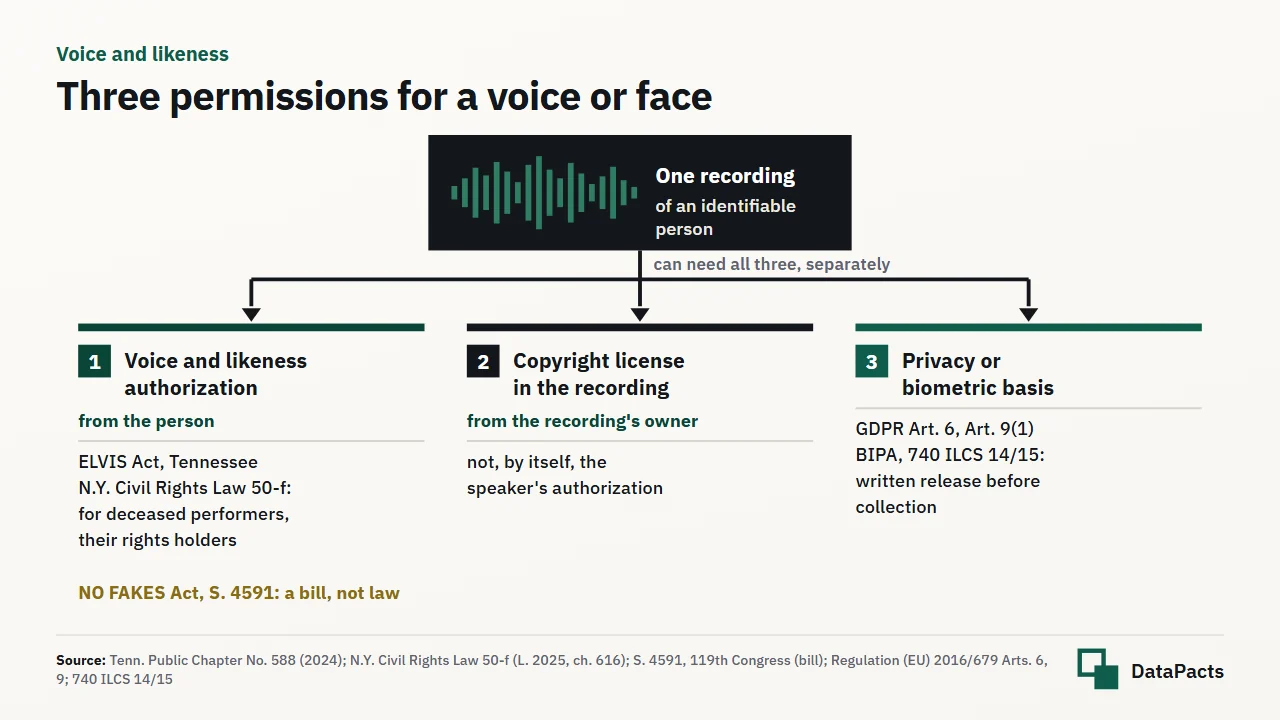
Tennessee's ELVIS Act has applied since 2024-07-01, New York's Civil Rights Law 50-f covers deceased performers' digital replicas since 2025-12-11, and the federal NO FAKES Act of 2026 (S. 4591) is a bill that was reported on 2026-06-24 and has had no later action as of 2026-11-09.
The page covers nine jurisdictions, six with a verified instrument, for holders of voice, image and video archives and for developers acquiring them. A license from the owner of a recording is not automatically the speaker's authorization, which makes these rules a separate layer of AI training data licensing.
Each rule below is checked against the statute, bill print or court docket and dated, following how we source, date and check every figure.
Three Permissions a Voice or Face in a Training Dataset Can Need
A recording or image of an identifiable person can need three separate permissions before it is licensed for training: the person's authorization under voice and likeness law, a license of any copyright in the recording, and a lawful basis under privacy or biometric law.
The right of publicity is the control a person has over the commercial use of their identity, and statutes now extend it to voice and to digital replicas (Tenn. Public Chapter No. 588 (2024); N.Y. Civil Rights Law 50-f as amended by L. 2025, ch. 616).
Neither statute names AI training. Tennessee's tool rule and the written-license model of the NO FAKES bill still reach a dataset that is licensed to build a model producing a particular person's voice, because the use, not the label, triggers the rule.
The copyright layer is separate: the owner of a recording may license the recording and still lack the speaker's authorization, which is why copyright and AI training across jurisdictions is a different question.
Voices can also be personal data under GDPR Art. 6, and voiceprints used to identify a person are biometric data under GDPR Art. 9(1) and 740 ILCS 14/15.
Voice and Likeness Rules in Nine Jurisdictions
The table sets nine jurisdictions side by side with the instrument, its status and date, what it protects, what it means for a voice or likeness license and the source, as of 2026-11-09. "Not stated" means no primary source was checked for this page, not that the jurisdiction has no rule.
| Jurisdiction | Citation | What it protects | Status and date | Meaning for a voice or likeness license | Source | As of |
|---|---|---|---|---|---|---|
| Tennessee | ELVIS Act, Tenn. Pub. Ch. 588 (2024), HB 2091 / SB 2096, amending Tenn. Code Ann. 47-25-1101 et seq. and 39-14-152 | voice as a protected attribute; tools whose primary purpose is producing a particular identifiable individual's voice or likeness | in force 2024-07-01 (s.13) | licensing a named person's voice for cloning needs authorization | publications.tnsosfiles.com | 2026-11-09 |
| New York | Civ. Rights Law 50-f as amended by L. 2025, ch. 616; GBL 396-b (ch. 617) | deceased performers' digital replicas in audiovisual works, sound recordings and live musical performance; 396-b: synthetic performers in ads | 50-f effective 2025-12-11; 396-b in force 2026-06-09 | replica uses of deceased performers need rights holders' consent; 396-b is output-side | nysenate.gov | 2026-11-09 |
| United States (federal) | NO FAKES Act of 2026, S. 4591, 119th Congress | would create a federal voice and visual likeness right | bill; reported 2026-06-24, Calendar No. 446 | would require written, use-specific licenses, maximum 10 years (5 for minors) | congress.gov; govinfo.gov | 2026-11-09 |
| Illinois | BIPA, 740 ILCS 14/15(b), (c) | voiceprints and face geometry as biometric identifiers (not a publicity statute) | in force; enactment year not stated | written notice and release before collection; selling or profiting barred | govinfo.gov (court orders quoting the act) | 2026-11-09 |
| California | not stated | not stated | not stated | not stated | n/a | 2026-11-09 |
| European Union | Regulation (EU) 2016/679, Arts. 6, 6(4), 9 | voices and images of identifiable people as personal data; biometric data for unique identification | applies from 2018-05-25 | Art. 6 basis and reuse test; Art. 9(2) exception for biometric processing | eur-lex.europa.eu | 2026-11-09 |
| Cyprus | Law 59/1976 as amended by Law 29(I)/2026, s.50 | deepfake imitations of personal physical characteristics | latest amending law 29(I)/2026 | not stated (provision text not recorded) | cylaw.org | 2026-11-09 |
| Denmark | bill L 49, Folketing 2026-27 (1. samling) | deepfakes of performances and personal physical traits (bill title) | bill; dates not stated | none until enacted | ft.dk | 2026-11-09 |
| United Kingdom | not stated | not stated | not stated | not stated | n/a | 2026-11-09 |
Tennessee's ELVIS Act: Voice as a Protected Attribute Since July 1, 2024
Tennessee's Ensuring Likeness, Voice, and Image Security Act of 2024 (Public Chapter No. 588) makes a person's voice a protected attribute beside name, image and likeness, and has applied since July 1, 2024.
HB 2091 passed on 2024-03-07, the act amends Tenn. Code Ann. 47-25-1101 et seq. and 39-14-152, and section 13 sets the effective date.
The act also reaches tools: distributing a tool whose primary purpose is producing a particular identifiable individual's voice or likeness without authorization creates liability.
For a data holder the consequence is direct, because a dataset sold or licensed to build a clone of a named person's voice needs that person's authorization. The act does not name AI training, and the remedies and penalty amounts are not stated on this page.
New York: Digital Replicas of Deceased Performers Under Civil Rights Law 50-f
New York amended Civil Rights Law 50-f on December 11, 2025 (L. 2025, ch. 616, S8391 / A8882) so that knowing unauthorized use of a deceased performer's digital replica in audiovisual works, sound recordings or live musical performances creates liability, effective immediately.
The amendment removes the disclaimer safe harbor and adds streaming services to the advertising-medium exemption. An archive of a deceased performer's voice or image therefore needs the rights holders' consent before any replica use, as set out on the page for New York's AI training data rules.
A second act, General Business Law 396-b (L. 2025, ch. 617), has been in force since 2026-06-09. It requires advertisers with actual knowledge to disclose a synthetic performer conspicuously, with civil penalties of USD 1,000 for a first violation and USD 5,000 for each later one, as of 2026-11-09. It governs advertisements, not training data. Rules for living performers' replicas are not stated here.
California and Other States Without a Verified Rule Here
California has a page in this reference, but no voice, likeness or digital-replica statute for it has been checked against an official text yet, so its row says "not stated".
The same holds for every state outside the table. Illinois appears only for voiceprints under BIPA, which protects biometric identifiers rather than the commercial value of a name, voice or image.
The NO FAKES Act of 2026: A Federal Likeness Right Still Pending in the Senate
The NO FAKES Act of 2026 (S. 4591) is a bill, not law: introduced on May 20, 2026, it was reported by the Senate Judiciary Committee and placed on the Senate calendar on June 24, 2026, with no later action as of November 9, 2026.
It would create a federal voice and visual likeness right licensed in writing for defined uses, and 15 senators are listed as cosponsors. The bill sits beside the other proposals on the page for federal AI training data bills.
The table compares the introduced text (S. 4591 IS, 2026-05-20) with the reported substitute (S. 4591 RS, 2026-06-24), as of 2026-11-09. It describes bill text, not law.
| Provision | Introduced text (S. 4591 IS, 2026-05-20) | Reported substitute (S. 4591 RS, 2026-06-24) | Source |
|---|---|---|---|
| Status | introduced and referred to the Senate Judiciary Committee; 13 original cosponsors | ordered reported 2026-06-18; reported 2026-06-24, Calendar No. 446; 15 cosponsors; no later action | api.congress.gov (actions, cosponsors) |
| Right created | federal voice and visual likeness right | kept | govinfo.gov |
| License form | written, use-specific | kept | govinfo.gov |
| License term, living person | maximum 10 years | kept | govinfo.gov |
| License term, minor | maximum 5 years | kept | govinfo.gov |
| Post-mortem term | 10 years, renewable in 5-year periods, maximum 70 years | kept | govinfo.gov |
| Online-service damages | USD 5,000 per display, copy or transmission, maximum USD 750,000 per work, for providers without good-faith compliance | kept | govinfo.gov |
| Preemption | Sec. 2(g)(1) preempts state claims on digital replicas in expressive works; (g)(2) saves state causes of action existing on 2025-01-02 and state statutes on sexually explicit or election-related replicas | kept; takes effect 180 days after enactment | govinfo.gov |
On preemption, section 2(g)(2) would except state causes of action in existence on January 2, 2025 regarding digital replicas or products and services capable of producing them.
That date falls after the ELVIS Act took effect, so the bill text would keep earlier state statutes in play, though no outcome is certain while the bill is pending. The Copyright Office published Part 1 of its AI report, on digital replicas, on 2024-07-31.
Outside the US: Personal Data, Deepfake Imitations and Open Rows
Outside the US, a recorded voice or a photo of an identifiable person is personal data under the GDPR, and some EU member states are adding rules against deepfake imitations of personal features.
Regulation (EU) 2016/679 applies from 2018-05-25; every disclosure of personal data to an AI buyer needs an Art. 6 basis and, for reuse, the Art. 6(4) compatibility test, and Art. 9(1) prohibits processing biometric data for uniquely identifying a person unless an Art. 9(2) exception applies.
The page on GDPR legal basis, notices and transfers for AI training data covers the basis for disclosing voices and images.
Cyprus Law 59/1976 was last amended by Law 29(I)/2026, which inserts section 50 on deepfake imitations of personal physical characteristics; the provision text is not recorded here.
Denmark's bill L 49 in the Folketing session 2026-27 would amend the Copyright Act on deepfakes of performances and personal physical traits, and only its title and status are stated here.
For the United Kingdom and every other country, no voice or likeness rule has been checked against a primary source for this page, so those rows say "not stated".
What the Court Record Shows on Voice Cloning Claims
Voice actors sued Lovo, Inc. in the Southern District of New York (No. 1:24-cv-03770-JPO, complaint filed May 16, 2024), alleging that their recorded voices were used to create and sell AI voice clones, with New York right of publicity, consumer protection, contract, trademark and copyright claims.
A renewed motion to dismiss was fully briefed on October 31, 2025 (Dkt. 57), and later rulings were not checked as of November 9, 2026. The outcome is not stated here, and the case record is kept on the page for Lehrman v. Lovo, voice actors v. an AI voice company.
Likeness and Voice Terms in Buyer Contracts and Music Deals
Buyers and licensors that publish terms on voice and likeness either require documented consent, shift publicity claims to the seller, or exclude likenesses altogether. The table lists six terms, each the stating party's own claim with its date, newest first, as of 2026-11-09.
| Party | Instrument | Voice or likeness term | Date | Source |
|---|---|---|---|---|
| micro1 | Data License Master Terms s.8.1 | licensor indemnifies IP, privacy, publicity and data protection claims arising from the data | updated 2026-11-08; checked 2026-11-09 | micro1.ai/legal |
| Labelbox (Prism) | Prism home page, data categories (checked 2026-11-16) | "consented likeness and voice" listed as data wanted; likeness and voice need explicit timestamped consent | checked 2026-11-09 | prism.labelbox.com |
| ElevenLabs | Voice Library documentation | Professional Voice Clones only; owner sets a notice period of 30 days to 2 years; users keep access for the notice period after sharing stops | checked 2026-11-09 | elevenlabs.io |
| Universal Music Group and ElevenLabs | multi-year licensing agreement | personalised vocals from participating artists; value not disclosed | 2026-09-10 | universalmusic.com |
| The Walt Disney Company and OpenAI | three-year character license | excludes talent likenesses and voices; subject to definitive agreements | 2025-12-11 | thewaltdisneycompany.com |
| Suno and Warner Music Group | licensing agreement | opt-in for artist names, likeness, voices and compositions; value not disclosed | 2025-11-25 | suno.com |
The practical reading for a holder is to keep documented, timestamped consent for each person whose voice or face is in the data, to read the indemnity before signing, and to carve out likenesses where consent is missing. Licensing one's own voice has its own page on selling your voice to AI.
Licensing Voice or Likeness Data: Benefits, Risks, Downsides and Alternatives, Including Not Licensing
A company can license recordings or images of people for training where each person's authorization covers the use, but voice and likeness rules add conditions, and not licensing remains a valid outcome.
Benefits of licensing voice or likeness data:
- Consented likeness and voice is a stated data category for Labelbox Prism (checked 2026-11-09).
- Opt-in music deals, such as Suno and Warner Music Group (2025-11-25) and Universal Music Group and ElevenLabs (2026-09-10), show a route built on artist consent.
- Consent records also serve GDPR Art. 6 and BIPA written releases.
Risks of licensing voice or likeness data:
- Tennessee's tool rule creates liability for distributing a tool made to produce a particular person's voice or likeness without authorization.
- New York's Civil Rights Law 50-f creates liability for knowing unauthorized replicas of deceased performers.
- A seller may carry a publicity indemnity, as in micro1's master terms s.8.1.
Downsides of licensing voice or likeness data:
- Per-person consent and re-consent take time and records.
- If the NO FAKES bill became law, living-person licenses would be capped at 10 years.
Alternatives to licensing voice or likeness data:
- License only the material where authorization is documented.
- Exclude identifiable voices and faces, as the Disney and OpenAI license does for talent.
- License de-identified transcripts instead of audio.
- Do not license at all.
The decision to license or not is covered in should you sell or license your data to AI companies.
Beyond Voice and Likeness Rules: Related Law, Data and Seller Pages
Each related law, data type and seller step has its own page.
- AI training data law by jurisdiction: copyright, privacy, employee and contract rules beside voice and likeness
- United States AI training data law: federal and state layers
- EU rules for AI training data: the other EU instruments
- Call and meeting recording consent rules: consent to record a voice in the first place
- Privacy law and AI training data: personal data in voice and image archives
- Illinois BIPA and AI training data: voiceprints and face geometry in Illinois
- Customer consent and confidentiality clauses: consent records before licensing
- AI data licensing agreements: where the publicity indemnity sits
- License clause matrix: indemnity clauses compared
- Individuals selling their own data: people licensing their own recordings
- Biometric data in AI training: voiceprints as biometric data
- Selling speech and audio data: speech corpora
- ElevenLabs data buyer profile: the voice developer in the contract table
- Labelbox Prism data buyer profile: the buyer that asks for timestamped consent
- Musicians, labels and publishers licensing music: artist voices in music deals
- US Copyright Office report on generative AI training: the Office's AI reports
What This Page Does Not Cover
This page covers voice and likeness rights in data licensed for AI training, not disputes over outputs that AI generates, impersonation scams or whether AI output can be copyrighted. Election and sexually explicit deepfake statutes appear only where the NO FAKES text saves them.
How This Page Is Sourced and Dated
Every rule cites the statute, bill print or court docket, with the date it was checked. The method is described in how we source, date and check every figure. This page is general information about voice and likeness law, not legal advice for any specific dataset or deal.
Frequently Asked Questions
What is the ELVIS Act?
The ELVIS Act is Tennessee's Ensuring Likeness, Voice, and Image Security Act of 2024 (Public Chapter No. 588), in effect since 2024-07-01. It protects voice as an attribute and creates liability for tools made to reproduce a particular person's voice or likeness without authorization.
Is the NO FAKES Act law?
No, the NO FAKES Act of 2026 (S. 4591) is a bill. The Senate Judiciary Committee reported it on 2026-06-24, and no later action is recorded as of 2026-11-09.
Does the right of publicity apply to AI training data?
It applies to uses of a voice or likeness, and neither the ELVIS Act nor New York's Civil Rights Law 50-f names training. Tennessee's tool rule and New York's replica rule can still reach a dataset licensed to produce a specific person's voice or replica.
Do you need someone's authorization to license their voice for AI training?
Yes, where the use clones a named person's voice, Tennessee law requires that person's authorization. Labelbox Prism states that likeness and voice need explicit timestamped consent (checked 2026-11-09).