A staff post of the US Federal Trade Commission dated February 13, 2024 says it may be unfair or deceptive to adopt more permissive data practices through a surreptitious, retroactive change to terms.
Under the California CCPA (statute version effective January 1, 2026), licensing personal information for money is a sale that consumers may opt out of.
Re-papering customer terms works forward only, and customers who refuse or stay silent are left out of the license. Customer permission is the gate in AI training data licensing that the seller does not control alone, and not licensing customer data is a valid outcome.
The DataPacts Editorial Team explains how we source, date and check every figure. Vendor and buyer terms below are checked November 9, 2026 unless another date is shown.
What Customer Terms Decide Before Company Data Is Licensed for AI Training
Customer terms decide three things for each dataset: whether the company may use the data beyond the service, whether it may disclose the data to a third party, and whether it must tell or ask the people concerned first.
No public figure exists for how many business customer contracts restrict licensing data for AI. One public signal is on the buyer side: Mercor states that customer data restricted by customer contracts is not a fit for its manufacturing and industrial listing (checked November 9, 2026).
Four Places Customer Restrictions Sit
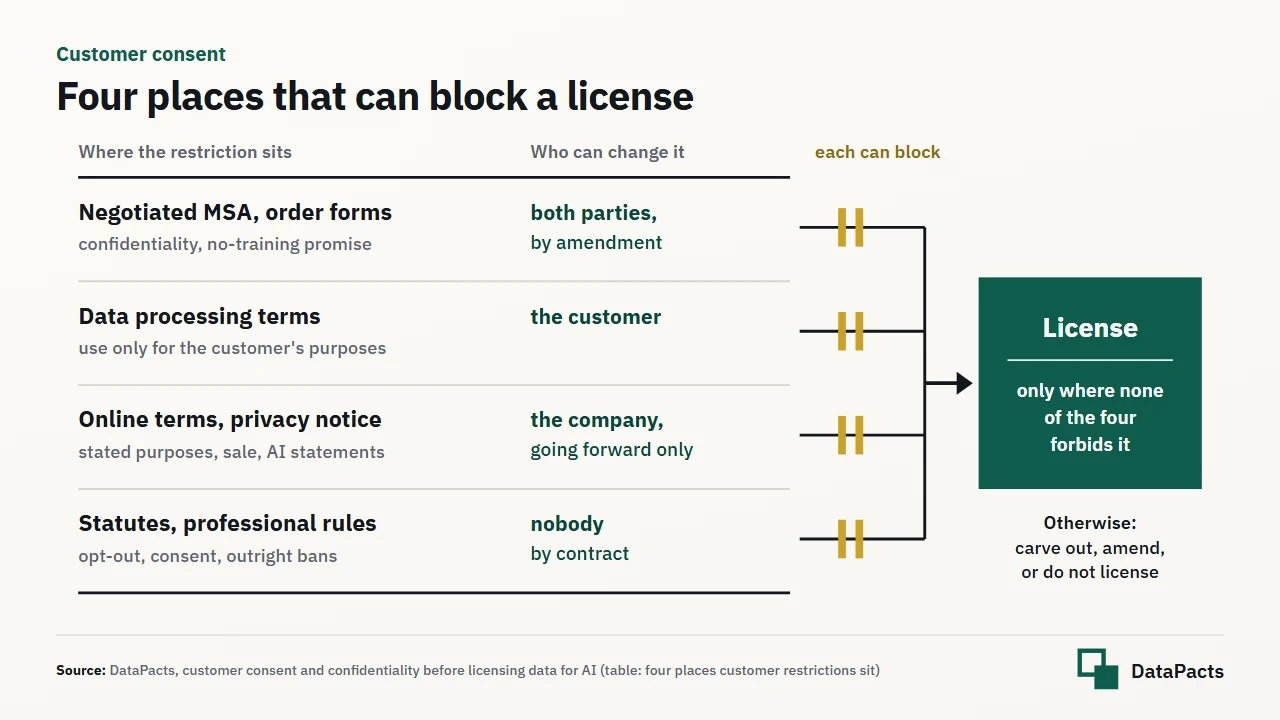
Customer restrictions sit in four places, and a dataset can be licensed only when none of them forbids it. The table shows who can change each one (as of November 10, 2026).
| Place | What it can say about AI training or disclosure | Who can change it | Evidence to collect | Source |
|---|---|---|---|---|
| Negotiated MSA and order forms | confidentiality, use limited to the services, an explicit no-training promise | both parties by amendment | signed contracts and amendments per customer | company records |
| Data processing terms (DPA) | processing only for the customer's purposes | the customer | DPA version per customer | company records |
| Online terms and privacy notice | stated purposes, sale and sharing statements, AI-training statements | the company, prospectively | every version with its date | ftc.gov; cga.ct.gov |
| Statutes and professional rules | sale opt-out, consent, outright bans | nobody by contract | regulated-data map | cppa.ca.gov; le.utah.gov; federalregister.gov; sra.org.uk; ecfr.gov |
Ownership of the data is a separate question from permission to license it. Whether the company owns the data is settled in the rights audit of the data you want to license, and this page starts where that audit ends.
Customer Contract Clauses That Restrict a Data License
Three kinds of clause in customer contracts restrict licensing most often: confidentiality, data processing terms and use restrictions.
Confidentiality Clauses and Customers' Confidential Information
A confidentiality clause bars disclosure of the customer's confidential information to third parties, and delivering a dataset to an AI buyer is a disclosure whatever the price or purpose.
The law backs the clause: under the Defend Trade Secrets Act (18 U.S.C. 1839(5), in force since May 11, 2016), misappropriation includes disclosure by a person who acquired a secret under a duty to keep it.
Some duties come from professional rules or statute. Rule 6.3 of the SRA Code of Conduct for Firms keeps client affairs confidential unless the law requires or permits disclosure or the client consents, and 26 CFR 301.7216-3(a) allows disclosure of tax return information only with written, knowing and voluntary consent, which conditioning a service on consent defeats.
The seller's own protection is NDAs before sharing data with an AI buyer, a different duty from the one owed to customers.
Data Processing Terms When the Company Holds Data for Its Customers
Where a company processes data on its customers' behalf, as most SaaS and outsourcing providers do, the data processing terms usually limit use to the customer's instructions, so the data is not the provider's to license.
Buyers draw the same line. Mercor states that its cybersecurity listing takes customer data only with customer agreement, and that customer data the company cannot share is not a fit. Its AI product listing asks for user terms that allow licensing de-identified usage data, or a way to get consent (both checked November 9, 2026).
Use Restrictions and No-Training Commitments in Customer Terms
Many software vendors now state in their customer terms whether customer data trains AI, and the wording falls into four patterns: a ban, opt-in consent, a default with opt-out, and terms that differ by plan. The table lists eight vendors alphabetically, each from its own page, as of November 9, 2026.
| Vendor | Pattern | What the terms or page state | Date shown | Source |
|---|---|---|---|---|
| Atlassian | default by plan, opt-out | data contribution in effect August 17, 2026; in-app contribution on for Free and Standard, off for Premium and Enterprise, all plans can opt out; metadata opt-out only on Enterprise | 2026-08-17 | atlassian.com/trust/ai/data-contribution |
| Figma | default with opt-out | content training from August 15, 2024; on for Starter and Professional, off and not toggleable for Organization and Enterprise | 2024-08-15 | help.figma.com |
| GitHub Copilot | default with opt-out | training on Free, Pro and Pro+ interaction data effective April 24, 2026, announced March 25, 2026; opt-out in settings | 2026-03-25 | github.blog |
| Google Workspace | permission | no training on customer data without the customer's prior permission or instruction (Training Restriction, Service Specific Terms) | page updated 2026-10-26 | knowledge.workspace.google.com |
| Microsoft 365 Copilot | ban (foundation models) | prompts, responses and Microsoft Graph data not used to train foundation LLMs | page updated 2026-11-04 | learn.microsoft.com |
| Slack | opt-in | no generative AI training on Customer Data without affirmative opt-in consent | checked 2026-11-09 | slack.com/trust |
| Truckstop | consent clause in MSA | Main Services Agreement s.11 bars inputting Truckstop Data into AI functions without consent | last updated 2026-09-15 | truckstop.com/terms-conditions |
| Zoom | ban | ToS s.10.2: communications-like Customer Content not used to train Zoom or third-party AI models | effective 2023-08-11 | zoom.com/en/trust/terms |
These terms cover the vendor's own model training; licensing to an outside buyer is a further disclosure the same customers have not been asked about. The full list of platform terms is under user data and platform terms when services train on their users.
Notice or Consent: What Each Rule Requires Before Customer Data Is Licensed
Notice tells customers before their data is used for a new purpose, an opt-out lets them refuse, and consent requires them to agree first; which one applies depends on the law, the data and the promise made at collection. The table sets seven regimes side by side as of November 9, 2026.
| Regime | Requirement before licensing | Applies to | Date | Source |
|---|---|---|---|---|
| CCPA, Cal. Civ. Code 1798.120 | opt-out: licensing personal information for money is a sale, and consumers may opt out; the business-to-business contact and employee exemptions are inoperative since 2023-01-01 (1798.145(m)(4), (n)(3)) | covered businesses (revenue threshold in 1798.140(d)) | statute version 2026-01-01 | cppa.ca.gov |
| Connecticut CTDPA, P.A. 25-113 | notice: the privacy notice must say whether personal data is collected, used or sold to train large language models | covered controllers | from 2026-07-01 | cga.ct.gov |
| Utah UCPA, Utah Code 13-61-302 | notice and opt-out, including for sensitive data | covered controllers | effective 2023-12-31 | le.utah.gov |
| Maryland MODPA | ban: no sale of sensitive data, and no sale of personal data of a consumer the controller knew or should have known is under 18 (14-4707(a)(5)) | covered controllers | effective 2025-10-01 | mgaleg.maryland.gov |
| COPPA Rule (16 CFR 312) | separate parental consent for disclosures to train AI (90 FR 16950) | operators collecting children's data | effective 2025-06-23; compliance 2026-04-22 | federalregister.gov |
| GDPR Art. 13(3), Art. 6(4) | notice before further processing for another purpose; a compatibility test with factors (a) to (e) | controllers of EU personal data | applies from 2018-05-25 | eur-lex.europa.eu |
| FTC Act s.5 (15 U.S.C. 45) | a retroactive, surreptitious change to allow AI training may be unfair or deceptive (staff post, not a Commission rule) | businesses under FTC jurisdiction | staff post 2024-02-13 | ftc.gov |
A contract can require more than any of these rules. Other countries are compared under privacy law and AI training data by jurisdiction.
What Buyers Ask Sellers to Show About Customer Consent
Buyers publish customer-consent conditions in their listings and terms, and the seller then confirms them in warranties backed by an indemnity. The table lists the conditions alphabetically by program as of November 9, 2026, and every value is the program's own statement.
| Program or listing | Role | Customer-consent condition | Checked | Source |
|---|---|---|---|---|
| Mercor listing: AI Product Company | buyer | user terms that allow licensing de-identified usage data, or a way to get consent | 2026-11-09 | api.data.mercor.com listings |
| Mercor listing: Call Center or BPO | buyer | recorded calls with consent that covers reuse | 2026-11-09 | api.data.mercor.com listings |
| Mercor listing: Cybersecurity Company | buyer | customer data only with customer agreement; not a fit: customer data the company can't share | 2026-11-09 | api.data.mercor.com listings |
| Mercor listing: Digital Health Company | buyer | consent that covers secondary use | 2026-11-09 | api.data.mercor.com listings |
| Mercor listing: Law Firm | buyer | client consent, or documents that can be fully anonymized | 2026-11-09 | api.data.mercor.com listings |
| Mercor listing: Manufacturing and Industrial Company | buyer | not a fit: data restricted by customer contracts | 2026-11-09 | api.data.mercor.com listings |
| micro1 Data License Master Terms | buyer | licensor indemnifies privacy and data protection claims (s.8.1); licensor keeps consent and release records at least 7 years after the agreement ends | updated 2026-11-08; checked 2026-11-09 | micro1.ai/legal |
| PIXTA AI provider terms | data vendor (listing) | consent of the individuals and written consent records where personal information is included (Art. 6.6) | 2026-11-09 | pixta.ai/term |
The warranty itself sits among the representations on rights and consent in an AI data licensing agreement.
Re-papering Customer Terms Before a License
Re-papering changes customer terms so that a future license is allowed, and it works forward: data collected under the old promise stays under the old promise.
- Sort customers by paper: negotiated MSA and order forms, DPAs, online terms and privacy notice versions.
- Mark the clauses that bar disclosure, limit use to the service or promise no AI training.
- Decide the route per group: rely on current terms, a new notice with opt-out going forward, or written consent or amendment.
- Send the change before any data collected under it is licensed, and keep the old version.
- Record each consent or refusal and keep the records.
- Exclude customers who refuse or do not answer.
The FTC staff post of February 13, 2024 (under 15 U.S.C. 45) says that it may be unfair or deceptive for a company to adopt more permissive data practices through a surreptitious, retroactive amendment to terms or a privacy policy. In FTC v.
Toysmart.com (D. Mass. 00-11341-RGS), the settlement conditions the FTC summarized in 2015 included affirmative consent for material changes.
Buyers expect records (micro1's master terms require the licensor to keep consent records at least 7 years after the agreement ends, checked November 10, 2026); the agency's approach is covered under FTC rules on AI training data and privacy policy changes.
Unlawfully obtained data can cost more than the license. An FTC staff post of January 9, 2024 notes that earlier orders required deleting products, including models and algorithms, developed with such data, and the Everalbum settlement of May 7, 2021 (FTC File No. 192-3172) requires deletion of the models and algorithms built from users' photos and videos. No public figure exists for how many customers answer an opt-in request.
Options When Customer Terms Do Not Allow a License
A customer restriction that cannot be lifted removes that customer's data from the license; it does not lower the price of the rest.
- Carve out the customer or the dataset that the contract protects.
- License only data from customers who consented.
- De-identify where the contract itself allows de-identified use and the law treats the result as outside personal data (CCPA 1798.140(m) sets reasonable measures, a public commitment not to reidentify and contractual obligations on recipients).
- Ask the customer for a written amendment.
- Do not license that data.
De-identification does not lift a confidentiality clause unless the clause says so. Methods and standards are covered under PII removal and de-identification before licensing.
Licensing Customer Data: Benefits, Risks, Downsides and Alternatives
Customer data is often the most useful data a company holds and the most restricted, so licensing it carries benefits and risks that last beyond the payment.
Benefits
- Customer data can match what buyer listings ask for, such as consented call data.
- A documented consent process answers buyers' diligence questions.
Risks
- A disclosure that breaches a confidentiality clause exposes the company to the customer and, for trade secrets, to the statute.
- Restricted data that a buyer discovers is turned away, as Mercor states for data restricted by customer contracts.
- A licensor indemnity, as in micro1's master terms, puts privacy claims on the seller.
Downsides
- Re-papering takes effort and cannot reach data already collected under the old promise.
- Customers who refuse or stay silent shrink the licensed set.
Alternatives
- License only data that is not customer data.
- Share aggregate or de-identified outputs where the contract allows.
- Do not license customer data at all.
The full decision is set out on should you sell or license your data.
Where Customer Consent Sits in the Process to Sell or License Company Data
Customer consent is step 4 of the seller process: it follows the rights audit and comes before de-identification, valuation and the manifest. The sequence to sell or license company data to AI companies runs as follows.
- Data sale readiness
- Data inventory for an AI data sale
- Rights audit
- Customer consent (this page); staff messages follow their own rules under employee notice and consent
- Anonymization vs pseudonymization
- How much company data is worth
- The data manifest
- Due diligence in an AI data deal
The Law Behind Customer Consent, and What This Page Is Not
Customer consent questions are answered by contract law first and privacy law second, and the law of the customer's location can apply as well as the company's. See AI training data law by jurisdiction, with GDPR and AI training data for legal basis and compatibility and California CCPA rules for thresholds and enforcement.
Notices before a sale are covered under GDPR notices before a data sale, and the state and children's rules under Connecticut CTDPA and AI training data and COPPA and children's data in AI training. This page is general information, not legal advice.
Customer Data Sold Out of a Bankruptcy Estate
In a US bankruptcy the privacy policy keeps binding: personally identifiable information may be sold only consistently with it, or after a consumer privacy ombudsman and court findings (11 U.S.C. 363(b)(1)). The court process is covered in US bankruptcy data sales under section 363(b)(1).
Customer Records That Stay Out Whatever the Contract Says
Some customer records cannot be licensed even with a permissive contract, because a statute bars it or requires a form of consent the contract cannot supply.
Maryland bans the sale of sensitive data and the COPPA Rule requires separate parental consent, and the full list is under company data that cannot be licensed for AI training; support records are treated under selling customer support tickets and chats.
Pages Cited on This Page
The vendor and buyer terms above come from their own pages, each checked November 9, 2026 unless another date is shown.
- Atlassian, Figma, GitHub, Google Workspace, Microsoft, PIXTA AI, Slack, Truckstop, Zoom
- Who buys AI training data
- Mercor data buyer profile
- micro1 (data license master terms)
- License clause matrix
- AI data partnership program terms compared
- Indemnities and warranties in AI data licenses
Frequently Asked Questions
Is it legal to sell customer data for AI training?
It is legal only where the customer contracts, the privacy notice given at collection and the privacy law that applies all allow it; under the CCPA a license of personal information for money is a sale that customers may opt out of.
Do you need customer consent to license their data for AI training?
Not always: some regimes require only notice or an opt-out, while children's data, some sensitive data and many negotiated contracts require consent first.
Does a confidentiality clause stop a company licensing data for AI?
Usually yes for the customer's confidential information, because handing it to a buyer is a disclosure to a third party, unless the customer agrees in writing.