The one support-specific license figure on record is Corpus Bridge's illustrative draft for 96,000 Zendesk tickets from 2015 to 2025, three years, non-exclusive, at USD 64,200 (checked November 9, 2026).
This page sets out, within AI training data licensing, what counts as support data, why buyers ask for it, what raises its value, and who asks. The customers in those conversations make the company answerable for their data, so the page also covers who controls the conversations, what notices say, redaction, and not licensing.
The DataPacts Editorial Team explains how we source, date and check every figure.
What Counts as Customer Support Data
This page covers five kinds of customer-facing support records: help-desk tickets, support email threads, live-chat transcripts, chatbot and AI-agent transcripts, and help-center articles.
The table shows what each kind holds and which programs name it, as of November 10, 2026 (program wording checked November 9, 2026).
| Family | Systems named by programs or documentation | What one record holds | Programs that name it (examples) | Source |
|---|---|---|---|---|
| Help-desk tickets | Zendesk, Intercom, "ticketing" | request, replies, internal notes, status, tags, attachments | Corpus Bridge, Scale AI, Turing | corpusbridge.com; scale.com; lazarus.turing.com |
| Support email threads | "support threads" | a customer email and the replies, with headers and signatures | Turing (artifact price), Sell Business Data | turing.com/blog; sellmybusinessdata.com |
| Live-chat and messaging transcripts | Intercom | turn-by-turn messages, timestamps, agent and customer identifiers | Turing | lazarus.turing.com; intercom.com/help |
| Chatbot and AI-agent transcripts | session logs | prompts, responses and tool calls with the customer | Mercor AI product listing | api.data.mercor.com |
| Help-center articles and knowledge bases | "knowledge bases" | the written answers support teams publish or reuse | micro1 | micro1.ai |
Engineering and internal IT tickets are a different family, covered under issue trackers, project histories and IT service-desk tickets. Staff chat and voice calls have their own pages too. Only records with a customer on the other side belong here.
Why AI Buyers Ask for Support Conversations
AI buyers ask for support conversations because each is a real, multi-turn dialogue that runs from a customer's problem to a resolution.
Labelbox Prism states that it wants "longitudinal customer support logs", micro1 states that it wants "customer support tickets and knowledge bases", and Turing states "support (Zendesk, Intercom)" among the systems it wants (all checked November 9, 2026).
A closed ticket holds the customer's question, the agent's replies, internal notes and a final status, so one record carries both the problem and the path to its end. That describes the record, not any buyer's stated reason.
Internal team chat is a different record: it has no customer and no outcome field, and it is covered under selling chat messages from Slack and Teams.
What Raises the Value of a Support Archive
A support archive gains value with its years of history, its links to the systems that resolved each case, its language, and how completely the export keeps each conversation; programs state inputs, not a formula.
The table lists each input as the program or vendor states it, as of November 10, 2026 (statements checked November 9, 2026).
| Value factor | What programs or documentation state | Stated by | Source |
|---|---|---|---|
| Length of history | illustrative draft covers tickets 2015 to 2025; price depends on years of history; 3+ years of operational workflows | Corpus Bridge, AfterQuery, Nyne | corpusbridge.com; afterquery.com; nyne.ai |
| Volume | 96,000 tickets in the illustrative draft; data volume | Corpus Bridge, Centific | corpusbridge.com; centific.com |
| Connected systems | number of connected systems; number of connected applications; "Connecting more tools generally results in a higher payout"; "support desk in daily use" | AfterQuery, Centific, Mercor | afterquery.com; centific.com; mercor.com/data; api.data.mercor.com |
| Language | "primarily in English"; English records sell best | micro1, Turing | micro1.ai; lazarus.turing.com |
| Rarity | how hard the data would be to recreate; availability of comparable data | AfterQuery, Centific | afterquery.com; centific.com |
| Export completeness | Zendesk: export tools only on named plans, enabled by the account owner via Zendesk Customer Support; XML capped at 500 MB (about 200,000 tickets); JSON omits comments when a ticket exceeds 1 MB. Intercom: dataset CSV has no conversation or message content; API export covers 90 days per request | Zendesk and Intercom documentation | support.zendesk.com; intercom.com/help |
An export without comments or message bodies loses the dialogue that buyers name, because the replies are the resolution path. This is reasoning about the record, not a price effect any program states.
Both documented limits bear on how complete a delivered archive can be, and neither sets a price.
What a Support Archive Is Worth: One Illustrative License, No Per-Ticket Rate
No program publishes a price per support ticket or chat; the one support-specific figure is an illustrative draft license, and every other figure prices a whole company package.
- Illustrative draft: Corpus Bridge states USD 64,200 for 96,000 Zendesk tickets, model training only, no resale, three years, non-exclusive (checked November 9, 2026).
- Per artifact with code: Turing states USD 50 per artifact (tickets, specs, docs, support threads) only when bundled with a codebase (newsletter 57, March 25, 2026).
- Package ranges: micro1 states tiers of USD 100,000 to 500,000, USD 500,000 to 3,000,000 and USD 3,000,000 and up; Mercor states USD 55,000 to 350,000 for its SaaS listing; Pangea.ai states deal size "around $100K to $2M" (checked November 9, 2026).
A draft is not a closed deal, and a package range includes other record types, so no per-ticket rate follows from either. Methods and their limits are set out in what company data is worth to AI companies.
Programs and Intermediaries That Name Support Data
Fifteen programs and intermediaries name support tickets, support threads or help-desk systems among the data they want, in three roles: licensees, platforms that sell on to labs, and intermediaries that never take the data.
Corpus Bridge, Data Licensing Advisors, Sell Business Data and Aba Compute find or introduce the buyer, Pangea.ai is a marketplace where the company grants the license itself, and Troveo licenses on the seller's behalf; none of them is a buyer. Nyne delivers to frontier AI labs, none named.
The table lists the companies alphabetically with the support records each names in its own words, as of November 10, 2026 (terms checked November 9, 2026). Profiles not yet published appear as plain names.
| Company (role) | Support data it names (own words) | One stated condition | Source |
|---|---|---|---|
| Aba Compute (intermediary, finds the buyer) | "support tickets" | holder can exclude named buyers, competitors, customers or uses | abacompute.com |
| AfterQuery (licensee) | "support", "tickets" | customer identities masked; re-identification test before delivery | afterquery.com |
| Centific (licensee) | "Salesforce, Workday, ServiceNow, SAP, HubSpot, Zendesk" | "You license your data. You never hand it over." | centific.com |
| Corpus Bridge (introducer; a brokerage partner approaches labs) | "Salesforce/HubSpot/Zendesk"; illustrative 96,000 Zendesk tickets | seller pays a success fee after closing, percentage not published | corpusbridge.com |
| Data Licensing Advisors (broker, seller-side; never takes custody) | "support tickets" | licenses typically limited to model training and evaluation | datalicensingadvisors.com |
| Labelbox Prism (data vendor) | "longitudinal customer support logs" | exclusive by default | prism.labelbox.com |
| Mercor (program) | SaaS listing: "support desk in daily use"; AI product listing: complete session logs | not a fit: "Agencies holding their clients' databases" | api.data.mercor.com |
| micro1 (program) | "customer support tickets and knowledge bases" | 30+ full-time employees, primarily English | micro1.ai |
| Nyne (licensee that delivers to frontier AI labs) | "Salesforce, HubSpot, Workday, ServiceNow, SAP, Zendesk" | training and evaluation only, not published | nyne.ai |
| Pangea.ai (marketplace) | "support tickets" | non-exclusive license for a set use and term | pangea.ai |
| Polyshares (data vendor, licenses directly) | "support tickets" | anonymization by a specialist PII partner | polyshares.com |
| Scale AI (program) | "Salesforce, HubSpot, Workday, ServiceNow, SAP, Zendesk" | anonymizes inside the company's environment | scale.com |
| Sell Business Data (intermediary, approaches AI companies privately) | "Slack/Teams/email/support threads"; "ticketing" | "licenses one copy for a defined purpose" | sellmybusinessdata.com |
| Troveo (marketplace, licenses on the seller's behalf) | "CRM, sales and support" | company never named publicly | troveo.ai |
| Turing (program) | helpdesk (Zendesk, Intercom, Freshdesk) | license to Turing exclusive for the first 6 months; Turing may license the record to more than one lab in that term (checked November 17, 2026) | lazarus.turing.com |
Customers' Personal Data in Support Conversations
Every support conversation holds a customer's personal data, often far more than a name: addresses, orders, account numbers and health or money problems in the customer's own words.
Who Controls the Conversations: the Company, Its Clients or the Help-Desk Vendor
A company that runs support for its own customers answers for those conversations itself; an outsourcer or agency answering for a client holds them for that client.
Mercor's SaaS listing draws the same line from the buyer side: it marks "Agencies holding their clients' databases" as not a fit (checked November 9, 2026).
Who owns client conversations is a question for the rights audit of the data to be licensed, and the help-desk vendor's own terms on AI training are read from the company's subscription, not assumed.
What Support Notices and Customer Terms Say About AI Training
The wording that decides a support license sits in three places: the privacy notice, the terms customers accepted, and any notice in the chat widget or ticket portal.
Each is read for two things: whether it names AI training, and whether it allows disclosure to third parties.
Regulation (EU) 2016/679 (applies from May 25, 2018) requires a compatibility assessment under Art. 6(4) before customer-service records are reused for another purpose, unless the reuse rests on consent or a law, and Art. 13(3) requires telling people that purpose first.
In California, licensing personal information for money is a sale with a right to opt out (Cal. Civ. Code 1798.120, statute version effective January 1, 2026).
From July 1, 2026, Connecticut privacy notices must say whether the controller sells personal data to train large language models (P.A. 25-113).
A staff post of the US Federal Trade Commission of February 13, 2024 says retroactive, surreptitious changes to terms to allow AI training may be unfair or deceptive, and the Irish Data Protection Commission (September 2026) finds it "unlikely that a controller will be able to demonstrate that data subjects expect the usage of their private messages or other private data for AI training".
These legal statements are information, not legal advice; clauses and re-papering are covered under customer consent and confidentiality clauses.
Support Agents Named in Every Thread
Support agents sign every reply, so a support archive is also a record of named staff.
In California the employee exemption has been inoperative since January 1, 2023 (Cal. Civ. Code 1798.145(m)(4)). Under the GDPR, legitimate interests (Art. 6(1)(f)) do not apply where the person's interests or rights override them.
Redacting Support Conversations Before Delivery
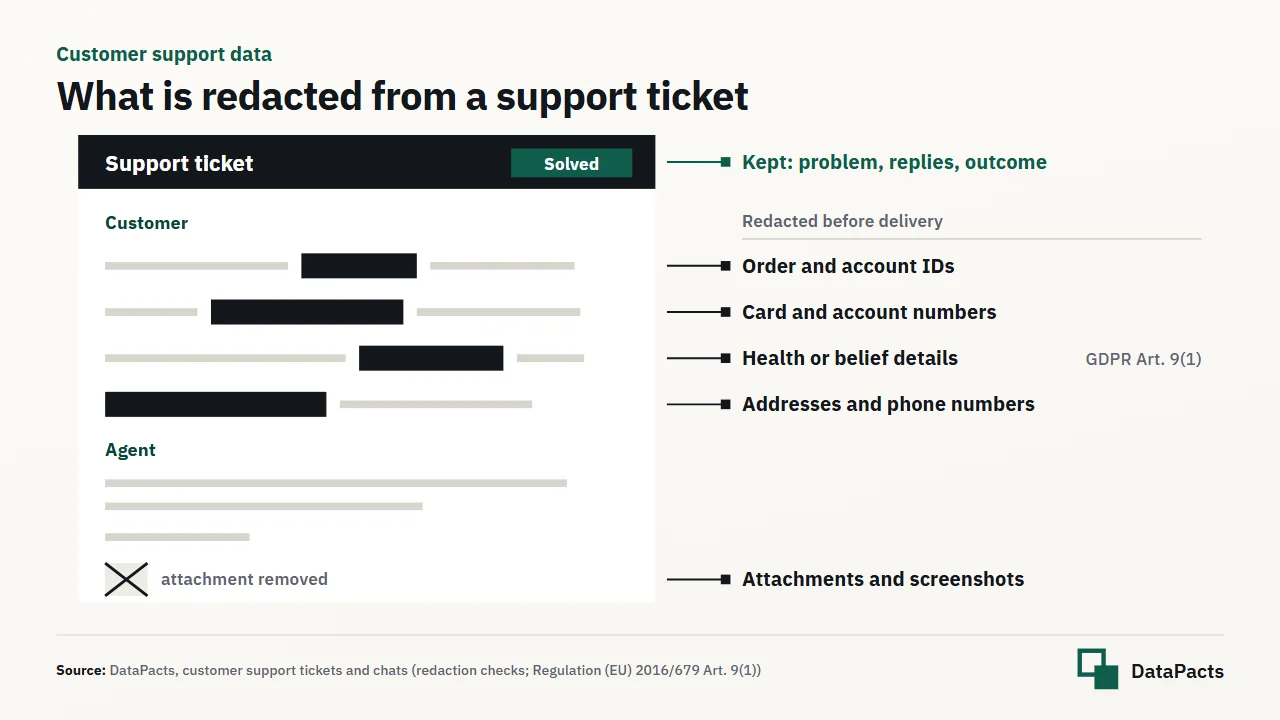
Redaction for support data works on what customers type and attach, and five things are checked before delivery.
- Card and account numbers
- Addresses and phone numbers
- Order and account IDs
- Special-category details, such as health data or religious belief (GDPR Art. 9(1))
- Attachments and screenshots of documents
micro1's master terms (updated November 8, 2026, s.5.7) exclude payment card and financial account data, protected health information, biometric identifiers and data of children under 18, or any higher age required by applicable law, unless the Order Form allows them (re-read November 16, 2026). micro1 states identity-preserving transformation with consistent synthetic identities (research post of September 24, 2026), Corpus Bridge's draft replaces names, emails and IDs, AfterQuery runs a re-identification test, and Polyshares names a specialist PII partner (all checked November 9, 2026). Techniques are set out under PII removal and de-identification before licensing.
Chatbot and AI-Agent Transcripts a Company Holds
A company's own chatbot or AI-agent transcripts are support data like any other: conversations with its customers, with a machine on one side.
Mercor's AI product listing asks for "Complete session logs: prompts, responses and every tool call" and "User terms that allow licensing de-identified usage data, or a way to get consent", and marks "Logs that can't be stripped of personal information" as not a fit; its range is USD 20,000 to 480,000 (checked November 9, 2026).
An AI provider training on its own users' chats is a different subject, covered under user data and platform terms.
Licensing Support Data: Benefits, Risks, Downsides and Alternatives
Licensing support conversations can earn from records a company already keeps, but the customers in them never expected it, and a trained model cannot unlearn them.
- Benefits:
- Income from records already kept: micro1, Mercor and Pangea.ai state ranges for company data (claims, checked November 9, 2026).
- Ownership can stay with the company: Turing states that ownership does not change hands.
- A defined scope: Corpus Bridge's draft is model training only, with no resale.
- Risks:
- Customers may not expect it (Irish DPC, September 2026).
- Selling personal information triggers opt-out rights in California.
- micro1's terms make the licensor indemnify privacy claims (s.8.1).
- Labelbox Prism states that models already trained cannot be unlearned.
- Downsides:
- Turing prices support threads only with a codebase, so no standalone price exists.
- Agencies holding clients' databases are not a fit for Mercor.
- Exports can be incomplete, as with the Zendesk and Intercom limits above.
- Alternatives:
- License help-center articles or resolved-case summaries instead of raw threads.
- License one product line, one region or older years only.
- Offer a de-identified sample first.
- Choose not licensing at all.
No option is a default; the choice depends on the rights review, the notices and tolerance for an irreversible grant.
Support Data Next to Calls, CRM and Contact Centers, and the Seller Steps
Support conversations sit between calls, CRM records and email: the same customer appears in all of them. The parent page shows data types AI companies buy in full.
- Calls: selling call recordings for voice support lines
- CRM: selling CRM records for customer records
- Email: licensing a company email archive for staff mailboxes
- Playbooks: SOPs, playbooks and process documentation for support playbooks
- Industry: contact centers licensing call and chat data for outsourcers
Export rights differ by platform, starting with export rights and mechanics by source system. The Zendesk export omits comments on tickets over 1 MB, and Intercom's dataset CSV has no message content:
The seller steps for a support archive run in this order:
- Read how to sell or license company data, the complete seller guide.
- Build a data inventory of channels and years.
- Give employee notice and consent for the agents named in threads.
- Prepare a data manifest describing ticket fields.
- Negotiate AI data licensing agreements clause by clause.
Every program and intermediary that asks for company records is compared under company data partnership programs.
This page is information, not legal advice.
Frequently Asked Questions
Can a company sell its customer support tickets to AI companies?
Yes, as a license where its customer terms and privacy law allow it, usually of a de-identified copy. Programs such as micro1, Pangea.ai and Turing name support tickets among the data they want; dated program terms are compared on their own page.
How much is customer support data worth to AI buyers?
No per-ticket rate is published; the one support-specific figure is Corpus Bridge's illustrative draft of USD 64,200 for 96,000 tickets (checked November 9, 2026). Other figures price whole company packages, and dated price points are collected separately.
Do customers have to be told before their support chats are licensed?
Often yes: GDPR Art. 13(3) requires telling people about a new purpose first, and Connecticut notices must address LLM training from July 1, 2026. The rules differ by place, as set out under privacy law and AI training data by jurisdiction.
Are internal IT help-desk tickets customer support data?
No, because they have staff, not customers, on the other side. Internal IT help-desk tickets are covered with engineering tickets.