The only per-ticket price on record is Turing's USD 50 per artifact, and it applies only when tickets come bundled with a codebase (Turing newsletter of March 25, 2026, checked November 9, 2026).
This page sets out, within AI training data licensing, why buyers ask for these records, what raises their value, what personal and customer data they hold, and who asks for them. No program publishes a standalone price per ticket, and not licensing is a valid outcome.
The DataPacts Editorial Team explains how we source, date and check every figure.
What Counts as Ticket and Project History Data
This page covers three families of work records: engineering issue trackers, project histories and IT service-desk tickets, each named by AI data programs in their own words.
The table shows what each family holds and which programs name it, as of November 10, 2026 (program wording checked November 9, 2026).
| Family | Systems named by programs | What one record holds | Programs that name it (examples) | Source |
|---|---|---|---|---|
| Engineering issue trackers | Jira, Linear | issue text, comments, status changes, assignee, links to commits and pull requests | Turing, Scale AI, Collinear AI, Mercor software-company listing | lazarus.turing.com; scale.com; collinear.ai; api.data.mercor.com |
| Project histories | Asana, Notion, "project management" | tasks, plans, approvals and the order in which work was done | micro1 ("project histories"), Replay, Sureform | micro1.ai; replay.ai; sureformhq.com |
| IT service-desk tickets and IT records | ServiceNow, ServiceNow SecOps | service requests and incidents, the employee who asked, the fix | Centific ("service/IT records"), Scale AI, Nyne, Mercor cybersecurity listing; Spirit schedule, 667,563 IT tickets | centific.com; scale.com; nyne.ai; courtlistener.com Dkt. 1463 |
Export routes, backup limits and Atlassian's AI data contribution (in effect since August 17, 2026) belong to the Jira page. For those, read Jira data: export rights and licensing issue history.
Why AI Buyers Value Ticket Histories
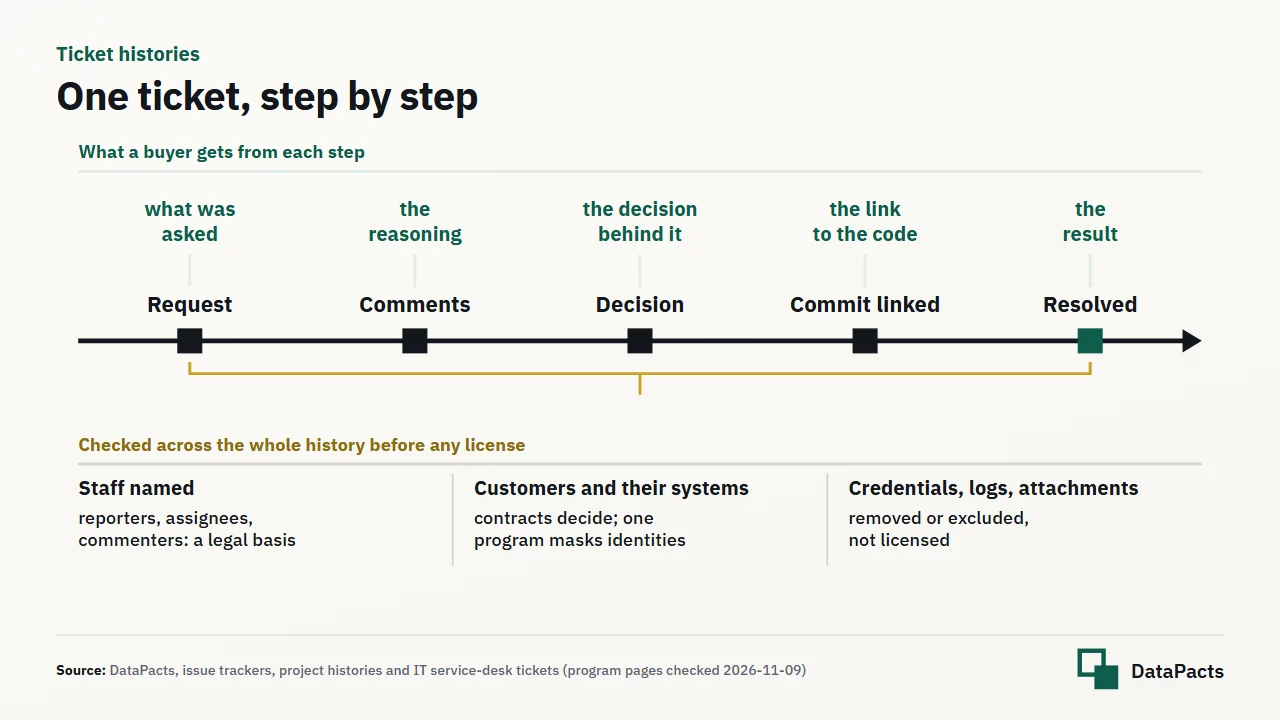
AI buyers value ticket histories because they record how work was done, step by step: the request, the discussion, the decision and the result, often linked to the code that changed.
Replay states a single requirement, "a record of how the work was done (communications, tickets, project histories)", and Endless asks for quotes, tickets, work orders and "the decisions behind them" (both checked November 9, 2026). These programs describe the decisions and the order of work as the asset, not only the final status.
SuperAnnotate lists tickets, approvals, escalations, incident reviews and QA trails. Labelbox Prism lists "Cross-system interaction data", which it describes as Salesforce, Jira and Slack workflows with timestamps, user roles and causal sequence, and states that its data partnerships are exclusive by default (checked November 16, 2026).
Buyers also read tickets as context for code: DataVendor lists issue or ticket history from Linear and Jira next to codebases, and Mercor's game-studio listing asks for "chat, tickets, code and shared drives" (checked November 9, 2026). The code itself is covered under selling or licensing source code and codebases.
What Makes a Ticket History Valuable
A ticket history gains value with its length, its links to code and other systems, the decisions it records and how hard it would be to recreate; programs state these inputs, not a formula.
The table lists each input as the program states it, as of November 10, 2026 (statements checked November 9, 2026).
| Value factor | What programs state | Stated by | Source |
|---|---|---|---|
| Length of history | price depends on years of history; "several years of history, written by people"; 3+ years of operational workflows; 2+ years; intake 3 to 100 years | AfterQuery, Collinear AI, Nyne, Pangea.ai, Sureform | afterquery.com; collinear.ai; nyne.ai; pangea.ai; sureformhq.com |
| Links to code and other systems | number of connected systems; number of connected applications; "Connecting more tools generally results in a higher payout"; at least 3 business tools | AfterQuery, Centific, Mercor, Sureform | afterquery.com; centific.com; mercor.com/data; sureformhq.com |
| Decisions and outcomes recorded | kind of work captured; "decisions behind them"; approvals, escalations, incident reviews, QA trails | AfterQuery, Endless, SuperAnnotate | afterquery.com; endless-data.com; superannotate.com |
| Rarity | how hard the data would be to recreate; availability of comparable data; rarity, depth and exclusivity | AfterQuery, Centific, SuperAnnotate | afterquery.com; centific.com; superannotate.com |
| Volume and quality | data volume, complexity and quality | Centific | centific.com |
| Team size and language | 30+ full-time employees, primarily English; 40+ employees preferred; about 50+ staff, English | micro1, Scale AI, Collinear AI | micro1.ai; scale.com; collinear.ai |
| Export completeness | Linear CSV excludes attachments and its field lists exclude comments (the Markdown copy includes comments); ServiceNow default export limit 10,000 records | Linear and ServiceNow documentation | linear.app/docs; servicenow.com/docs |
Comments and resolution notes carry the reasoning, so an export without them holds less of what buyers describe.
Linear states that its view CSV export covers 250 issues for members and 2,000 for admins (owners on Enterprise), and ServiceNow states a default limit of 10,000 records per export (both checked November 9, 2026). Neither fact sets a price; both bear on how complete a delivered history can be.
A buyer can test a long history on a small part before a license; the methods are set out under proving data quality without sharing the data.
How Ticket Histories Are Priced: Per Artifact, Per Package, Never Per Ticket Alone
No program publishes a standalone price per ticket; the figures on record price tickets as artifacts bundled with code, or price a whole company package in which tickets are one record type.
Three kinds of figure appear, each as the stating party gives it (checked November 9, 2026):
- Per artifact, bundled with code: Turing states USD 50 per artifact (tickets, specs, docs, support threads) only with a codebase.
- Package ranges (checked November 9, 2026): micro1 states tiers of USD 100,000 to 500,000, USD 500,000 to 3,000,000 and USD 3,000,000 and up; Replay states USD 10,000 to 100,000 for 20 to 50 employees; Mercor states USD 50,000 to 500,000 for its software-company listing.
- Illustrative support-ticket license (checked November 9, 2026): Corpus Bridge states an illustrative draft for 96,000 Zendesk tickets, three years, non-exclusive, at USD 64,200. Support tickets have their own page.
No seller-confirmed amount paid for a ticket history is on the public record, and no per-ticket rate can be derived from a package range, because the packages include other record types. Methods are set out in what company data is worth to AI companies.
Acquirers and Intermediaries That Ask for Tickets
Eighteen companies name tickets, project histories or IT records among the data they want, and they play different roles: licensees that build datasets, platforms that place data with labs, and intermediaries that license on the seller's behalf.
Avelence, DataVendor, Pangea.ai and Troveo list or license on the seller's behalf and are not buyers. Endless takes a license and places data with labs.
The table lists the companies alphabetically with the ticket records each names in its own words, as of November 10, 2026 (terms checked November 9, 2026).
| Company (role) | Ticket or project records it names (own words) | One stated condition | Source |
|---|---|---|---|
| Abaka AI (licensee) | "company operating data (docs, chats, tickets, SOPs)" | company data: 10+ employees across departments | abaka.ai |
| AfterQuery (licensee) | "tickets" with email, chat, CRM | customer identities masked; credentials never used | afterquery.com |
| Avelence (broker, seller-side) | "Jira/Linear/Asana/Notion"; "ServiceNow/Dynamics" | no default system access | avelence.com |
| Centific (licensee) | Jira, Asana; ServiceNow; "service/IT records" | read-only connection; "You license your data. You never hand it over." | centific.com |
| Collinear AI (RL-environment builder) | "Private repositories with pull requests and linked tickets"; Jira | one-time snapshot; seller keeps ownership | collinear.ai |
| DataVendor (marketplace, lists on the seller's behalf) | issue or ticket history (Linear, Jira) next to codebases | vendors set the price; 20 % fee at withdrawal | docs.datavendor.ai |
| Endless (licensee that places data with labs) | quotes, tickets, work orders, "decisions behind them" | non-exclusive; seller defines exclusions | endless-data.com |
| Labelbox Prism (data vendor) | cross-system interaction data (Salesforce, Jira and Slack workflows) | exclusive by default | prism.labelbox.com |
| Mercor (program) | Jira, Linear (software-company listing); ServiceNow SecOps (cybersecurity listing); "chat, tickets, code and shared drives" (game-studio listing) | software-company listing range USD 50,000 to 500,000 | api.data.mercor.com |
| micro1 (program) | "software and engineering documentation and bug tracking"; "project histories"; "tickets" | 30+ full-time employees, primarily English | micro1.ai |
| Nyne (licensee) | ServiceNow among business systems | 20+ full-time U.S. W-2 employees; 3+ years | nyne.ai |
| Pangea.ai (marketplace) | "project and engineering"; "support tickets" | non-exclusive; company keeps ownership | pangea.ai |
| Replay (licensee) | "a record of how the work was done (communications, tickets, project histories)" | only de-identified data licensed | replay.ai |
| Scale AI (program) | "Jira, Confluence, Asana, Notion, Linear"; ServiceNow | anonymizes inside the company's environment | scale.com |
| SuperAnnotate (licensee) | "tickets, approvals, escalations, incident reviews, QA trails" | seller approves each buyer | superannotate.com |
| Sureform (platform that identifies buyers) | "project management, ticketing"; "codebases, PRs, issues" | raw data deleted after processing | sureformhq.com |
| Troveo (marketplace, licenses on the seller's behalf) | "Jira, Linear, Asana, Notion, Figma"; "ServiceNow, Workday, SAP, Dynamics" | no OAuth access or install required | troveo.ai |
| Turing (program) | work management (Jira, Linear, Asana) | license to Turing exclusive for the first 6 months; Turing may license the record to more than one lab in that term (checked November 17, 2026) | lazarus.turing.com |
Personal Data, Customer Data and Secrets Inside Tickets
Tickets mix work content with the names of staff, the details of customers and, too often, passwords and logs, so each needs its own check before any license.
Employees and Contractors Named in Tickets
Every ticket names people: the reporter, the assignee, the commenters and often the employee who asked IT for help.
In Germany, BAG 8 AZR 209/21 of May 8, 2025 leaves § 26(1) BDSG unapplied because it does not meet Art. 88 GDPR, so employee data in archives such as Jira needs a GDPR basis, consent under § 26(2) BDSG standards or a works agreement that meets Art. 88(2) GDPR.
Former employees and applicants are covered (§ 26(8) BDSG). SimpleClosure states that sensitive employee, compensation, health and personal information is excluded from its AssetHub listings, which include tickets (checked November 9, 2026).
The notice and consent steps are set out under employee notice and consent before licensing. This section is information, not legal advice.
Customers, Clients and Their Systems
Tickets in IT service desks and client projects describe other companies' systems and people, so customer contracts can bar a license even when the company owns the tracker.
AfterQuery states that customer identities are masked and that it never uses credentials or privileged legal material (checked November 9, 2026). The company's own customer contracts and platform terms decide whether a license is allowed; no program publishes a rule for this.
Where the lawful basis for disclosing customer or user personal data is legitimate interests, Art. 6(1)(f) of Regulation (EU) 2016/679 (applies from May 25, 2018) requires the three-step test. Contract limits are covered under customer consent and confidentiality clauses.
Credentials, Logs and Attachments
Engineering and IT tickets collect pasted credentials, tokens, logs and screenshots, which are removed or excluded before delivery rather than licensed.
AfterQuery states that credentials are never used, that identifiers are removed or pseudonymised, and that a re-identification test runs before delivery, adding that "no process removes all risk on its own".
Scale AI anonymizes inside the company's environment, and micro1 states that it de-identifies itself and that companies need not anonymize before transfer (all checked November 9, 2026). Checks before delivery cover:
- Credentials and tokens pasted into comments
- Log excerpts with addresses, hostnames and user names
- Screenshots and attachments
- Links to other systems that expose their content
Techniques are covered under PII removal and de-identification before licensing.
IT Service-Desk Tickets in a Bankruptcy Asset Schedule: Spirit Airlines
The only court record that counts tickets is the Spirit Airlines asset schedule: 667,563 IT tickets from ServiceNow, listed as included in the de-identified data offered for sale.
The schedule sits in Dkt. 1463 of In re Spirit Aviation Holdings, Inc., No. 25-11897 (SHL), Bankr. S.D.N.Y. (notice of auction results, August 14, 2026), and the counts are the debtor's. The same schedule lists 516 repositories, 43,170 pull requests and 372,585 commits as included.
The bids cover the whole package: Google LLC is the successful bidder at USD 10,000,000 and Mercor.io Corporation the alternate bidder at USD 7,500,000, and the sale is not approved as of November 9, 2026, with a hearing set for November 17, 2026 (Dkt. 1779).
No value per ticket follows from either bid. The sale itself is covered under Spirit bids and status.
Licensing Ticket Histories: Benefits, Risks, Downsides and Alternatives
Licensing ticket history can earn from records a company already keeps, but it exposes staff, customers and secrets, and a model trained on it cannot unlearn it.
Benefits
- Income from existing records: programs license rather than buy, and Turing, Collinear AI and Endless state that the seller keeps ownership.
- Cost handling: Turing covers de-identification, cleanup and packaging costs, and Centific states no setup fees or deductions (checked November 9, 2026).
- Control over scope: Endless states that the seller defines exclusions, and SuperAnnotate that the seller approves each buyer.
Risks
- Named staff: employee data in tickets needs a lawful basis, and German rules reach former employees and applicants.
- Customer exposure: client names, systems and incidents appear in service-desk tickets.
- Secrets: pasted credentials and logs survive in comments and attachments.
- Irreversibility: Labelbox states that models already trained cannot be unlearned.
Downsides
- No standalone price: the one per-ticket figure applies only with a codebase, so tickets alone have no stated rate.
- Exclusivity: Labelbox Prism is exclusive by default, which removes other licenses of the same records.
- Incomplete exports: Linear and ServiceNow limits can leave comments, attachments or records out.
Alternatives
- License the history together with the codebase.
- License one project, closed tickets or older years only.
- Offer a de-identified sample first.
- Not licensing at all, as weighed under whether to sell or license your data at all.
Each alternative leaves the seller with the full record and the option to license later.
Neighboring Data Types, Source Systems and the Seller Steps for Tickets
Tickets sit between chat, documents and code: the same work often appears in all of them, and buyers who ask for one usually ask for several.
The wider range of data types AI companies buy shows where tickets sit. Neighboring pages:
Source systems (Linear and ServiceNow limits are set out in the table above):
Software companies follow software companies' route, and MSPs holding client tickets have a separate one. Seller steps for tickets:
- Read the complete seller guide for the whole process.
- Count projects and years in the data inventory.
- Check client-project ownership in the rights audit.
- Describe ticket fields in the data manifest.
- Agree every clause of the license.
Programs that take company data are compared under all company programs.
Frequently Asked Questions
Are tickets worth anything without the code?
Some programs ask for tickets alone, but the only per-ticket price applies with a codebase. Replay, SuperAnnotate and Endless name tickets without code, while Turing states USD 50 per artifact only when bundled (checked November 9, 2026). Terms are compared in dated program terms.
How much do AI companies pay for ticket data?
No standalone rate exists; package ranges cover all record types. No seller-confirmed amount for ticket histories is on the public record. See dated price points for other data types.
Do employee names have to come out of tickets?
In most programs, yes. Replay licenses only de-identified data, AfterQuery removes or pseudonymises identifiers, and German law adds the BAG ruling above. Rules by country are in employee data rules.
Are customer support tickets covered here?
No; customer conversations are a separate data type. Customer support conversations have their own page, not yet published. This page covers internal engineering, project and IT records.
Advisers and agents can use the introducer form.