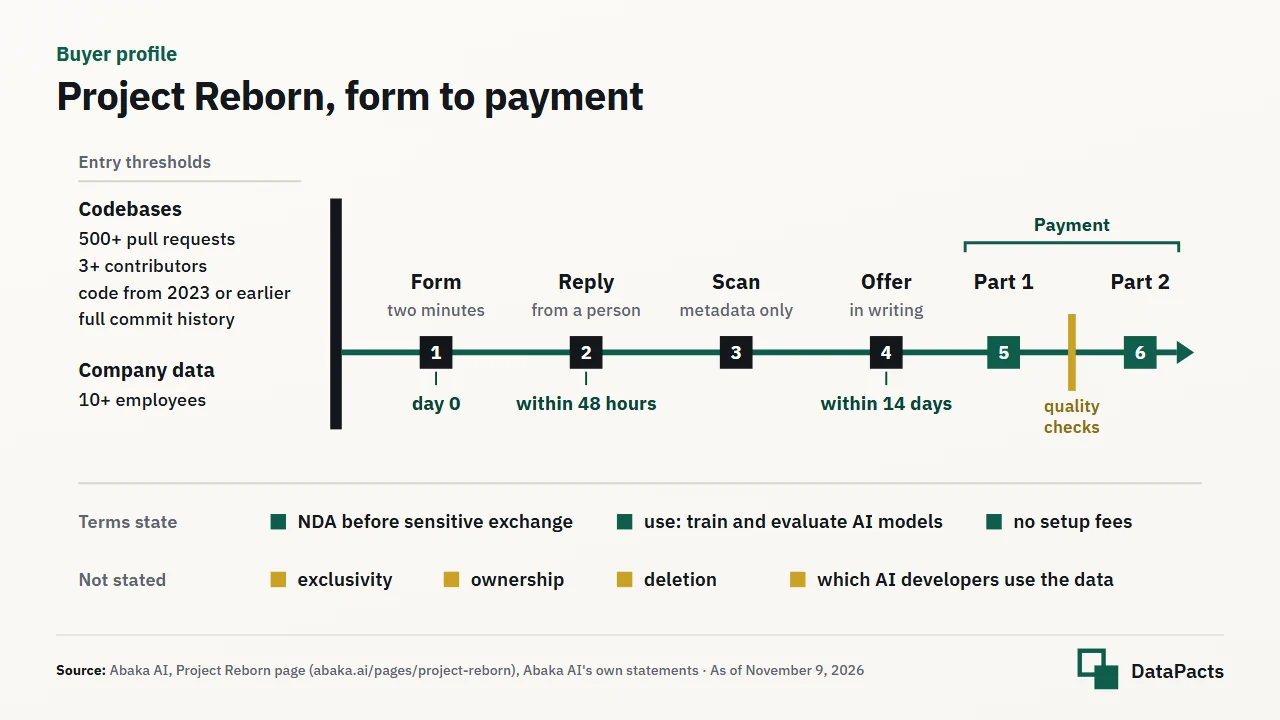
Abaka AI states payout ceilings of up to USD 1,000,000 per repository and up to USD 5,000,000 per company (checked 2026-11-09), paid in two parts.
Every figure on this page is Abaka AI's own claim, checked 2026-11-09, and the page covers abaka.ai only, not other companies with a similar name.
DataPacts is an independent reference on AI training data licensing that covers Abaka AI. The legal entity behind the brand is not named on the pages checked, and the recorded terms leave exclusivity, ownership and deletion unstated.
Sources and check dates follow how DataPacts sources and dates every figure.
What Abaka AI Licenses Through Project Reborn: Private Codebases and Company Operating Data
Project Reborn asks for two kinds of data: private codebases with their full commit history, and company operating data, meaning the documents, chats, tickets and SOPs a company's teams produce.
Abaka AI's wider business covers data collection, annotation and off-the-shelf datasets. Project Reborn is the route by which it takes licenses in. The recorded terms say the data is used only to train and evaluate AI models, and they do not name the AI developers whose models use it.
The recorded terms set eligibility by team size and code history, and they name no condition on whether the company still operates. Programs with terms for closed companies are covered under selling data from a shut-down or defunct company.
Abaka AI Company Identity
No legal entity, address or registry number appears on the Abaka AI pages checked on 2026-11-09; the home page lists only the brand and a business contact address.
| Attribute | Value | Source |
|---|---|---|
| Brand | Abaka AI (Project Reborn) | abaka.ai |
| Website | https://www.abaka.ai | abaka.ai |
| Legal entity | not named on the pages checked | abaka.ai home page |
| Registry number, headquarters, founding year | not stated | n/a |
| Business contact | business@abaka.ai | abaka.ai home page |
| Type | AI data vendor: data collection, annotation, off-the-shelf datasets, Project Reborn licensing | abaka.ai/pages/project-reborn |
The privacy and terms paths returned errors on the check date, so no operator can be named from Abaka AI's own terms.
Project Reborn Program Terms, Dated
Abaka AI's Project Reborn page states payout ceilings, a two-part payment, a five-step process with three deadlines, eligibility thresholds, a use limit and referral terms, all checked 2026-11-09.
| Term | Abaka AI's stated value | Checked | Source |
|---|---|---|---|
| Program and page | Project Reborn, abaka.ai/pages/project-reborn | 2026-11-09 | abaka.ai/pages/project-reborn |
| Data wanted | private codebases; company operating data (docs, chats, tickets, SOPs) | 2026-11-09 | abaka.ai/pages/project-reborn |
| Maximum per repository | up to USD 1,000,000 | 2026-11-09 | abaka.ai/pages/project-reborn |
| Maximum per company | up to USD 5,000,000 | 2026-11-09 | abaka.ai/pages/project-reborn |
| Payment | two parts, the second after quality checks; no setup or listing fees | 2026-11-09 | abaka.ai/pages/project-reborn |
| Process and deadlines | 2-minute form; human answer within 48 hours; local metadata-only scan; written offer within 14 days | 2026-11-09 | abaka.ai/pages/project-reborn |
| Use of data | only to train and evaluate AI models; NDA before sensitive exchange | 2026-11-09 | abaka.ai/pages/project-reborn |
| Exclusivity, ownership, deletion | not stated | 2026-11-09 | abaka.ai/pages/project-reborn |
| Code eligibility | 500 or more pull requests; 3 or more contributors; handwritten code from 2023 or earlier; full commit history | 2026-11-09 | abaka.ai/pages/project-reborn |
| Company data eligibility | 10 or more employees across departments | 2026-11-09 | abaka.ai/pages/project-reborn |
| Referral fee | 10 % of each referred deal; up to USD 100,000 per codebase referral and USD 500,000 per company data referral; minimum USD 2,000 per signed deal | 2026-11-09 | abaka.ai/pages/project-reborn |
Every row is Abaka AI's own statement, and the check date in the table is the date attached to the values. A "not stated" cell is a gap in the terms, not a default.
To read these rows beside other buyers, see the program terms compared by date, where the same fields appear for each program.
Abaka AI Payouts: Up to USD 1 Million per Repository and USD 5 Million per Company (Checked 2026-11-09)
Abaka AI states that Project Reborn pays up to USD 1,000,000 per repository and up to USD 5,000,000 per company, checked 2026-11-09.
Both figures are ceilings, not prices or averages, and neither is described as typical. No per-repository rate, formula or paid-out total is published in the sources checked, so a seller learns its own figure only from the written offer.
Payment comes in two parts, the second after quality checks, and Abaka AI states there are no setup or listing fees.
The ceilings sit beside what buyers pay per token and record, where other acquirers state per-token and per-pull-request figures on their own terms.
How Project Reborn Runs: Form, Call, Metadata Scan, Written Offer, Payment
Abaka AI describes Project Reborn in five steps, from a two-minute form to a written offer within 14 days and payment in two parts (checked 2026-11-09), and the first reply comes from a person.
- A two-minute form.
- A person answers within 48 hours.
- A local scan reads metadata only.
- A written offer arrives within 14 days.
- Payment is made in two parts, the second after quality checks.
Abaka AI states that an NDA comes before any sensitive exchange. Whether the seller controls what the scan reads, and how an offer is declined, is not stated in the recorded terms. Detail on what to put in NDAs before sharing data with an AI buyer covers the terms to check before signing.
Who Qualifies for Project Reborn: Codebase and Team Thresholds
Abaka AI sets separate thresholds for code and for company data: a codebase needs 500 or more pull requests, 3 or more contributors, handwritten code from 2023 or earlier and its full commit history, and company data needs 10 or more employees across departments.
- Codebases: 500 or more pull requests, 3 or more contributors, handwritten code from 2023 or earlier, full commit history.
- Company data: 10 or more employees across departments.
Three or more contributors means several authors, so with several authors, check who owns the code you want to sell before licensing. "Handwritten code from 2023 or earlier" is Abaka AI's own criterion and is not explained on the record.
Project Reborn License Terms: Training and Evaluation Use, Gaps in the Terms
Abaka AI states that licensed codebases and company data are used only to train and evaluate AI models, and that an NDA is signed before anything sensitive changes hands.
Exclusivity, ownership and deletion are not stated in the recorded terms. Whose models use the data is not stated either, so the use limit cannot be tied to a named developer.
Before signing, a seller asks for exclusivity, ownership, deletion and return at term end in writing; the options are set out under deletion and return clauses.
Abaka AI Referral Terms for Introducers
Abaka AI states that an introducer earns 10 % of each referred deal, capped at USD 100,000 per codebase referral and USD 500,000 per company data referral, with a minimum of USD 2,000 per signed deal (checked 2026-11-09).
- Share: 10 % of each referred deal.
- Codebase referral cap: USD 100,000 (checked 2026-11-09).
- Company data referral cap: USD 500,000 (checked 2026-11-09).
- Minimum per signed deal: USD 2,000 (checked 2026-11-09).
The fee is tied to a signed deal. Whether it is paid on top of or out of the seller's amount is not stated. The cap and the minimum can be set against other fee models in referral programs compared.
Abaka AI Reputation: Complaints, Incidents and Open Records
No complaint, incident or lawsuit involving Project Reborn was found from a primary or named-person source, checked 2026-11-09.
What is documented is a published program page with terms. What is not documented is the legal entity, registry entry, headquarters, founding year, named AI developer customers and any confirmed payout. Contributor forum threads concern annotation work, not data licensing, and are not a source here.
Before sharing anything, a seller matches the contact domain to abaka.ai, asks for the contracting entity's legal name in the NDA and reads the full license before signing; the red flags are listed under data licensing email legitimate checks. This page gives no verdict on the program.
Benefits, Risks, Downsides and Alternatives to Licensing Data to Abaka AI
Project Reborn publishes high payout ceilings, deadlines and a use limit, but it names no legal entity, states no exclusivity, ownership or deletion terms, and pays the second part only after quality checks.
Benefits:
- Published ceilings of up to USD 1,000,000 per repository and USD 5,000,000 per company, as of 2026-11-09.
- Stated deadlines: an answer within 48 hours and a written offer within 14 days.
- A metadata-only scan before signing and an NDA before sensitive exchange.
- No setup or listing fees.
Risks:
- The contracting entity is not named on the pages checked.
- Exclusivity, ownership and deletion are not stated.
- Company records carry staff and customer personal data, which the seller must clear before sharing.
Downsides:
- The ceilings are not offers.
- Part of the payment waits on quality checks.
- The thresholds exclude small teams and short code histories.
Alternatives:
- Turing Project Lazarus: revenue share with nothing upfront, a license to Turing that is exclusive for the first 6 months after signing, during which Turing may license the same record to more than one lab, open to active, winding-down or wound-down companies (Turing's claim, checked 2026-11-17).
- AfterQuery: no payout figures published; operating, winding-down and closed companies welcome (AfterQuery's claim, checked 2026-11-09).
- Pangea.ai: indicative USD 100 per million tokens of source code and USD 40 per million tokens of git history, non-exclusive (Pangea's claim, checked 2026-11-09).
- pre.dev: non-exclusive by default, seller payout not published (checked 2026-11-09).
- Keeping the code and records unlicensed.
Not licensing is a valid outcome. The wider set of alternatives to selling data includes keeping code and records in house.
Abaka AI Among Company Data Programs and Dataset Vendors
Project Reborn is one of several company data partnership programs, and Abaka AI is also a dataset vendor, so the profile sits on two directories.
Abaka AI is listed with the other company data partnership programs, and its dataset business sits with dataset vendors and data labs. Every answer to who buys AI training data starts from the main buyer comparison.
- Every code acquirer and the token arithmetic for licensing source code and codebases.
- Wind-down firms that handle a closing company's data are covered under shutdown services.
- Turing Project Lazarus, a revenue-share program for company records.
- Pangea.ai, a per-token marketplace for code.
- The SOPs Abaka AI asks for, covered as SOPs, playbooks and process documentation.
More About Abaka AI
Abaka AI Contributor Work
Searches for Abaka AI also return annotation and AI-trainer recruiting, which is contributor work rather than data licensing. Pay and assessments across AI training jobs and platforms are compared on their own page.
Frequently Asked Questions About Abaka AI Project Reborn
What is Abaka AI?
An AI data vendor offering data collection, annotation and off-the-shelf datasets. Through Project Reborn it also licenses private codebases and company operating data to train and evaluate AI models.
How much does Abaka AI pay for code and company data?
Abaka AI states up to USD 1,000,000 per repository and up to USD 5,000,000 per company, checked 2026-11-09. These are ceilings, not prices, paid in two parts.
Does a company pay Abaka AI to take part?
No; Abaka AI states there are no setup or listing fees (checked 2026-11-09).
Does Project Reborn accept companies that have closed?
The recorded terms set thresholds for team size and code history and name no condition on company status. Turing Project Lazarus and AfterQuery state they accept winding-down and closed companies.