Two services are on record, listed alphabetically. SimpleClosure states a percentage fee only on success and a license or an outright sale, and Sunset's own terms could not be read on 2026-11-09. Each term is the service's own claim. The page belongs to AI training data licensing.
DataPacts Editorial Team checked the figures here against the services' own pages and the cited reports on November 9, 2026; the page on how we source, date and check every figure sets out the rules.
What a Shutdown Service Does With a Closing Company's Data
A shutdown service treats a closing startup's code and workspace archives as assets to place with AI buyers during the wind-down, alongside its domains and intellectual property.
SimpleClosure's AssetHub product lists source code (codebases, repositories, documentation, tests), workspace data (Slack, Google Drive, email, Notion, Figma, tickets), intellectual property and domains as the assets it handles (checked 2026-11-09).
The service is an intermediary, not the licensee: SimpleClosure states that it sells or licenses to "vetted" buyers and names none. Dori Yona, SimpleClosure's chief executive by the company's own description, told MIT Technology Review on 2026-10-13 that 47 % of its deals include code or data sales.
The chain has three parties: the company, the service and the buyer, which holds the license. The buyers themselves are compared under who buys AI training data.
Shutdown Services on Record
Two shutdown services are on record, and only SimpleClosure states on its own pages that it places data with AI buyers. The table lists them alphabetically as of 2026-11-09, with the operator name as each source gives it.
| Service | Operator | What it handles | Data deal form | Checked | Source |
|---|---|---|---|---|---|
| SimpleClosure (AssetHub) | Simple Closure Inc. | closing startups' source code and workspace data, placed with AI buyers for a percentage on success | license or outright sale | 2026-11-09 | simpleclosure.com |
| Sunset | Sunsets HQ Corp. (name from Replay's footer) | wind-down service for founders closing their companies; its founder also started Replay, which licenses company data | not stated (own site unreadable) | 2026-11-09 | replay.ai/about |
- "What it handles" describes the service's role and never means that the service buys.
- The Sunset row rests on Replay's pages because Sunset's own site blocked automated checks.
- Profiles are linked once they are published.
Terms the Two Services Publish
SimpleClosure publishes a fee model, data categories and exclusions for its AssetHub product, while Sunset's own terms could not be read on the check date. Sunset's site returned an HTTP 403 challenge to automated checks, so its column shows only what Replay's About page says.
| Term | SimpleClosure AssetHub | Sunset | Source |
|---|---|---|---|
| Fee | no upfront cost; a percentage only if assets are sold or licensed; percentage not published | not stated | simpleclosure.com/product/assethub; replay.ai/about |
| Deal size claim | "tens to hundreds of thousands of dollars for unique assets" | not stated | simpleclosure.com/product/assethub |
| Data handled | source code; workspace data (Slack, Google Drive, email, Notion, Figma, tickets); also IP and domains | not stated | simpleclosure.com/product/assethub |
| Excluded | sensitive employee, compensation, health and personal information; PII processed before licensing | not stated | simpleclosure.com/product/assethub |
| Deal form | license or outright sale | not stated | simpleclosure.com/product/assethub |
| Who may use it | shutting-down startups; its FAQ states operating companies can explore licensing while keeping the assets (checked 2026-11-10) | founders winding down their companies | simpleclosure.com; replay.ai/about |
| Buyers | "vetted" AI buyers, not named | not stated | simpleclosure.com |
| Steps | short form or GitHub connection; viability assessment; buyer interest review; PII processing | not stated | simpleclosure.com/product/assethub |
Terms as of 2026-11-09; a "not stated" cell means no term could be read, not that none exists.
How a Data Sale Runs Inside a Wind-Down
SimpleClosure describes four steps from first contact to a licensed or sold asset: a short form or a connected GitHub repository, a viability assessment, a review of buyer interest, and PII processing before licensing.
- The company submits a short form or connects a GitHub repository.
- SimpleClosure makes an initial viability assessment.
- The company reviews buyer interest and next steps.
- PII is processed before licensing.
SimpleClosure states that cleaning removes roughly 37 % of raw code, such as third-party or generated code and duplication (blog post of 2026-09-03).
The closed-company process itself, meaning who signs, which duties survive and which deletion clocks run, is covered under selling data from a shut-down or defunct company. This page covers only what the shutdown services state.
Track-Record Claims: Offered, Handled and Paid
SimpleClosure's own figures count companies that offered assets, not completed sales, and DataPacts shows each figure with its date and wording rather than merging them.
- SimpleClosure states that 350+ companies have offered assets since the April launch and nearly 500 million lines of code (blog post of 2026-09-03; "offered", not sold).
- SimpleClosure's blog states assets from more than 350 companies through AssetHub (post of 2026-10-01), a different wording for a similar number.
- The chief executive told MIT Technology Review on 2026-10-13 that 47 % of deals include code or data sales.
No independent count of completed deals exists in the record. Only one seller-stated amount is on record: one founder told MIT Technology Review on 2026-10-13 that a code-base sale netted roughly USD 25,000, with about USD 15,000 pending for workspace data, and the report states that SimpleClosure brokered the sale. Claims and confirmed sums are tracked under advertised vs confirmed payouts.
Operators Behind Each Service: Legal Names and Unreadable Terms
SimpleClosure's pages name Simple Closure Inc., and no registry number appears on the primary pages checked on 2026-11-09.
Sunset's operator is named Sunsets HQ Corp. in the footer of Replay's site, and sunsethq.com returned a challenge to automated checks on 2026-11-09, so no terms and no file number were read. MIT Technology Review reported on 2026-10-13 that Sunset values assets by head count, years in operation, data volume and tool use.
Replay's terms (last updated 2026-09-28) name Replay Data, LLC, a Delaware limited liability company in Brooklyn, while the footer names Sunsets HQ Corp.; both names are shown as found and DataPacts does not reconcile them.
Replay is a data vendor that takes a license, not a shutdown service. It states upfront cash plus a perpetual revenue share, de-identified data only, and sales only to frontier AI and data labs, "not to foreign adversaries or through brokers" (checked 2026-11-09).
Its own claims are set out under Replay's data licensing terms, and it states no closed-company wording.
What the Closing Company Gives Up When Its Wind-Down Firm Sells the Data
Letting the firm that closes a company also sell its data trades negotiating effort for control over the deal form, the buyer and the fee.
Outright Sale or License
AssetHub offers both a license and an outright sale, and an outright sale ends the company's ownership of the code or archive.
Buyer-side terms show how wide a grant can be: micro1's Data License Master Terms (last updated 2026-11-08) take a nonexclusive, perpetual grant, delete raw data within 120 days after delivery and impose no duty to delete or retrain models (section 4.4), while Turing states that the license to Turing is exclusive for the first 6 months, during which Turing may license the record to more than one lab (checked 2026-11-17). The clauses are explained under AI data licensing agreements.
The Success Fee and Who Chooses the Buyer
SimpleClosure is paid only if an asset is sold or licensed, and it does not publish the percentage.
SimpleClosure names its buyers "vetted" and lists none, so the choice of buyer rests with the service unless the agreement says otherwise. Replay, by contrast, states that it sells only to frontier AI and data labs and "not through brokers" (checked 2026-11-09).
Employee, Customer and Credential Data
SimpleClosure states that sensitive employee, compensation, health and personal information is excluded, which narrows what is sold but does not settle the company's own duties.
FTC staff stated on 2024-02-13 that retroactive, surreptitious changes to privacy terms to allow AI training "may be unfair or deceptive"; the statement is a staff blog post, not a rule.
An attorney quoted by MIT Technology Review on 2026-10-13 called employee data sales "legally radioactive". The notice side is covered under employee notice and consent.
Using a Shutdown Service for the Data Sale: Benefits, Risks, Downsides and Alternatives, Including Not Selling
A shutdown service can turn archives that would otherwise be deleted into money without the founders running a sale themselves, but the fee, the deal form and the buyer choice sit with the service.
Benefits
- No upfront cost: SimpleClosure takes a percentage only if assets are sold or licensed (checked 2026-11-09).
- A stated process of four steps, from form to PII processing.
- Sensitive employee, compensation, health and personal information is stated as excluded.
Risks
- An outright sale ends the company's ownership of the code or archive.
- The buyers are not named, and no independent deal count exists.
- Retroactive terms may be unfair or deceptive, as FTC staff stated on 2024-02-13.
- Employee data sales are described as "legally radioactive" by an attorney quoted on 2026-10-13.
Downsides
- The percentage is not published, so the cost is known only from the agreement.
- Cleaning removes roughly 37 % of raw code, SimpleClosure states.
- Only one seller-stated amount (about USD 25,000 for a code base, reported 2026-10-13) is on record.
Alternatives
- A company-data program that takes the license itself: AfterQuery, Labelbox Prism, micro1's defunct track, Ooak Data or Turing Project Lazarus, each stating closed or winding-down eligibility (checked 2026-11-09).
- A seller-side broker, such as Marin Data, which states it charges companies nothing and is paid by AI labs, or Pewter, which states a 10 % fee on a closed deal.
- An insolvency officeholder, when the company is insolvent.
- Deleting the archive after retention periods, for example 10 years for German books and annual accounts (HGB 257(4)) or 3 years for UK private company accounting records (Companies Act 2006 s.388(4)).
- Not selling at all.
No option is the default, and each leaves the company's duties in place. Further routes are compared under alternatives to selling data to AI labs.
When the Closing Company Is Insolvent or Already Dissolved
A shutdown service works for a company that can still act through its board; once the company is insolvent or dissolved, someone else decides whether its data is sold.
In a US bankruptcy, 11 U.S.C. 363(b)(1) bars a trustee from selling personally identifiable information covered by a debtor's privacy policy unless the sale is consistent with it or a consumer privacy ombudsman is appointed under 11 U.S.C. 332 and the court approves (as of 2026-11-09).
A solvent Delaware corporation selling all or substantially all of its assets needs a majority of the outstanding voting stock under 8 Del. C. 271(a), and a dissolved Delaware corporation continues for 3 years for winding up under 8 Del. C. 278.
In the United Kingdom, section 1012 of the Companies Act 2006 makes a dissolved company's property bona vacantia, subject to restoration. Officeholder sales are covered under data assets in insolvency.
Where Shutdown Services Sit Among Programs, Brokers and Officeholders
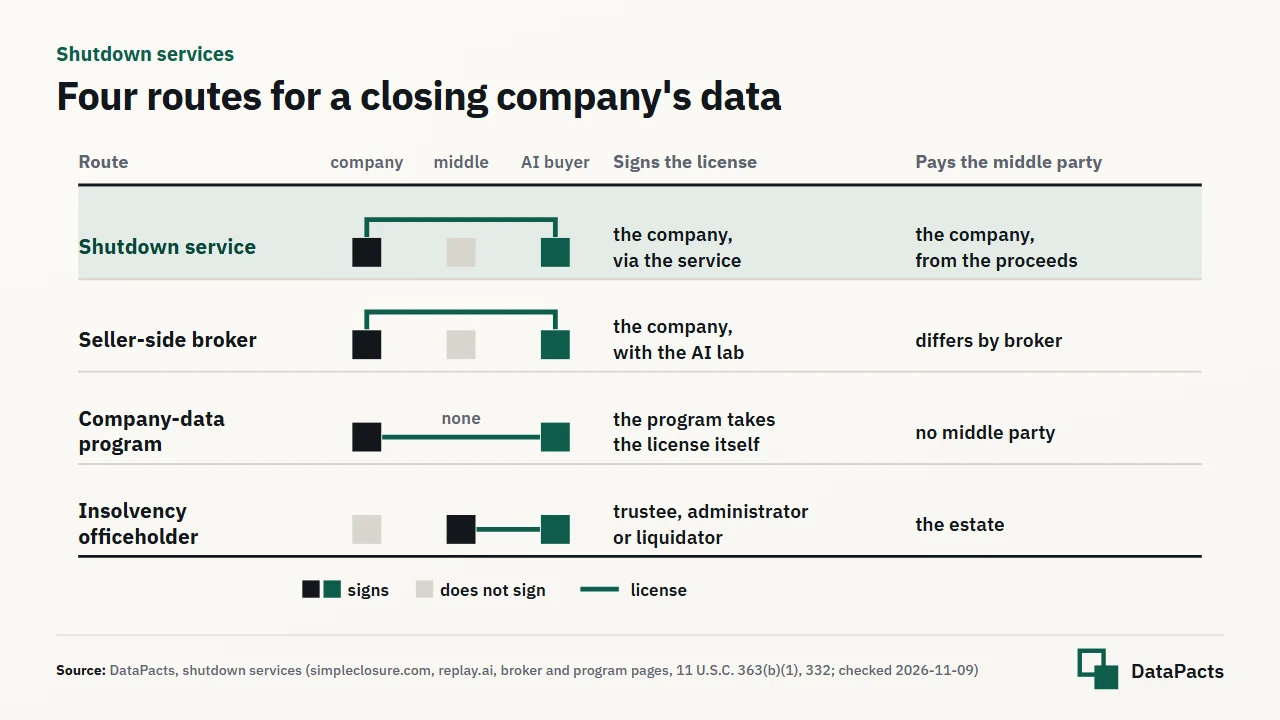
A closing company can reach AI buyers through four kinds of party, and they differ in who signs the license and who pays the party in the middle. This page is information, not legal advice (see how DataPacts is funded).
The table compares the four routes as of 2026-11-09, with examples in alphabetical order.
| Route | Who signs the license with the AI buyer | Who pays the party in the middle | Examples with closed-company wording | Source |
|---|---|---|---|---|
| Shutdown service | the company (via the service) or the acquirer of an outright sale | the company, from proceeds (SimpleClosure) | SimpleClosure, Sunset | simpleclosure.com/product/assethub; replay.ai/about |
| Seller-side broker | the company with the AI lab or licensing partner | Pewter: 10 % of the license price on close, payer not stated; Marin Data: the AI lab | Marin Data, Pewter | pewterdata.com; marindata.ai/terms |
| Company-data program (licensee) | the program takes the license itself | no middle party | AfterQuery, Labelbox Prism, micro1 defunct track, Ooak Data, Turing Project Lazarus | micro1.ai/company-referral; lazarus.turing.com; afterquery.com/data-partnerships; prism.labelbox.com/faq; ooakdata.com/partner |
| Insolvency officeholder | trustee, administrator or liquidator, often with court approval | the estate | US bankruptcy cases | 11 U.S.C. 363(b)(1), 332 |
The linked pages cover each route and the steps around it:
- company data partnership programs: programs that license the data themselves
- AI data licensing brokers and sell-side advisers: fees as published
- selling direct or through a broker: the direct-or-broker decision
- Turing Project Lazarus terms and micro1's program terms: the two program profiles
- program terms compared: payouts and terms side by side
- referral programs of AI data buyers: referral fees
- evaluating an offer for your data: price, payment trigger and license terms
- PII removal and de-identification: before any license
- SimpleClosure AssetHub alternatives: named alternatives to AssetHub
- exporting company data before shutting down: vendor deletion deadlines
- who owns a dissolved company's data: custody after dissolution
- record retention after closing a company: minimum periods
Questions About Shutdown Services and Company Data
Do shutdown services buy a startup's data?
No: on their own pages the shutdown services on record sell or license a closing startup's data to AI buyers on its behalf and take a fee, so the AI buyer is the licensee. SimpleClosure states a percentage only on success (checked 2026-11-09).
What does a shutdown service charge for a data sale?
SimpleClosure states no upfront cost and a percentage only if assets are sold or licensed, without publishing the percentage; Sunset states no fee that could be read on 2026-11-09. The percentage appears only in the written agreement.
Are startup shutdown services legit?
DataPacts does not certify any service; a founder can check the operator's legal name, the written fee, the deal form and whether buyers are named before signing. DataPacts lists services regardless of any referral program. Unsolicited offers are checked under is that data licensing email legitimate.
Can a company use a shutdown service's data sale without closing?
Yes, for SimpleClosure: its FAQ states that companies still operating can explore licensing while continuing to use the underlying assets (checked 2026-11-10). Sunset's terms could not be read.