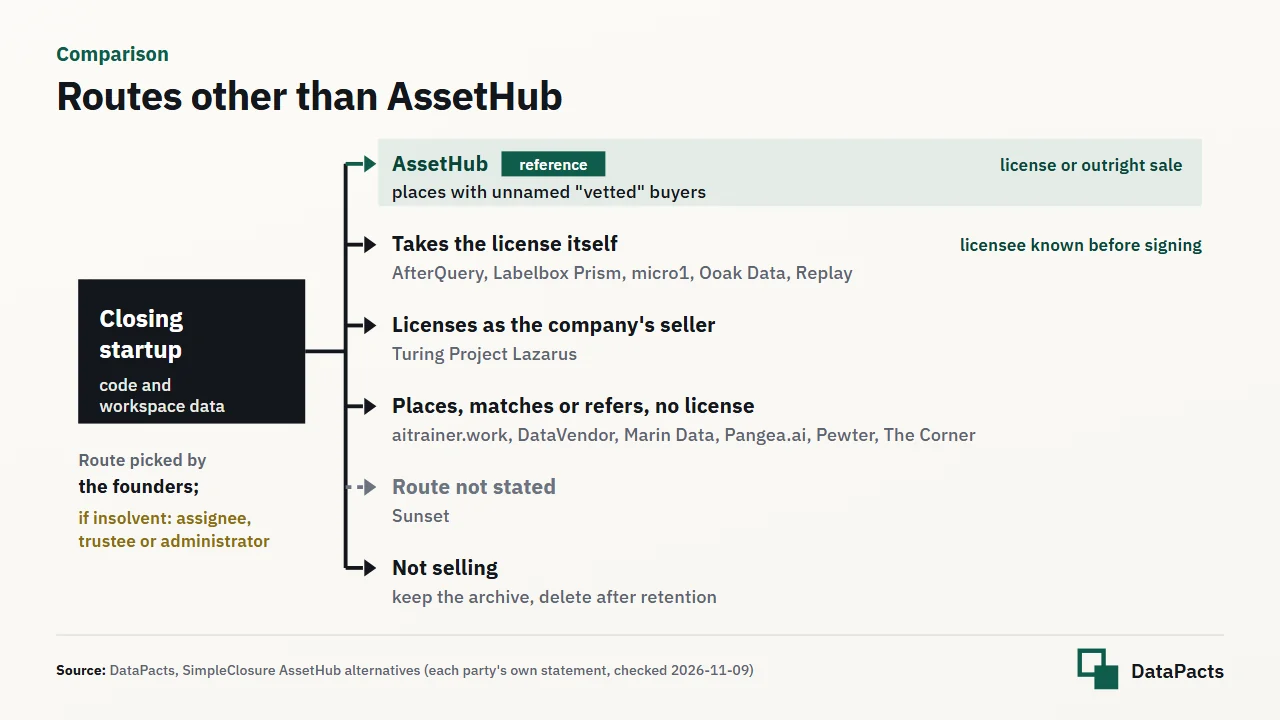
AssetHub itself sells or licenses the data to buyers it calls "vetted" and does not name, for a percentage that is unpublished and charged only if an asset is sold or licensed; it places the data and does not buy it. The page sits inside the wider reference on AI training data licensing.
Every term below is the party's own claim, checked 2026-11-09, and the rows are alphabetical after the AssetHub reference row. No party pays to be listed or placed.
Routes Other Than AssetHub, Compared on AssetHub's Own Terms
Each row is a party on record for closed or winding-down companies or for startup source code, set against the AssetHub reference row on the five things AssetHub states.
The table has no amount column, because every amount is the party's own claim and the payouts tool compares them, and no score, because order never depends on fees.
Alternatives to SimpleClosure AssetHub for a closing startup's code and workspace data, as each party states (as of 2026-11-09):
| Party | Route | Takes the license or places it | Code or workspace records stated | Deal form stated | Party in the middle paid by | Closed or winding-down wording | As of | Source |
|---|---|---|---|---|---|---|---|---|
| SimpleClosure AssetHub (reference) | wind-down service | places with unnamed "vetted" AI buyers | both | license or outright sale | a percentage from the sale, only on success; not published | shutting-down startups; operating companies too (FAQ, 2026-11-10) | 2026-11-09 | simpleclosure.com |
| AfterQuery | company data program | takes the license | both (codebases named in a launch post) | terms proposed after sample review; not published | no middle party | "operating, winding-down and closed companies welcome" | 2026-11-09 | afterquery.com |
| aitrainer.work | matching (intermediary) | matches; the company deals directly with the buyer | private code repos; closed-startup records | buyer sets the price; "Most repos don't sell at all" | some buyers pay it a fee on completed deals | sells closed startups' records | 2026-11-09 | aitrainer.work |
| DataVendor (HUD) | code marketplace (intermediary) | lists; buyers license | private codebases | license, "rather than transferring them" | keeps 20 % of vendor earnings at withdrawal | none; organizations only | 2026-11-09 | docs.datavendor.ai |
| Labelbox Prism | company data program | takes the license | both (code edit traces; Slack, Jira, Salesforce) | upfront fee plus revenue share; exclusive by default; seller keeps ownership | no middle party | distressed and wound-down companies eligible | 2026-11-09 | prism.labelbox.com |
| Marin Data | adviser (intermediary) | negotiates; the company signs with the lab | workspace records across several tools | license set in the agreement with the lab | the AI lab; nothing charged to the company | winding-down companies may qualify | 2026-11-09 | marindata.ai |
| micro1 (defunct partnerships) | company data program | takes the license | workspace records; engineering documentation, bug tracking | nonexclusive, perpetual, irrevocable (Master Terms of 2026-11-08) | no middle party | defunct partnerships: 30+ employees, "10+ Countries", English | 2026-11-09 | micro1.ai |
| Ooak Data | company data program | takes the license; buyers get the cleaned dataset under a code name | workspace records (Slack, Gmail, Notion, Jira, SharePoint, Teams) | training use only; raw archive deleted within 30 days | no middle party | wind-down deals closed with a director, liquidator or administrator signing | 2026-11-09 | ooakdata.com |
| Pangea.ai (code licensing) | code marketplace (intermediary) | batches code to buyers | private code and git history only | non-exclusive; owner keeps ownership | not stated; owner paid within 15 days of the buyer's payment | none; owned private code only | 2026-11-09 | pangea.ai |
| Pewter | broker (intermediary) | places; the licensing partner signs | workspace records (email, files, operating records) | license; ownership of originals unchanged | 10 % of the license price on close; payer not stated | operating, winding down or closed; 20+ people now or at peak | 2026-11-09 | pewterdata.com |
| Replay | data vendor | takes the license; sells only to frontier AI and data labs | both (code and commits among company records) | upfront cash plus perpetual revenue share; de-identified only | no middle party; "not through brokers" | none; its founder started Sunset | 2026-11-09 | replay.ai |
| Sunset | wind-down service | not stated | not stated | not stated (own site unreadable on 2026-11-09) | not stated | wind-down service for founders | 2026-11-09 | replay.ai/about |
| The Corner | referral partner of micro1 (intermediary) | refers to micro1, which takes the license | Slack or Teams history | micro1's terms | micro1 may pay it; amount not stated | closed companies with 25+ staff at peak | 2026-11-09 | thecorner.ai |
| Turing Project Lazarus | licensing program (seller's agent) | licenses as the company's seller, under a license to Turing exclusive for the first 6 months | both (GitHub, GitLab; Slack, Teams, Jira) | Turing may license the record to more than one lab (checked 2026-11-17); ownership does not change hands; revenue share, nothing upfront | no middle party | statuses "Shut down ≤90 days ago" and ">90 days ago" | 2026-11-09 | lazarus.turing.com |
"Not stated" means the party's pages are silent, not that the answer is no. "Places" means the party arranges a license between the company and a buyer and does not buy. Each cell is the party's own statement, shortened and never extended.
Where the Alternatives Part Ways With AssetHub
Four attributes separate the alternatives from AssetHub more than any price does: who takes the license, whether ownership leaves the company, who pays the party in the middle, and which data the route accepts. The four sections below take each in turn.
Taking the License Itself or Placing the Data With a Buyer
AssetHub places the data with buyers it calls "vetted" and does not name, while five alternatives take the license themselves, so the company knows its licensee before signing. Replay states that it sells only to frontier AI and data labs, "not to foreign adversaries or through brokers", which names a buyer class and no buyer.
- Takes the license itself: AfterQuery, Labelbox Prism, micro1, Ooak Data and Replay.
- Licenses as the company's seller: Turing, under a license that is exclusive to Turing for the first 6 months (checked 2026-11-17).
- Places, matches or refers without taking a license: aitrainer.work, DataVendor, Marin Data, Pangea.ai, Pewter and The Corner.
Sunset's own terms could not be read on 2026-11-09, so its route is shown as not stated. Each licensee program is set out in company data partnership programs.
Ownership After the Deal: AssetHub's Outright Sale Against License-Only Routes
AssetHub offers a license or an outright sale, and it is the only route on record whose own page offers to sell the data outright; five alternatives state that ownership stays with the company.
- DataVendor: "a sale licenses your assets for a commercial use rather than transferring them".
- Labelbox Prism: the seller retains full ownership, and the license is exclusive by default.
- Pangea.ai: a non-exclusive license, and the owner keeps ownership.
- Pewter: the ownership of the originals is unchanged.
- Turing: ownership does not change hands, and the license to Turing is exclusive for the first 6 months.
micro1 states a nonexclusive, perpetual, irrevocable grant with no duty to retrain models already trained on the data (Data License Master Terms, last updated 2026-11-08). The clauses that decide what a grant leaves with the company are explained in AI data licensing agreements.
Who Pays the Party in the Middle
AssetHub takes an unpublished percentage only if an asset is sold or licensed, and the brokers and marketplaces among the alternatives state three other arrangements: the AI lab pays, a fixed share of the license price, or a cut at withdrawal.
- AssetHub: a percentage only on a sale or license, not published.
- Marin Data: charges companies nothing, and the AI lab pays it separately.
- Pewter: 10 % of the license price when a deal closes (checked 2026-11-09), with the payer not stated on its page.
- DataVendor: keeps 20 % of vendor earnings, assessed when earnings are withdrawn.
- The Corner: micro1 may pay it a referral fee, amount not stated.
The licensee routes (AfterQuery, Labelbox Prism, micro1, Ooak Data, Replay and Turing) have no party in the middle. How fees and conflicts differ between selling direct and selling through an intermediary is covered in selling direct or through a broker.
Code, Workspace Records or Both
AssetHub handles source code and workspace data in one sale, and only some alternatives take both: two marketplaces take private code only, and five other routes name workspace records only. Turing, Replay, AfterQuery and Labelbox Prism name both code and workspace systems, and aitrainer.work names private code repositories together with closed-startup records.
- Code only: DataVendor and Pangea.ai, which take private code from organizations or owners.
- Workspace records only: micro1, Ooak Data, Marin Data, Pewter and The Corner.
- Both: AssetHub, AfterQuery, Labelbox Prism, Replay and Turing.
Per-token and per-codebase rates are not compared here; they sit on the page for selling or licensing source code to AI companies.
When an Assignee, Trustee or Administrator Decides Instead of the Founders
An insolvent company's data is sold by an assignee, trustee or administrator for the creditors, so the choice between AssetHub and another route passes from the founders to that officeholder.
AssetHub's founder-led route is then no longer the company's choice alone. Ooak Data states that its wind-down deals are closed with a director, liquidator or administrator signing, the only alternative in the table to name officeholders (checked 2026-11-09).
In a US bankruptcy, 11 U.S.C. 363(b)(1) allows personally identifiable information covered by a privacy policy to be sold only if the sale is consistent with that policy, or after a consumer privacy ombudsman is appointed under 11 U.S.C. 332 and the court approves (as of 2026-11-09).
Delaware's Uniform Assignment for Benefit of Creditors Act (10 Del. C. 7301A-7324A, in force since 2026-06-10) gives an out-of-court route in which the assignee petitions the Court of Chancery within 14 days under s.7321A(a) and which has no consumer privacy ombudsman mechanism.
The route is set out in assignment for the benefit of creditors and data assets.
Choosing a Route Other Than AssetHub: Benefits, Risks, Downsides and Alternatives
Moving from AssetHub to another route changes who signs, who is paid and whether the company keeps the data, and no route removes the company's own duties to staff and customers.
Benefits:
- A named licensee instead of unnamed "vetted" buyers, where AfterQuery, Labelbox Prism, micro1, Ooak Data or Replay takes the license.
- Ownership stays with the company on five routes (DataVendor, Labelbox Prism, Pangea.ai, Pewter and Turing).
- A broker that states the AI lab pays it, as Marin Data does, so the company is charged nothing.
Risks:
- Revenue-share routes pay only when the record sells and nothing upfront, as Turing states.
- micro1's grant is perpetual and irrevocable, with no duty to retrain models.
- FTC staff stated on 2024-02-13 that surreptitious, retroactive changes to terms or privacy policies to allow AI training may be unfair or deceptive, which is a staff post and not a rule, and it applies whichever route is chosen.
Downsides:
- Several alternatives require a size or history the company may not meet: micro1 asks 30+ employees for defunct partnerships, Pewter 20+ people now or at peak, and The Corner 25+ staff at peak.
- Several rows publish no fee or license terms, so the comparison ends at "not stated", as AssetHub's percentage does.
Alternatives:
- An enquiry for an independent introduction to buyers that match the data.
- Keeping the archive for its retention period and then deleting it: HGB 257(4) sets 10 years for German books and annual accounts, and Companies Act 2006 s.388(4) sets 3 years for a UK private company's accounting records.
- Not selling at all, which is a valid outcome; the case for it is in alternatives to selling data to AI labs, including not selling at all.
Where AssetHub Alternatives Sit Among Shutdown Services, Brokers and Programs
This page compares substitutes for one wind-down intermediary; the category of shutdown services, the closed-company process and the full directories cover the wider field. The category and its route-type comparison are in shutdown services that sell or license closing companies' data.
- Selling data from a shut-down or defunct company: signing authority, surviving duties and deletion clocks
- AI data licensing brokers and sell-side advisers: every broker, with fees as published
- AI training data marketplaces: marketplace fees and payouts
- Data assets in insolvency: officeholder sales
- Exporting company data before shutting down: export before any sale
- Record retention after closing a company: minimum periods in the US, UK and Germany
How Routes Are Selected and Ordered
A party enters the table when its own pages state terms for closed or winding-down companies, or when it is a marketplace for startup source code; fees and referral programs never decide inclusion or order.
Replay is included through its founder's link to Sunset, and brokers without closed-company wording, such as DataSupply.ai, sit in the broker directory. Rows are alphabetical after the AssetHub reference row (see how DataPacts is funded). This page is information, not legal advice.
Frequently Asked Questions
What are the alternatives to SimpleClosure for selling startup data?
Thirteen are on record: programs that take the license (AfterQuery, Labelbox Prism, micro1, Ooak Data, Replay), Turing Project Lazarus, brokers and referral partners (aitrainer.work, Marin Data, Pewter, The Corner), code marketplaces (DataVendor, Pangea.ai) and Sunset. Each is the party's own claim, checked 2026-11-09.
Is there an AssetHub alternative that charges the company nothing?
Marin Data states that it charges companies nothing and is paid by the AI lab, and the licensee programs have no party in the middle. Each is a claim checked 2026-11-09. A fee-free route can still pay less once terms are set, which is how evaluating an offer for your data compares net value.
Can a closing startup license its code without a shutdown service?
Yes: Turing states Project Lazarus accepts companies shut down more than 90 days ago, and DataVendor and Pangea.ai take private code from organizations directly. Pangea.ai states that licensing is not guaranteed (checked 2026-11-09).
Is Sunset an alternative to SimpleClosure for data?
Sunset is the other wind-down service on record; its own terms could not be read on 2026-11-09, and its founder also started Replay, which licenses company data itself. Sunset's data terms are therefore shown as not stated.