DataPacts is an independent reference on AI training data licensing that covers SimpleClosure. Every term below is SimpleClosure's own claim, checked 2026-11-09 unless a newer date is shown.
What SimpleClosure Does: Wind-Downs and the AssetHub Data Sale
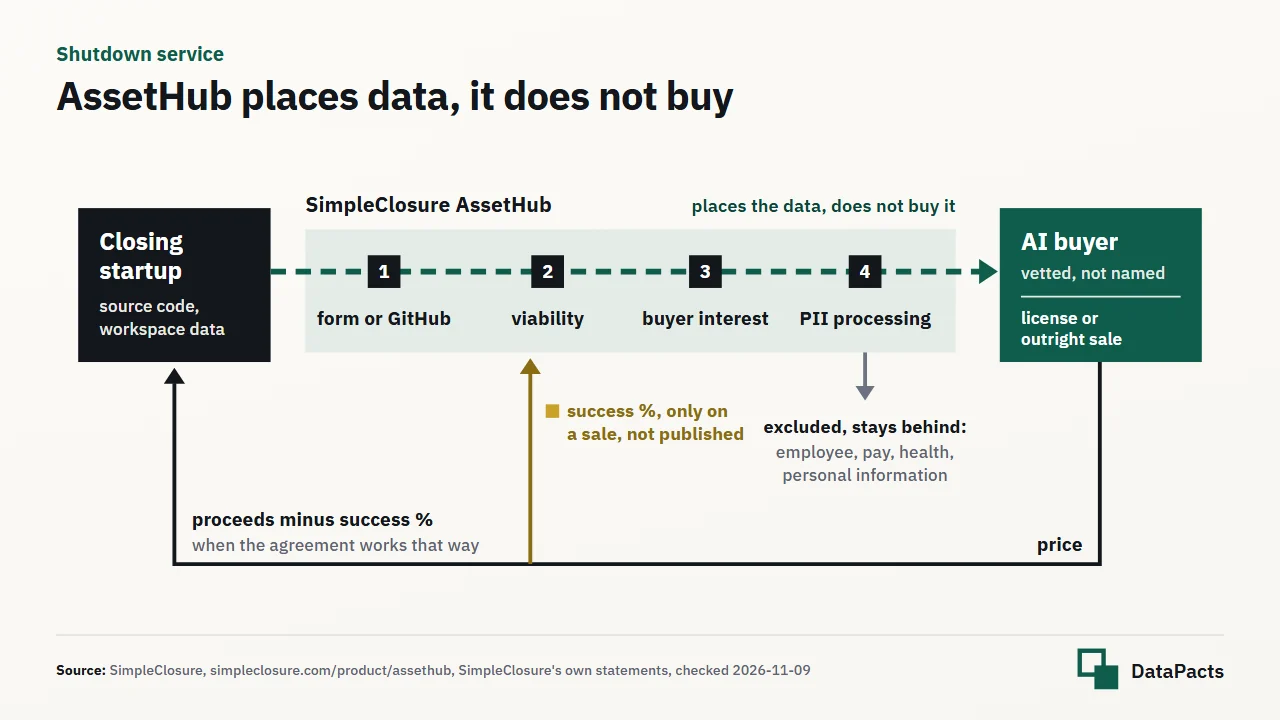
SimpleClosure runs two lines of work: it winds down startups, and through AssetHub it places their leftover code and workspace data with AI buyers.
The wind-down service is the company's main business, and its steps and prices are outside this page, which covers only what happens to a closing startup's data.
A founder who searches for SimpleClosure will mostly find the dissolution service, and the data sale is a separate product with its own terms. AssetHub added data sales in April 2026 and sits beside the sale of other assets of a closing startup: intellectual property, domains and talent.
The role is that of an intermediary. SimpleClosure states that it sells or licenses to "vetted" buyers and names none, so the AI buyer is the licensee or, in an outright sale, the acquirer.
Dori Yona, SimpleClosure's chief executive by the company's own blog, told MIT Technology Review on 2026-10-13 that 47 % of its deals include code or data sales. The AI labs at the end of the chain are among those that who buys AI training data compares.
SimpleClosure Company Identity
SimpleClosure's pages name Simple Closure Inc. as the operator, and no registry number appears on the primary pages checked.
The table lists what the pages state, as of 2026-11-10.
| Attribute | Value | Source |
|---|---|---|
| Operator | Simple Closure Inc. (footer "© 2026 Simple Closure Inc.") | simpleclosure.com/product/assethub |
| Website | simpleclosure.com | simpleclosure.com |
| Country | United States | simpleclosure.com |
| Role | startup wind-down service; AssetHub sells or licenses code and workspace data for a percentage on success; an intermediary, not a buyer (DataPacts classification) | simpleclosure.com |
| Registry number | not found on the primary pages checked 2026-11-09 | n/a |
| Chief executive | Dori Yona (the company's own blog) | simpleclosure.com/blog |
| Founded, address, funding | not stated | n/a |
Founding year, address and funding rounds are not stated here because no primary page or filing in the record gives them. No filing names the officers, so the chief executive is a self-description.
SimpleClosure AssetHub Program Terms, Dated
SimpleClosure states one program for company data, AssetHub, with no upfront cost and a percentage taken only if an asset is sold or licensed, checked 2026-11-09. Other programs' dated terms appear in program terms compared.
The table lists each term as SimpleClosure states it.
| Term | SimpleClosure's stated value | Checked | Source |
|---|---|---|---|
| Program | AssetHub, data sales added in April 2026 | 2026-11-09 | simpleclosure.com/product/assethub |
| Fee | "There's no upfront cost"; a percentage only if assets are "successfully sold or licensed"; percentage not published | 2026-11-09 | simpleclosure.com/product/assethub |
| Deal size claim | "in the tens to hundreds of thousands of dollars for unique assets" | 2026-11-09 | simpleclosure.com/product/assethub |
| Data handled | SourceCode (codebases, repositories, documentation, tests); WorkspaceData (Slack, Google Drive, email, Notion, Figma, tickets) | 2026-11-09 | simpleclosure.com/product/assethub |
| Excluded | sensitive employee, compensation, health and personal information; PII processed before licensing | 2026-11-09 | simpleclosure.com/product/assethub |
| Deal form | license or outright sale | 2026-11-09 | simpleclosure.com/product/assethub |
| Buyers | "vetted" AI buyers, not named | 2026-11-09 | simpleclosure.com |
| Steps | short form or GitHub connection; viability assessment; buyer interest review; PII processing | 2026-11-09 | simpleclosure.com/product/assethub |
| Eligibility | shutting-down startups; operating companies "can explore licensing opportunities while continuing to use the underlying assets" | 2026-11-10 | simpleclosure.com/product/assethub |
| Timing and payment schedule | FAQ: timelines "vary based on asset type and buyer interest"; payment schedule not stated | 2026-11-10 | simpleclosure.com/product/assethub |
The product page leaves out the percentage, the timing, the payment schedule, the buyer names and the license length. Its FAQ answers were collapsed on the visible page on the 2026-11-10 fetch, and the cost answer in the page's FAQ markup names no percentage, so the percentage appears only in the agreement a company signs.
The FAQ answers the operating-company question with "No. Companies that are still operating can explore licensing opportunities while continuing to use the underlying assets" (checked 2026-11-10). The service therefore is not limited to companies that have closed.
What AssetHub Handles and What It Leaves Out
AssetHub handles two kinds of data, SourceCode and WorkspaceData, and SimpleClosure names the systems each covers. The wider market for selling or licensing source code to AI companies is compared on its own page.
- SourceCode: codebases, repositories, documentation and tests.
- WorkspaceData: Slack, Google Drive, email, Notion, Figma and tickets.
- Other assets: intellectual property, domains and talent, outside the data sale.
SimpleClosure states that sensitive employee, compensation, health and personal information is excluded and that PII is processed before licensing. An attorney quoted by MIT Technology Review on 2026-10-13 called employee data sales "legally radioactive", a sector view and not a statement about SimpleClosure.
The exclusions do not settle the company's own duties. FTC staff stated on 2024-02-13 that retroactive, surreptitious changes to privacy terms to allow AI training "may be unfair or deceptive", in a staff blog post and not a rule, and employee notice and consent remain the company's duty.
How a Sale Runs Through AssetHub, Step by Step
SimpleClosure describes four steps from first contact to a licensed or sold asset.
- The company submits a short form or connects a GitHub repository.
- SimpleClosure makes an initial viability assessment.
- The company reviews buyer interest and next steps.
- PII is processed before licensing.
SimpleClosure states in a blog post of 2026-09-03 that roughly 37 % of raw code is removed in cleaning, such as third-party or generated code and duplication. The FAQ states that timelines vary with asset type and buyer interest and gives no total duration (checked 2026-11-10).
The process of a closed company, meaning who signs, which duties survive and which deletion clocks run, is covered under selling data from a shut-down or defunct company. This page does not repeat it.
SimpleClosure Fees: The Success Percentage and What Is Not Published
SimpleClosure charges nothing upfront for an AssetHub sale and takes a percentage only if an asset is sold or licensed, without publishing the percentage, checked 2026-11-09.
The fee is taken from the sale, and the AI buyer pays the price, so the company receives the proceeds net of the percentage when the agreement works that way. The wind-down service price is not published in the record checked, and third-party price ranges are not used here.
The agreement is therefore the only place the cost can be read. A company can ask for four things in writing before signing: the percentage, the base it applies to, the timing of the fee and who receives the buyer's payment.
What SimpleClosure Says Startup Assets Are Worth
SimpleClosure states that AssetHub deals run in the tens to hundreds of thousands of dollars for unique assets, checked 2026-11-09.
A SimpleClosure blog post of 2026-09-03 gives the same range, tens of thousands to hundreds of thousands of dollars, and says enterprise asset sales run "into the millions".
Both statements are claims by the service that earns the fee, not valuations of how much company data is worth, and neither is a price any seller received. SimpleClosure's blog gives no per-asset price list, so the range cannot be tested against a single named sale.
SimpleClosure's Own Figures and the One Seller-Stated Amount
SimpleClosure's own figures count companies that offered or brought assets, not completed sales, so each is shown with its date and wording.
- SimpleClosure states that 350+ companies have offered assets since the April launch, with nearly 500 million lines of code (blog post of 2026-09-03; "offered", not sold).
- Dori Yona wrote on 2026-10-01 that assets from more than 350 companies were coming through AssetHub, a different wording for a similar number.
- Dori Yona told MIT Technology Review on 2026-10-13 that 47 % of SimpleClosure's deals include code or data sales.
- The same blog post of 2026-09-03 states that roughly 37 % of raw code is removed in cleaning.
One seller-stated amount is on record: a founder told MIT Technology Review on 2026-10-13 that the sale of his startup's code base netted roughly USD 25,000, with about USD 15,000 pending for workspace data by his estimate, and the report states that SimpleClosure brokered the sale. It is tracked with other advertised vs confirmed payouts.
No independent count of completed deals is in the record. Press deal counts, dollar totals and figures from search snippets are not stated here because they differ between reports and could not be matched to a primary page.
SimpleClosure Reputation: Reviews, Complaints and Incidents
No complaint, incident or lawsuit involving SimpleClosure's data sales is recorded from a primary or named-person source, checked 2026-11-09.
The case record names no proceeding against SimpleClosure, and there is no entry among data buyer incidents and disputes.
Review sites and forum threads are not used as sources here, and no score from them is quoted, because they carry no checkable name, date or document.
The employee-data warning quoted above is a sector point from the press, not a finding about SimpleClosure.
SimpleClosure's own warning is the other record: on 2026-10-01 its chief executive reported that another firm's ads promised founders USD 1 million, 3 million and 5 million for data, set against SimpleClosure's own claim of tens to hundreds of thousands. The checks for evaluating an offer for your data apply to both.
Using AssetHub for a Data Sale: Benefits, Risks, Downsides and Other Routes, Including Not Selling
AssetHub can turn archives that would otherwise be deleted into money without the founders running a sale, but the fee, the buyer and the deal form sit largely with SimpleClosure.
Benefits
- No upfront cost: a percentage only if assets are sold or licensed (checked 2026-11-09).
- A stated process of four steps, from form to PII processing.
- Sensitive employee, compensation, health and personal information is stated as excluded.
Risks
- An outright sale ends the company's ownership of the code or archive; for a solvent Delaware corporation, 8 Del. C. 271(a) requires a majority of the outstanding voting stock at a meeting on at least 20 days' notice for a sale of all or substantially all assets, and the clauses of AI data licensing agreements decide what a license grants.
- The buyers are not named, so the company does not know the licensee in advance.
- Retroactive terms may be unfair or deceptive, as FTC staff stated on 2024-02-13.
- No independent deal count exists.
Downsides
- The percentage is not published, so the cost is known only from the agreement.
- Roughly 37 % of raw code is removed in cleaning, SimpleClosure states.
- The buyer pool is "vetted" by SimpleClosure and not by the company.
Other routes, in alphabetical order
- A broker: DataSupply.ai, Marin Data or Pewter, each a seller-side intermediary with its own fee terms.
- A company-data program that takes the license itself: AfterQuery, Labelbox Prism, micro1's defunct track, Ooak Data, Replay or Turing Project Lazarus.
- An insolvency officeholder, when the company is insolvent.
- Not selling at all: keeping or deleting the archive after the retention period, for example 10 years for German books and annual accounts (HGB 257(4)) or 3 years for UK private company accounting records (Companies Act 2006 s.388(4)).
- Selling directly to a buyer without an intermediary.
No route is the default, and each leaves the company's duties in place. The named alternatives are compared in full under SimpleClosure AssetHub alternatives.
SimpleClosure Among Shutdown Services, Brokers and Company-Data Programs
SimpleClosure is one of two shutdown services DataPacts covers, and a closing company can also reach AI buyers through brokers, company-data programs or, in insolvency, an officeholder. This page is information, not legal advice (see how DataPacts is funded).
- Shutdown services that sell or license closing companies' data: the category and the route comparison
- Sunset: the other wind-down service on record
- Replay's data licensing terms: Replay takes the license itself
- Pewter's seller fee: 10 % of the license price on close, as Pewter states
- DataSupply.ai's success fee: a 20 % success fee paid by the seller, as DataSupply.ai states
- AI data licensing brokers and sell-side advisers: the directory with fees as published
- Selling direct or through a broker: the decision
- micro1's program terms: the defunct-company track
- Turing Project Lazarus terms: the revenue share
- Data assets in insolvency: when the company is insolvent
- Exporting company data before shutting down: vendor deletion deadlines before any sale
- Alternatives to selling data to AI labs: including not selling at all
Questions About SimpleClosure
What does SimpleClosure do?
SimpleClosure winds down startups and, through AssetHub, sells or licenses their source code and workspace data to AI buyers for a percentage on success. It places the data and does not buy it.
Who is the CEO of SimpleClosure?
Dori Yona is SimpleClosure's chief executive by the company's own blog; no filing in the record names the officers.
Does SimpleClosure buy data from startups?
No: SimpleClosure places a startup's data with vetted AI buyers and takes a fee; the AI buyer is the licensee or acquirer. The buyers are not named.
How much does SimpleClosure charge to sell company data?
SimpleClosure states no upfront cost and a percentage only on a sale or license, without publishing the percentage (checked 2026-11-09). The wind-down price is not covered here.
Is SimpleClosure legit?
DataPacts certifies no service; the operator, Simple Closure Inc., is named on its pages, no complaint is recorded from a primary source, and the fee percentage appears only in the agreement.
Unsolicited offers from any party are checked under is that data licensing email legitimate.
Can an operating company use AssetHub?
Yes, by SimpleClosure's FAQ: companies still operating can explore licensing while continuing to use the underlying assets (checked 2026-11-10).