The page covers vendor deadlines, the records that tax and employment law keep alive, export formats, the order of export and cancellation, and whether an export ever becomes training data.
An export secures records first and is not a decision to sell; the archive is one more source of AI training data licensing only if the company later chooses so.
The vendor pages, statutes and program terms below were checked against their primary sources, under the rules on how we source, date and check every figure.
What Each Vendor Does With Company Data After Cancellation
Each vendor runs its own clock after cancellation, and the shortest clocks sit on the export files themselves rather than on the account. The table lists 13 clocks in alphabetical order, each from the vendor's own help or terms page, as of 2026-11-09.
| Vendor and object | Clock | What it means before a shutdown | Source and check date |
|---|---|---|---|
| GitHub organization | deletion permanently removes all repositories, wikis, issues and pull requests | export before any deletion | docs.github.com, 2026-11-09 |
| GitHub organization migration archive | deleted automatically after seven days | generate when ready to save | docs.github.com, 2026-11-09 |
| GitLab project export file | deleted every 24 hours | save the same day | docs.gitlab.com, 2026-11-09 |
| Gong account | export requests within 30 days after termination (s. 9.4) | request inside the window | gong.io terms, 2026-11-09 |
| Google Workspace subscription | core service data excluded from Data Export once cancelled or suspended | export before cancelling | knowledge.workspace.google.com, 2026-11-09 |
| Google Workspace export bucket | deleted 60 days from the beginning of the export | copy out inside 60 days | knowledge.workspace.google.com, 2026-11-09 |
| HubSpot record export | file link expires after 30 days | save the file | knowledge.hubspot.com, 2026-11-09 |
| Jira Cloud backup | restore limited to backups no older than 30 days (from 2026-01-22) | keep the file outside Atlassian | support.atlassian.com, 2026-11-09 |
| Microsoft 365 for business | Expired 30 days, Disabled 90 days (admins only); a monthly subscription cancelled inside the cancellation window skips Expired; since 2026-02-09 no Expired state for license-based subscriptions bought directly under a Microsoft Customer Agreement; data deleted no later than 180 days after cancellation | export before cancelling | learn.microsoft.com, page dated 2026-06-08 |
| Microsoft Purview eDiscovery export | package expires after 14 days; exports running longer than 7 days are cancelled | split large exports | learn.microsoft.com, 2026-11-09 |
| Microsoft Teams Export API | user-deleted messages 21 days; deleted teams, channels and users 30 days | export before removing users | learn.microsoft.com, 2026-11-09 |
| Notion workspace export | file link expires after 7 days | save the file | notion.com help, 2026-11-09 |
| Xero subscription | data no longer available after termination; reactivation by paying fees; no read-only period stated (cl. 62) | export before termination | xero.com terms, 2026-11-09 |
Vendor clocks that affect a shutdown export, as of 2026-11-09. Not a complete list; no post-closure deletion period is on record here for Slack, Atlassian Cloud or Salesforce.
Account clocks differ in length and in what stays reachable. An ending Microsoft 365 for business subscription moves to Expired for 30 days and to Disabled for 90 days, when only admins can access data, before deletion; a monthly subscription cancelled inside the cancellation window goes straight to Disabled, and since February 9, 2026 license-based subscriptions bought directly under a Microsoft Customer Agreement have no Expired state.
Xero's terms make data unavailable after termination, and Gong's terms allow export requests for 30 days. Zoom deletes cloud recordings 30 days after a downgrade to free unless the account resubscribes (checked 2026-11-09).
The export package has a shorter clock than the account. Google deletes its bucket 60 days from the start of the export, a Purview package expires after 14 days, a GitHub migration archive is deleted after seven days, a GitLab export file within 24 hours, and Notion and HubSpot file links expire after 7 and 30 days. Deleting a GitHub organization permanently removes its repositories, wikis, issues and pull requests.
No deletion period after workspace deletion or plan cancellation is on record here for Slack, Atlassian Cloud or Salesforce, so the vendor's current page needs reading before any cancellation.
Slack Free workspaces have lost message and file history older than one year since 2024-08-26. SimpleClosure states that 95 % of the workspaces it sees use Slack, 87 % Google Drive and 82 % GitHub (checked 2026-11-09). Each system's mechanics sit under export rights and mechanics by source system.
Which Records Must Outlive the Accounts: Tax and Employment Duties Against Deletion
A vendor's deletion clock does not end the company's duty to keep records, so records under a tax or employment retention duty are exported and kept even when nothing else is.
The duty sits with the company and, after closure, with whoever holds its books, not with the vendor. Four examples show why an export is forced:
- US tax: the IRS states that general income tax records are kept 3 years and employment tax records at least 4 years after the tax is due or paid (page as of 2026-06-30).
- US employment: 29 CFR 516.5 sets at least 3 years for payroll records and 516.6 at least 2 years for time cards; 29 CFR 1602.14 sets 1 year for personnel records, and until final disposition when a charge is filed.
- UK: private company accounting records are kept 3 years under Companies Act 2006 s.388(4), while HMRC expects 6 years (gov.uk page checked 2026-11-09).
- Germany: HGB s.257(4) sets 10 years for books and annual accounts and 8 years for booking vouchers.
Keeping data alive carries its own risk. On 2026-04-17 Italy's Garante fined Framos Italia s.r.l. in liquidazione EUR 5,000, taking the liquidation into account, for keeping a former employee's mailboxes active for 6 months after termination and breaching GDPR Arts 5(1)(a), (c), (e), 6, 12, 13, 17 and 29.
The minimum periods by country are collected under record retention after closing a company.
Export Formats and What Each Export Leaves Behind
An export is complete only for what the vendor's tool includes, and several tools leave out attachments, comments, files or whole conversation bodies. The table compares nine systems on record in alphabetical order, as of 2026-11-09.
| System | Export route and format on record | What the export leaves out or limits | Source and check date |
|---|---|---|---|
| HubSpot | record export; 300 exports per rolling 24 hours | engagements not included | knowledge.hubspot.com, 2026-11-09 |
| Intercom | dataset CSV; Export API 90 days per request | conversation and message content not in the CSV | intercom.com help, 2026-11-09 |
| Jira Cloud | site backup | automation flows, third-party app data, Assets | support.atlassian.com, 2026-11-09 |
| Linear | view CSV, 250 issues for members, 2,000 for admins (owners on Enterprise) | attachments; comments not in the field list | linear.app docs, 2026-11-09 |
| Microsoft 365 (Purview) | PST packages of 1, 2, 5 (default) or 10 GB | package expires after 14 days | learn.microsoft.com, 2026-11-09 |
| Notion | HTML or Markdown & CSV plus files; PDF with subpages on Business or Enterprise; up to 30 hours | PDF not on other plans | notion.com help, 2026-11-09 |
| ServiceNow | XML, CSV, XLSX, XLS, JSON; default limit 10,000 records (Zurich) | records above the limit | servicenow.com docs, 2026-11-09 |
| Slack | Free and Pro: public channels; Business+ by application and Enterprise via Support: private channels and DMs; Enterprise JSON or TXT | described as file links; Free file links last 90 days only | slack.com help, 2026-11-09 |
| Zendesk | XML or JSON on Suite Growth and above or Support Professional and Enterprise; account owner asks Support | XML capped at 500 MB (about 200,000 tickets); JSON omits comments of tickets over 1 MB | support.zendesk.com, 2026-11-09 |
Export formats and gaps for systems on record, as of 2026-11-09. Export steps for each system are on its own page.
A shutdown export keeps the records in the vendor's format. Reformatting, de-identification and delivery to any later licensee are separate steps that start only if the company decides to license, and Slack's help page describes exports as containing file links.
The work needed before any license is set out under PII removal and de-identification before licensing.
The Order of a Shutdown Export: Admin Access, Long Exports, Copies, Then Cancellation
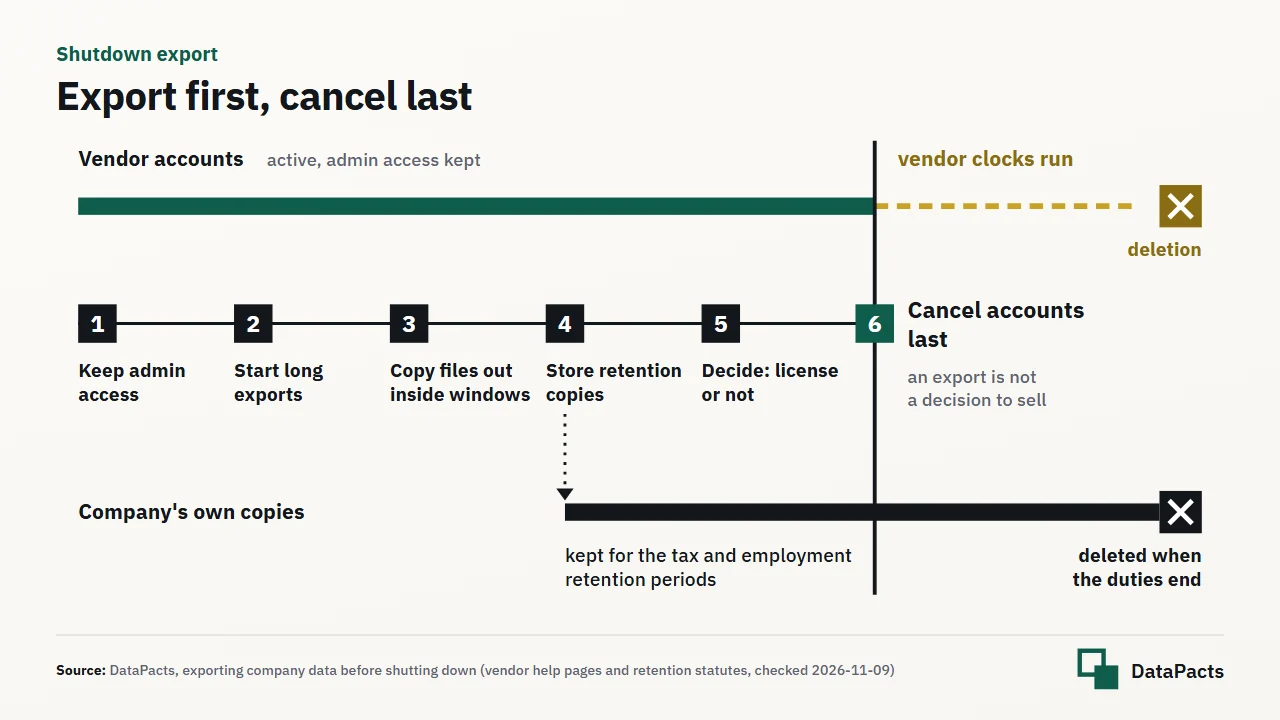
The order that keeps the most options open is to secure admin access, start the slow exports, save copies under the retention duties, decide on any license, and cancel last.
- Keep admin accounts. Google's Data Export needs a super admin account at least 30 days old, and organizations with more than 1,000 users or FedRAMP contact Support first. Purview exports need a Microsoft 365 E3 or E5 licensed user, and the Teams Export API an active Teams license per exported user.
- Start the long exports first. Google's export is available no earlier than 48 hours, typically in 72 hours and up to 14 days. A Jira Cloud backup with attachments can run every 48 hours, and restores use backups no older than 30 days.
- Copy files out inside each file window. The windows run from 24 hours (GitLab) to 60 days (Google), as the vendor table shows.
- Store retention copies where the record holder controls them. The periods above set how long each copy stays.
- Decide whether any of the archive is licensed, or not, before deletion is irreversible. Deleting a GitHub organization permanently removes its repositories and issues.
- Cancel, then delete the remaining copies when the duties end.
A company that has already cancelled has the least room, because Microsoft's 180-day and Google's cancelled-or-suspended rules apply from the day of cancellation. The tests before any sale sit under data sale readiness.
Exporting Before Closure: Benefits, Risks, Downsides and Alternatives
Exporting before closure keeps both legal records and options, but the export is a copy of personal data that the company must secure and later delete, and exporting only what the law requires is a valid choice.
Benefits
- Records under tax and employment duties survive the vendor's deletion.
- The company keeps copies of data whose deletion is permanent, such as a GitHub organization's repositories.
- An archive that still exists can later be licensed or not. Ooak states that its wind-down deals close with a director, liquidator or administrator signing (checked 2026-11-09), as covered under selling data from a shut-down or defunct company.
Risks
- The export holds former staff's and customers' personal data, and regulators act against companies in liquidation.
- Slack's API Terms (effective 2025-10-10) bar apps distributed outside the organization from bulk exporting message data except under an additional agreement, and Google's Workspace API user data policy bars using API user data to train models, so connector routes offered later carry terms risk.
Downsides
- Admin licenses must be kept paid until exports finish.
- Several exports omit attachments, comments or content.
- Storage and access control for the copies cost money until the retention periods end.
Alternatives
- Export only the records under a retention duty and let the rest lapse with the accounts.
- Not selling or licensing at all: keep the archive for its retention periods and then delete it.
- A wind-down service that handles assets for a fee: SimpleClosure states it takes a percentage only if assets are sold or licensed (checked 2026-11-09), handling and not buying the data.
DataPacts takes no position on whether a closing company should license its archive; an export protects records, and the decision to sell belongs to the company or its officeholder.
Where the Shutdown Export Connects to Systems, Insolvency and the Seller Path
This page covers what to export before vendor accounts end and by when; the pages below cover each system's export steps, the insolvency procedures and the seller path.
- Parent: data assets in insolvency, how estates sell data assets once records are secured
- Officeholders: insolvency administrators and liquidators as data sellers, who may sign for the archive
- Custody: who owns a dissolved company's data, records custody after dissolution
- Out of court: assignment for the benefit of creditors and data assets, the route in Delaware
- Germany: German insolvency and data sales, the Insolvenzverwalter's route
- Staff records: employee data in bankruptcy data sales in an estate sale
- Slack: Slack data export rights by plan
- Google: Google Workspace exports for Gmail and Drive
- Microsoft: Microsoft 365 exports of mail and files, and Microsoft Teams data export for chats and meetings
- Code and issues: GitHub repositories export, Jira data export and Confluence data export for Atlassian wikis
- CRM: Salesforce data export for CRM records
- Deletion later: deletion, return and machine unlearning clauses, what a licensee must delete
- Intermediaries: shutdown services that handle data for closing companies
- The general decision: should you sell or license your data after the export
This page is information, not legal advice.
Frequently Asked Questions
Will a company lose its data if it cancels Microsoft 365?
Yes, eventually. A cancelled Microsoft 365 for business subscription moves to Disabled, when only admins can access data, and the data is deleted no later than 180 days after cancellation (Microsoft Learn, page dated 2026-06-08).
Can Google Workspace data be exported after the subscription is cancelled?
Not completely. Google's help page states that core service data is excluded from Data Export once the subscription is cancelled or suspended, and the export bucket is deleted 60 days from the start (checked 2026-11-09).
Must a closing company keep its records or delete them?
Both, in sequence. Records under tax or employment duties are kept for their periods (in the US, for example, 3 years for payroll records under 29 CFR 516.5), and keeping personal data longer than needed has drawn a regulator fine.