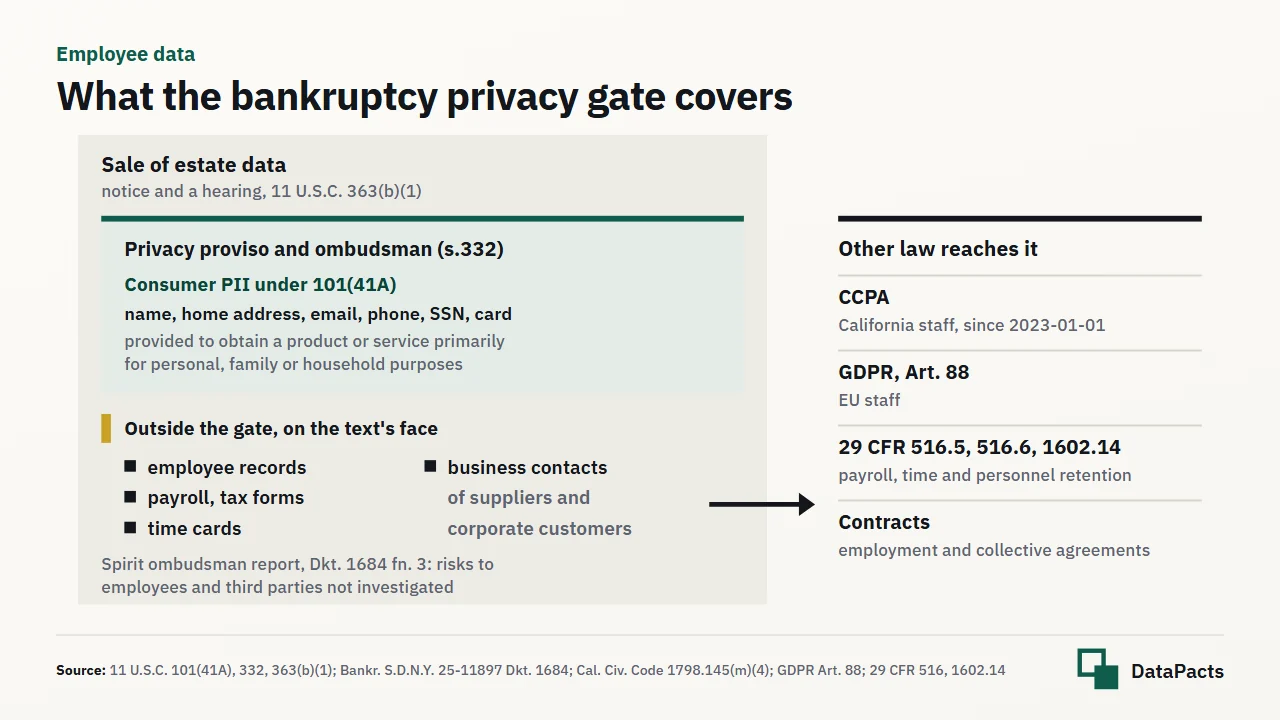
Staff records can still sit inside an estate's data sale, as the Spirit Airlines asset schedule shows, and other law governs them: the CCPA, the GDPR, federal retention periods and contracts. The sections below apply to staff data in AI training data licensing.
Statutes and dockets here were checked against primary sources under DataPacts Editorial Team: how we source, date and check every figure.
Where the Bankruptcy Code's Privacy Gate Stops: Consumer Data Only
The privacy gate of 11 U.S.C. 363(b)(1) opens only for personally identifiable information under section 101(41A), and that definition is built on consumer transactions.
Under paragraph (A), a name, residential address, email address, home telephone number, Social Security number or credit card number counts only if "provided by an individual to the debtor in connection with obtaining a product or a service from the debtor primarily for personal, family, or household purposes".
Paragraph (B) adds birth data and other identifying information linked to those items. The proviso itself applies when the debtor disclosed a privacy policy "in connection with offering a product or a service" that was in effect when the case began. The provisions were read on uscode.house.gov on 2026-11-10.
Table: which records fall inside 11 U.S.C. 101(41A), as of 2026-11-10.
| Record held by the debtor | Inside 101(41A)? | Why | Source |
|---|---|---|---|
| Customer name, home address, email, phone, SSN or card number given to buy a consumer product or service | yes | (A): items provided for personal, family or household purposes | uscode.house.gov 11 U.S.C. 101 |
| Birth data or other identifying information linked to those items | yes | (B) | uscode.house.gov 11 U.S.C. 101 |
| Employee records, payroll, tax forms, time cards | no, on the text's face | not provided to obtain a consumer product or service | uscode.house.gov 11 U.S.C. 101 |
| Business contacts of suppliers and corporate customers | no, on the text's face | not provided for personal, family or household purposes | uscode.house.gov 11 U.S.C. 101 |
A staff record, payroll line or business contact therefore sits outside the proviso on its face, even when it holds the same identifiers, such as a home address on a personnel file.
That is a reading of the text, not a holding: no court ruling applying section 101(41A) to staff data is cited here. The ombudsman's appointment, the two routes through the proviso and the FTC conditions are covered by the full proviso and ombudsman process in US bankruptcy data sales.
What the Court Still Hears When a Sale Includes Staff Records
A sale of staff records outside the ordinary course still needs notice and a hearing under 11 U.S.C. 363(b)(1); what drops away is the privacy-specific review. The first clause of section 363(b)(1) applies to every estate asset, data included.
Paragraph (B) of the proviso needs a consumer privacy ombudsman under section 332, appointed not later than 7 days before the hearing, and a court finding that no showing was made that the sale would violate applicable nonbankruptcy law.
That route applies only to information within 101(41A). No court-ordered privacy report therefore covers staff data; objections and the debtor's own choice to exclude or de-identify bring it before the court, as the Spirit record shows next.
Staff Lines in the Spirit Airlines Asset Schedule and the Ombudsman's Footnote
The Spirit Airlines chapter 11 (Bankr. S.D.N.Y. 25-11897 (SHL)) is the court record where staff data sits inside a data sale for AI buyers: the revised asset schedule of 2026-11-09 (ECF 1802) lists employee records as included and payroll, tax-form and time-card records as Not Included.
The auction of 2026-08-14 produced a Google LLC successful bid of USD 10,000,000 and a Mercor.io Corporation alternate bid of USD 7,500,000 (Dkt. 1463); no sale order was on the docket as of 2026-11-18.
Table: staff and other lines of the revised Spirit asset schedule, as of 2026-11-18, counts as listed by the debtors in ECF 1802 (2026-11-09).
| Schedule line | Count | Status in schedule | Source |
|---|---|---|---|
| Employee Records | 175,658 | Included | ECF 1802 |
| Payroll | 3,426,618 | Not Included | ECF 1802 |
| Tax Forms | 148,018 | Not Included | ECF 1802 |
| Time Card | 1,092,000 | Not Included | ECF 1802 |
| Emails / Teams Count | 1,986,737,423 / 663,530,348 | Included | ECF 1802 |
| Passengers | 97,500,000 | Not Included | ECF 1802 |
The data pass first to a Deidentification Agent (Tonic AI) that de-identifies them to Cal. Civ. Code 1798.140(m) at Google's cost, and the revised proposed order bars Google from intentionally or knowingly re-identifying them (ECF 1802).
The ombudsman's supplemental report (Dkt. 1684, 2026-10-05) finds that approval of the sale of the de-identified data "would be appropriate" from a privacy perspective, and its footnote 3 states that risks to employees and third parties were not investigated.
The sale as a whole is covered by terms and sources of the Spirit Airlines data archive sale.
The Notice of Adjournment (Dkt. 1779, filed 2026-11-04) moves the sale hearing to 2026-11-17 at 11:00 a.m. ET and records that the debtors are working with objecting parties on employee information. Staff and union reactions are left to the employee-view page in the border below.
The Rules That Govern Staff Data in an Estate Sale Instead
Staff data in an estate sale answer to the privacy and employment law of the place where the staff work, the company's contracts and the federal retention rules, none of which the Bankruptcy Code displaces.
That is the reading of 11 U.S.C. 363(b)(1)(B)(ii), which itself refers to "applicable nonbankruptcy law"; no preemption is claimed either way.
Table: rules that reach staff data in an estate sale, as of 2026-11-10.
| Rule | Reaches staff data in an estate sale | Source |
|---|---|---|
| 11 U.S.C. 363(b)(1) proviso and 332 ombudsman | no: 101(41A) is consumer data | uscode.house.gov |
| CCPA (Cal. Civ. Code 1798.100 ff.) | yes for California staff since 2023-01-01 | cppa.ca.gov |
| GDPR (Regulation (EU) 2016/679) and Art. 88 national rules | yes for EU staff | eur-lex.europa.eu |
| 29 CFR 516.5, 516.6; 29 CFR 1602.14 | yes: retention periods for payroll, time and personnel records | ecfr.gov |
| Employment contracts and collective agreements | case by case | the company's own documents |
California Staff: The CCPA Since 2023
For California staff, the CCPA applies, because its employee exemption has been inoperative since 2023-01-01 (Cal. Civ. Code 1798.145(m)(4)).
Licensing personal information for money is a sale, and the exception in 1798.140(ad)(2)(C) and (ah)(2)(C) covers only a transfer in a bankruptcy or similar transaction in which the third party "assumes control of all or part of the business".
A sale of a data archive alone to an AI buyer does not match that wording on its face, which is a reading of the text, not a ruling. The rules are set out in the full California CCPA/CPRA rules for licensing data.
De-identified data that meets 1798.140(m) is outside personal information, which is the standard the Spirit sale uses. Administrative fines run up to USD 2,500 per violation and USD 7,500 per intentional violation (1798.155(a)), CPI-adjusted to USD 2,663 and USD 7,988 from 2025-01-01.
EU Staff: The GDPR and National Employment Rules
EU staff data stay under the GDPR (Regulation (EU) 2016/679, applicable since 2018-05-25) whatever court runs the insolvency, so a sale needs a legal basis, a compatibility test and notices.
That means an Art. 6 basis, the Art. 6(4) factors for reuse, the Art. 13(3) notice before the new purpose, the buyer's Art. 14 notice within one month at the latest and, for a US buyer, a Chapter V transfer tool.
Art. 88 lets member states and collective agreements set more specific employee-data rules with the safeguards of Art. 88(2), and in CJEU C-34/21 (2023-03-30) national rules that fail Art. 88(2) must be disregarded.
Two records sit close to insolvency: the German Data Protection Conference (DSK) resolution of 2024-09-11 states that transferring employee data to a bidder before signing is in principle not permitted without consent, with legitimate interest possible for key persons in advanced negotiations, and the Italian Garante order of 2026-04-17 fined a company in liquidation EUR 5,000 after it kept a former employee's mailboxes active and left an erasure request unanswered.
Both are developed under Article 88 and national rules for employee data under the GDPR.
Employment Contracts and Collective Agreements
Employment contracts, handbooks and collective agreements can limit what an estate does with staff data, and the estate checks them before a sale. No rule on how a bankruptcy court treats such limits for data is stated here, so the check is a step, not a conclusion.
Works councils and unions have their own routes, which the staff-notice page in the border below covers.
Records an Estate Must Keep Even After a Sale
Federal recordkeeping rules require payroll records for at least 3 years (29 CFR 516.5), time cards for 2 years (29 CFR 516.6) and personnel records for 1 year from the action (29 CFR 1602.14), so an estate that sells staff records keeps its own copies.
The wider question of minimum periods for record retention after closing a company has its own page.
A license that requires deletion of the seller's copy conflicts with these periods, so the seller checks that clause in drafting; no ruling is cited.
How an Estate Handles Staff Records Before a Data Sale
An estate that holds staff records decides first whether they belong in the sale at all, then de-identifies, documents and discloses what remains. The steps run in this order:
- Map the staff systems (HR, payroll, time, tax, email and chat) against the asset schedule, as the Spirit schedule lists them line by line.
- Check where the staff live and work, which decides whether the CCPA, the GDPR or national rules apply.
- Keep the copies that the retention periods require.
- Exclude or de-identify the records using standards for PII removal and de-identification of staff records, and name the standard in the sale documents, as Spirit names 1798.140(m).
- For EU staff, give the Art. 13(3) notice before the transfer.
- Disclose the staff lines and their treatment in the sale motion, so that objections can be heard at the hearing.
Including Staff Records in an Estate Sale or Not: Benefits, Risks, Downsides and Alternatives
For an estate, staff records can add to a data package, but no ombudsman reviews them, objections are likely, and leaving them out is a valid outcome.
- Benefits: the archive is sold whole where the law allows; de-identified staff data can stay in, as the Spirit structure proposes; a sale order, once entered, follows notice and a hearing.
- Risks: objections and adjournments tied to employee information, as in Spirit; CCPA fines for California staff where the transfer counts as a sale; GDPR exposure for EU staff; an ombudsman's report that gives the court no view on staff risk.
- Downsides: de-identification cost, borne by the buyer in Spirit; retention copies that stay with the estate; contract review before any transfer.
- Alternatives: not selling staff records, excluding them as Spirit excludes passenger profiles; selling only de-identified staff data; selling the business as a going concern to a buyer that assumes control, the case the CCPA exception describes; not selling any data.
DataPacts takes no position on whether an estate should include staff records; the trustee or debtor proposes and the court decides.
Where Staff Data in Insolvency Connects to Employee Law, Estates and the Seller Path
This page covers staff records in bankruptcy data sales; the pages below cover the employee view, the jurisdiction rules, the estates tracker and the seller decision. This page is information, not legal advice.
- every insolvency route for data assets in insolvency (parent)
- the tracker of bankruptcy estates selling data assets
- employee data and AI training rules by jurisdiction
- employee notice and consent steps, including works councils
- the employee perspective on company data sales, including union reactions
- the out-of-court route: assignment for the benefit of creditors and data assets
- outside the US: insolvency administrators and liquidators as data sellers
- the seller view: selling data from a shut-down or defunct company
- alternatives to selling data to AI labs, including not selling
- what buyers ask of HR and payroll systems
Frequently Asked Questions
Does the consumer privacy ombudsman protect employee data?
No, the ombudsman acts only where 11 U.S.C. 363(b)(1)(B) applies, and that covers information within 101(41A) given to obtain consumer products or services. Employee and payroll records are outside that definition on the text's face.
Can a bankrupt company sell employee records to an AI buyer?
The Bankruptcy Code does not single staff records out: a sale outside the ordinary course needs notice and a hearing, and then the CCPA, the GDPR, retention rules and contracts apply. The court decides.
Were Spirit Airlines' employee records sold?
No sale is approved as of 2026-11-09. The records are listed as included assets in a sale whose hearing is set for 2026-11-17 (Dkt. 1779), and the debtors are working with objecting parties on employee information.