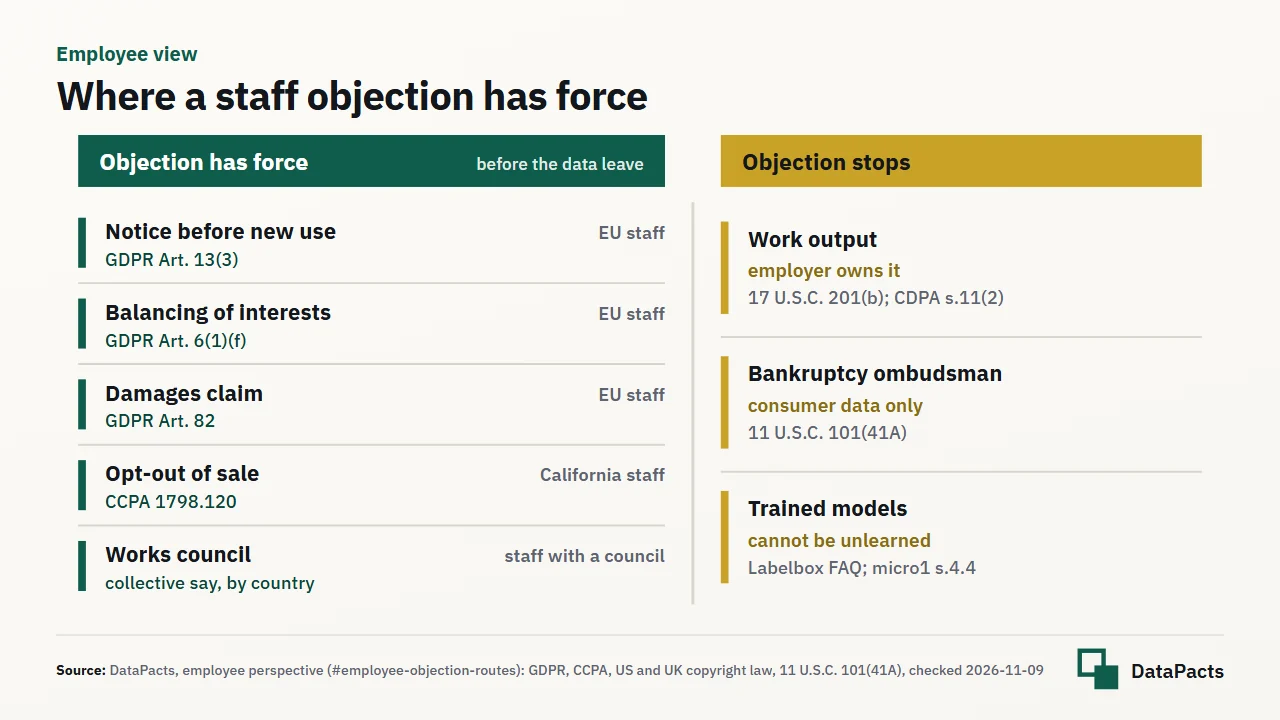
Staff can rely on notice, a balancing test, damages, a California opt-out or a collective say, and have little force against the employer's ownership of their work or a model already trained.
This page takes the staff side: rights, documented reactions and what primary guidance calls fair. Staff are one party affected by AI training data licensing, and the employer's own duties sit on the seller pages. Not licensing staff data at all is a valid outcome for the company.
DataPacts Editorial Team checked every rule, case and term here on November 9, 2026 and re-checked the Spirit Airlines record on November 10, 2026; the page on how we source, date and check every figure sets out the method.
What Staff Have at Stake When an Employer Licenses Workplace Records
Staff have their messages, their personnel records and their work output at stake, because a workplace archive holds all three.
The revised Spirit Airlines asset schedule in the bankruptcy court (ECF 1802, 2026-11-09) lists 175,658 employee records, 1,986,737,423 emails and 663,530,348 Teams items as included, and marks 3,426,618 payroll items, 1,092,000 time cards and 148,018 tax forms Not Included.
- Messages: Slack, Teams and email threads, where staff wrote as individuals.
- HR and payroll records: personnel files, pay, time cards and tax forms.
- Work output: code, documents and tickets staff produced.
- Recordings and voice: call and meeting recordings that carry a person's voice.
Buyers and intermediaries already carve some of this out. AfterQuery states that payroll is never used, and SimpleClosure, a wind-down service and intermediary, states that sensitive employee and compensation information is excluded (both checked November 9, 2026).
The asymmetry is that the license fee goes to the licensor, and under micro1's data license master terms (updated November 8, 2026) the seller carries privacy claims through its indemnity in s.8.1 (checked November 9, 2026).
What Employees Can Object To, and Where an Objection Stops
An employee's objection has legal force where a statute gives staff a notice, a balancing test, a damages claim, an opt-out or a collective say, and little force where the employer owns the work or the model is already trained.
The table compares nine routes by who can use them, what they achieve and what they cannot do, as of 2026-11-09.
| Route | Who can use it | What it can achieve | What it cannot do | Instrument | Source |
|---|---|---|---|---|---|
| Notice before new use | EU staff | learn the purpose before disclosure | stop the disclosure by itself | GDPR Art. 13(3) | eur-lex.europa.eu |
| Balancing of interests | EU staff | interests weighed; real data only where dummy data do not suffice | guarantee an outcome | GDPR Art. 6(1)(f); BAG 8 AZR 209/21 | eur-lex.europa.eu; bundesarbeitsgericht.de |
| Damages claim | EU staff | compensation (EUR 200 in the BAG case, 2025-05-08) | undo a transfer | GDPR Art. 82 as applied by the BAG | bundesarbeitsgericht.de |
| Regulator complaint | EU staff, including former staff | findings and a fine (EUR 5,000, Garante, 2026-04-17) | stop a deal in advance | Garante order doc. web 10250265 | garanteprivacy.it |
| Opt-out of sale | California staff | stop the sale of their personal information | reach de-identified data | CCPA 1798.120, 1798.140(m) | cppa.ca.gov |
| Collective say | staff with a works council | co-determination, consent or consultation by country | act for an individual alone | see the jurisdiction page | gesetze-im-internet.de; wetten.overheid.nl; code.travail.gouv.fr |
| Copyright in work output | limited | little: the employer is first owner or author | block licensing of work made in employment | 17 U.S.C. 201(b); CDPA s.11(2) | govinfo.gov; legislation.gov.uk |
| Bankruptcy ombudsman | limited | none for staff: consumer data only | represent employees | 11 U.S.C. 101(41A) | govinfo.gov |
| Objection after training | limited | contract claims against the seller | unlearn a trained model | Labelbox FAQ; micro1 s.4.4 | prism.labelbox.com; micro1.ai |
Objection Routes That Work Before the Data Leave
In the EU, staff must be told before their data are put to a new purpose, and their interests are weighed against the employer's, which makes timing the employee's main lever.
Article 13(3) of Regulation (EU) 2016/679 requires the controller to inform data subjects of the new purpose before further processing, and Article 6(1)(f) allows legitimate interests only "except where overridden by the interests or fundamental rights and freedoms of the data subject".
Article 6(4)(b) adds the relationship between data subjects and controller as a factor in judging reuse.
In BAG 8 AZR 209/21 (May 8, 2025, final), an employee who chaired the works council won EUR 200 under Article 82 GDPR after real staff data were used beyond a works agreement, and the court accepted real data only where dummy data do not suffice.
A works council can hold co-determination in Germany, consent in the Netherlands and consultation in France, and these collective steps are mapped country by country in employee data rules by jurisdiction. The page does not repeat them.
California staff can opt out of the sale of their personal information: the employee exemption has been inoperative since January 1, 2023, and section 1798.120 of the CCPA gives the opt-out (cppa.ca.gov statute text, 2026-01-01 version).
In Italy, a former employee's complaint led the Garante to find, among other violations, a breach of Article 17 (erasure) and to fine an Italian company in liquidation EUR 5,000 on April 17, 2026.
Where Staff Objections Carry Little Force
Staff objections are weakest against the work they produced, against internal systems in US federal law, inside a US bankruptcy and after a model has been trained.
Under 17 U.S.C. 201(b), the employer of a work made for hire is the author and owns the rights unless both parties sign a written instrument saying otherwise, and CDPA 1988 s.11(2) makes the employer first owner in the UK, subject to agreement.
Copyright therefore rarely lets staff block the licensing of code, documents or tickets they wrote, as explained under who owns the code staff produced.
The Stored Communications Act, 18 U.S.C. 2702, binds providers that offer services to the public, and a company's internal systems are generally not such services.
The bankruptcy route is narrow as well: 11 U.S.C. 101(41A) covers consumer data only, so the consumer privacy ombudsman does not represent staff. In the Spirit case the ombudsman's supplemental report (Dkt. 1684, October 5, 2026, footnote 3) records that risks to employees and third parties were not investigated.
After delivery, an objection rarely reaches the model. Labelbox states "Models already trained on the data cannot be unlearned", and micro1's terms in s.4.4 set no duty to delete or retrain trained materials (both checked November 9, 2026). What survives delivery is set by retraining and model retention rights in the contract.
How Employees and Unions Have Reacted on the Record
The documented employee reactions so far come from a court claim in Germany, a regulator complaint in Italy and union objections in the Spirit Airlines bankruptcy, with academics and lawyers quoted in the press. The table lists them in date order, as of 2026-11-09, each with its forum and source.
| Date | Who | Reaction | Forum | Source |
|---|---|---|---|---|
| 2025-05-08 | an employee who chaired the works council | damages claim over staff data used beyond a works agreement; EUR 200 awarded | Bundesarbeitsgericht, 8 AZR 209/21 | bundesarbeitsgericht.de |
| 2026-04-17 | a former employee | complaint over mailboxes kept active and an unanswered erasure request; EUR 5,000 fine | Garante, doc. web 10250265 | garanteprivacy.it |
| by 2026-10-05 | AFA-CWA, ALPA, Allied Pilots Association, IAM, TWU Local 570 | listed among objectors to the Spirit data sale | Bankr. S.D.N.Y. 25-11897 | courtlistener.com (Dkt. 1684) |
| 2026-10-05 | consumer privacy ombudsman (not named) | footnote 3: risks to employees not investigated | Dkt. 1684 | courtlistener.com |
| 2026-10-13 | Ifeoma Ajunwa, Emory University | employers should have express consent before selling workers' data | MIT Technology Review | technologyreview.com |
| 2026-10-13 | Greg Ewing, attorney | "legally radioactive" | MIT Technology Review | technologyreview.com |
| 2026-11-03 | Sara Nelson, AFA-CWA president | "AI is a fast-growing industry that is completely unregulated." | KTIV interview | ktiv.com |
| 2026-11-03 | SkyWest InFlight Association | motion for leave to participate as amicus (ECF 1774) | Bankr. S.D.N.Y. 25-11897 | courtlistener.com |
| 2026-11-04 | Spirit debtors | working with objecting parties on employee information | Dkt. 1779 | courtlistener.com |
The sale to the successful bidder is not approved as of November 9, 2026, and the court has set a hearing for November 17, 2026 (Dkt. 1779); the debtors have hired a de-identification agent, as the ombudsman's report recites. The unions' objections are part of the record of the Spirit Airlines data archive sale.
What Primary Guidance Treats as a Fair Process for Staff
Regulators and courts describe a fair process for staff data as one where people are told first, the employment relationship is weighed, the least intrusive data are used and nothing is changed quietly after the fact. The table sets out eight elements with their primary source, as of 2026-11-09.
| Element | What staff can expect | Primary source | Date |
|---|---|---|---|
| Told first | notice of the new purpose before the data are used for it | GDPR Art. 13(3) | applies from 2018-05-25 |
| Relationship weighed | the employment relationship is a factor in whether reuse is compatible | GDPR Art. 6(4)(b) | applies from 2018-05-25 |
| Safeguards in staff rules | national or collective rules carry transparency and monitoring safeguards, reviewable by courts | GDPR Art. 88(2); CJEU C-65/23 | 2024-12-19 |
| Impact assessed | employees count as vulnerable data subjects; a DPIA in most two-criteria cases | WP248 rev.01; GDPR Art. 35(1) | WP248 rev.01 |
| Least intrusive data | real staff data only where dummy data do not suffice | BAG 8 AZR 209/21 | 2025-05-08 |
| No early hand-over | staff data to a bidder before signing not without consent, with a key-person exception | DSK resolution | 2024-09-11 |
| No quiet changes | "It may be unfair or deceptive for a company to adopt more permissive data practices" (consumer context, staff blog) | FTC Office of Technology staff | 2024-02-13 |
| Anonymity tested | anonymous only if extraction and query risks are insignificant | EDPB Opinion 28/2024 | 2024-12-17 |
The DSK resolution, issued by the German data protection authorities' conference, treats customer, supplier and employee data handed to a bidder before signing as "grundsätzlich unzulässig" without consent, and allows a legitimate-interest basis for key persons in advanced negotiations.
The FTC statement concerns consumers' privacy terms, not employees, and is a staff blog rather than a Commission rule, so it is an analogy only. The employer's step-by-step sequence is on the seller page for employee notice and consent when licensing internal communications.
Staff Data in a License, Seen From the Company: Benefits, Risks, Downsides and Alternatives
For the company, including staff data can raise license value, but every benefit comes with employee-side risk, and leaving staff data out is a valid choice.
Benefits
- The data already sit in the company's systems, so no new collection is needed.
- A documented, told-first process keeps staff trust and meets the Article 13(3) notice duty.
Risks
- Individual damages claims: EUR 200 to the claimant in the BAG case of May 8, 2025.
- Union objections can delay a court-supervised sale, as the Spirit record shows.
- Privacy claims fall back on the seller through the indemnity in micro1's s.8.1.
Downsides
- Exclusions that buyers already apply, such as payroll, shrink the licensable set.
- Collective processes add time before any data leave.
Alternatives
- License only non-personal systems.
- De-identify to a stated standard such as CCPA 1798.140(m).
- Offer staff a real opt-out.
- Do not license staff data at all.
The wider question of whether to license anything is covered under should you sell or license your data.
How the Employee View Fits the Ethics of Selling Data
The employee view is one of four ethics questions about selling data for AI training, next to the privacy of people in the data, reputational risk and fair treatment of creators. The parent overview sets out all four under ethics and risk of selling data for AI training.
- Privacy: privacy risk to people in licensed data
- Reputation: reputational risk of licensing data
- Creators: consent and compensation for creators
- EU staff rules: employee data under GDPR Article 88
- Germany: works council co-determination in Germany
- Netherlands: works council consent in the Netherlands
- France: CSE consultation in France
When the Employer Has Closed: Former Staff
Former employees keep their say after a company closes, because whoever controls the archive, such as a liquidator, inherits the duties to them. The Garante complainant was a former employee of a company later in liquidation, and the DSK resolution of September 11, 2024 shows that staff data cannot simply travel to a bidder.
See selling data from a shut-down or defunct company for that route. The bankruptcy angle is covered under employee data in bankruptcy data sales.
What This Page Does Not Cover
This page covers staff whose employer licenses workplace data, not staff using AI tools at work, workplace monitoring or job losses from AI. People paid to create training data as contributors are covered under human data for AI. This page is information, not legal advice.
Frequently Asked Questions
Can my employer sell my work emails to an AI company?
Often yes, if it has a legal basis and tells staff first, but in the EU their interests must be weighed, in California staff can opt out of a sale, and a works council may have to agree. The employer still owns most work output, and the Garante and BAG cases show that staff data cannot be used freely.
Can employees stop their company's data sale?
Rarely on their own: individual staff usually have notice, balancing, damages or opt-out rights, while a block needs a works council consent right or a court that sustains an objection. The unions in the Spirit bankruptcy have objected, and the sale is not approved as of November 9, 2026.
Does de-identification end an employee's say?
Largely, once the data are truly anonymous: the GDPR does not apply to anonymous information and the CCPA excludes de-identified data, but regulators set a high bar for that test. Recital 26 GDPR looks at all means reasonably likely to be used, and EDPB Opinion 28/2024 of December 17, 2024 asks whether extraction risk is insignificant.