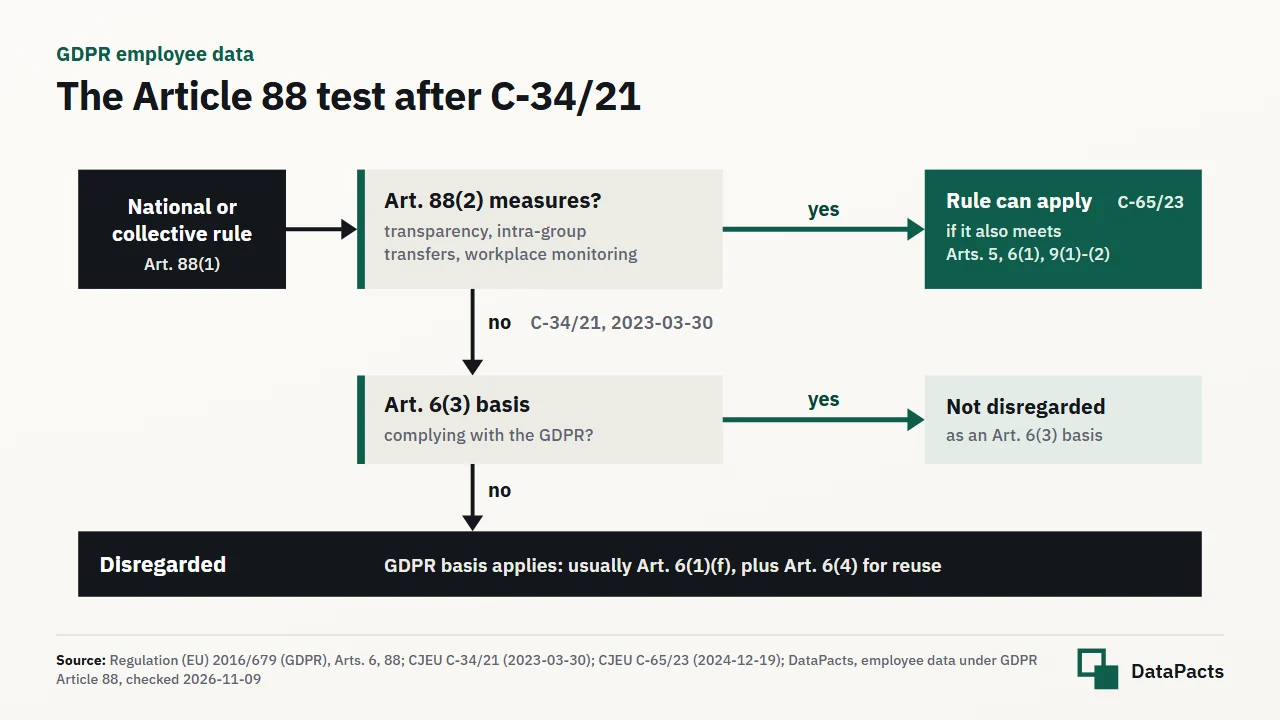
A works agreement can still be an Article 88 rule, but the Court held in C-65/23 on December 19, 2024 that it must also meet Articles 5, 6(1) and 9(1)-(2). Regulation (EU) 2016/679 applies from May 25, 2018; rulings are stated as of November 9, 2026.
Employee rules are one layer of AI training data licensing, and this page covers the article text, the two Court of Justice rulings, the German Federal Labour Court's application, the steps for staff archives and the pending Article 88c.
What Article 88 Lets Member States and Collective Agreements Set
Article 88(1) allows member states, by law or by collective agreements, to set more specific rules for processing employee data in the employment context, and Article 88(2) requires those rules to include suitable and specific measures on transparency, intra-group transfers and monitoring systems at the workplace.
The table compares the two paragraphs and their effect on a staff-data license, as of 2026-11-09.
| Paragraph | What it says (as recorded) | Effect on a staff-data license | Status | Source |
|---|---|---|---|---|
| Art. 88(1) | member states, by law or collective agreements, may set more specific rules on processing employee data in the employment context | a national or collective rule can govern staff data only within Art. 88 | in force; applies from 2018-05-25 | publications.europa.eu (CELEX 32016R0679) |
| Art. 88(2) | rules include suitable and specific measures to safeguard human dignity, legitimate interests and fundamental rights, with regard to transparency, intra-group transfers and monitoring systems at the workplace | a rule without these measures is disregarded (C-34/21) | in force | publications.europa.eu (CELEX 32016R0679) |
The article gives an employer no basis of its own to disclose staff data; data outside a valid rule falls back on the general articles, as the next section shows.
How the 19 jurisdictions compare, including Switzerland, the UK and the United States, is set out in the comparison of employee data and AI training rules by jurisdiction.
What the Court of Justice Decided in C-34/21 on March 30, 2023
In C-34/21 (Hauptpersonalrat der Lehrerinnen und Lehrer, First Chamber, March 30, 2023), the Court of Justice held that national rules which do not meet Article 88(2) are not "more specific rules" and must be disregarded unless they are a legal basis under Article 6(3) that complies with the GDPR.
The parties are the main staff council of teachers at the Hessian Ministry of Education and the Minister of that ministry.
For a seller the consequence is practical. The judgment states that more specific rules cannot be limited to repeating the GDPR's conditions for lawful processing (paragraph 71), and a provision that only repeats the necessity test cannot carry a disclosure of staff data.
The Fallback When a National Rule Is Disregarded
When a national employee rule is disregarded, processing of staff data needs a basis directly in the GDPR, usually Article 6(1)(f), and any reuse of staff records for a new purpose such as a training data license also needs the Article 6(4) compatibility test.
Article 6(4) weighs five factors: the link between the purposes, the context and the relationship between the people and the controller, the nature of the data, the consequences, and safeguards such as pseudonymization.
The employer-staff relationship belongs to the context factor, and the full test is on the page on purpose compatibility under Article 6(4) when reusing data for AI training.
Later Rulings That Apply C-34/21 to Workplace Data
Two later rulings show how C-34/21 works in practice: the Court of Justice's C-65/23 of December 19, 2024 and the German Federal Labour Court's 8 AZR 209/21 of May 8, 2025.
The table lists the three rulings by date, as of 2026-11-09.
| Date | Court and docket | Holding (as recorded) | Status | Source |
|---|---|---|---|---|
| 2023-03-30 | CJEU (First Chamber), C-34/21 Hauptpersonalrat | national rules not meeting Art. 88(2) are not "more specific rules" and are disregarded unless an Art. 6(3) basis complying with the GDPR | decided | publications.europa.eu (62021CJ0034) |
| 2024-12-19 | CJEU (Eighth Chamber), C-65/23 MK v K GmbH | Art. 88 rules must also comply with Arts. 5, 6(1), 9(1)-(2); agreement parties' discretion on necessity does not prevent full judicial review | decided | publications.europa.eu (62023CJ0065) |
| 2025-05-08 | Bundesarbeitsgericht, 8 AZR 209/21 | § 26(1) BDSG unapplied as not meeting Art. 88; real data in tests under Art. 6(1)(f) only where dummy data do not suffice; EUR 200 non-material damages (2025-05-08) | final | bundesarbeitsgericht.de |
In C-65/23, a reference from the Federal Labour Court, the Eighth Chamber held that a rule adopted under Article 88, including a works agreement, must also comply with Articles 5, 6(1) and 9(1)-(2), and that the discretion of the agreement parties on what is necessary does not prevent full judicial review.
In 8 AZR 209/21 an employer moved staff data beyond a temporary works agreement to a group SharePoint to test Workday. The agreement allowed 9 fields, and home address, date of birth, marital status, social security number, tax ID, salary and nationality were also uploaded.
The court left § 26(1) BDSG unapplied as not meeting Article 88, accepted real data in a test under Article 6(1)(f) only where dummy data do not suffice, and on May 8, 2025 awarded EUR 200 in non-material damages under Article 82. The German rule in full sits on the page on employee data in Germany after the BAG ruling on BDSG Section 26.
Licensing Staff Slack, Email and Ticket Archives After C-34/21
A Slack workspace, a mailbox archive or a ticket system holds staff names, messages and performance traces, so each of the three Article 88(2) safeguard areas reaches a training data license, and the table maps each area to the step it touches.
The table maps the three Article 88(2) areas to a staff-data license, as of 2026-11-09; the application to licensing is analysis, not a court holding.
| Art. 88(2) area | Where it touches a staff-data license | GDPR or national instrument | Source |
|---|---|---|---|
| Transparency | staff informed of the new purpose before disclosure (Art. 13(3)); buyer's own notice within one month (Art. 14(3)(a)) unless Art. 14(5)(b) applies; employees listed as vulnerable data subjects in WP248 rev.01 | GDPR Arts. 13(3), 14; WP248 rev.01 | publications.europa.eu; ec.europa.eu |
| Intra-group transfers | moving staff data to a group entity beyond a works agreement was the BAG fact pattern; a license to an outside buyer is a disclosure to a new controller | BAG 8 AZR 209/21 | bundesarbeitsgericht.de |
| Monitoring systems at the workplace | export, labeling or de-identification tooling run on company systems can be a monitoring device in Germany; objective suitability decides, not intent | BetrVG § 87(1) Nr. 6; BAG 1 ABR 7/15 (2016-12-13) | gesetze-im-internet.de; bundesarbeitsgericht.de |
The BAG facts are a group transfer, not a sale, so a license to an outside buyer goes further than the transfer the court reviewed (analysis). In Germany applicants and persons whose employment has ended count as employees under § 26(8) BDSG, so old archives are covered too.
The seller's step-by-step sequence is owned by the page on employee notice and consent when licensing internal communications, which also covers the works council step table.
Which Legal Basis Remains for Staff Messages
With the national rule out of the way, a seller of staff messages usually relies on legitimate interest under Article 6(1)(f), which requires a lawful interest, necessity and a balancing that the people in the data do not override.
The Irish Data Protection Commission states in its AI Insights Report of September 2026 that it is "unlikely that a controller will be able to demonstrate that data subjects expect the usage of their private messages or other private data for AI training".
Before signing, the German supervisory authorities' resolution of September 11, 2024 treats disclosing employee data to a bidder as in principle not permitted without consent, with a legitimate interest possible for key persons in advanced negotiations.
In Germany employee consent must meet the standards of § 26(2) BDSG, and the page does not describe general EU guidance on consent in employment. The three-step test is set out on the page on legitimate interest under Article 6(1)(f) for AI training data.
Works Agreements and Collective Agreements as Article 88 Rules
A works agreement or collective agreement can be an Article 88 rule, but after C-65/23 it must still meet Articles 5, 6(1) and 9 and stays open to full review by the courts.
Existing IT works agreements on email, chat or ticket tools can restrict new uses such as AI training in the German record.
Whether a collective body must agree, be consulted or only be informed is national: co-determination over monitoring devices in Germany (BetrVG § 87(1) Nr. 6), consent in the Netherlands (WOR art. 27(1)(k), (l)) and information and consultation in France (Code du travail L2312-8 II 4°). The country list below carries one line each.
Pending, Not Article 88: The Proposed Article 88c
The Commission's Digital Omnibus proposal COM(2025) 837 of November 19, 2025 would add an Article 88c on legitimate interest for the development and operation of AI, which is a proposal and not part of Article 88's employment rule.
As of November 9, 2026 the European Parliament lists procedure 2025/0360(COD) as "Awaiting committee decision", unchanged on November 10, 2026. The procedure is tracked on the page on EU Digital Omnibus proposed GDPR changes.
Benefits, Risks, Downsides and Alternatives for an Employer Licensing Staff Data Under Article 88, Including Not Licensing
Article 88 does not forbid licensing staff data, but after C-34/21 an employer cannot lean on a national employee statute that only restates the GDPR, and not licensing remains a valid choice.
Benefits
- A works agreement meeting Article 88(2) and C-65/23 can give staff a defined process.
- One EU-wide test applies once national rules fall away.
Risks
- A disregarded national rule leaves the disclosure without a basis.
- Article 82 damages claims by staff, EUR 200 in the BAG case of May 8, 2025.
- Co-determination or consent rights of works councils.
Downsides
- The Article 6(4) test and notice are due before disclosure.
- The Irish DPC's view on private messages narrows what a balancing test supports.
- Former staff and applicants still count as employees in Germany.
Alternatives
- Remove or de-identify staff identifiers before licensing.
- License only non-personal content.
- Negotiate a works agreement first.
- Do not license staff communications at all; see also alternatives to selling data to AI labs, including not selling.
Beyond Article 88: Member-State Rules and Related Staff Data Pages
Article 88 is one article of the GDPR, and the member-state pages hold the national rules it allows. The page on GDPR and AI training data sets it beside legal basis, notices and transfers.
- Germany: § 26(1) BDSG unapplied since May 8, 2025; BetrVG § 87(1) Nr. 6, with the Einigungsstelle deciding under § 87(2)
- France: CSE information and consultation under L2312-8 II 4° and L2312-38, not consent
- Netherlands: works council consent under WOR art. 27(1)(k) and (l), kantonrechter under art. 27(4); untested for licensing
- Italy: Statuto dei lavoratori art. 4(3); licensing staff email or chat is not covered on our reading
- Spain: works council informed on algorithms and AI systems, ET art. 64(4)(d)
- Austria: ArbVG § 96(1) Z 3 and § 96a
Related pages:
- Selling chat messages (Slack, Teams) for AI training
- Licensing a company email archive for AI training
- Selling issue trackers and service-desk tickets for AI training
- The employee perspective on company data sales
- Employee data in bankruptcy data sales
- GDPR notices before a data sale
- Germany works council co-determination
How This Page Is Sourced and Dated
Article text is taken from the Official Journal version of Regulation (EU) 2016/679 and the rulings from the Court of Justice and Federal Labour Court judgments, each checked on the date shown.
The rules on how we source, date and check every figure apply. This page is general information about Article 88, not legal advice for any specific deal.
Frequently Asked Questions
What does Article 88 GDPR allow?
It lets member states and collective agreements set more specific rules on employee data. Those rules must include suitable and specific measures on transparency, intra-group transfers and workplace monitoring (Art. 88(1)-(2)).
What did the CJEU decide in C-34/21?
On March 30, 2023 the Court held that national rules missing the Art. 88(2) measures are disregarded. They still apply only if they are an Art. 6(3) basis that complies with the GDPR.
Can a company license employee emails for AI training under the GDPR?
Not on a national employee rule that merely restates the GDPR. The seller needs a GDPR basis, usually Art. 6(1)(f), the Art. 6(4) test, notice under Art. 13(3) and any national works council step.
Is employee consent a valid basis for licensing staff data?
It is one basis, but in Germany it must meet § 26(2) BDSG standards. In a works setting the collective step still applies, and no general EU consent guidance is stated here.