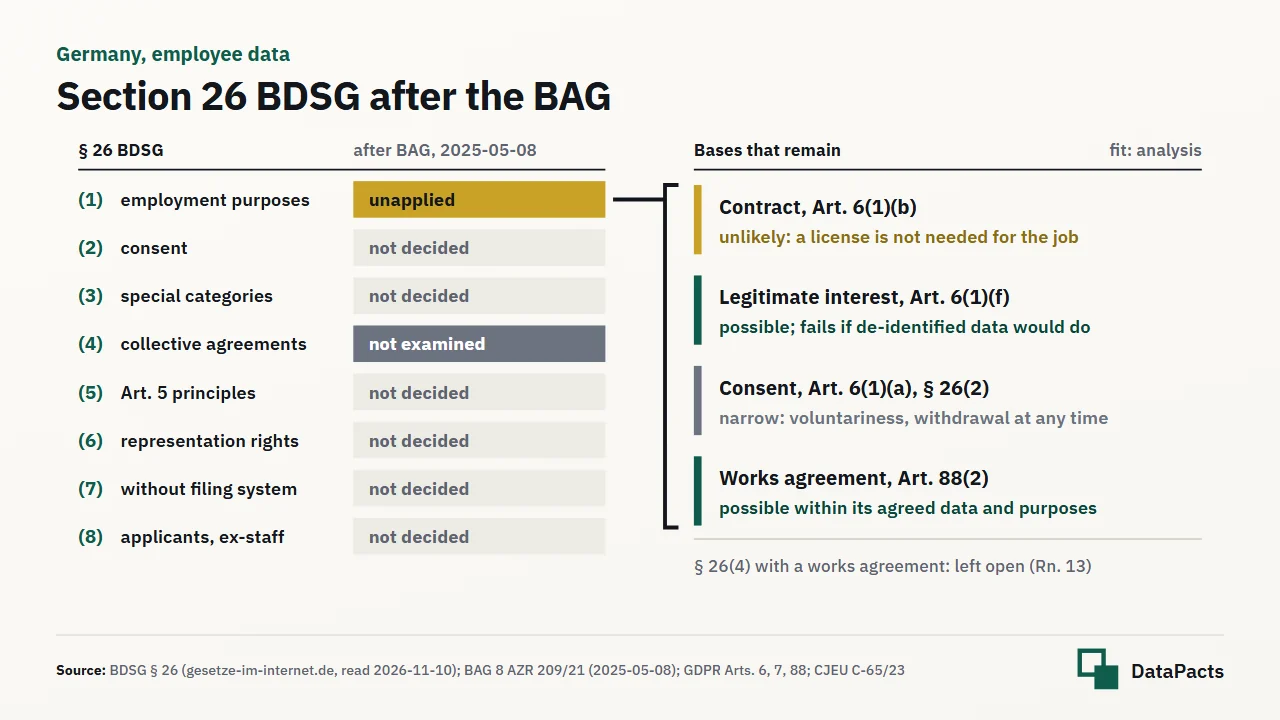
The basis must come from the GDPR directly (contract, legitimate interest, consent) or from a works agreement (Betriebsvereinbarung) that meets Article 88(2). Section 26(8) extends this to applicants and former staff.
This page covers the statute's paragraphs, the BAG's reasons, the four bases that remain and the damages exposure, as of November 10, 2026. It is written for German employers holding Slack, email, ticket or HR archives and for AI developers acquiring them, as the German employee-data layer of AI training data licensing.
What Section 26 BDSG Says, Paragraph by Paragraph
Section 26 BDSG has eight paragraphs, and the BAG ruling of May 8, 2025 left only paragraph 1 unapplied; the table states each paragraph and what the ruling did to it (statute text read on gesetze-im-internet.de, as of 2026-11-10).
| Paragraph | What it says (summary) | After BAG 8 AZR 209/21 | Source |
|---|---|---|---|
| § 26(1) | Staff data may be processed for employment purposes where necessary for hiring, performing or ending employment or for representatives' rights and duties; stricter test for detecting crimes | Unapplied, does not meet Art. 88 (Rn. 16, 17); no Art. 6(3) basis (Rn. 19) | gesetze-im-internet.de; bundesarbeitsgericht.de |
| § 26(2) | Consent: voluntariness judged by dependence and circumstances; possible where there is a legal or economic advantage or aligned interests; written or electronic form; text-form information on purpose and the Art. 7(3) withdrawal right | Not decided | gesetze-im-internet.de |
| § 26(3) | Special categories (Art. 9(1)) where needed for labor, social security or social protection rights and duties; consent must expressly name the data | Not decided | gesetze-im-internet.de |
| § 26(4) | Processing permitted on collective agreements; the parties must observe Art. 88(2) | Not examined (Rn. 13) | gesetze-im-internet.de; bundesarbeitsgericht.de |
| § 26(5) | The controller ensures the Art. 5 principles | Not decided | gesetze-im-internet.de |
| § 26(6) | Participation rights of employee representatives stay unaffected | Not decided | gesetze-im-internet.de |
| § 26(7) | Paragraphs 1 to 6 apply also without a filing system | Not decided | gesetze-im-internet.de |
| § 26(8) | "Employees" include applicants and persons whose employment has ended | Not decided | gesetze-im-internet.de |
The BAG did not disapply the other paragraphs, but no court holding cited on this page confirms that each of them meets Article 88, so the table says "not decided" and never "valid". Because paragraph 8 reaches applicants and former staff, archives of people who have left are covered too.
Why the BAG Left Section 26(1) Unapplied on May 8, 2025
The Eighth Senate held that section 26(1) BDSG does not satisfy the opening clause of Article 88 GDPR, because it lacks the protective measures that Article 88(2) requires, and therefore stays unapplied (Rn. 16 and 17).
It added that no Article 6(3) basis exists for the provision (Rn. 19) and that, without specific rules, the GDPR governs employment processing directly (Rn. 20). The BAG relied on C-34/21 and cited C-65/23.
Paragraph 1 is a necessity clause, and C-34/21 (2023-03-30) states that more specific rules cannot be limited to reiterating the GDPR (para. 65) and that a necessity-for-employment clause appears to reiterate Article 6(1)(b) without adding a more specific rule (para. 81).
The BAG case concerned a German subsidiary of a US group that moved staff data beyond a temporary works agreement to a group SharePoint to test Workday.
The Court of Justice rulings, the text of Article 88 and the position in other member states sit on the page about employee data under GDPR Article 88 after C-34/21. This page does not repeat them.
What the Court Left Open: Works Agreements Under Section 26(4)
The BAG did not decide whether section 26(4) BDSG together with a works agreement is a valid Article 88 rule, because the claimant relied only on data the agreement did not cover (Rn. 13).
The Senate put it in these words: "Der Senat hatte daher nicht zu prüfen, ob die Betriebsvereinbarung so ausgestaltet war, ..." (the Senate therefore did not have to examine whether the works agreement was designed in such a way that it qualifies).
The temporary agreement listed nine permitted fields: personnel number, names, entry dates, work location, company, business phone and business email. The court treated that list as the measure of what the test needed (Rn. 21). The employer had also uploaded home address, date of birth, marital status, social security number, tax ID, salary and nationality.
Legal Bases That Remain for Staff Data in a Training License
Four routes remain once section 26(1) is out: contract performance, legitimate interest, consent and a works agreement, and only the last two are specific to employment (table as of 2026-11-10; the fit column is analysis, not a holding).
| Basis | Instrument | What the BAG or CJEU said | Fit for a training license (analysis) | Source |
|---|---|---|---|---|
| Contract performance | Art. 6(1)(b) GDPR | Test use was "wohl" (probably) further processing, not performance of employment (BAG Rn. 22); necessity clauses appear to reiterate Art. 6(1)(b) (C-34/21 para. 81) | Unlikely: a license is not needed to perform the job | bundesarbeitsgericht.de; eur-lex.europa.eu |
| Legitimate interest | Art. 6(1)(f) GDPR | Real data only where dummy data do not suffice (BAG Leitsatz, Rn. 21); disclosure for consideration only if strictly necessary (C-621/22, 2024-10-04) | Possible after balancing; fails where de-identified data would serve | bundesarbeitsgericht.de; publications.europa.eu |
| Consent | Art. 6(1)(a), Art. 7 GDPR; § 26(2) BDSG | No consent issue in the BAG case; statute plus Art. 7(4) and Recital 43 | Narrow: voluntariness, form, withdrawal at any time | gesetze-im-internet.de; eur-lex.europa.eu |
| Works agreement | Art. 88 GDPR, Recital 155; § 26(4) BDSG | Must meet Arts. 5, 6(1) and 9 under full judicial review (C-65/23); BAG left validity open (Rn. 13) | Possible within its agreed list of data and purposes | gesetze-im-internet.de; publications.europa.eu; bundesarbeitsgericht.de |
Article 6(1)(b): Why Training Use Falls Outside the Employment Contract
Article 6(1)(b) GDPR covers processing necessary to perform a contract with the data subject, and the BAG treated even a software test as "wohl" (probably) further processing that no longer served the employment, so the basis did not carry it (Rn. 22, checked 2026-11-16).
A license to an outside AI developer sits further from the employment contract than an in-group software test (analysis). Reuse of staff records for a new purpose therefore needs the compatibility test, set out on the page about purpose compatibility under Article 6(4).
Article 6(1)(f) After the BAG: Real Staff Data Only Where Dummy Data Fail
Legitimate interest under Article 6(1)(f) can justify processing staff data for a purpose outside the job, but the BAG accepted real data in a software test only where depersonalized dummy data do not suffice (Leitsatz, Rn. 21). Data beyond the works agreement were not necessary, and the employer did not even claim they were.
In C-621/22 (2024-10-04) the Court of Justice held that disclosing personal data for consideration to satisfy a commercial interest may rest on Article 6(1)(f) only if strictly necessary and not overridden by the data subject's interests.
A paid license is such a disclosure (analysis). If de-identified or synthetic records would serve the buyer, real staff data fail the necessity step (analysis, not a holding).
For the balancing, see legitimate interest for AI training data, which sets out the three-step test in full.
Article 6(1)(a) and Section 26(2) BDSG: The Limits of Staff Consent
Consent is the one basis section 26 still shapes in detail: section 26(2) BDSG judges voluntariness by the employee's dependence and the circumstances of consent, and allows it mainly where the employee gains a legal or economic advantage or shares the employer's interest.
Consent needs written or electronic form unless special circumstances justify another, and the employer informs the employee in text form of the purpose and of the Article 7(3) withdrawal right. Under section 26(3), consent to special-category data must expressly name those data.
The GDPR adds its own limits. Article 7(3) lets the employee withdraw at any time, as easily as consent was given.
Article 7(4) requires utmost account of whether a contract is conditional on consent it does not need, and Recital 43 treats consent as invalid where there is a clear imbalance and presumes it unfree where separate consent for different operations is not allowed.
Withdrawal leaves earlier processing lawful but stops further use, which a trained model cannot always reverse (analysis).
The Conference of German Data Protection Authorities (DSK) resolved on 2024-09-11 that disclosing employee data to a bidder before signing is in principle not permitted without consent, with a possible exception for key persons. The seller's sequence is owned by employee notice and consent when licensing internal communications.
Article 88 and Section 26(4) BDSG: A Works Agreement as the Basis
A works agreement (Betriebsvereinbarung) can be the legal basis for processing staff data, because section 26(4) BDSG admits collective agreements and Recital 155 GDPR names works agreements, provided the parties observe Article 88(2).
That paragraph requires suitable and specific measures to safeguard human dignity, legitimate interests and fundamental rights, with regard to transparency, intra-group transfers and monitoring systems at the workplace.
In C-65/23 (2024-12-19), a reference from the BAG, the Court of Justice held that such agreements must also comply with Articles 5, 6(1) and 9(1) and (2), and that the parties' discretion on necessity does not prevent full judicial review. A works agreement therefore cannot make an unnecessary disclosure necessary.
The BAG case shows the scope rule in practice: data outside the agreed list lost its basis (Rn. 21). Whether the works council must co-determine the export tooling is covered under works council co-determination under BetrVG section 87.
Damages When Staff Data Leaves the Agreed Scope
Each employee whose data is processed without a basis can claim non-material damages under Article 82 GDPR, and in the BAG case the loss of control over data sent to the group parent was the damage (Rn. 25).
The court awarded EUR 200 plus interest from 2018-05-26. The claimant had suggested EUR 3,000 in the reasons while leaving the amount to the court.
Rn. 29 names the factors: the sensitivity of the data (below Article 9), the group-internal circle of recipients and the duration of the loss of control. A license to an outside buyer would widen the circle of recipients (analysis; no total is computed for an archive).
Licensing Staff Data Under German Law: Benefits, Risks, Downsides and Alternatives, Including Not Licensing
German law does not forbid licensing staff data, but after the BAG ruling no employment statute carries it, so an employer weighs what a license adds against a basis that must be built case by case, and not licensing remains a valid choice.
Benefits
- One EU-wide test applies once section 26(1) falls away.
- A works agreement meeting Article 88(2) and C-65/23 gives a defined, reviewable process.
- De-identified records can pass the necessity step the BAG applied; see de-identifying staff records before a license.
Risks
- Article 82 claims per employee.
- Disclosure without a basis where staff data exceed an agreement.
- Consent challenged as not voluntary under section 26(2).
Downsides
- The BAG did not decide whether section 26(4) with a works agreement is valid.
- Section 26(8) keeps applicants and former staff in scope.
Alternatives
- De-identify or remove staff identifiers first.
- License only non-personal content.
- Negotiate a works agreement before any export.
- Do not license staff data at all.
The full decision framework is on the page about whether to license data to AI companies at all.
Beyond Section 26: The German Page, Neighboring Rules and the Seller Process
Section 26 is one German rule; copyright reservations, recordings, insolvency and the full German overview sit on the Germany page. The German overview is the parent of this page.
- Employee data and AI training rules by jurisdiction: how other countries treat staff data.
- GDPR and AI training data: notices and transfers beside the legal basis.
- EU Digital Omnibus proposed GDPR changes: the proposed Article 88c, not law.
- Telecom secrecy and private use of work email and chat: mailboxes where private use is allowed.
- Recorded speech and call data: call and meeting recordings.
- Selling chat messages (Slack, Teams) for AI training: the chat archive as a data type.
- Licensing a company email archive for AI training: the email archive as a data type.
- German insolvency and data sales: when an administrator sells staff archives.
- The employee perspective on company data sales: how staff see a sale.
- Alternatives to selling data to AI labs: alternatives, including not selling.
What This Page Does Not Cover
This page covers employee data an employer licenses or discloses for AI training, not how staff may use AI tools at work or AI Act literacy duties. It does not cover future German employee-data legislation.
How This Page Is Sourced and Dated
Statute text is taken from gesetze-im-internet.de and the GDPR from the Official Journal, and the ruling is cited by senate, file number, date and marginal number (Rn.), each checked on the date shown.
The method is set out in how we source, date and check every figure. This page is general information about German employee-data law, not legal advice for any specific deal or dispute.
Frequently Asked Questions
Can a German employer still rely on section 26 BDSG to license staff data?
Not on paragraph 1: the BAG left section 26(1) BDSG unapplied on May 8, 2025 (8 AZR 209/21). The employer needs a GDPR basis or a works agreement meeting Article 88(2). Paragraphs 2 to 8 remain in the statute, but the BAG has not decided on them.
Is employee consent enough to license staff emails for AI training in Germany?
Rarely on its own: section 26(2) BDSG judges voluntariness by the employee's dependence and the circumstances. Article 7(3) GDPR lets the employee withdraw at any time, and Article 7(4) and Recital 43 add limits on conditional and imbalanced consent.
Did the BAG decide whether a works agreement can be the legal basis?
No, the BAG did not need to decide it (Rn. 13). The claimant relied only on data outside the agreement. C-65/23 requires such agreements to comply with Articles 5, 6(1) and 9 under full judicial review.