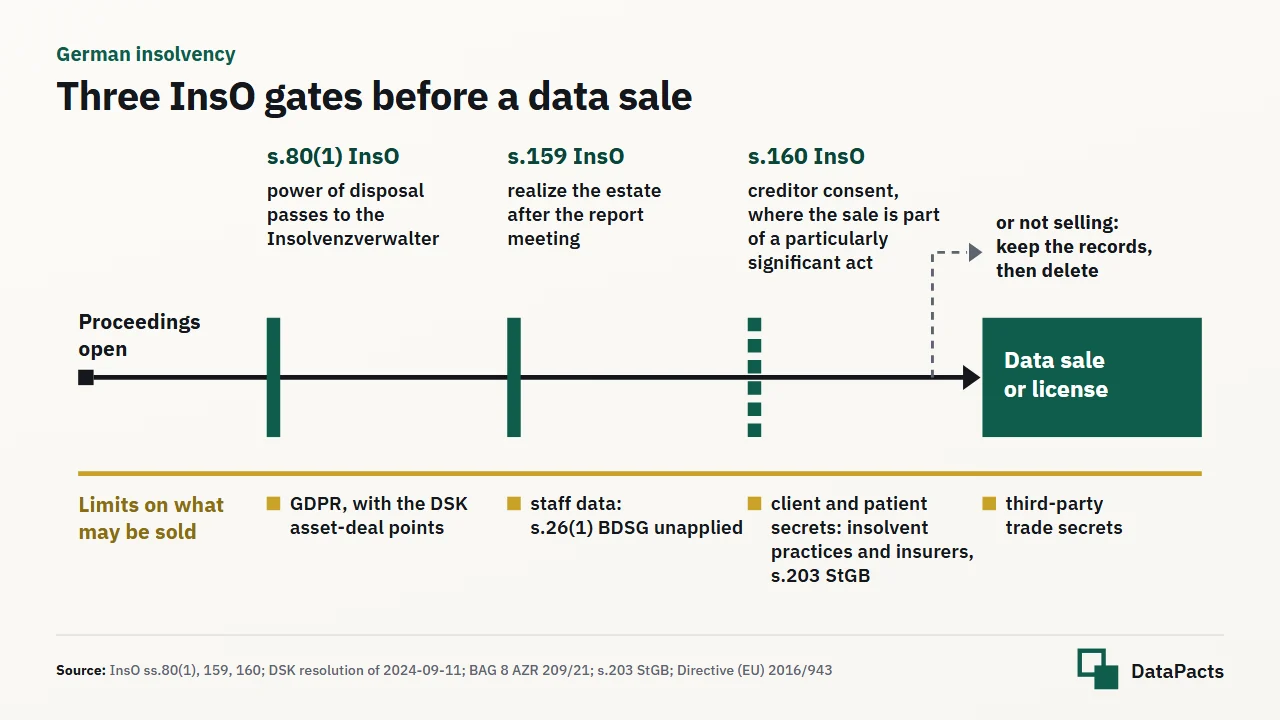
The administrator must realize the estate after the report meeting and needs creditors' consent for particularly significant acts. This page sets out those duties as one route in AI training data licensing, then the data protection authorities' asset-deal points, employee, secrecy and trade-secret limits, buyer programs as dated claims and the option not to sell.
The statutes, rulings and program pages below were checked against their primary sources, under the rules on how we source, date and check every figure.
The Insolvenzverwalter's Power of Disposal and Duty to Realize Data Assets
When German insolvency proceedings open, the debtor's right to manage and dispose of the estate passes to the Insolvenzverwalter (s.80(1) InsO), who must realize the estate without delay after the report meeting (Berichtstermin) unless creditors' resolutions stand in the way (s.159).
The Insolvenzordnung (InsO, Insolvency Code) does not name data, but estate assets include data assets.
The table compares the three provisions as in force on 2026-11-09.
| Provision | Who | What it says | Relevance to a data sale | Source |
|---|---|---|---|---|
| s.80(1) InsO | Insolvenzverwalter | on opening, the debtor's right to manage and dispose of the estate passes to the administrator | the administrator, not the managing directors, decides on selling data assets | gesetze-im-internet.de |
| s.159 InsO | Insolvenzverwalter | after the report meeting, realize the estate without delay unless creditors' resolutions stand in the way | realization of data assets is part of the duty | gesetze-im-internet.de |
| s.160(1)-(2) InsO | creditors' committee or meeting | consent for particularly significant acts, such as selling the business, the whole stock, participations or rights to recurring income; deemed consent if the meeting is inquorate and creditors were warned | applies where the data sale is part of such an act | gesetze-im-internet.de |
Insolvenzordnung as in force on 2026-11-09. The Act does not name data.
Section 160 requires the consent of the Gläubigerausschuss (creditors' committee) or the Gläubigerversammlung (creditors' meeting) for besonders bedeutsame Rechtshandlungen (particularly significant acts), and consent is deemed given where the meeting is inquorate and creditors were warned of that.
Where the data sale forms part of such an act, that consent is needed; this page does not classify a standalone license.
Section 159 frames realization as a duty of the administrator. The general officeholder view, including other jurisdictions, is covered under insolvency administrators and liquidators as data sellers.
What Passes to the Insolvenzverwalter and What Does Not: Data Subject Rights
The power of disposal does not make the Insolvenzverwalter a data subject: the Bundesverwaltungsgericht (Federal Administrative Court) held on 2020-09-16 (6 C 10.19) that the access right under GDPR Art. 15 is highly personal and does not pass under s.80(1) InsO.
An insolvency administrator had asked a tax office for the debtor's tax account data, and the revision was dismissed.
The administrator disposes of data as an asset but holds no data subject rights in it, and the people in the data keep theirs.
Customer Data in a German Estate Sale: The DSK Asset-Deal Points
The Datenschutzkonferenz (DSK), the joint body of Germany's federal and state data protection authorities, resolved on 2024-09-11 how customer, supplier and employee data may move in an asset deal, and its points shape the planning of an estate sale even though the resolution does not address AI buyers by name.
The application to AI buyers is this page's reading. An earlier resolution of 2019-05-24 is still listed on the DSK page.
The table lists four points as of 2026-11-09, from the resolution PDF of 2024-09-11.
| Point | DSK position | Date | Source |
|---|---|---|---|
| Customer, supplier and employee data to bidders before signing | in principle not permitted without consent (grundsätzlich unzulässig); legitimate interest possible for key persons in advanced negotiations | 2024-09-11 | datenschutzkonferenz-online.de |
| Customer data transfer in negotiations in progress | objection solution (Widerspruchslösung) with a period of about 6 weeks ("etwa 6 Wochen") | 2024-09-11 | datenschutzkonferenz-online.de |
| Special-category customer data, such as health data | only with informed explicit consent (GDPR Art. 9(2)(a), Art. 7) | 2024-09-11 | datenschutzkonferenz-online.de |
| Earlier resolution | "Asset Deal: Katalog von Fallgruppen" still listed on the DSK page; relation to the 2024 text not stated | 2019-05-24 | datenschutzkonferenz-online.de |
The resolution is the authorities' position, not statute. GDPR Art. 6(4) lists the factors for a new purpose, including safeguards such as encryption or pseudonymisation, Art. 13(3) requires notice before further processing, and Art. 14(3)(a) requires it within one month at the latest.
Art. 14(5)(b) exempts disproportionate effort with appropriate measures, and the GDPR has applied since 2018-05-25.
The legal basis, notices and transfers are set out under GDPR and AI training data.
Employee Records and the Betriebsrat When a German Estate Sells Data
Employee records in a German estate cannot be sold for AI training on the basis of s.26(1) BDSG, because the Bundesarbeitsgericht (Federal Labour Court) held on 2025-05-08 (8 AZR 209/21) that the provision does not meet GDPR Art. 88 and stays unapplied.
In that case (2025-05-08) the employer had moved staff data beyond a temporary works agreement to a group SharePoint to test Workday, and the court awarded the claimant EUR 200 non-material damages under Art. 82. Real data serve testing only where dummy data do not suffice.
The CJEU applied the same disregard rule in C-34/21 on 2023-03-30, and s.26(8) BDSG treats applicants and former staff as employees.
The Betriebsrat (works council) co-determines technical devices designed to monitor employee behavior or performance under s.87(1) Nr. 6 BetrVG, and the Einigungsstelle (conciliation board) decides where no agreement is reached (s.87(2)).
The BAG held in 1 ABR 7/15 on 2016-12-13 that a device qualifies when objectively suitable for collecting conduct or performance data, whatever the employer intends.
Section 3 TDDDG is generally not read as binding employers, according to the Federal Network Agency (July 2025) and the LDI NRW (2024), and the GDPR applies in any case. The notice steps are covered under employee notice and consent when licensing internal communications.
Professional Secrets and Patient Records in Insolvent Practices
When the insolvent company is a medical, legal, tax or audit practice or an insurer, client and patient secrets are protected by criminal law (s.203 StGB), so the estate cannot license them to an AI buyer without authorization.
The offence carries up to one year or a fine, and up to two years or a fine where the offender acts for remuneration or to enrich (s.203(6)). It is prosecuted only on request (s.205(1)).
The DSK adopted a resolution titled "Besserer Schutz von Patientendaten bei Schließung von Krankenhäusern" on 2024-05-15; call recordings raise a separate risk under s.201 StGB, up to 3 years or a fine.
Trade Secrets (Geschäftsgeheimnisse) in the Estate's Archives
An estate's archives usually hold trade secrets (Geschäftsgeheimnisse) of the company and of its customers and suppliers, and EU law makes their disclosure to an AI buyer risky for both sides: under Directive (EU) 2016/943 Art. 4(4), acquiring or using a trade secret is also unlawful where the recipient knew or ought to have known it came from someone disclosing it unlawfully.
The Directive entered into force on 2016-07-05, with transposition due by 2018-06-09 (Art. 19(1)), and Art. 8(2) caps the limitation period at 6 years.
Protection depends on reasonable secrecy steps, and breaching contractual use limits is unlawful use. Germany's Gesetz zum Schutz von Geschäftsgeheimnissen (GeschGehG, Trade Secrets Act) defines a Geschäftsgeheimnis in s.2 Nr. 1 as information that is not generally known or readily accessible, is of economic value for that reason, is subject to reasonable secrecy measures by its lawful holder and carries a legitimate interest in secrecy (checked 2026-11-10).
Third-party secrets are outside what the estate can license, and its own go to a buyer only under a confidentiality agreement, as covered under NDAs before sharing data with an AI buyer.
Buyer Programs That State Wind-Down or EU Terms
Two buyer programs state on their own pages that they take records from wound-down companies and name EU terms; each statement is the buyer's claim, checked 2026-11-09.
The table lists them alphabetically, as of 2026-11-09.
| Program | What its own pages state about wind-downs or the EU | Terms relevant to an estate | Checked | Source |
|---|---|---|---|---|
| Ooak Data partner program | wind-down deals closed with a director, liquidator or administrator signing; EU partner data processed and stored in the EU via Ooak Data SAS | training use only; raw data deleted within 30 days of delivery with written confirmation | 2026-11-09 | ooakdata.com/partner; ooakdata.com/legal |
| Turing Project Lazarus | active, winding-down or wound-down companies; strongest demand US, UK, Canada and EU | license to Turing exclusive for the first 6 months; Turing may license the record to more than one lab in that term (checked 2026-11-17); revenue share, nothing upfront; Turing covers de-identification costs | 2026-11-09 | lazarus.turing.com |
Neither is endorsed or ranked, and no German law is named on either page. Turing states that the license to Turing is exclusive for the first 6 months after signing, during which it may license the same record to more than one lab (checked 2026-11-17).
The full dated terms sit in the AI data partnership payouts and program terms compared.
Selling German Estate Data or Not: Benefits, Risks, Downsides and Alternatives
For an Insolvenzverwalter, a data sale can add realizations for the creditors, which s.159 InsO makes a duty, but customer consent rules, staff records, professional secrets and third-party trade secrets limit what can be sold, and leaving data unsold is a valid outcome.
Benefits
- Data assets can be realized like other estate assets.
- Programs state that they take wind-down records.
- De-identified sets reduce the personal data that moves, and the GDPR names pseudonymisation as a safeguard.
Risks
- Pre-signing disclosure of customer, supplier and employee data is in principle not permitted without consent in the DSK's reading.
- A court awarded one claimant EUR 200 for staff data moved beyond a works agreement (2025-05-08), not a per-employee rate.
- Section 203 StGB protects client and patient secrets.
- Recipients that ought to know of an unlawful disclosure are exposed under Art. 4(4) of the Directive.
Downsides
- Creditor consent can be needed and takes time.
- In the DSK's reading, objection periods of about 6 weeks apply to customer data in negotiations in progress.
- Scoping and de-identification cost the estate unless a program covers them.
- Records must still be kept: HGB s.257(4) sets 10 years for books and annual accounts and 8 years for booking vouchers.
Alternatives
- Not selling: keep the records for their periods, then delete them.
- Selling the business or other assets without the personal data.
- Licensing instead of selling, with ownership unchanged, as Turing states for Project Lazarus.
- Where a GmbH is liquidated instead, its books and records go into custody for 10 years under s.74(2) GmbHG, which is custody, not a power to sell; see who owns a dissolved company's data.
DataPacts takes no position on whether an estate should sell; the decision belongs to the Insolvenzverwalter and, where s.160 InsO requires it, the creditors.
From Opening to Delivery: Steps for an Insolvenzverwalter Selling Data
An Insolvenzverwalter's data sale runs from an inventory after the opening to creditor consent where needed, a scoped and de-identified offer, a contract and delivery of only what the buyer may lawfully receive.
- Inventory systems, data types and the privacy notices given to customers and staff.
- Separate customer, staff and special-category data and check the new purpose against Art. 6(4) and Art. 9.
- Involve the Betriebsrat where s.87(1) Nr. 6 BetrVG applies.
- De-identify what can be de-identified, using the rules on PII removal and de-identification.
- Obtain creditor consent where s.160 InsO requires it.
- Contract the use limits, deliver, and keep the HGB s.257 records.
Advisers check whether consent is needed for a specific sale.
Where German Insolvency Data Sales Connect to Other Pages
This page covers the German insolvency route; the pages below cover other jurisdictions, German and EU law, the seller process and the buyers.
- Parent: data assets in insolvency in every jurisdiction
- UK: UK administration and liquidation, selling company data
- US: US bankruptcy data sales under section 363
- Staff data: employee data in bankruptcy data sales
- Records: record retention after closing a company in Germany, the UK and the US
- German law: Germany, rules for licensing data for AI training outside insolvency
- Works councils: works council co-determination under BetrVG section 87 in data sales
- Trade secrets: the EU Trade Secrets Directive and licensed datasets
- EU law: EU rules: GDPR, AI Act, TDM exception and Data Act
- Staff data rules: employee data and AI training rules by jurisdiction
- Outside insolvency: selling data from a shut-down or defunct company
- Transfers and contracts: selling data to AI companies from outside the US
- The general decision: should you sell or license your data
- Buyers: who buys AI training data
This page is information, not legal advice.
Frequently Asked Questions
Can an Insolvenzverwalter sell a company's customer database?
Yes, as an estate asset: the power of disposal passes on opening (s.80(1) InsO) and realization follows the report meeting (s.159). Customer data stay under the GDPR, and the DSK's 2024-09-11 resolution sets an objection period of about 6 weeks.
Do the creditors have to agree to a data sale?
Where the sale is part of a particularly significant act, such as selling the business, the creditors' committee or meeting must consent (s.160 InsO). Consent is deemed given if the meeting is inquorate and creditors were warned.
Can the Insolvenzverwalter demand the debtor's data from authorities under the GDPR?
No: the Federal Administrative Court held on 2020-09-16 (6 C 10.19) that the Art. 15 GDPR access right is highly personal. It does not pass to the administrator under s.80(1) InsO.