This page covers each jurisdiction, restoration of a UK company, what former founders and directors may do, and the choice between restoring, waiting and letting the data go, for sellers weighing AI training data licensing of an archive that outlived its company. It is not the seller guide for closed companies.
The statutes, guidance and program terms below were checked against their primary sources, under the rules on DataPacts Editorial Team: how we source, date and check every figure.
What Happens to a Company's Data on the Day It Is Dissolved
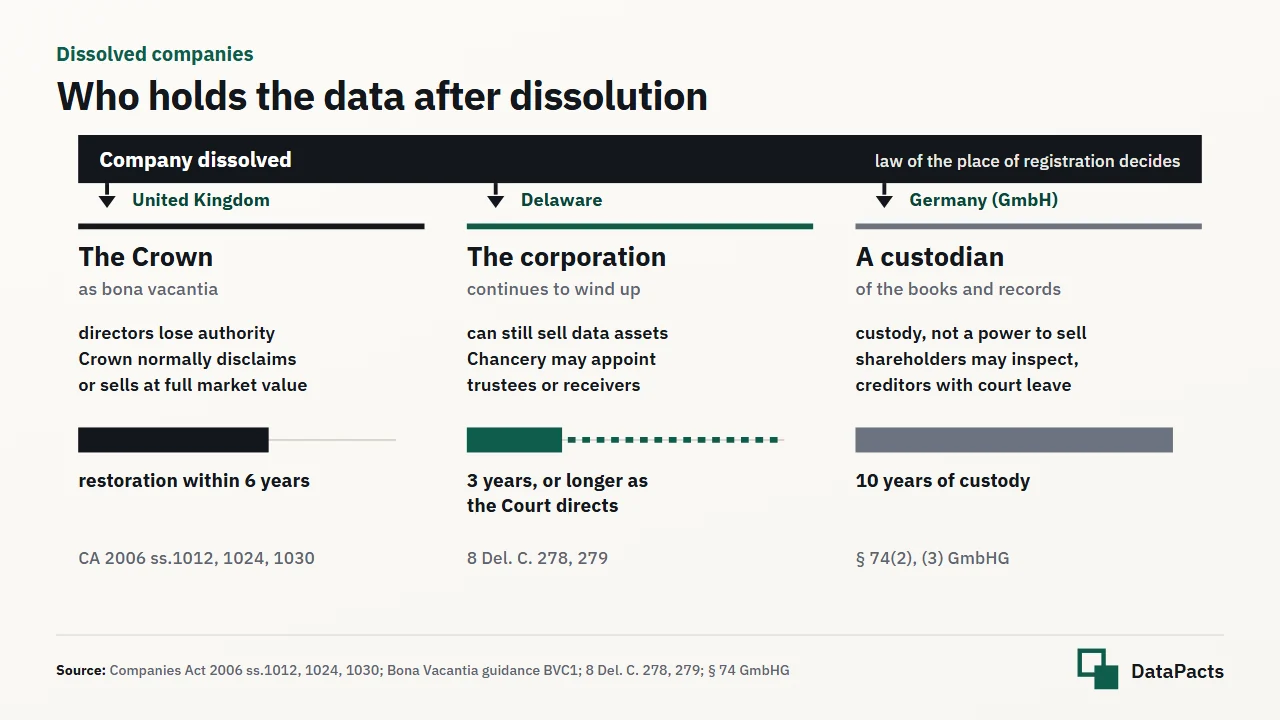
On dissolution the company stops existing as a legal person, but its data, IP and records do not disappear: the law of the place of registration decides who holds them.
The table compares three jurisdictions, as of 2026-11-09. Other US states, Scotland and Northern Ireland are not covered.
| Jurisdiction | What happens to the company's property, data included | Who can act | Time limit | Source |
|---|---|---|---|---|
| Delaware (US) | The corporation continues for suits and winding up (8 Del. C. 278) | The corporation through its directors; trustees or receivers the Court of Chancery appoints (s.279) | 3 years, or longer as the Court directs | delcode.delaware.gov |
| Germany (GmbH) | After liquidation, books and records go into custody (§ 74(2) GmbHG); custody, not a power to sell | The custodian; shareholders inspect, creditors with court authorization (§ 74(3)) | 10 years of custody | gesetze-im-internet.de |
| United Kingdom | Property and rights vest in the Crown as bona vacantia, subject to restoration (Companies Act 2006 s.1012) | The Crown, through the Bona Vacantia Division in England and Wales; directors lose authority | Restoration within 6 years (ss.1024, 1030); Crown disclaimer within 3 years or 12 months (s.1013) | legislation.gov.uk; gov.uk |
Data counts as company property and rights, so the same rule that moves cash or IP moves datasets, code and archives. Dissolution is not insolvency: a company in liquidation or administration still exists, and its officeholder decides what is sold.
United Kingdom: Company Data as Bona Vacantia and the Crown's Options
When a UK company is dissolved, all property and rights it held, except property it held on trust for others, are bona vacantia and pass to the Crown (Companies Act 2006 s.1012).
The vesting is subject to restoration of the company. Data and IP left in the company vest in the Crown, and the directors lose authority to sell them.
The Crown may disclaim the property within 3 years of its representative learning of the vesting, or within 12 months after a written application (s.1013). In England and Wales the Government Legal Department's Bona Vacantia Division deals with such assets.
Its guidance BVC1, updated 2022-09-28, states: "Normally an asset will either be disclaimed or sold for full market value." The effect of a disclaimer, and the rules for Scotland and Northern Ireland, are not stated here.
Before dissolution, an administrator or liquidator sells instead, under the Insolvency Act 1986. The sale route is set out under UK administration and liquidation.
Putting a UK Company Back on the Register Before Its Data Is Licensed
A dissolved UK company can be restored to the register within 6 years of dissolution, either administratively by a former director or member or by court order.
The table compares the two routes, as of 2026-11-09, using statute text. Effects of restoration and fees are not covered here.
| Route | Who applies | Which companies | Time limit | Source |
|---|---|---|---|---|
| Administrative restoration (Companies Act 2006 s.1024) | A former director or member | Companies struck off under ss.1000, 1001 or 1002A | 6 years from dissolution | legislation.gov.uk |
| Restoration by court order (Companies Act 2006 s.1030) | Not stated here | Not stated here | 6 years from dissolution; any time for personal injury claims | legislation.gov.uk |
Administrative restoration under s.1024 is open only to companies struck off under those sections, and court restoration under s.1030 has the same 6-year limit except for personal injury claims. Section 1012 makes the Crown's vesting subject to restoration, which is why restoration comes before any license.
The legal effect of restoration on property and contracts, who besides a former director or member may apply to court, and filing fees are not stated here.
Ooak Data states that the company must own its records (checked 2026-11-09), so for a struck-off UK company restoration is the first step with such a program. The wider United Kingdom rules for licensing data for AI training apply once the company is back.
Delaware: Winding Up for Three Years and Court-Appointed Trustees
A dissolved Delaware corporation does not lose its property: it continues for 3 years, or longer if the Court of Chancery directs, to bring and defend suits and wind up its affairs (8 Del. C. 278).
The corporation can still sell data assets during that period. Under 8 Del. C. 279 the Court of Chancery may appoint directors as trustees, or other persons as receivers, to take charge of the corporation's property.
Before dissolution, a sale of all or substantially all assets needs a majority of the outstanding voting stock at a meeting on at least 20 days' notice (8 Del. C. 271(a)). Revival of a dissolved corporation and the rules of other states are not covered.
A closing Delaware company can instead assign its assets to an independent assignee under 10 Del. C. ch. 73A, in force 2026-06-10, who petitions the Court of Chancery within 14 days. That route is covered under assignment for the benefit of creditors and data assets.
Germany: Books and Records in Custody After a GmbH Is Wound Up
When a GmbH's liquidation ends, its books and records are given into custody for ten years (§ 74(2) GmbHG), and custody is a duty to keep them, not a power to sell them.
Under § 74(3) GmbHG shareholders and their successors may inspect the books, and creditors may inspect them only if the court authorizes it.
The retention periods behind the books are 10 years for books, inventories and annual accounts and 8 years for booking vouchers (HGB § 257(4)), with the full periods left to the record retention page. Who owns assets found after deletion from the register, and whether a supplementary liquidation can sell them, is not stated here.
A sale of a German company's data before the end of the procedure belongs to the Insolvenzverwalter or the liquidators, as set out under German insolvency and data sales.
What Former Founders and Directors May and May Not Do With the Data
Former founders and directors do not inherit the company's data on dissolution, so what they may do depends on whether the jurisdiction still lets them act for the company.
May:
- Apply for administrative restoration of a struck-off UK company within 6 years, as a former director or member (s.1024).
- In Delaware, wind up the corporation's affairs during the continuation period, or act as trustees if the Court of Chancery appoints them (8 Del. C. 278, 279).
- As German shareholders, inspect the books in custody (§ 74(3) GmbHG).
- Approach programs that state they take closed companies: Turing's Project Lazarus lists "Shut down ≤90 days ago" and ">90 days ago" statuses, Labelbox states that distressed and wound-down companies are eligible, and AfterQuery states that closed companies are welcome (all checked 2026-11-09).
May not:
- Sign a license or sale for a dissolved UK company, whose directors have lost authority.
- Treat the data as passing to founders or shareholders: s.1012 sends it to the Crown.
- Assume data protection law stops: the GDPR has applied since 2018-05-25 (Regulation (EU) 2016/679, Art. 99), and Italy's Garante fined a company in liquidation EUR 5,000 on 2026-04-17. Who is the controller of personal data after dissolution is not stated here.
- Rely on a program to check authority: no program record states how a closed company's status or the signer's authority is verified.
The seller view of a closed company, from what labs want to the program terms and steps, is covered under selling data from a shut-down or defunct company.
Restoring, Waiting or Letting the Data Go: Benefits, Risks, Downsides and Alternatives
Restoring a company to license its data can turn an archive into income, but it costs time, revives duties and may not be possible, and letting the data go is a valid outcome.
Benefits:
- Restoration is the statutory route back for a struck-off UK company, and s.1012 makes the Crown's vesting subject to it.
- A Delaware corporation within its continuation period needs no restoration to act.
- Several programs state that they take wound-down companies (checked 2026-11-09).
Risks:
- Acting for a dissolved UK company without authority.
- The Bona Vacantia Division may disclaim the asset or sell it at full market value to someone else.
- Regulators can order erasure of a dataset or model built on unlawfully processed personal data (EDPB Opinion 28/2024, adopted 2024-12-17, para. 114).
- Data protection enforcement reaches companies in liquidation, as the Garante order above shows.
Downsides:
- Restoration is limited to 6 years, and its costs and effects are not stated here.
- A revenue share pays nothing upfront, as Turing states (checked 2026-11-09).
- German custody lasts ten years whether or not anyone licenses the data.
Alternatives:
- Not selling: leave the data with the Crown or the custodian, or keep records until their retention periods end and then delete them (UK private company accounting records 3 years under Companies Act 2006 s.388(4), with HMRC expecting 6; German books 10 years).
- For a company not yet dissolved, choose an insolvency or assignment route that keeps a seller in place.
- License only part of the archive, such as code without workspace data.
DataPacts takes no position on whether a dissolved company should be restored to sell its data. The decision rests with the former directors or members, the Crown, the custodian or the court, as the law provides.
Where Ownership After Dissolution Connects to Insolvency, Closing and Selling
This page covers who owns the data after dissolution; the pages below cover insolvency procedures, closing a company and the seller process. This page is information, not legal advice.
- Every route: data assets in insolvency
- The officeholder before dissolution: insolvency administrators and liquidators as data sellers
- Court sales in a US bankruptcy: US bankruptcy data sales
- Before closing: exporting company data before shutting down
- Records: record retention after closing a company
- Intermediaries: shutdown services that handle data for closing companies
- Ownership of what would be licensed: rights audit
- Personal data in an archive: GDPR and AI training data
- The decision: should you sell or license your data and alternatives to selling data to AI labs
- Programs: who buys AI training data
- Terms: AI training data glossary
Frequently Asked Questions
Can a director sell a dissolved company's data?
Not in the UK: on dissolution the company's property and rights vest in the Crown as bona vacantia (Companies Act 2006 s.1012), so restoration within 6 years (ss.1024, 1030) comes first. A dissolved Delaware corporation can still act while it winds up (8 Del. C. 278).
Does bona vacantia cover data and intellectual property?
Yes. Section 1012 covers all property and rights the company held, except property held on trust for others, so datasets, code and IP pass to the Crown; the Bona Vacantia Division normally disclaims an asset or sells it for full market value.
How long does a dissolved Delaware corporation have to wind up?
Three years from dissolution, or longer if the Court of Chancery directs (8 Del. C. 278). The Court may also appoint directors as trustees or other persons as receivers to take charge of the corporation's property (s.279).