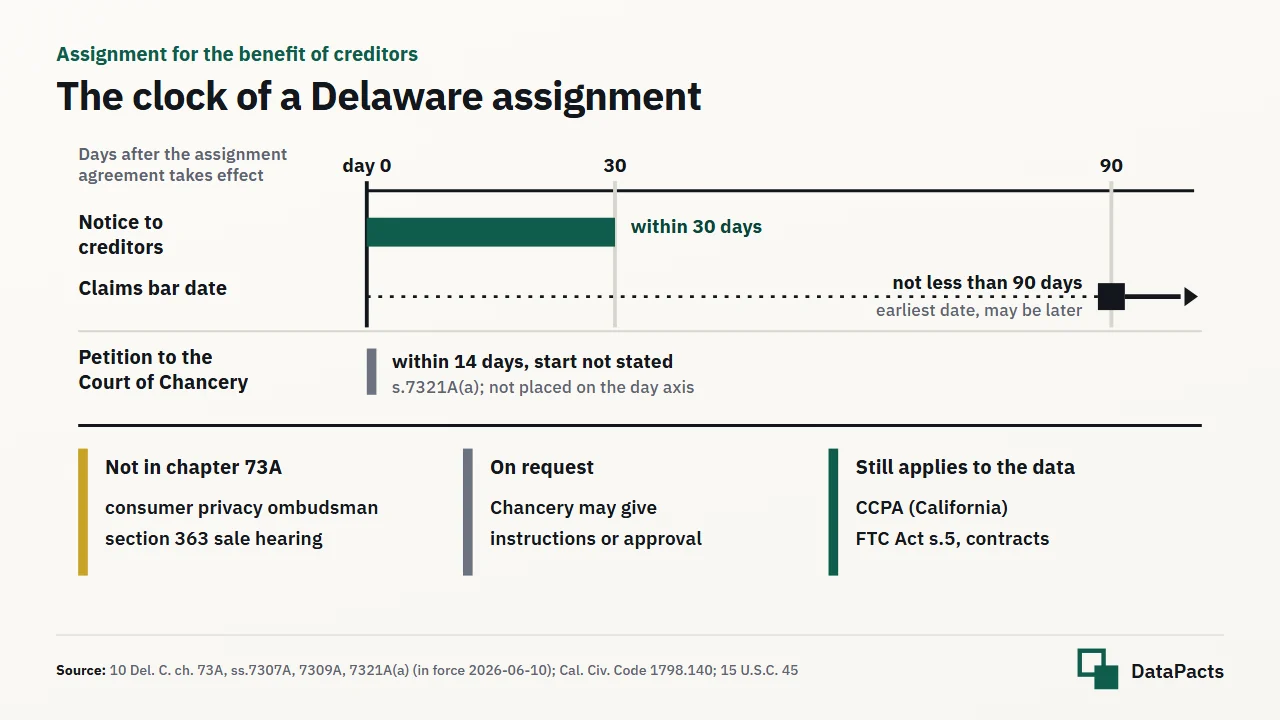
C. ch. 73A since 2026-06-10. The assignee must petition the Court of Chancery within 14 days, notify creditors within 30 days and set a claims bar date at least 90 days after the assignment agreement takes effect.
The chapter contains no consumer privacy ombudsman mechanism, but privacy law and the company's own promises still apply to the data, as the rules below show for an out-of-court route in AI training data licensing.
The statutes, deadlines and program terms below were checked against their primary sources, under the rules on DataPacts Editorial Team: how we source, date and check every figure.
Assignment, Dissolution or Chapter 7: Who Signs a Closing Company's Data Sale
Three routes decide who signs a closing company's data sale: the independent assignee in an assignment, the trustee or debtor in possession in a bankruptcy case, and the dissolved corporation itself while it winds up.
An assignment is a state-law, out-of-court transfer chosen by the company, and after the transfer the assignee, not the founders, signs the sale.
Table: the three routes compared on signer, court role and consumer-privacy review, as of 2026-11-10.
| Route | Who signs the data sale | Court role | Consumer-privacy review in the statute | Source |
|---|---|---|---|---|
| Delaware assignment (10 Del. C. ch. 73A) | independent assignee | petition to the Court of Chancery within 14 days; court may give instructions or approval (s.7321A(a)) | none in chapter 73A | delcode.delaware.gov |
| Chapter 7 or 11 sale (11 U.S.C. 363(b)(1)) | trustee, in chapter 11 usually the debtor in possession | notice and a hearing; sale order | privacy-policy proviso and consumer privacy ombudsman (11 U.S.C. 332) | govinfo.gov |
| Delaware dissolution (8 Del. C. 278) | the dissolved corporation, continued for winding up | continuation for 3 years, or longer as the Court of Chancery directs | none in s.278 | delcode.delaware.gov |
A bankruptcy sale needs notice and a hearing under 11 U.S.C. 363(b)(1), and personal data covered by a privacy policy needs the proviso or a section 332 ombudsman; that route is the subject of US bankruptcy data sales under section 363(b)(1).
A dissolved Delaware corporation continues for 3 years for winding up, or longer as the Court of Chancery directs (8 Del. C. 278), and the ownership questions are left to the dissolution page in the border below.
Delaware's Chapter 73A: Petition, Creditor Notice and Claims Deadlines
Delaware's Uniform Assignment for Benefit of Creditors Act, 10 Del. C. ss.7301A to 7324A (85 Del. Laws c. 291), governs assignments made since 2026-06-10, the date the old voluntary-assignment sections 7381 to 7387 were repealed. The chapter's own section notes give no separate effective date, so the date rests on that repeal.
Table: the chapter 73A rules that matter for a data sale, as of 2026-11-10.
| Item | Rule | Source |
|---|---|---|
| Citation | 10 Del. C. ss.7301A to 7324A (85 Del. Laws c. 291) | delcode.delaware.gov |
| In force | 2026-06-10, when old ss.7381 to 7387 were repealed | delcode.delaware.gov (ch. 73, subch. VI note) |
| Court petition | assignee petitions the Court of Chancery within 14 days of entry into the assignment agreement; court may give instructions or approval (s.7321A(a)) | delcode.delaware.gov |
| Creditor notice | within 30 days after the effective date of the assignment agreement (s.7307A(a)) | delcode.delaware.gov |
| Claims bar date | not less than 90 days after the effective date of the assignment agreement (s.7309A(b)(6)) | delcode.delaware.gov |
| Privacy review | no consumer privacy ombudsman mechanism | delcode.delaware.gov |
For a data sale the petition matters most: the assignee petitions the Court of Chancery within 14 days and the court may give instructions or approval (s.7321A(a)), so an assignee unsure about a data sale can ask the court.
Creditors are notified within 30 days, and the claims bar date falls at least 90 days after the assignment agreement takes effect (ss.7307A, 7309A). The text check of 2026-11-10 found neither "ombudsman" nor "personally identifiable" in the chapter.
California: The CCPA Asset-Transfer Rule and the Unverified Assignment Periods
California data rules reach an assignment through the California Consumer Privacy Act, whose definitions of sale and sharing exclude a transfer of personal information as an asset in a bankruptcy or similar transaction in which the recipient assumes control of all or part of the business (Cal. Civ. Code 1798.140(ad)(2)(C), (ah)(2)(C)).
Whether a given assignment is a "similar transaction" is not settled in the sources used here. On its face, a license of data alone to an AI buyer, without the business, does not match the "assumes control" wording; both points are a reading of the text, not a ruling.
The CCPA covers employee and business-to-business contact data since 2023-01-01 (1798.145(m)(4), (n)(3)), and data that meets the three-part deidentified test of 1798.140(m) is outside personal information.
In the statute text as of 2026-11-09, the Attorney General can seek civil penalties of up to USD 2,500 per violation or USD 7,500 per intentional violation (1798.199.90), subject to CPI adjustment.
California's own general-assignment statute and its notice and claims periods are not stated here until they are verified from the official code text. For the privacy side, see California CCPA/CPRA rules.
Personal Data and Customer Promises in an Assignment Without an Ombudsman
An assignment has no consumer privacy ombudsman: 11 U.S.C. 332 and the privacy-policy proviso of 363(b)(1) apply only to sales by a bankruptcy trustee, and chapter 73A contains no comparable review. A court may still give instructions on request under s.7321A(a), but the Act does not require a privacy report before a sale.
The FTC's conditions from Toysmart (2000), as the FTC restated them in its 2015-05-16 RadioShack letter, were written for bankruptcy sales: no standalone sale, a buyer in substantially the same line of business, a buyer bound by the privacy policy, and affirmative consent before material changes. No FTC statement applying them to an assignment is in the sources used here.
Section 5 of the FTC Act (15 U.S.C. 45) applies whatever the route. FTC staff wrote on 2024-02-13 that a surreptitious, retroactive change of terms or privacy policy to permit AI training may be unfair or deceptive, and on 2024-01-09 that the FTC has required firms that unlawfully obtained data to delete models and algorithms (Everalbum, final settlement 2021-05-07). The full treatment is in FTC rules on AI training data.
Customer and supplier contracts travel with the data: confidentiality and use limits bind the assignee, so the assignee checks them before a sale. No state attorney general position on an assignment data sale is in the sources used here.
How an Assignee Sells or Licenses Data Assets
An assignee may sell or license a company's data assets for the creditors, and the routes on record run through company data programs that accept closing companies and through wind-down intermediaries. A sale transfers the data outright; a license keeps it in the estate and may pay over time, as Turing's revenue share states.
Table: programs that handle data from closing companies, alphabetical, as of 2026-11-09; each term is the named party's own claim, checked 2026-11-09.
| Program | Role | What it acquires or handles | Terms as stated | Source |
|---|---|---|---|---|
| micro1 Company Data Partnerships | company data program with a Defunct referral category | company data packages | micro1 states "$100K-$3M+ for approved data packages" | micro1.ai/company-referral |
| SimpleClosure AssetHub | wind-down intermediary, not a buyer | source code and workspace data of shutting-down startups, licensed or sold to third parties after PII processing | SimpleClosure states no upfront cost and "only takes a percentage if your assets are successfully sold or licensed" | simpleclosure.com/product/assethub/ |
| Turing Project Lazarus | licensing program that resells records | operating records and code of active, winding-down and wound-down companies | Turing states revenue share, "Nothing upfront", license to Turing exclusive for the first 6 months, during which Turing may license the record to more than one lab (checked 2026-11-17) | lazarus.turing.com |
The steps an assignee follows:
- Inventory the data systems and the privacy policy and contracts that cover them.
- Check personal data under the CCPA and other applicable law.
- De-identify or exclude personal data, using the standards for PII removal and de-identification.
- Where the sale is unusual, petition or return to the Court of Chancery for instructions.
- Compare offers and terms, including revenue share against outright sale.
- Sign, deliver and record the proceeds in the claims process before the bar date.
The assignee owes the result to the creditors, not to the former founders, and none of these programs is a partner or recommended by DataPacts. The number of AI-buyer sales made through assignments is not stated here because no source gives it.
Selling Data Through an Assignment or Not: Benefits, Risks, Downsides and Alternatives
For a closing company and its assignee, an assignment can turn data into money for creditors without a bankruptcy sale hearing, but no court shields the privacy decision, and leaving the data unsold is a valid outcome.
- Benefits: no section 363 hearing or ombudsman report before a sale; the Court of Chancery can still give instructions or approval on request; the assignee may license instead of selling outright.
- Risks: no court order that clears the privacy question; a buyer's later use against the original privacy promises risks FTC action; California civil penalties where the transfer counts as a sale; contracts with confidentiality limits.
- Downsides: de-identification and contract review cost money and time, borne by the estate unless the buyer agrees otherwise; claims and notice deadlines run in parallel; intermediaries take a percentage on success, as SimpleClosure states.
- Alternatives: not selling, keeping records for their retention periods and then deleting them; selling the business with its data to a buyer that assumes control, the case the CCPA rule describes; selling only de-identified data; a chapter 7 or 11 case if the parties want a sale order with a privacy review; a license on revenue share with ownership unchanged, as Turing states for Project Lazarus.
DataPacts takes no position on whether an assignee should sell; the decision belongs to the assignee, the creditors and, where asked, the court.
Where Assignee Data Sales Connect to Bankruptcy, Dissolution and the Seller Path
This page covers the assignment route; the pages below cover dissolution, export before closing, other insolvency routes, the programs and the seller decision. This page is information, not legal advice.
- Every route: data assets in insolvency
- After dissolution: who owns a dissolved company's data
- Before closing: exporting company data before shutting down
- Court-appointed officeholders: insolvency administrators and liquidators as data sellers
- The seller view: selling data from a shut-down or defunct company
- Intermediaries: shutdown services that handle data from closing companies
- Programs: SimpleClosure AssetHub terms, Turing Project Lazarus revenue share terms and micro1 program terms
- Contracts: customer consent and confidentiality clauses
- Options: alternatives to selling data to AI labs
- Records: record retention after closing a company
- Comparison: employee data in bankruptcy data sales
Frequently Asked Questions
What is an ABC process?
An ABC is an out-of-court transfer of a company's assets to an independent assignee who sells or licenses them for creditors. In Delaware it runs under 10 Del. C. ch. 73A since 2026-06-10. "ABC restructuring" is a misnomer: an assignment liquidates, it does not reorganize the company.
What is the process of an assignment for the benefit of creditors?
The company signs an assignment agreement, and the assignee petitions the Court of Chancery within 14 days. Creditors are notified within 30 days, the claims bar date falls at least 90 days after the agreement takes effect, the assignee sells or licenses the assets, and the proceeds are distributed.
Is an assignment better than dissolution for selling company data?
Neither is better in general. An assignment hands the sale to an independent assignee, while a dissolved Delaware corporation continues for 3 years to wind up (8 Del. C. 278), or longer as the Court of Chancery directs.