Status is given as of 2026-11-09. This page covers one statute, two FTC staff posts of 2024, a final order, civil penalties and the related FTC-enforced rules.
A seller meets the FTC when its privacy promises limit what it may license, and a buyer meets it when it trains on that data. Together they form the FTC layer of AI training data licensing, and the sections below run from binding rules to staff views.
FTC Instruments and Staff Statements on Training Data at a Glance
Six FTC instruments and statements bear on a training data deal, and the table gives each one's citation, date, binding force and meaning for the data, as of 2026-11-09.
| Instrument or statement | Citation | Date | Binding force | What it means for training data | Source |
|---|---|---|---|---|---|
| FTC Act Section 5 | 15 U.S.C. 45 | in force | statute | unfair or deceptive acts are unlawful; training against collection promises may qualify | govinfo.gov |
| Civil penalty adjustment | 15 U.S.C. 45(m)(1)(A); 16 CFR 1.98(d) | 90 FR 5580 (2025-01-17); kept for 2026 by 91 FR 58446 (2026-09-15) | regulation | up to USD 53,088 per knowing violation of a trade regulation rule | ecfr.gov; federalregister.gov |
| COPPA Rule as amended | 16 CFR Part 312; 90 FR 16918 | effective 2025-06-23; compliance 2026-04-22 | regulation | separate parental consent to disclose children's data to train AI | federalregister.gov |
| Impersonation Rule | 16 CFR Part 461, 461.3 | effective 2024-04-01 | regulation | posing as a known AI data buyer to solicit data or fees is a violation | ecfr.gov |
| Staff post on privacy and confidentiality commitments | Office of Technology post | 2024-01-09 | staff statement | prior orders required deleting models and algorithms built on unlawfully obtained data | ftc.gov |
| Staff post on quietly changing terms | Office of Technology and DPIP post | 2024-02-13 | staff statement | a surreptitious, retroactive change to allow AI training may be unfair or deceptive | ftc.gov |
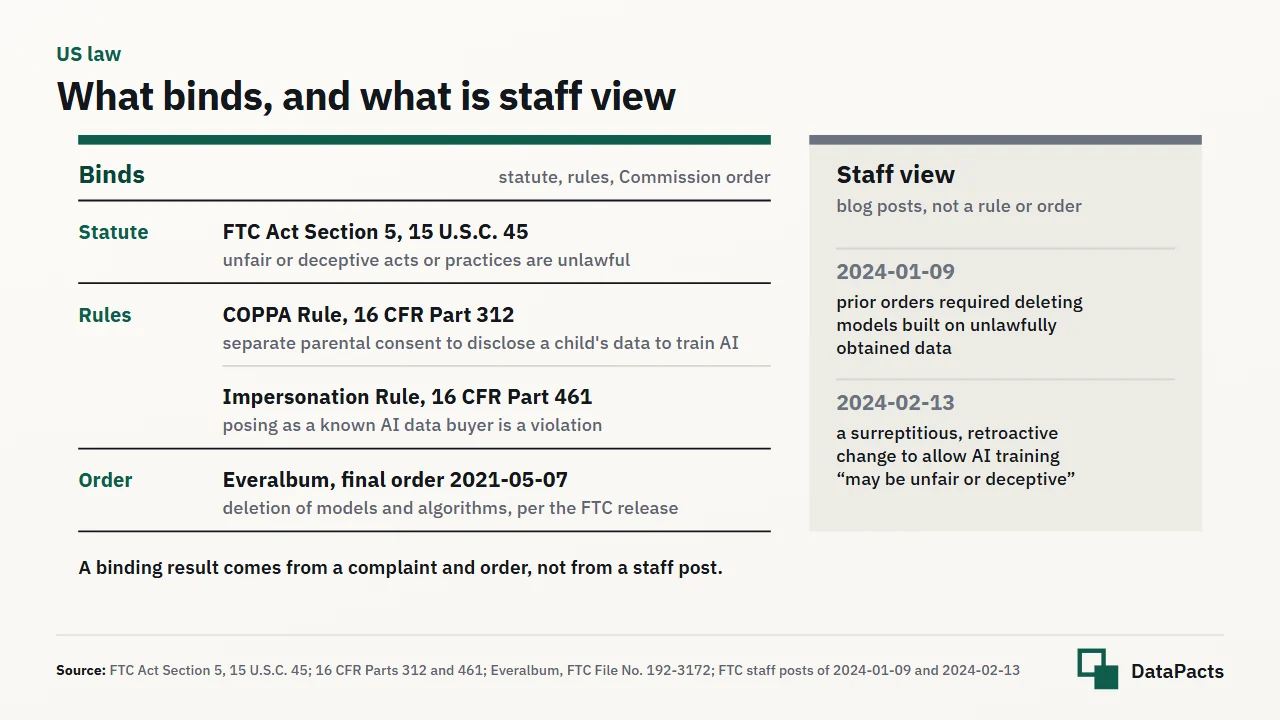
Binding force differs: the statute and the rules bind, while the staff posts state the staff's view, and the sections below follow that order.
Section 5 of the FTC Act Applied to Data Used for Training
Section 5 of the FTC Act (15 U.S.C. 45) declares unfair or deceptive acts or practices in commerce unlawful, and the FTC applies it to training data when a company uses customer or user data contrary to the privacy promises under which it was collected.
The statute is in force. The FTC (ftc.gov) also enforces the COPPA Rule (16 CFR Part 312) and, for non-bank financial institutions, the GLBA Privacy and Safeguards Rules (16 CFR Parts 313 and 314).
Two theories apply to training data. The first is deception: breaking a promise, as the FTC alleged in Everalbum about facial recognition on users' photos and videos. The second is a surreptitious, retroactive change of a privacy policy, covered in the next section. Remedies have included deletion of models and algorithms.
Privacy Policy Changes to Allow AI Training: The February 2024 Staff Post
FTC staff wrote on February 13, 2024 that "it may be unfair or deceptive for a company to adopt more permissive data practices", such as using data for AI training, through a surreptitious, retroactive amendment to its terms of service or privacy policy.
The authors are staff of the FTC's Office of Technology and its Division of Privacy and Identity Protection, and the post is titled "AI (and other) Companies: Quietly Changing Your Terms of Service Could Be Unfair or Deceptive" on ftc.gov.
For a seller, the version of the notice in force when each record was collected decides what it may license, and a new notice acts from its date, not backwards.
That reading is an inference from the post, not a staff statement. The clause-by-clause check of contracts and notices sits on the page for customer consent and confidentiality clauses before licensing data for AI, which applies the post to customer contracts.
A Staff Statement, Not a Commission Rule
The February 2024 post is a staff blog post, not a rule or a Commission order, so it states how FTC staff read Section 5 rather than creating a new obligation.
The same holds for the staff post of January 9, 2024 on privacy and confidentiality commitments. A binding result comes from a complaint and order, as in the matter below.
Algorithmic Disgorgement: FTC Orders to Delete Models and Algorithms
Algorithmic disgorgement is the name used for an order that makes a company delete the models and algorithms it built with data it obtained unlawfully, and FTC staff wrote on January 9, 2024 that the FTC has required exactly that in prior enforcement actions.
The staff post says the FTC has "required businesses that unlawfully obtain consumer data to delete any products, including models and algorithms, developed in whole or in part using that unlawfully obtained data". The FTC sources checked here do not use the term itself, so it is the common name, not an FTC label.
The table lists the matters recorded for this page, oldest first, as of 2026-11-09.
| Date | Matter and number | Forum | What the FTC record says | Model deletion | Source |
|---|---|---|---|---|---|
| 2021-05-07 (proposed order posted 2021-01-11) | In the Matter of Everalbum, Inc., FTC File No. 192-3172 | FTC (administrative) | deception about facial recognition on users' photos and videos; final order | yes: the FTC release states deletion of "the models and algorithms it developed by using the photos and videos uploaded by its users" | ftc.gov press release and case page |
| not stated | FTC v. Rite Aid Corporation, FTC matter 2023190, E.D. Pa. No. 2:23-cv-5023 | federal court | 5-year ban on facial recognition use | not mentioned on the FTC case page | ftc.gov case page |
Everalbum is the recorded deletion order: the FTC posted the proposed order on 2021-01-11 and finalized it on 2021-05-07. The order text itself was not checked, so the deletion terms rest on the FTC release.
Rite Aid carries a 5-year facial recognition ban, and the FTC case page does not mention model deletion, so this page does not call it a disgorgement order. Matters that other sources list under the label are not described here until their FTC pages are checked.
What a Deletion Order Means for the Company That Licensed the Data
A deletion order binds the company that trained the model, but it reaches every model built in whole or in part on the data, so a licensor whose data was obtained or used against its own privacy promises shares the exposure through its warranties.
The seller's records of consent and notice versions are the evidence that the data was lawfully obtained, which is an inference from the staff post and the Everalbum release. No FTC order against a data licensor is recorded for this page.
What a license says about models trained before it ends is a contract question, covered under retraining and model retention rights after a license ends.
The FTC Inquiry Into Licensing User Content Disclosed by Reddit
Reddit, Inc. disclosed in its amended Form S-1 that it received a letter from the FTC on March 14, 2024 about a non-public inquiry into its licensing of user content to train AI.
The statement is Reddit's, filed on 2024-03-15, and the filing ties the inquiry to no licensee. No outcome is found as of 2026-11-09.
The terms, values and counterparties of the licenses are on the page for Reddit's AI data licensing deals with Google and OpenAI, which also dates the filings around them.
Civil Penalties and the 2025 Executive Order on a Section 5 Policy Statement
For a knowing violation of an FTC trade regulation rule, 15 U.S.C. 45(m)(1)(A) and 16 CFR 1.98(d) allow a civil penalty of up to USD 53,088 per violation, the January 2025 adjustment (90 FR 5580, 2025-01-17) that the FTC's notice of September 15, 2026 (91 FR 58446) keeps for 2026.
The amount applies to rule violations, not to Section 5 in general, and this page gives no penalty amount for a first Section 5 violation without a rule or order.
Executive Order 14365 of December 11, 2025 (90 FR 58499, published 2025-12-16) directs an FTC Section 5 policy statement on AI models and a legislative recommendation on preempting conflicting state AI laws. The order does not itself regulate training data, and this page does not state whether the policy statement has been issued.
Other Rules the FTC Enforces: Children's Data, Financial Data and Insolvent Estates
Three further FTC-enforced rules decide whether some data can enter a training license at all: the COPPA Rule for children's data, the GLBA rules for financial customer data, and the FTC's conditions on selling customer data in bankruptcy.
Under the COPPA Rule as amended (90 FR 16918, effective 2025-06-23, compliance from 2026-04-22), disclosing a child's personal information to train AI is not integral to the service and needs separate verifiable parental consent under 16 CFR 312.5(a)(2).
Under GLBA, a financial institution gives notice and an opt-out before disclosing nonpublic personal information to a nonaffiliated buyer (15 U.S.C. 6802(b)(1)), and recipients inherit reuse limits (16 CFR 313.11).
In FTC v. Toysmart.com (D. Mass. 00-11341-RGS), the settlement conditions included affirmative consent for material changes, as the FTC restated them in its 2015 RadioShack letter. The conditions are set out under US bankruptcy data sales and the FTC conditions.
Benefits, Risks, Downsides and Alternatives for a Seller Under FTC Scrutiny, Including Not Selling
No FTC rule forbids licensing data for AI training, but the promises a company made when it collected the data decide what it may license, and licensing only what those promises cover or not licensing at all remain valid choices.
Benefits:
- data collected under notices that cover training carries no Section 5 deception theory in the sources checked here;
- a documented consent history answers a buyer's diligence questions.
Risks:
- a deletion order can reach models built on the data;
- civil penalties apply to knowing violations of a trade regulation rule;
- an FTC inquiry, as Reddit disclosed, can follow a licensing program.
Downsides:
- older records collected under narrower notices may be unusable without fresh consent;
- children's data needs separate parental consent.
Alternatives:
- license only records collected under notices that cover training;
- exclude children's data and GLBA data;
- deidentify before licensing;
- not selling or licensing at all.
The page on alternatives to selling data to AI labs, including not selling compares these routes.
Beyond the FTC: Other US Rules and the Seller Process
The FTC is one federal layer among several. The overview of United States AI training data law sets it beside copyright, sector statutes and state laws, while the seller pages turn these limits into steps.
- AI training data law by jurisdiction: regulators outside the US.
- Privacy law and AI training data by jurisdiction: the FTC beside the GDPR and state privacy acts.
- California CCPA and AB 2013 training data rules: the state layer most deals meet.
- HIPAA and AI training data: health data outside FTC jurisdiction.
- COPPA and children's data in AI training: separate parental consent in detail.
- GLBA and licensing financial customer data: financial customer data in detail.
- User data and platform terms: platforms training on their own users.
- Due diligence in an AI data deal: the consent records a buyer asks for.
- Data licensing scam checks: impersonation of known buyers.
- Should you sell or license your data to AI companies: the decision before any license.
How This Page Is Sourced and Dated
Every statement here cites the FTC Act, the Code of Federal Regulations, an FTC order or staff post on ftc.gov, or a company filing, with the date it was checked. The methodology describes the process, and this page is general information about US law, not legal advice for any specific deal.
Frequently Asked Questions
What is algorithmic disgorgement?
Algorithmic disgorgement is an order to delete models and algorithms built with unlawfully obtained data. FTC staff wrote on 2024-01-09 that prior FTC orders required it.
Can a company change its privacy policy to train AI on data it already holds?
FTC staff wrote on 2024-02-13 that a surreptitious, retroactive change to allow AI training may be unfair or deceptive. That is a staff view, not a rule.
Has the FTC ordered a company to delete an AI model?
Yes: the final Everalbum order of 2021-05-07 (File No. 192-3172) requires deletion of models and algorithms built on users' photos and videos, according to the FTC release.
Does the FTC regulate selling data to AI companies?
No FTC rule targets AI data licensing. Section 5 applies when the sale or use breaks the promises made at collection, and COPPA and GLBA add consent and notice rules.