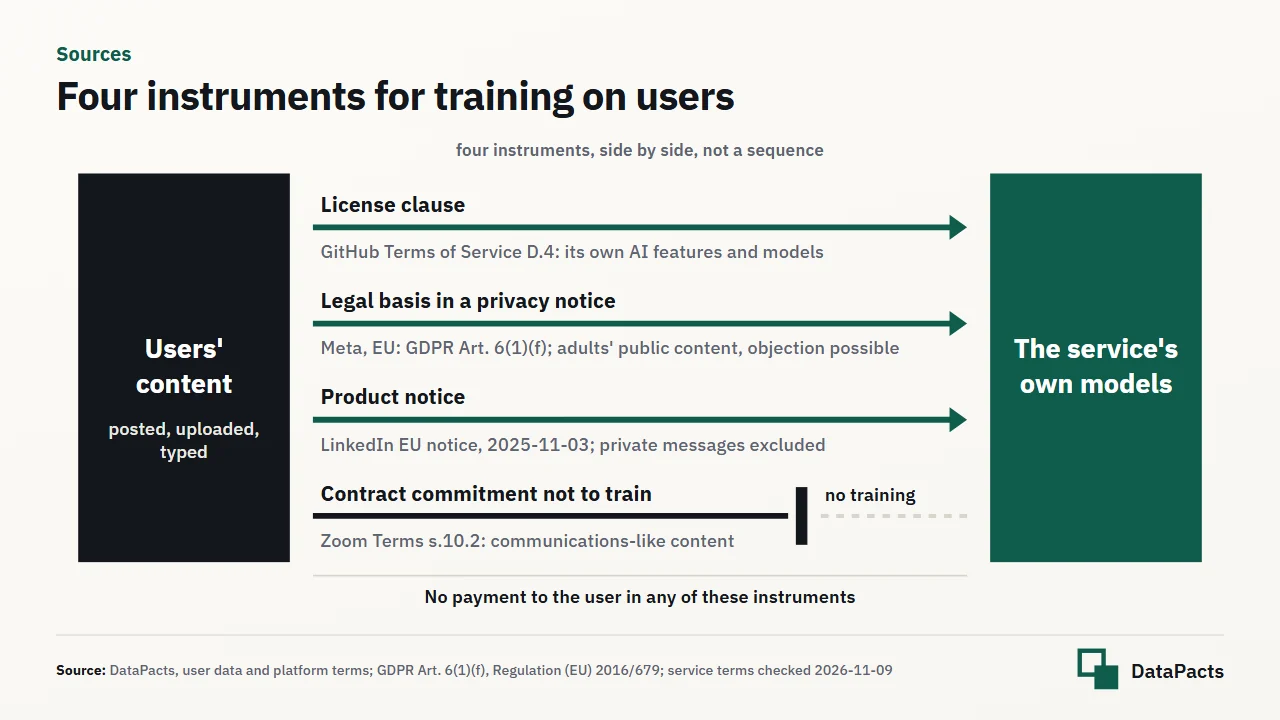
Many services train their own AI models on what their users post, upload or type, and the permission sits in their terms of service, privacy notices or product terms rather than in a deal with each user.
The sections below place that practice within AI training data licensing, as a route that pays neither the user nor the data holder. Business contracts often draw the opposite line from consumer accounts, and regulators have answered with suspensions, inquiries and one court ruling on an injunction.
Each term is the service's own wording with its check date. DataPacts is independent.
Fact-check note: every term, date and ruling below is sourced and dated as described in how we source, date and check every figure.
What does it mean when a service trains on its own users?
A service trains on its users when it feeds the content and interactions on its own product into its own models, under a license or legal basis it set for itself. Four instruments carry the permission.
A license clause is the first: GitHub's Terms of Service, effective 2026-04-27, grant in section D.4 a license that covers training AI features and the models and technologies of GitHub and its Affiliates.
A legal basis in a privacy notice is the second: Meta relies on legitimate interest, Article 6(1)(f) of Regulation (EU) 2016/679.
A product notice is the third, such as LinkedIn's EU notice update of 2025-11-03. The fourth runs the other way, a contract commitment not to train, as in section 10.2 of Zoom's Terms of Service.
Crawling collects content from other sites, and a platform selling access to what its users wrote belongs under platforms licensing user content to AI developers. Here no third party pays, and the user is not paid.
Services that train on users, and the terms behind it
The table lists each service's own statement on training with its users' data, the instrument that carries it, the date it changed and the regulator or court response on record. The method behind every row is explained under how we source, date and check every figure.
The table is as of 2026-11-10 and ordered alphabetically. "None recorded" means no regulator or court action on this point is held here, not that none exists.
| Service and operator | What the service states about training on its users | Instrument | Date of change | Regulator or court response on record | Checked | Source |
|---|---|---|---|---|---|---|
| Anthropic Claude, consumer plans (Anthropic, PBC) | chats train models if the user allows; kept 5 years if allowed, 30 days if not; commercial services excluded | consumer terms update | announced 2025-08-28; choose by 2025-10-08 | none recorded | 2026-11-09 | anthropic.com/news/updates-to-our-consumer-terms |
| Atlassian cloud products (Atlassian Corp) | in-app data contribution on for Free and Standard, off for Premium and Enterprise; metadata contribution on by default | data contribution policy | in effect 2026-08-17 | none recorded | 2026-11-09 | atlassian.com/trust/ai/data-contribution |
| Figma (Figma, Inc.) | content training on for Starter and Professional; off and not toggleable for Organization and Enterprise | AI training settings; Terms of Service effective 2026-03-11 | 2024-08-15 | none recorded | 2026-11-09 | help.figma.com (Control AI training settings) |
| GitHub Copilot Free, Pro, Pro+ (GitHub, Inc.) | interaction data used for training; the D.4 license covers training AI features and the models and technologies of GitHub and its Affiliates and is stated not to be a sale | usage policy update; Terms of Service D.3, D.4 | announced 2026-03-25; effective 2026-04-24; Terms 2026-04-27 | none recorded | 2026-11-09 | github.blog; docs.github.com (GitHub Terms of Service) |
| Google Gemini Apps (Google) | uploads sampled under Keep Activity | product announcement | announced 2025-08-13; from 2025-09-02 | none recorded | 2026-11-09 | blog.google (temporary chats and privacy controls) |
| Google Workspace, business customers (Google) | no training on customer data without prior permission or instruction | Workspace Service Specific Terms (Training Restriction) | Privacy Hub updated 2026-10-26 | none recorded | 2026-11-09 | knowledge.workspace.google.com (Gemini privacy hub) |
| LinkedIn (LinkedIn Corporation; LinkedIn Ireland Unlimited Company in the EU, EEA, Switzerland) | member data trains content-generating AI models; saved resumes and screening answers used; private messages excluded | EU privacy notice update | 2025-11-03 | none recorded | 2026-11-09 | linkedin.com/help/linkedin/answer/a5538339 |
| Meta Facebook and Instagram (Meta Platforms Ireland Limited in the EU) | public content of adults used for training under legitimate interest, subject to objection | privacy policy in force from 2024-06-26 | EU start planned 2025-05-27, per Meta as reported by the DPC | ANPD suspension 2024-07-02; OLG Köln injunction refused 2025-05-23 | 2026-11-09 | dataprotection.ie (DPC statement on Meta AI) |
| Microsoft 365 Copilot (Microsoft) | prompts, responses and Graph data not used to train foundation LLMs | product privacy documentation | page updated 2026-11-04 | none recorded | 2026-11-09 | learn.microsoft.com (Microsoft 365 Copilot privacy) |
| Slack (Slack Technologies, LLC) | generative AI training on customer data only with affirmative opt-in consent | privacy principles | n/a | none recorded | 2026-11-09 | slack.com/trust/data-management/privacy-principles |
| X and Grok (SpaceXAI LLC, formerly xAI LLC) | user interaction data used: Yes; X data of users who opted out not used | EU training content summary, Grok 4.7 | placed on the EU market 2026-09-21 | DPC s.134 application 2024-08-08; DPC inquiry announced 2025-04-11 | 2026-11-09 | media.x.ai (Grok 4.7 public summary of training content) |
| Zoom (Zoom Communications, Inc.) | communications-like customer content not used to train Zoom or third-party AI models | Terms of Service s. 10.2 | terms page effective 2023-08-11 | none recorded | 2026-11-09 | zoom.com/en/trust/terms |
Adobe and the consumer services of OpenAI are not yet listed, because no dated statement has been checked for them.
How the terms changed, service by service
The terms changed at different times for assistants, the professional network, social platforms and business software, in the order below. The switches that control them are covered in the settings for opting out of AI training and their limits.
Claude, Gemini and GitHub Copilot: consumer terms rewritten in 2025 and 2026
Anthropic, Google and GitHub each changed consumer terms between August 2025 and April 2026 so that user conversations or interactions can train their models.
Anthropic announced on 2025-08-28 that consumer Claude chats train its models if the user allows, with existing users to choose by 2025-10-08. Google announced on 2025-08-13 that Gemini Apps samples uploads under Keep Activity from 2025-09-02. GitHub announced on 2026-03-25 that Copilot interaction data trains models from 2026-04-24.
LinkedIn: member data and the EU notice of November 2025
LinkedIn states that it uses member data to train content-generating AI models, and its EU privacy notice update of November 3, 2025 sets out which data that covers. The notice lists saved resumes and screening answers and excludes private messages. LinkedIn Ireland Unlimited Company serves members in the EU, the EEA and Switzerland (checked 2026-11-09).
X and Grok: user interaction data and the Irish regulator
The provider of Grok states in its own EU training summary that user interaction data is used, and that X data of users who opted out is not.
The provider is SpaceXAI LLC (formerly xAI LLC), and the summary covers Grok 4.7, placed on the EU market on 2026-09-21. The Irish Data Protection Commission (DPC) applied to the High Court on 2024-08-08 and announced an inquiry into X Internet Unlimited Company on 2025-04-11.
Meta: from the June 2024 policy to the planned EU start
Meta's training on public Facebook and Instagram content rests on a privacy policy in force from June 26, 2024, and its EU start was planned for May 27, 2025, as the Irish DPC reported on 2025-05-21. Brazil's ANPD ordered a preventive suspension on 2024-07-02, and the Cologne court refused an interim injunction on 2025-05-23. The full chronology sits in the case record on Meta AI training on EU user data.
Figma, Atlassian and Zoom: product terms for business content
Business software splits the other way by plan and by product terms: Figma and Atlassian train on customer content on smaller plans, while Zoom's terms rule out training on communications content. Figma states that content training took effect on 2024-08-15 and is on for Starter and Professional.
Atlassian states that its data contribution has applied since 2026-08-17, with in-app data on for Free and Standard. Zoom states in section 10.2 that communications-like Customer Content does not train Zoom or third-party models (checked 2026-11-09).
How regulators and courts have responded to training on users
Regulators have answered first-party training with suspensions, inquiries, court applications and staff warnings, and the only court ruling on the merits of an injunction on record let Meta's EU training proceed. The table lists each response in date order, as of 2026-11-10.
| Date | Authority or court | Instrument or docket | Service | What it did | Status | Source |
|---|---|---|---|---|---|---|
| 2021-05-07 | FTC | In the Matter of Everalbum, Inc., FTC File No. 192-3172 | Everalbum photo app | final order requires deletion of models and algorithms developed using users' photos and videos | final order | ftc.gov (press release 2021-05) |
| 2024-02-13 | FTC Office of Technology staff | staff blog post | any service | "It may be unfair or deceptive for a company to adopt more permissive data practices" | staff post, not a Commission rule | ftc.gov (tech-at-ftc 2024/02) |
| 2024-07-02 | ANPD (Brazil) | Voto nº 11/2024/DIR-MW/CD | Meta | preventive suspension of the privacy policy and of processing for AI training; daily fine BRL 50,000 | later status not checked | gov.br/anpd |
| 2024-08-08 | Data Protection Commission (Ireland) | s.134 Data Protection Act 2018, High Court application | Twitter (Grok) | urgent application to the High Court | record number not stated | dataprotection.ie (AI Insights Report, 2026-09) |
| 2024-12-17 | EDPB | Opinion 28/2024 | AI models generally | erasure of the dataset or the model listed as a corrective measure, para. 114 | adopted | edpb.europa.eu |
| 2025-04-11 | Data Protection Commission (Ireland) | s.110 Data Protection Act 2018 inquiry | X Internet Unlimited Company (Grok training) | inquiry announced | no outcome on record | dataprotection.ie |
| 2025-05-21 | Data Protection Commission (Ireland) | statement | Meta | reported Meta's planned EU start of 2025-05-27; effectiveness report expected October 2025 | actual start not confirmed by the DPC | dataprotection.ie |
| 2025-05-23 | OLG Köln | 15 UKl 2/25 | Meta | interim injunction sought by Verbraucherzentrale NRW rejected; AI training can be a legitimate interest; value in dispute EUR 250,000 | main proceedings not found as of 2026-11-09 | nrwe.justiz.nrw.de |
| 2026-09 | Data Protection Commission (Ireland) | AI Insights Report | controllers generally | unlikely that a controller can show users expect private messages to be used for AI training | published position | dataprotection.ie |
| 2026-10-22 | U.S. District Court, N.D. Cal. | 3:23-cv-05437-RFL | Google Cloud Contact Center AI | motion to dismiss granted with leave to amend; three plaintiffs compelled to arbitration | as of 2026-11-09, stayed as to the arbitration plaintiffs | govinfo.gov (USCOURTS-cand-3_23-cv-05437) |
In the EU, the legal basis for training on users is usually legitimate interest under Article 6(1)(f) of Regulation (EU) 2016/679. The OLG Köln rejected the injunction against Meta on 2025-05-23. EDPB Opinion 28/2024, adopted 2024-12-17, lists erasure of the dataset or the model as a corrective measure.
Meta says objections are honored at any time (April 2025), while noyb states in its letter of 2025-05-14 that only earlier objections count. The pending Digital Omnibus proposal COM(2025) 837 would add an Article 88c on legitimate interest for AI development.
In the US, FTC staff wrote on 2024-02-13 that quietly changing terms to permit more data use may be unfair or deceptive, and the Everalbum order of 2021-05-07 required deletion of models built on users' photos and videos. Both sit under FTC rules on AI training data and privacy policy changes.
This section is information, not legal advice.
Business contracts versus consumer accounts: where the terms draw the line
Most services that train on consumer accounts promise business customers in their contract that customer content stays out of training, so the same product can train on one user and not on another. Each commitment is the provider's claim, checked 2026-11-09. Anthropic excludes Claude for Work, the API, Claude Gov and Claude for Education.
Microsoft states that Microsoft 365 Copilot does not use prompts, responses or Microsoft Graph data to train foundation LLMs. Google states that Workspace does not train on customer data without the customer's prior permission or instruction. Slack states that it trains on customer data only with affirmative opt-in consent.
The line blurs when the user is someone else's customer. In N.D. Cal. case 3:23-cv-05437-RFL, the court ruled on 2026-10-22 that accountholders consented through a business customer's privacy statement and that the training-use claim failed without a predicate violation.
It granted the motion to dismiss with leave to amend and compelled three plaintiffs to arbitration, stayed as to them as of 2026-11-09. The matter is recorded as the Google Cloud Contact Center AI privacy litigation.
The Irish DPC wrote in its AI Insights Report of September 2026 that it is unlikely a controller can demonstrate that data subjects expect their private messages to be used for AI training.
Terms that run the other way: platforms that bar others from training on their data
The same services that train on their users often forbid app developers and other users to train on the data they reach through the service. Five instruments say so:
- Slack API Terms (2025-10-10): third-party apps "must not… use API Data to train a large language model"; bulk export needs an additional agreement.
- Google Workspace API user data policy (checked 2026-11-09): "Transferring, selling, or using user data to create, train, or improve a machine learning or artificial intelligence model is prohibited".
- Discord Terms of Service s. 9 (effective 2025-09-29): selling, licensing or otherwise commercializing content or data obtained from the services is prohibited.
- Atlassian Developer Terms s. 9.2 (effective 2025-12-01): "You may not sell any End User Data".
- Anthropic's terms: the consumer terms (2025-10-08) bar use to develop competing products, including to train AI models, and the commercial terms s. D.4 (effective 2025-06-17) bar access to train competing AI models.
For a company holding exports from these tools, the question is whether its own rights reach the data, which is the work of a rights audit before licensing data to AI companies.
The export routes are covered for GitHub repositories and their export rights and Slack data and AI training by plan.
What first-party training means for a data holder: benefits, risks, downsides and alternatives
For a company whose staff or customers use these services, first-party training is a route that pays the company nothing, and for a company with its own users it is a model to follow or avoid.
A company that licenses its own users' data needs terms that allow it. Mercor's listing for AI product companies asks for "user terms that allow licensing de-identified usage data, or a way to get consent" (Mercor's claim, checked 2026-11-09). Consent questions sit under customer consent and confidentiality clauses before licensing data.
Benefits
- Business contracts already exclude training on many tools, as Microsoft, Google and Slack state.
- A service's own training creates no new obligation for the holder.
Risks
- Terms can change after upload, as FTC staff flagged on 2024-02-13.
- Plan defaults differ: Figma and Atlassian train on smaller plans only.
- Effect dates are disputed, as the Meta objection timing shows.
Downsides
- No payment term appears in any instrument in the first table.
- Content granted under a service license stays licensed to that service.
Alternatives
- Accept the terms.
- Move to a business plan that excludes training.
- License the company's own data on its own terms: see whether to sell or license your data at all.
- Do nothing further.
Beyond a service's own users: licensing, crawling and the law
Training on a service's own users is one source among several; the pages below cover the other routes, the law behind the legal basis, and the export side of the tools named here.
- How AI companies get training data: the parent overview of all routes.
- Licensed versus scraped training data: the sibling comparison.
- AI crawlers that collect training data: bots, rules and charging.
- Legitimate interest for AI training data: Article 6(1)(f) applied.
- Irish rules for licensing data for AI training: the DPC and Irish law.
- Privacy law and AI training data by jurisdiction: the comparison.
- Selling chat messages for AI training: Slack and Teams data.
- Brazil's suspension of Meta's AI training: the ANPD case.
- User chats in the Character.AI chapter 11 case: the bankruptcy angle.
- xAI as a data buyer: the buyer profile.
Frequently asked questions
Which companies use user data for AI training?
Anthropic for consumer Claude, Google for Gemini Apps, GitHub for Copilot, LinkedIn, Meta, X with Grok, and Figma and Atlassian on smaller plans state that they train on user data. Each is the service's own statement.
Do terms of service allow AI training on my content?
Some do, through a license clause or a notice, and some rule it out. GitHub's section D.4 license and LinkedIn's EU notice allow it, while Zoom's section 10.2 excludes it. In the EU, a legal basis such as Article 6(1)(f) is still needed.
Are private messages used to train AI?
LinkedIn states that private messages are excluded from the data it uses. The Irish DPC wrote in September 2026 that it is unlikely a controller can show users expect private messages to be used for AI training, so the position depends on the service and its legal basis.
Does a business plan keep company data out of training?
Often yes, by contract. Anthropic, Microsoft, Google and Slack each state that business content stays out of training or needs consent (checked 2026-11-09), while Figma and Atlassian train on content on their smaller plans.