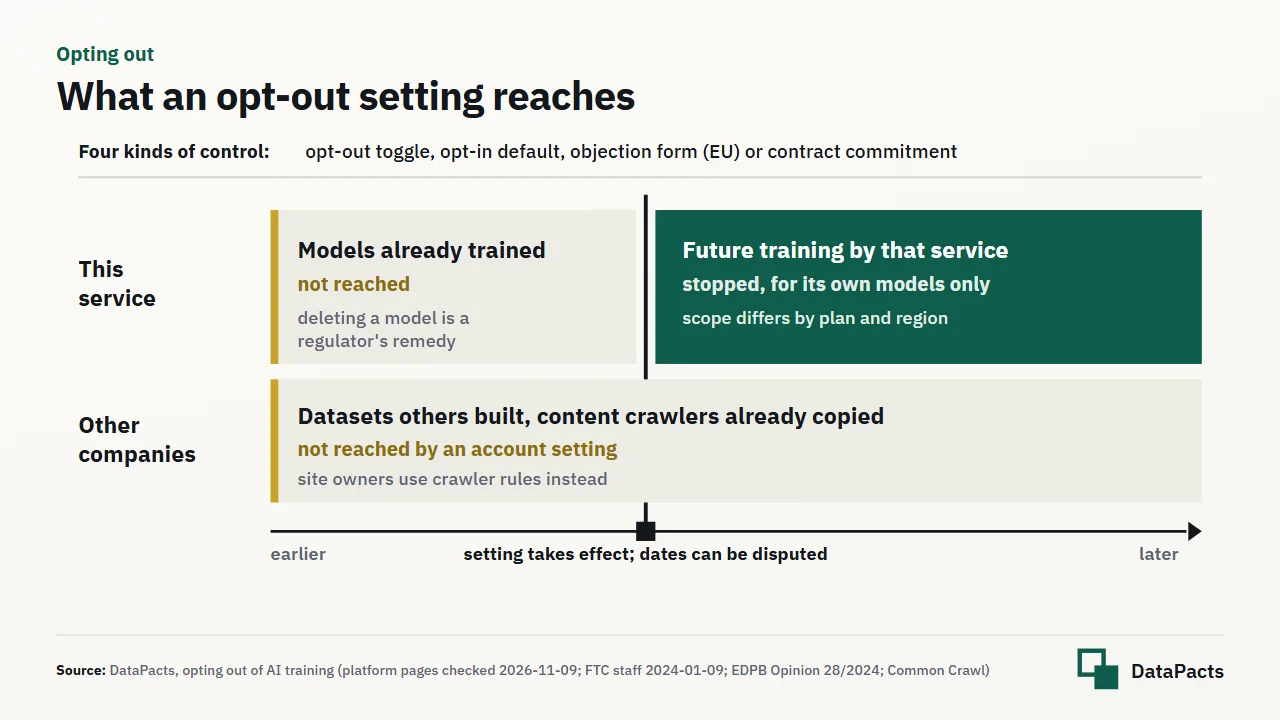
Many platforms now offer a setting, an objection form or a contract commitment that keeps their users' content out of the platform's own AI training, but each covers only that platform's models and only from the moment it takes effect.
The settings differ by service, plan and region, and the sections below sit within the wider field of AI training data licensing. Defaults range from training on unless the user opts out (LinkedIn, GitHub Copilot) to no training without opt-in consent (Slack).
Each setting is dated here as the platform's own claim with its check date, and the page also records what no setting reaches: models already trained, datasets built earlier and content copied by crawlers. DataPacts is independent. Opting out is one alternative to licensing, and not licensing is a valid outcome.
Fact-check note: every platform claim below is dated and sourced as described in how we source, date and check every figure.
What does an AI training setting on a platform actually control?
A platform training setting controls whether that service uses what a person posts, uploads or types to train its own models; it does not control what other companies copy from the public web. Four mechanisms exist. Opt-out toggles (LinkedIn) leave training on until the member turns it off.
Opt-in defaults (Slack) leave it off until the customer consents. Objection forms under EU law (Meta) ask the company to exclude the person's data. Contract commitments (Microsoft 365 Copilot, Google Workspace) offer no switch at all, because the training is excluded by the terms.
Site owners use crawler rules, not account settings. OpenAI states that disallowing GPTBot signals that content should not be used in training, and Google states that Google-Extended controls training of future Gemini models without affecting Search. The full list of AI crawlers that collect training data and the rules for each belong to that section.
Training controls by platform, with defaults and check dates
The table lists each control as the platform describes it on its own pages, with the default, who can change it and the date it was checked.
It is ordered alphabetically by platform, and values are as of 2026-11-10 unless a row shows an earlier check. "Not recorded" means the platform's page did not state the point on the check date.
| Platform and service | Control as the platform describes it | Default | Who can change it | Effective or announced | Checked | Source |
|---|---|---|---|---|---|---|
| Anthropic Claude (consumer plans) | choice to allow chats for training; 5-year retention if allowed, 30 days if not | user's choice | the user | announced 2025-08-28; choose by 2025-10-08 | 2026-11-09 | anthropic.com/news/updates-to-our-consumer-terms |
| Atlassian (cloud products) | in-app data and metadata contribution | in-app: on for Free and Standard, off for Premium and Enterprise; metadata: on | in-app: opt-out on all plans; metadata: opt-out on Enterprise only | in effect 2026-08-17 | 2026-11-09 | atlassian.com/trust/ai/data-contribution |
| Figma | content training setting | on for Starter and Professional; off and not toggleable for Organization and Enterprise | admins on Starter and Professional | 2024-08-15 | 2026-11-09 | help.figma.com (Control AI training settings) |
| GitHub Copilot (Free, Pro, Pro+) | training on interaction data, opt-out in settings | on unless opted out | the user | announced 2026-03-25; effective 2026-04-24 | 2026-11-09 | github.blog (Copilot interaction data usage policy) |
| Google Gemini Apps | Keep Activity samples uploads; Temporary Chats kept up to 72 hours | not recorded | the user | 2025-09-02 (announced 2025-08-13) | 2026-11-09 | blog.google (temporary chats and privacy controls) |
| Google Workspace (business customers) | no training on customer data without prior permission or instruction | not used | the customer, by permission | Privacy Hub updated 2026-10-26 | 2026-11-09 | knowledge.workspace.google.com (Gemini privacy hub) |
| "Data for Generative AI Improvement" | on unless turned off | the member | EU notice update 2025-11-03 | 2026-11-09 | linkedin.com/help/linkedin/answer/a5538339 | |
| Meta Facebook and Instagram (EU) | objection to training on public content | public content used unless objected | the user, by objection | planned start 2025-05-27 per Meta, as reported by the DPC | 2026-11-09 | dataprotection.ie (DPC statement on Meta AI) |
| Microsoft 365 Copilot | prompts, responses and Graph data not used to train foundation LLMs | not used | n/a (commitment) | page updated 2026-11-04 | 2026-11-09 | learn.microsoft.com (Microsoft 365 Copilot privacy) |
| Slack | generative AI training on customer data only with affirmative opt-in consent | off | the customer, by opt-in | n/a | 2026-11-09 | slack.com/trust/data-management/privacy-principles |
| X (training of Grok by SpaceXAI) | X data of users who opted out not used | not recorded | the user | Grok 4.7 summary, 2026-09-21 | 2026-11-09 | media.x.ai (Grok 4.7 public summary of training content) |
| YouTube | third-party training setting, permission without payment | off | channel owners and Content Manager admins | n/a | 2026-11-09 | support.google.com/youtube/answer/15509945 |
| Zoom | communications-like customer content not used to train Zoom or third-party models, ToS s. 10.2 | not used | n/a (terms) | terms page effective 2023-08-11 | 2026-11-09 | zoom.com/en/trust/terms |
Settings change without notice, so the table shows only the latest check, and dated changes follow how we source, date and check every figure. A platform's own page always wins over this summary.
How each platform's control works
The order below runs from assistants to code, the professional network, social platforms, workplace tools, video and the services not yet covered.
Claude and Gemini: chat training choices and how long chats are kept
Anthropic asks consumer Claude users to choose whether their chats train its models, and the choice also sets how long the chats are kept: 5 years if training is allowed and 30 days if not.
Anthropic announced the change on 2025-08-28 and asked existing users to choose by 2025-10-08. Claude for Work, the API, Claude Gov and Claude for Education are excluded from the consumer choice. Google states that Gemini Apps samples uploads under Keep Activity from 2025-09-02 and keeps Temporary Chats for up to 72 hours (checked 2026-11-09).
GitHub Copilot: interaction data and the opt-out in settings
GitHub trains on Copilot interaction data from Free, Pro and Pro+ users from 2026-04-24, unless the user opts out in settings.
GitHub announced the policy on 2026-03-25. Its Terms of Service, effective 2026-04-27, state in section D.3 that "You own Your Content" and in section D.4 grant a license that covers training AI features and the models and technologies of GitHub and its Affiliates, which GitHub states is not a sale.
The sentences describe what GitHub states; the settings page itself is the place to confirm the current option.
LinkedIn: the generative AI improvement setting and the EU notice
LinkedIn uses member data to train content-generating AI models unless the member turns off "Data for Generative AI Improvement". The operator is LinkedIn Corporation, and LinkedIn Ireland Unlimited Company for members in the EU, the EEA and Switzerland.
An EU privacy notice update of 2025-11-03 covers generative AI training, lists saved resumes and screening answers among the data used and excludes private messages (checked 2026-11-09).
Facebook, Instagram and X in the EU: objections and excluded users
In the EU, Meta relies on an objection rather than a switch for training on public Facebook and Instagram content, and xAI states it excludes the X data of users who opted out.
The Irish Data Protection Commission (DPC) reported on 2025-05-21 a planned Meta start of 2025-05-27, and the DPC does not confirm an actual start.
SpaceXAI LLC (formerly xAI LLC) states in its Grok 4.7 summary, placed on the EU market on 2026-09-21, that it does not train on X data of users who opted out; the DPC announced an inquiry into X Internet Unlimited Company on 2025-04-11. The claims and rulings on Meta sit in the case record on Meta AI training on EU user data.
Workplace tools that train only with the customer's permission
Several workplace tools commit in their own terms not to train on customer content without permission, so there is nothing to switch off.
Slack states that generative AI training on customer data requires affirmative opt-in consent. Microsoft states that prompts, responses and Microsoft Graph data in Microsoft 365 Copilot are not used to train foundation LLMs.
Google states that Workspace does not use customer data for training without prior permission or instruction, and Zoom states in s. 10.2 of its terms that communications-like content is not used to train Zoom or third-party models.
All were checked 2026-11-09. These commitments sit in the business customer's contract; the settings of consumer Gmail and Docs are not covered here.
Atlassian and Figma: defaults that depend on the plan
Atlassian and Figma train on customer content by default on their smaller plans, and the larger plans either default to off or cannot be switched on.
Atlassian states that its data contribution has been in effect since 2026-08-17: in-app data is on for Free and Standard plans and off for Premium and Enterprise, every plan can opt out, and the metadata opt-out exists only on Enterprise (checked 2026-11-09).
Figma states that its content training took effect on 2024-08-15, is on for Starter and Professional, and is off and not toggleable for Organization and Enterprise.
YouTube: a setting that grants permission to third parties
YouTube's third-party training setting works the other way round: it is off by default, and a channel owner switches it on to let listed AI companies train on public videos.
YouTube states that it "isn't facilitating payments between third-party companies and creators or other rights holders at this time", so the setting grants permission and carries no payment. Status changes can take up to 7 days to appear in the YouTube Data API (checked 2026-11-09).
Services with no training control recorded here yet
For several services people ask about, including consumer Gmail, ChatGPT, Adobe, WhatsApp and Reddit, no setting has been checked against the service's own page for this reference yet, so none is described.
Reddit's Form S-1 states an aggregate contract value of USD 203.0 million for its data licensing arrangements of January 2024 with terms of two to three years, and the counterparties are not named there. Reddit's AI data licensing deals with Google and OpenAI are covered on their own page.
Reddit also disclosed that it received a non-public FTC inquiry letter on licensing user content to train AI on 2024-03-14, and no outcome is on record.
What a platform setting does not stop
A setting stops future use by one service; it does not pull data out of models already trained, out of datasets others built, or out of what crawlers already copied. Five limits follow.
- Models already trained: deleting a model is a regulator's remedy, not a setting. FTC staff wrote on 2024-01-09 that prior orders required businesses that unlawfully obtained consumer data to delete products, including models and algorithms, built with it. The EDPB lists erasure of the dataset or of the model as a corrective measure in Opinion 28/2024, adopted 2024-12-17.
- Datasets built earlier: Common Crawl states that its WARC files are immutable and that affected URLs are removed or filtered only from subsequent crawls and public indexes (2025-11-04). The Stack v2.2.0 removed opt-outs received before 2026-07-29.
- Content others crawled: OpenAI states that user-initiated fetchers such as ChatGPT-User may not follow robots.txt, and other operators say the same of their fetchers.
- Business versus consumer plans: commercial Claude services are excluded from the consumer choice, and Figma's enterprise plans are off without a toggle.
- Timing disputes: Meta says objections are honored at any time, while noyb states in its letter of 2025-05-14 that an objection counts only if made before training starts.
Published works in the EU have a separate legal reservation: Article 4(3) of Directive (EU) 2019/790 allows a reservation "in an appropriate manner, such as machine-readable means" for content made available online.
That route is explained under the EU text and data mining exception and its opt-out, and a contract can override the exception because Article 7(1) does not protect Article 4 against it.
Terms can also change after a user's choice. FTC staff wrote on 2024-02-13 that "It may be unfair or deceptive for a company to adopt more permissive data practices", which is a staff blog post and not a Commission rule.
What gives a setting legal force: objection, consent and regulator positions
A setting is a company's own promise unless a law requires it, and the clearest requirement on record comes from EU data protection law. Meta relies on legitimate interest under Article 6(1)(f) of Regulation (EU) 2016/679.
The Higher Regional Court of Cologne (OLG Köln, 15 UKl 2/25, 2025-05-23) rejected an interim injunction sought by Verbraucherzentrale NRW and held that AI training can be a legitimate interest, with a value in dispute of EUR 250,000, and no main proceedings were found as of 2026-11-09. EDPB Opinion 28/2024 of 2024-12-17 sets out how legitimate interest applies to AI models.
Other regulators have acted differently. The Brazilian authority ANPD ordered a preventive suspension of Meta's processing for AI training on 2024-07-02, with a daily fine of BRL 50,000, and its later status has not been checked.
The DPC applied to the High Court under section 134 against Twitter on 2024-08-08 over Grok training. The Digital Omnibus proposal COM(2025) 837 is pending and would add an Article 88c on legitimate interest for AI development.
In the US, no federal rule on platform training settings is recorded, only FTC staff statements. The differences between regions are compared under privacy law and AI training data by jurisdiction.
This section is information, not legal advice.
Opt out, license or leave it: benefits, risks, downsides and alternatives
For a person or a company whose content sits on a platform, opting out is one choice among four, and none of them reaches data already used.
Benefits
- Stops future training by that service, as GitHub and LinkedIn describe for their own settings.
- Shortens retention where the platform ties retention to the choice, as Anthropic does with 30 days against 5 years.
- Creates a record of the choice, which matters in disputes such as the timing disagreement over Meta objections.
Risks
- The setting may not cover past training, as the model-deletion and erasure positions show.
- Effect dates are disputed.
- Terms can change later.
Downsides
- AI features tied to the same switch may stop working.
- Settings differ by plan and region, so a company has to check each tool one by one.
Alternatives
- Keep the default.
- License the content on the holder's own terms, which suits company holders: see whether to sell or license your data at all.
- Grant permission without payment where a platform offers it, as YouTube does.
- Do nothing and accept the platform's terms.
Beyond account settings: crawler controls, platform terms and source systems
Account settings are one layer; the pages below cover the crawler rules site owners use, the terms under which services train on users, and the export side of each workplace system. The shared training signal and the question of when services train on their users are covered on pages not yet published.
- How AI companies get training data: the parent overview of all routes.
- robots.txt for AI crawlers: rules, limits and examples.
- Google-Extended for Gemini training: the site-owner control for Gemini.
- GPTBot and OpenAI's other crawlers: which OpenAI bots respect which signals.
- The shared AI training opt-out signal: the IETF draft and who recognizes it.
- User data and platform terms: when services train on their users.
- GitHub repositories and their export rights: the code side.
- Slack data and AI training by plan: the license view of Slack.
- Google Workspace exports: the Workspace side.
- Jira data and Atlassian's contribution settings: Atlassian's license view.
- Individuals selling their own data: the personal route.
- Legitimate interest for AI training data: the Article 6(1)(f) test.
Frequently asked questions
How do I opt out of GitHub using my data for AI training?
GitHub trains on Copilot interaction data from Free, Pro and Pro+ users from 2026-04-24 unless the user opts out in settings. GitHub announced the policy on 2026-03-25. Its Terms of Service of 2026-04-27 grant a license covering training of AI features and of the models and technologies of GitHub and its Affiliates, and state that the user owns their content.
Does turning a setting off remove my data from models already trained?
No: a setting acts from its date forward. Deleting a model is a regulator's remedy, as FTC staff and the EDPB describe, and Common Crawl changes only subsequent crawls.
Can I opt out of Meta AI training?
In the EU, Meta offers an objection rather than a switch for public Facebook and Instagram content. Meta says objections are honored at any time, noyb says only those made before training starts count. Both claims are kept as stated. The rulings are followed in the case record on Meta AI training on EU user data.
Does Slack train AI on workspace messages?
Slack states that generative AI training on customer data happens only with affirmative opt-in consent (checked 2026-11-09). Microsoft states for Microsoft 365 Copilot that its data is not used to train foundation LLMs.
Is it possible to opt out of AI altogether?
No single switch exists: settings are per service, and site owners use crawler rules. The shared training signal is an Internet-Draft of 2026-10-30, not a standard; Google plans support in 2027 and Anthropic recognizes a general no-AI-training signal from 2026-10-30.