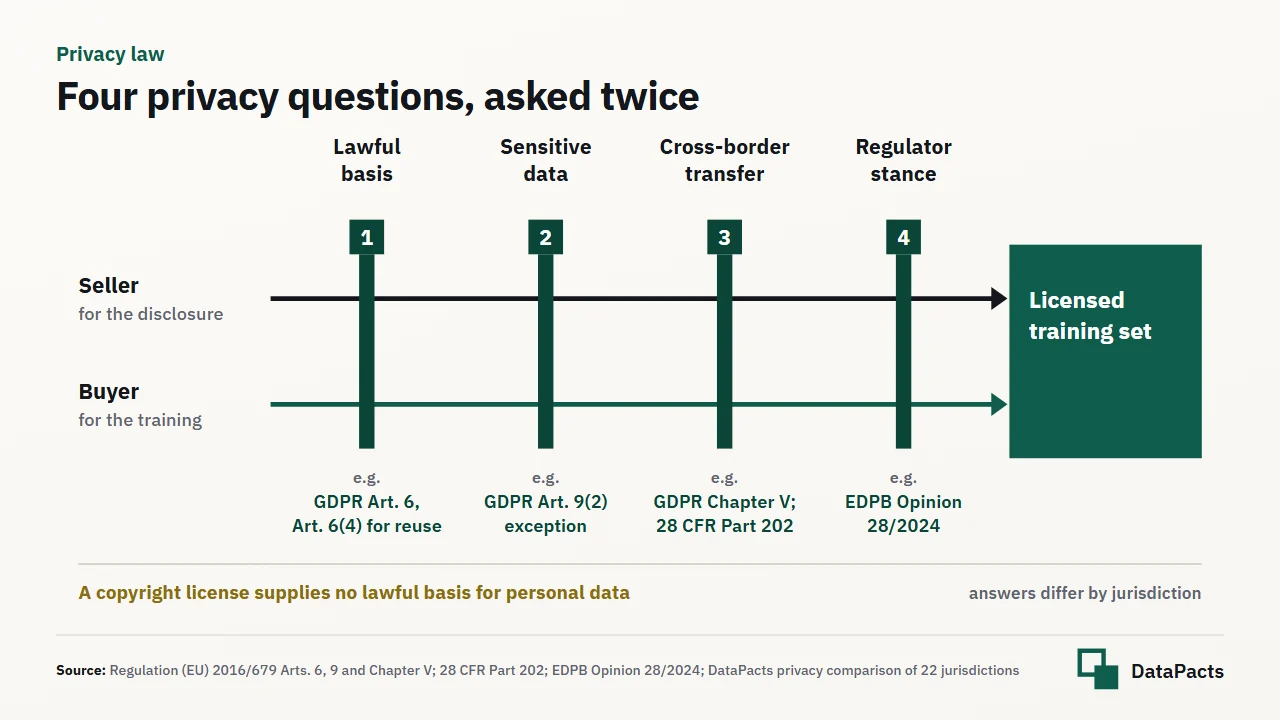
The table below compares 22 jurisdictions on four questions: lawful basis, sensitive data, cross-border transfer and the regulator's stance. Consent leads in some, balancing in others, and a sale with an opt-out in California and most US states.
Of the 22 jurisdictions, 17 have a verified instrument, as of November 9, 2026. The page serves holders of records and developers acquiring them within AI training data licensing, and copyright and recording consent are separate layers with their own pages. Nine regulator actions and ten pending changes have their own tables.
What Privacy Law Asks Before Personal Data Enters a Licensed Training Set
Privacy law asks four questions before personal data is licensed for training: which lawful basis covers the disclosure, whether sensitive data needs more, whether the data may leave the country, and what the regulator expects. The seller answers them for the disclosure to the buyer and the buyer again for the training.
A dataset with people from several countries meets several laws, so planning starts from the strictest rule present. That is a planning consequence, not a holding on which law governs a record, and a copyright license supplies no lawful basis for personal data.
Privacy Rules for AI Training Data in 22 Jurisdictions
The table sets 22 jurisdictions side by side with the instrument, the lawful basis for licensing, the sensitive-data rule, the transfer rule, the regulator's stance, the source and the date each row was checked.
"Not stated" means no primary source was verified for this page, not that no rule exists, and eight US state laws share one row.
| Jurisdiction | Instrument and date | Lawful basis to license | Sensitive data | Cross-border transfer | Regulator stance on training | Source | As of |
|---|---|---|---|---|---|---|---|
| European Union | Reg. (EU) 2016/679, applies from 2018-05-25 | Art. 6 basis plus Art. 6(4) test for reuse | Art. 9(2) exception plus Art. 6 | Chapter V: DPF Decision 2023/1795 for certified US buyers, SCCs 2021/914, Art. 49 | EDPB Opinion 28/2024: models not anonymous in all cases | eur-lex.europa.eu; edpb.europa.eu | 2026-11-09 |
| United Kingdom | UK GDPR as amended by DUAA 2025; ss.67, 70, 71 in force 2026-02-05 | Art. 6(1)(ea) only with an Annex 1 condition; commercial research (s.67); DPA 2018 s.170 offence | not stated | not stated | not stated | legislation.gov.uk | 2026-11-09 |
| Switzerland | DSG, SR 235.1, in force 2023-09-01 | justification ground (consent, overriding interest, law) | Art. 31(2)(e): disclosed only non-identifiably | Swiss-US DPF, certified US organisations, since 2024-09-15 | not stated | fedlex.admin.ch | 2026-11-09 |
| United States (federal) | FTC Act s.5; HIPAA 45 CFR 164; COPPA 16 CFR 312; 28 CFR Part 202 (2025-04-08) | sectoral; no general federal basis recorded | PHI sale needs authorization; separate parental consent for AI training | no bulk sensitive data to six countries, even de-identified | FTC staff post 2024-02-13 | ftc.gov; ecfr.gov | 2026-11-09 |
| California | CCPA, Cal. Civ. Code 1798.100 ff., in force 2020-01-01 | licensing for money is a sale; opt-out (1798.120) | statute rule not stated; risk assessment before selling PI (2026-01-01) | none recorded | CPPA regulations in force 2026-01-01 | cppa.ca.gov | 2026-11-09 |
| US state privacy laws (CT, FL, MD, OR, TX, UT, VA, WA) | VCDPA, CTDPA (P.A. 25-113), TDPSA, OCPA, UCPA, MODPA, FDBR, MHMDA | sale with opt-out; Connecticut LLM-training notice from 2026-07-01 | consent (VA, TX, OR, FL); notice and opt-out (UT); sale banned (MD); authorization (WA) | none recorded | Oregon AG guidance 2024-12-24 | state legislature and AG sites | 2026-11-09 |
| Canada (federal) | PIPEDA, S.C. 2000, c. 5 | consent; s.7.2(4): business-transaction exception excludes sale or lease of personal information | not stated | not stated | Findings #2026-002: licensed datasets need individuals given a choice | laws-lois.justice.gc.ca; priv.gc.ca | 2026-11-09 |
| Quebec | Law 25, S.Q. 2021, c. 25 (staged) | consent per specific purpose | express consent for a different purpose | assessment and written agreement before leaving Quebec | CAI joined Findings #2026-002 | cai.gouv.qc.ca | 2026-11-09 |
| Mexico | LFPDPPP, in force 2025-03-21 | privacy notice or new consent; dissociated and public data exempt | fines may double (Art. 59) | not stated | not stated | diputados.gob.mx | 2026-11-09 |
| Brazil | LGPD: not stated | not stated | not stated | not stated | ANPD suspension of Meta's AI training, 2024-07-02 | gov.br/anpd | 2026-11-09 |
| China | PIPL (2021-11-01); Interim Measures (2023-08-15) | notice plus separate consent; public data within reasonable scope | not stated | mechanism plus separate consent | consent or other legal basis for personal information in training data | cac.gov.cn | 2026-11-09 |
| Japan | APPI; amendment promulgated 2026-07-17, not in force | amendment: consent-free statistics route incl. AI development (Arts. 30-2, 31-3) | amendment: public sensitive data for statistics | not stated | PPC alert to OpenAI, 2023-06-02 | ppc.go.jp | 2026-11-09 |
| Taiwan | PDPA, amended 2025-11-11 | public sources unless overriding interest bars it | not stated | authority may restrict (Art. 21) | not stated | law.moj.gov.tw | 2026-11-09 |
| Malaysia | PDPA 2010 (Act 709), amended 2024 | notice and consent | not stated | not stated | draft paper 1/2026: fresh notice or consent for new AI purposes | pdp.gov.my | 2026-11-09 |
| South Korea | PIPA: not stated; AI special provision passed 2026-08-20 | not stated | not stated | not stated | PIPC-supervised basis under the special provision (passed, commencement not stated) | pipc.go.kr | 2026-11-09 |
| Singapore | not stated | not stated | not stated | not stated | not stated | n/a | 2026-11-09 |
| Australia | Privacy Act: not stated | not stated | not stated | not stated | OAIC guidance, 2024-10-21 | oaic.gov.au | 2026-11-09 |
| India | not stated | not stated | not stated | not stated | not stated | n/a | 2026-11-09 |
| Türkiye | KVKK, Law No. 6698; amended by Law No. 7499 | explicit consent default; alternatives listed | not stated | Art. 9 | not stated | mevzuat.gov.tr | 2026-11-09 |
| Saudi Arabia | PDPL, Royal Decree M/19 (1443H), as amended | public sources; non-identifiable disclosure | not stated | restricted (articles not stated) | not stated | sdaia.gov.sa | 2026-11-09 |
| United Arab Emirates | Federal Decree-Law No. 45 of 2021; DIFC Law No. 5 of 2020 | consent except listed cases | not stated | cross-border requirements; DIFC, ADGM own laws | DIFC Regulation 10 on AI systems | u.ae; difc.com | 2026-11-09 |
| South Africa | POPIA, Act 4 of 2013 | not stated | not stated | not stated | not stated | gov.za | 2026-11-09 |
Four Questions Answered Differently Across Jurisdictions
The table shows each rule; the four sections below show the pattern behind each question, with the jurisdictions that answer it alike.
Lawful Basis: Consent First, Interest Balancing or a Sale With an Opt-out
Jurisdictions answer the lawful-basis question in three ways: consent first, as in China, Canada, Quebec and Türkiye; a choice among several bases with balancing, as in the EU, the UK and Switzerland; and a sale that people may opt out of, as in California and most US state laws.
Consent-first rules treat a licensing deal as a disclosure that needs the person's agreement. China's PIPL (in force 2021-11-01) requires notice plus separate consent to sell or license personal information to an AI developer.
Canada's PIPEDA denies the business-transaction exception to a transaction whose primary purpose or result is the sale or lease of personal information (s.7.2(4)).
Quebec's Law 25 asks consent per specific purpose, Türkiye's Law No. 6698 makes explicit consent the default, the UAE's Federal Decree-Law No. 45 of 2021 bars processing without consent except in listed cases, and Mexico's LFPDPPP treats licensing as a transfer the privacy notice or a new consent must cover.
Balancing rules let the discloser choose among bases and test the choice. The GDPR needs an Art. 6 basis and, for reuse, the Art. 6(4) compatibility test, and a buyer's promise to anonymize does not replace the seller's basis.
The UK adds Art. 6(1)(ea) only where an Annex 1 condition is met (DUAA 2025 s.70), and its conditions (public-task disclosure, national security, emergencies, crime, safeguarding) do not name AI training.
Section 67 counts commercial research as research, and s.71 says compatible processing is not lawful by that fact alone. Switzerland's DSG requires a justification ground: consent, an overriding interest or law. Contract terms are covered under customer consent and confidentiality clauses before licensing data.
The sale model treats licensing for money as a sale with an opt-out. The CCPA gives consumers a right to opt out of sale (Cal. Civ. Code 1798.120), and Virginia defines a sale as an exchange for monetary consideration (Va.
Code 59.1-575). FTC staff wrote on 2024-02-13 that it may be unfair or deceptive to adopt more permissive data practices, such as AI training, through a surreptitious, retroactive change of terms.
Sensitive Data: Extra Consent, Outright Sale Bans and Narrow Research Routes
Sensitive data such as health, biometric, children's or precise location data carries a stricter rule in almost every row, ranging from an extra legal condition to an outright ban on selling it.
In the EU, Art. 9(1) GDPR prohibits special categories unless an Art. 9(2) exception applies, in addition to the Art. 6 basis. Other rows set their own rules:
- Consent: Virginia (Va. Code 59.1-578), Texas (TDPSA, in force 2024-07-01) and Florida (Fla. Stat. 501.715, any for-profit business collecting personal data) require consent for sensitive data, and Quebec requires express consent before sensitive information is used for a different purpose.
- Ban: Maryland's MODPA (effective 2025-10-01) bans selling sensitive data and selling data of consumers the controller knew or should have known are under 18 (14-4707(a)(5)).
- Named buyer: Washington's My Health My Data Act (RCW 19.373, in force 2024-03-31) requires a signed authorization naming the buyer for selling health data.
- US federal: a sale of PHI needs an authorization stating remuneration (45 CFR 164.508(a)(4)), and the 2025 COPPA Rule amendments, with compliance date 2026-04-22, require separate parental consent for disclosures to train AI.
- Research routes: Switzerland's Art. 31(2)(e) DSG allows sensitive data to be disclosed for research or statistics only non-identifiably, and Japan's APPI amendment (promulgated 2026-07-17, not in force) will open a statistics route for public sensitive data.
Mexican fines under Art. 59 LFPDPPP may double for sensitive data. Utah requires only clear notice and an opportunity to opt out before sensitive data is processed (Utah Code 13-61-302), not consent.
The sensitive-data rules of the UK, Canada, China and Korea are not stated here, and biometric rules are covered under biometric data in AI training.
Sending a Training Set Abroad: Transfer Tools, Separate Consent and Export Limits
Personal data delivered to a buyer in another country needs a transfer route in most rows, and the United States adds a rule that limits exports by the seller rather than imports.
The EU's Chapter V (Arts. 45, 46, 49) allows transfer under an adequacy decision, safeguards such as the standard contractual clauses of Decision 2021/914, or a derogation, and Decision (EU) 2023/1795 covers only US buyers certified under the Data Privacy Framework.
The General Court dismissed the challenge T-553/23 on 2025-09-03 and the appeal C-703/25 P is pending as of 2026-11-09.
- China: a transfer mechanism plus separate consent (PIPL).
- Quebec: a privacy impact assessment and a written agreement before communicating personal information outside Quebec, since September 2023.
- Taiwan: the competent authority may restrict transfers (PDPA Art. 21).
- Türkiye: transfers must meet Art. 9 of Law No. 6698.
- Saudi Arabia and the UAE: the PDPL restricts transfers abroad, with its articles not stated here, and the UAE decree-law sets cross-border requirements while DIFC and ADGM have their own laws.
The seller-side limit is 28 CFR Part 202, effective 2025-04-08, which prohibits licensing bulk US sensitive personal data to buyers in or linked to China, Cuba, Iran, North Korea, Russia and Venezuela, even if de-identified.
Thresholds in 202.205 run from more than 100 persons (genomic data) to more than 100,000 (covered personal identifiers), and 202.302 sets an onward-transfer clause. The detail sits under DOJ bulk sensitive data rule and selling data to foreign AI buyers.
Public and De-identified Records: Where the Rules Loosen and Where They Do Not
Several laws loosen their rules for de-identified or publicly available data, but each sets its own conditions, and regulators have rejected the idea that public availability alone permits training. De-identified health data under 45 CFR 164.514 is outside the HIPAA Privacy Rule (164.502(d)).
Mexico exempts dissociated data, Utah treats synthetic data as deidentified only with a public commitment and contractual flow-down, and Quebec allows anonymization only by the criteria of its regulation. Part 202 has no de-identification exception.
Public sources get their own conditions. China allows public data within a reasonable scope, Taiwan allows collection from public sources unless the person's overriding interest bars it, and Saudi Arabia allows disclosure from public sources. The Canadian finding of 2026-05-06 held that indiscriminate scraping does not meet PIPEDA's publicly available exception.
The EDPB's Opinion 28/2024 (adopted 2024-12-17) says a model trained on personal data is not anonymous in all cases, because anonymity needs an insignificant likelihood of extraction and of query retrieval. The test is explained under anonymization vs pseudonymization for AI training data.
What Privacy Regulators Have Said About Training on Personal Data
Privacy regulators outside the EU member states have acted on AI training at least nine times since 2023, through findings, a suspension order, guidance and alerts, and none of these actions concerns a company licensing its own records to a buyer. The table sets the nine actions side by side, newest first, as of 2026-11-09.
EU member-state authorities are covered in the GDPR enforcement record.
| Date | Regulator | Action | What it says about training data | Source | Page |
|---|---|---|---|---|---|
| 2026-10 | JPDP Malaysia | Consultation Paper No. 1/2026 (draft) | controller responsible for third-party and public data; fresh notice or consent for new AI purposes; consultation dates 2026-10-05 to 2026-10-23 on the paper, listing dated 2026-10-29 | pdp.gov.my | Malaysia |
| 2026-05-06 | OPC Canada with CAI, OIPC BC, OIPC Alberta | Findings #2026-002 (OpenAI) | no implied consent for scraped and licensed data; licensed datasets need individuals given a choice; conditionally resolved | priv.gc.ca | OPC Findings #2026-002 |
| 2024-12-24 | Oregon DOJ | OCPA AI guidance | disclose training; explicit consent for sensitive data; no retroactive changes | doj.state.or.us | Oregon |
| 2024-12-17 | EDPB | Opinion 28/2024 | model anonymity needs insignificant extraction and query retrieval | edpb.europa.eu | Model anonymity |
| 2024-10-21 | OAIC | generative AI training guidance | content not stated beyond title and date | oaic.gov.au | Australia |
| 2024-07-02 | ANPD Brazil | preventive measure (Voto nº 11/2024) | Meta's AI-training processing suspended; BRL 50,000 daily fine | gov.br/anpd | ANPD v Meta |
| 2024-02-13 | FTC staff | Office of Technology post | retroactive privacy-term changes for AI training may be unfair or deceptive | ftc.gov | FTC |
| 2023-08-15 | CAC and six agencies | Interim Measures in force | lawful sources; consent or other legal basis for personal information | cac.gov.cn | China |
| 2023-06-02 | PPC Japan | alert to OpenAI | content not stated beyond date | ppc.go.jp | Japan |
The Canadian finding is the only action on licensed datasets, and OpenAI's statement that licensed data were under 1 % of its pre-training datasets is a figure the offices could not verify. The ANPD measure's later status and the content of the PPC alert and OAIC guidance beyond date and title are not stated.
Enacted, Pending and Open: Privacy Changes as of November 2026
Ten privacy changes affect training-data deals in 2026 and 2027, and the table keeps rules in force, laws enacted but not yet in force, and proposals strictly apart, as of 2026-11-09.
| Change | Jurisdiction | Status | Date | Source |
|---|---|---|---|---|
| DUAA ss.67, 70, 71 | United Kingdom | in force | 2026-02-05 (S.I. 2026/82) | legislation.gov.uk |
| CCPA risk-assessment and ADMT regulations | California | in force | 2026-01-01 | cppa.ca.gov |
| COPPA Rule amendments, compliance date | United States | in force | 2026-04-22 | ecfr.gov |
| P.A. 25-113 LLM-training notices | Connecticut | in force | 2026-07-01 | cga.ct.gov |
| APPI amendment | Japan | enacted, not in force | promulgated 2026-07-17 | ppc.go.jp |
| PIPA AI special provision | South Korea | passed | 2026-08-20 | pipc.go.kr |
| Bill C-36 | Canada | proposal, second reading | first reading 2026-06-15 | parl.ca |
| Digital Omnibus COM(2025) 837 | European Union | proposal, awaiting committee decision | 2025-11-19 | publications.europa.eu |
| EDPB Guidelines 02/2026 and 03/2026 | European Union | consultation closed, not final | 2026-07-07 | edpb.europa.eu |
| DPF appeal C-703/25 P | European Union | appeal pending | 2025-10-31 | publications.europa.eu |
Bill C-36 and the Digital Omnibus proposal are proposals, Japan's amendment is promulgated but not in force, and Korea's provision has passed without a commencement date stated here.
What Buyers Ask of Personal Data in a Licensed Set
Buyers that publish requirements ask for consent or for records that can be fully anonymized, and some cover the anonymization themselves. Mercor's claims are quoted as stated, checked 2026-11-09:
- Its law-firm listing requires "Client consent, or documents that can be fully anonymized".
- The same listing states a location preference of "United States preferred".
- Mercor states that it covers extraction, anonymization and transfer costs and pays on delivery of the anonymized dataset.
A buyer's anonymization does not replace the seller's lawful basis for the disclosure, as the Mercor data buyer profile sets out with the other claims on that page.
Licensing Personal Data for AI Training: Benefits, Risks, Downsides and Alternatives, Including Not Licensing
A company can license personal data for training where a lawful basis, the sensitive-data rule and the transfer rule all allow it, but each layer adds cost and some breaches are criminal, so not licensing stays a valid outcome.
Benefits
- Some routes need no new consent under conditions: UK commercial research (s.67), Mexico's dissociated data, and Japan's statistics route once in force.
- Documented consent meets the expectation in the Canadian finding and the requirement in Mercor's listing.
Risks
- Fines as of 2026-11-09 reach CNY 50 million or 5 % of prior-year turnover under PIPL Art. 66, CAD 25,000,000 or 4 % of worldwide turnover under Quebec's Law 25, USD 50,000 per violation in Florida and USD 7,500 per violation in Texas, Oregon and Utah.
- A regulator can suspend processing: ANPD suspended Meta's AI-training processing on 2024-07-02, with a daily fine of BRL 50,000 for non-compliance.
- Knowingly or recklessly disclosing personal data without the controller's consent is an offence under s.170 DPA 2018.
- The bulk rule bars exports of covered data to six countries.
Downsides
- Assessments and re-consent cost time, and pending rules can change terms during a license.
Alternatives
- License only non-personal or de-identified records.
- Obtain consent for training first.
- License to same-jurisdiction buyers only.
- Do not license, which stays a valid outcome, as the guide on should you sell or license your data to AI companies sets out.
Beyond This Comparison: Jurisdiction Pages, Seller Steps and Related Rules
Each jurisdiction, adjacent legal topic and seller step has its own page.
- AI training data law by jurisdiction: the parent comparison.
- EU rules for AI training data.
- Employee data and AI training rules.
- Call and meeting recording consent rules.
- Web scraping for AI training.
- PII removal and de-identification before licensing.
- What company data cannot be licensed for AI training.
- Transferring training data to US buyers.
- UK GDPR after the Data (Use and Access) Act 2025.
- HIPAA and AI training data.
- COPPA and children's data in AI training.
- Privacy risk to people in licensed data.
- Synthetic data and privacy law.
What This Page Does Not Cover
This page covers privacy rules for licensing personal data to AI developers, not staff training in data protection or consumer data brokers for marketing. Copyright in the same records is outside it, and individuals who want to opt out of chatbot training will find settings and their limits on that page.
How This Page Is Sourced and Dated
Every rule cites the statute, regulation or regulator record, with the date it was checked. The method is described in how we source, date and check every figure, and this page is general information about privacy law, not legal advice for any specific dataset or deal.
Frequently Asked Questions
Does privacy law allow personal data in AI training data?
Yes, where the lawful basis, sensitive-data and transfer rules of each jurisdiction allow it. Three models apply: consent first, interest balancing under the GDPR, UK GDPR and Swiss DSG, and sale with opt-out in California and most US states. A copyright license supplies none of them.
Which privacy laws mention AI training by name?
Few do. Connecticut's P.A. 25-113 requires notices about training large language models from 2026-07-01, the CCPA regulations on risk assessments apply from 2026-01-01, the COPPA Rule requires separate consent, DIFC Regulation 10 covers AI systems, and Japan's amendment, not in force, names AI development.
Can a training set with personal data be sent to a buyer in another country?
Only with a transfer route in most jurisdictions. The EU needs a Chapter V tool, China a mechanism plus separate consent, and Quebec an assessment plus a written agreement. US bulk sensitive data may not go to six countries of concern (28 CFR Part 202), even de-identified.