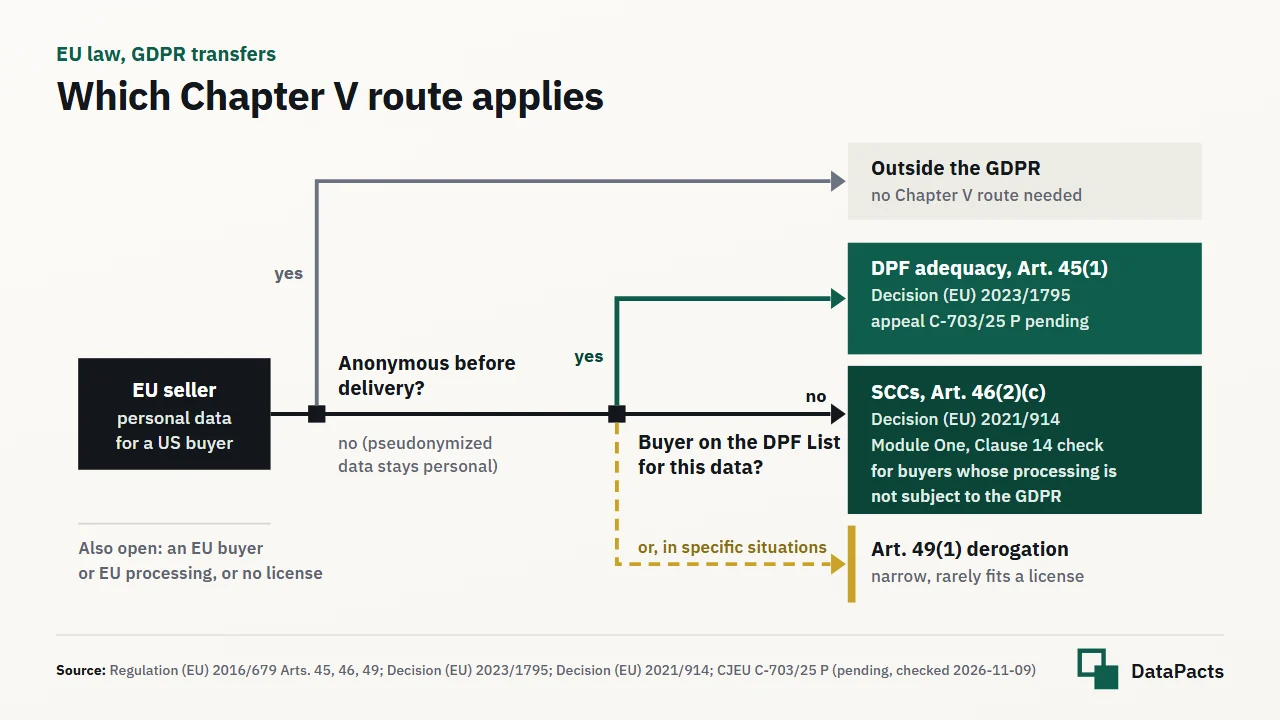
The General Court dismissed the challenge to the framework on September 3, 2025 (T-553/23), and the appeal C-703/25 P is pending as of November 9, 2026.
The seller is the data exporter and carries the choice of route, one transfer step in AI training data licensing. Decisions and the court record were checked on November 9, 2026, and the texts re-read on November 10, 2026.
Three Chapter V Routes for Delivering Training Data to a US Buyer
Chapter V of the GDPR (Articles 44 to 49) offers three routes for a US delivery, and the table shows which buyer each fits and what the seller must check as of 2026-11-10.
| Route | Instrument | Fits which buyer | Seller's check | Status | Source |
|---|---|---|---|---|---|
| Adequacy (Art. 45(1)) | Decision (EU) 2023/1795, C(2023) 4745, OJ L 231, 20.9.2023, p. 118 | US organization on the DPF List under FTC or DoT jurisdiction | listing, re-certification, covered data | in force; appeal C-703/25 P pending as of 2026-11-09 | eur-lex.europa.eu (32023D1795) |
| Appropriate safeguards (Art. 46(1), (2)(c)) | Decision (EU) 2021/914, OJ L 199, 7.6.2021, p. 31 | buyer off the list whose processing is not subject to the GDPR | module, Clause 14 assessment | in force | eur-lex.europa.eu (32021D0914) |
| Derogation (Art. 49(1)) | Regulation (EU) 2016/679 | specific situations, such as explicit consent or contract necessity | each condition case by case | in force | eur-lex.europa.eu (32016R0679) |
A dataset that is anonymous before delivery is outside the GDPR and needs no route, while pseudonymized data stays personal data, as the page on anonymization vs pseudonymization for AI training data explains.
The EU-US Data Privacy Framework: Decision (EU) 2023/1795
Commission Implementing Decision (EU) 2023/1795 finds that the United States ensures an adequate level of protection for personal data transferred from the Union to organizations included in the Data Privacy Framework List kept by the US Department of Commerce (Article 1).
Under Article 45(1) of the GDPR such a transfer needs no specific authorization and no standard contractual clauses. It is C(2023) 4745 (OJ L 231, September 20, 2023).
The framework reaches only organizations under the enforcement powers of the Federal Trade Commission (FTC) or the Department of Transportation (DoT) (recital 9), never all US companies.
The Commission may suspend, amend or repeal the decision under Article 45(5) of the GDPR (Article 3(4) to (5) of the decision), so a seller relying on it keeps an SCC fallback.
What to Check on the DPF List Before Delivery
A US buyer is covered only from the date the Department of Commerce lists it and only while it re-certifies each year, so the seller checks the buyer's own entry at dataprivacyframework.gov before each delivery.
An applicant submits its name, the purposes of processing, the personal data covered, a verification method, a recourse mechanism and the enforcing body (recital 48), and may not claim adherence before listing (recital 49). The table is a method as of 2026-11-10, not a list of buyers, and the seller records the check date.
| Check | What to confirm | Why | Source |
|---|---|---|---|
| Listed | the buyer's exact legal entity appears on the DPF List | coverage starts on the listing date | recital 49 |
| Current | re-certification not lapsed; not on the removed-organizations record | annual re-certification; removed organizations lose the benefit | recitals 49, 55; Annex III |
| Framework | EU-US DPF for EU data; UK Extension for UK data; Swiss-US DPF for Swiss data | each covers its own data | Art. 1; SI 2023/1028 reg. 3(2); Annex 1 to the Swiss Data Protection Ordinance |
| Covered data | the certification covers the personal data in the set (HR data needs the DPA cooperation commitment) | the certification states the personal data covered | recitals 48, 67 |
| Purposes | declared purposes match training on licensed data | the certification describes purposes | recital 48 |
| Enforcement | FTC or DoT named as the statutory body | only these organizations may certify | recital 9 |
When a Buyer Leaves the DPF List: Return, Deletion or Another Tool
A buyer removed for persistent non-compliance must return or delete the personal data it received under the framework, and a buyer that withdraws or fails to re-certify must delete or return it, or keep it only under an annual affirmation or another authorized means such as a contract reflecting the SCCs (recitals 54 and 55; Annex III).
A license therefore carries an SCC fallback for the case that the buyer leaves the list or the decision falls. The Department of Commerce keeps a public record of removed organizations (Annex III).
What a Listed Buyer May Do With the Data Next
A DPF-listed buyer may pass the data to a third party only for limited and specified purposes under a contract, and the recipient may process it only for purposes not incompatible with those of collection (Accountability for Onward Transfer Principle, recitals 38 and 39).
For an onward transfer to a third-party controller, individuals must be informed and may opt out, and sensitive data needs affirmative express consent (recital 40). The license's own terms on sublicensing and onward transfer in AI data licenses are covered on a separate page.
The DPF in Court: From Schrems II to Latombe and Appeal C-703/25 P
The General Court dismissed Philippe Latombe's action for annulment of the DPF decision on September 3, 2025 (Case T-553/23, Tenth Chamber, Extended Composition), and his appeal C-703/25 P, brought on October 31, 2025, is pending as of November 9, 2026.
The court examined four pleas after the first, on languages, was withdrawn at the hearing of April 1, 2025: bulk collection (Charter Articles 7 and 8), the Data Protection Review Court (DPRC; Charter Article 47 and GDPR Article 45(2)), GDPR Article 22 and GDPR Article 32. It held that bulk collection is subject to ex post judicial oversight by the DPRC, whose decisions bind the US government (para. 106), and that a change in the US framework obliges the Commission to suspend, amend or repeal if necessary (para. 58). Ireland and the United States intervened for the Commission.
Schrems II (C-311/18, July 16, 2020) invalidated the Privacy Shield decision (EU) 2016/1250, and Executive Order 14086 of October 7, 2022 followed (recitals 5 and 6). The table gives court status as of 2026-11-09.
| Date | Event | Instrument or docket | Source |
|---|---|---|---|
| 2020-07-16 | Court of Justice invalidates the Privacy Shield decision (EU) 2016/1250 | C-311/18 (Schrems II) | eur-lex.europa.eu (32023D1795, recital 5) |
| 2021-06-04 | Commission adopts the modular SCCs; old clauses repealed from 2021-09-27 | Decision (EU) 2021/914 | eur-lex.europa.eu (32021D0914) |
| 2022-10-07 | US adopts Executive Order 14086 | EO 14086 | eur-lex.europa.eu (32023D1795, recital 6) |
| 2023-07-10 | Commission adopts the DPF adequacy decision | Decision (EU) 2023/1795, C(2023) 4745 | eur-lex.europa.eu (32023D1795) |
| 2023-10-12 | UK Extension regulations in force | SI 2023/1028 | legislation.gov.uk |
| 2024-09-15 | Swiss-US DPF annex in force | Annex 1, SR 235.11 | fedlex.admin.ch |
| 2025-09-03 | General Court dismisses Latombe's action | T-553/23 | curia.europa.eu; eur-lex.europa.eu (62023TJ0553) |
| 2025-10-31 | Appeal brought; pending as of 2026-11-09 | C-703/25 P, OJ C/2025/6610 | curia.europa.eu; eur-lex.europa.eu (62025CN0703) |
Standard Contractual Clauses (Decision (EU) 2021/914) for Buyers Off the List
Standard contractual clauses adopted by Decision (EU) 2021/914 of June 4, 2021 give appropriate safeguards under Article 46(1) and (2)(c) of the GDPR for a transfer to a buyer that is not on the DPF List.
Article 1(1) covers transfers to an importer "whose processing of the data is not subject to" the GDPR, so a US buyer already within the GDPR's territorial scope is not addressed here.
Article 4 repealed the 2001 and 2010 clauses from September 27, 2021, and contracts concluded before then counted as safeguards only until December 27, 2022, so an older license needs the 2021 set.
The clauses go unchanged into or beside the license, as the page on AI data licensing agreements shows. The table lists the modules as of 2026-11-10.
| Module | Transfer | Fit in a training data deal | Source |
|---|---|---|---|
| One | controller to controller | sale or license to a buyer that trains for its own purposes | eur-lex.europa.eu (32021D0914, Annex) |
| Two | controller to processor | US service processing on the seller's instructions | same |
| Three | processor to processor | a seller's processor passing data to a US sub-processor | same |
| Four | processor to controller | EU processor returning data to a US controller | same |
Module One for a Sale, Module Two When the Buyer Only Processes
Module One (controller to controller) fits a training data sale or license, because the seller decides to disclose and the buyer decides to train for its own purposes.
Module Two (controller to processor) fits only where the US party processes on the seller's instructions, for example an annotation or hosting service, not a buyer. Modules Three and Four appear in the table only.
SCC Clauses a Training Data License Must Leave Intact
Several SCC clauses fix terms that a buyer's draft may try to change, and the clauses apply as adopted.
- Clause 8.7 (Module One): onward transfer only to a party bound by the clauses, in an adequate country, with Article 46 or 47 safeguards, or under a binding instrument with the same protection.
- Clause 13: the exporter's supervisory authority is competent.
- Clause 15.1: the importer notifies the exporter and, where possible, the data subject of legally binding requests from public authorities.
- Clauses 17 and 18: the law of an EU Member State that allows third-party beneficiary rights, and disputes before the courts of an EU Member State, with the data subject free to sue where they habitually reside.
A license's general choice of law, arbitration and forum is a separate question covered under governing law, arbitration and disputes in AI data licenses.
The Clause 14 Transfer Impact Assessment
Under Clause 14 of the 2021 SCCs, seller and buyer warrant that they have no reason to believe that US laws and practices, including public authority access, prevent the buyer from complying, and they document the assessment and give it to the competent supervisory authority on request.
Clause 14(b) names three elements: (i) the specific circumstances of the transfer, such as processing chain, onward transfers, recipient type, purpose, categories and format of data, and storage location; (ii) the laws and practices of the destination on disclosure and access; and (iii) supplementary contractual, technical or organizational safeguards. The buyer must make best efforts to supply the information (14(c)).
During the license the buyer must notify the seller promptly if it becomes subject to laws that do not match the warranty (Clause 14(e)), and the seller then identifies measures or suspends the transfer (Clause 14(f)).
Article 49 Derogations and Why They Rarely Carry a Sale
Article 49(1) of the GDPR allows a transfer without adequacy or safeguards only in specific situations, such as the data subject's explicit consent or necessity for a contract.
A training set covers many people who signed no contract with the buyer, so contract necessity does not describe a license, and explicit consent would be needed from each person.
UK Sellers: The UK Extension to the DPF (SI 2023/1028)
UK personal data may go to a US buyer without further authorization only if the buyer is shown on the DPF List as participating in the UK Extension and the data will be subject to the DPF Principles on receipt (Data Protection (Adequacy) (United States of America) Regulations 2023, SI 2023/1028, reg. 3(2), in force October 12, 2023).
The regulations were made on September 20, 2023 and name the FTC and the DoT (reg. 4). An EU-US listing without the UK Extension does not cover UK data.
The UK GDPR, as amended by the Data (Use and Access) Act 2025 (c. 18, Royal Assent June 19, 2025), governs everything else, and the page on rules for licensing data for AI training in the United Kingdom covers it.
Benefits, Risks, Downsides and Alternatives for a Seller Exporting Training Data, Including Not Transferring
A US delivery is lawful through a DPF listing or SCCs, but each route leaves the seller with checks and records, and anonymizing, keeping the data in the EU or not licensing remain valid choices.
Benefits
- A listed buyer needs no SCCs and no specific authorization (Art. 45(1)).
- SCCs give data subjects enforceable rights and EU courts (Clauses 17 and 18).
- The buyer must cooperate on the Clause 14 assessment.
Risks
- A listing lapses or the buyer is removed from the list.
- The appeal C-703/25 P is pending as of November 9, 2026.
- Clause 14(f) can force a suspension in the middle of a license.
Downsides
- A documented assessment is kept for the supervisory authority.
- The listing is re-checked before each delivery.
- Article 49 rarely fits a license.
Alternatives
- Deliver anonymous data only.
- Choose a buyer on the DPF List for the framework that covers the data.
- Use an EU-based buyer or EU processing, which raises no Chapter V question.
- Do not license at all; see alternatives to selling data to AI labs, including not licensing.
Beyond the Transfer: Other GDPR Steps and Related Pages
A transfer tool does not replace a legal basis, a compatibility test or a notice. The page on GDPR and AI training data sets the transfer beside those steps.
- EU rules for AI training data: GDPR beside the AI Act and Data Act
- Privacy law and AI training data compared: transfer rules in other jurisdictions
- Selling data to AI companies from outside the US: payment, tax and buyer geography for non-US sellers
- Legitimate interest for AI training data: the legal basis for disclosure
- When is an AI model anonymous: whether a trained model still holds personal data
- GDPR notices before a data sale: telling people about the recipient
- UK GDPR after the Data (Use and Access) Act 2025: UK transfer tools beyond the UK Extension
- Switzerland rules for licensing data for AI training: the Swiss-US DPF
- Delivering licensed data to an AI buyer: formats and technical transfer
- Should you sell or license your data to AI companies: the decision before any export
How This Page Is Sourced and Dated
Every rule here cites the EUR-Lex text of Decision (EU) 2023/1795, Decision (EU) 2021/914 or Regulation (EU) 2016/679, the court's judgment or the legislation.gov.uk text. The rules on how we source, date and check every figure apply. This page is general information about GDPR transfers, not legal advice for any specific deal.
Frequently Asked Questions
Can an EU company send training data to a US AI company?
Yes, if the buyer is on the DPF List or signs the 2021 SCCs, and a legal basis and notices are in place. Article 49 derogations rarely fit a license.
Is the EU-US Data Privacy Framework still valid?
Yes, as of November 9, 2026. The General Court dismissed Latombe (T-553/23) on September 3, 2025, and the appeal C-703/25 P is pending.
Which SCC module fits a training data sale?
Module One, controller to controller. Buyer and seller each pursue their own purposes, and Module Two applies only where the US party processes on the seller's instructions.
Do anonymized datasets need a transfer tool?
Not if the data is anonymous before delivery. Anonymous data is outside the GDPR, while pseudonymized data stays personal data and needs a route.