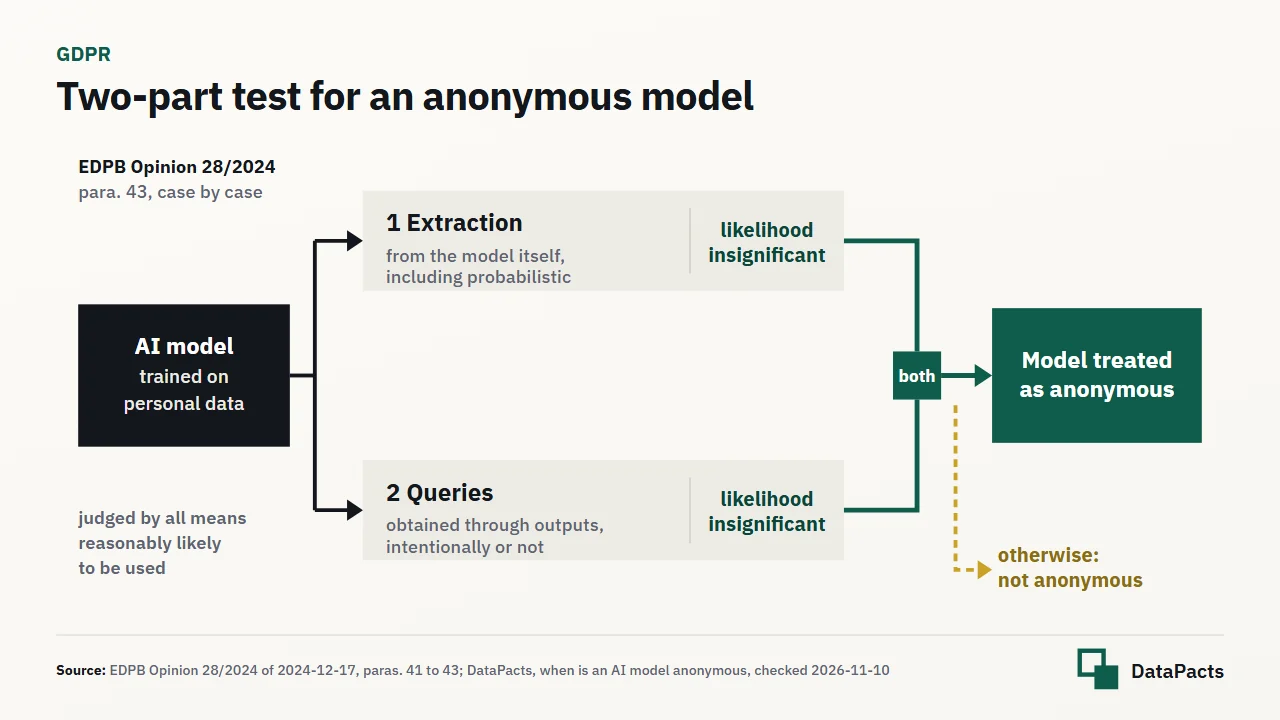
The Opinion adds that models trained on personal data cannot in all cases be considered anonymous, so each supervisory authority assesses a claim of anonymity case by case.
For AI training data licensing, the point is that a dataset and the model trained on it each get their own test: the dataset can be anonymous while the model is not.
This page sets out the test, the evidence regulators review, the three scenarios for unlawfully trained models and what a seller can read from buyers' terms. The Opinion is soft law; its status was checked on November 10, 2026, and the EDPB web page carries the publication date December 18, 2024.
Four Questions, Four Answers: What the Opinion Decides
The Irish supervisory authority asked the EDPB four questions under Article 64(2) GDPR, and the table gives the Opinion's answer to each with the section of this page that explains it. The table is as of 2026-11-10, after the Opinion's PDF was read.
| Question (Request) | Opinion's answer | Paragraphs | Section on this page | Source |
|---|---|---|---|---|
| 1. When and how can an AI model be considered anonymous? | only if extraction and query likelihoods are both insignificant, case by case, with documentation | 34 to 58 | Two-part test, evidence | edpb.europa.eu (Opinion 28/2024) |
| 2. How can controllers show legitimate interest in development? | three cumulative steps; no hierarchy of legal bases | 59 to 108 (section 3.3) | Three-step summary | edpb.europa.eu |
| 3. The same for deployment | same three steps, with deployment risks and expectations | 59 to 108 (section 3.3) | Three-step summary | edpb.europa.eu |
| 4. Consequences of unlawful development for later use | three scenarios; corrective measures case by case | 109 to 135 (section 3.4) | Three scenarios | edpb.europa.eu |
The Opinion leaves out Article 9 special categories, Article 22 automated decisions, Article 6(4) compatibility, data protection impact assessments and data protection by design (para. 17), which other GDPR pages cover.
The Two-Part Test for an Anonymous AI Model
For an AI model to be anonymous, both the likelihood of direct, including probabilistic, extraction of personal data about people in the training data and the likelihood of obtaining such data from queries, intentionally or not, must be insignificant for any data subject (Opinion 28/2024, para. 43).
By default, supervisory authorities should consider that models are likely to need a thorough evaluation of the likelihood of identification (para. 43).
The reference point is the single out, link and infer approach of Article 29 Working Party Opinion 05/2014 (para. 40). The Opinion never says that all models are anonymous or that none can be.
Extraction: Personal Data Taken From the Model Itself
Extraction covers personal data deduced from the AI model itself with little or no use of the query interface, because a model's parameters hold probabilistic relationships from which accurate or inaccurate personal data can be inferred (paras. 37 to 38, footnote 29).
Inference such as membership inference may be possible in realistic scenarios (para. 38). The authority asks for sufficient evidence that personal data related to the training data cannot be extracted with reasonable means (para. 38(i)). Direct access to the model is part of the evaluation even where measures reduce what queries reveal (para. 44).
Queries: Personal Data Obtained Through Outputs
The second limb asks whether any output produced when querying the model relates to the people whose data trained it, whether or not the person querying intended that (paras. 38(ii) and 43).
Regurgitation is the case where outputs directly relate to training data (footnote 25). Measures on outputs can lower this likelihood, but they do not affect direct extraction by someone with access to the model (para. 53).
Whose Means Count: The Controller, Other Persons and Personal Data
The likelihood is judged by all the means reasonably likely to be used by the controller or another person, determined from objective factors (para. 41). Those factors are:
- the characteristics of the training data, the model and the training procedure;
- the context of the model's release and processing;
- additional information available to the person;
- the cost and time needed to obtain that information;
- the available technology and its development.
Other persons include unintended third parties who access the model, and unintended reuse or disclosure of the model counts (paras. 42 to 43). A public model reachable by an unknown number of people can lead to a different conclusion than an internal model used only by employees (para. 46).
The Court of Justice judged pseudonymised data from each recipient's means on September 4, 2025 (C-413/23 P), which is the same recipient-perspective logic, and the case is covered in when pseudonymised data stops being personal data.
Evidence a Supervisory Authority Reviews Before Accepting a Model as Anonymous
The Opinion gives supervisory authorities a non-prescriptive, non-exhaustive list of elements for judging an anonymity claim, and the presence or absence of any one of them is not conclusive (paras. 47 to 48). The table lists the four areas in the Opinion's order, as of 2026-11-10.
| Area | What the authority looks at | Paragraphs | Source |
|---|---|---|---|
| Model design | selection of sources (criteria, relevance, excluded sources); data preparation and minimization (use of anonymous or pseudonymized data considered, reasons if not, filtering); training methods (regularization against overfitting, privacy-preserving techniques such as differential privacy); measures on outputs | 49 to 53 | edpb.europa.eu |
| Model analysis | document-based internal or external audits, code review reports, theoretical analysis of the chosen measures | 54 | edpb.europa.eu |
| Testing and resistance to attacks | scope, frequency, quantity and quality of tests; structured testing against attribute and membership inference, exfiltration, regurgitation, model inversion and reconstruction | 55 | edpb.europa.eu |
| Documentation | DPIA records; DPO advice; technical and organizational measures with a threat model, per-source measures and source URLs; lifecycle measures; resistance documentation including the ratio of training data to parameters, re-identification metrics, test reports and results; documentation given to deployers and data subjects | 56 to 58 | edpb.europa.eu |
Tests against widely known attacks only show resistance to those attacks (para. 55). If the authority cannot confirm effective anonymization from the documentation, it can find a breach of the accountability duty in Article 5(2) (para. 57). The Opinion sets no numeric threshold for "insignificant" and no differential privacy parameter.
Unlawfully Trained Models: The Opinion's Three Scenarios
Question 4 asks what unlawful processing during development, meaning processing without a lawful basis under Articles 5(1)(a) and 6 GDPR, means for the later use of the model, and the Opinion answers through three scenarios (paras. 109 to 111, 118). The table is as of 2026-11-10.
| Scenario | Facts | Opinion's position | Paragraphs | Source |
|---|---|---|---|---|
| 1 | unlawful development; personal data retained in the model; the same controller processes it later | separate purposes and the effect on later lawfulness are assessed case by case; under legitimate interest the earlier unlawfulness counts in the assessment | 119 to 123 | edpb.europa.eu |
| 2 | unlawful development; personal data retained; another controller deploys the model | each controller's lawfulness is assessed; the deployer should check the source of the data and any finding of infringement by an authority or court, with depth varying by risk | 124 to 132 | edpb.europa.eu |
| 3 | unlawful development; the model is then anonymized; the same or another controller processes new personal data in deployment | if later operation processes no personal data, the GDPR does not apply and the earlier unlawfulness does not affect it; authorities can still act on development; a mere assertion of anonymity is not enough (para. 134); new deployment-phase data falls under the GDPR without being tainted | 133 to 135 | edpb.europa.eu |
Where an infringement is found, para. 114 lets authorities issue a fine, impose a temporary limitation, order erasure of the unlawfully processed part of the dataset or, where that is not possible and proportionate, order erasure of the whole development dataset and/or the model itself.
Retraining counts in the proportionality assessment. Data subjects can request erasure under Article 17, and authorities can order it ex officio (para. 115).
An AI Act declaration of conformity (Article 47 and Annex V point 5 of Regulation (EU) 2024/1689) may not be a conclusive finding of GDPR compliance (para. 131). GDPR measures are without prejudice to AI Act measures and other frameworks (para. 117).
Questions 2 and 3: The Three-Step Test Summarized
On questions 2 and 3, the Opinion recalls that the GDPR sets no hierarchy between legal bases and applies the three cumulative steps of the legitimate interest test to developing and deploying AI models: a legitimate interest, necessity of the processing, and a balancing test against data subjects' rights (paras. 60, 66).
Its examples of interests are a conversational agent, fraud detection and threat detection (para. 69), and an unlawful earlier stage feeds into the balancing test (paras. 123, 132). The step-by-step method for a seller and a buyer sits in the three-step test for legitimate interest applied to licensed training data.
What the Model Test Means for a Company Licensing Data
A company that licenses personal data to an AI developer does not control the model, but the model's status decides whether its data keeps being processed after delivery. The developer and the acquiring controller are assessed separately (para. 126), with duties between them under Article 17(1)(d) and Article 19 (para. 127).
An anonymous dataset does not settle the model question, and a model that is not anonymous stays within the GDPR, where data subjects can request erasure of unlawfully processed data (para. 115). The table gives three licensors' own terms as dated claims, in alphabetical order, as of 2026-11-09.
| Buyer or licensor | Terms (date) | What the terms say about trained models | Source | Page |
|---|---|---|---|---|
| Defined.ai | Data License Agreement, effective 2022-11-30, checked 2026-11-09 | models trained on the data may be exploited commercially if the data is not made available and outputs contain no recognizable contributor content (1(c)); this is the licensor-to-customer agreement | defined.ai/data-license-agreement | Defined.ai data buyer profile |
| Labelbox (Prism) | Prism FAQ, checked 2026-11-09 | "Models already trained on the data cannot be unlearned"; after revocation no further training, transfer or sublicensing; a kill clause with deletion within 30 days | prism.labelbox.com/faq | Labelbox Prism data buyer profile |
| micro1 | Data License Master Terms, last updated 2026-11-08, checked 2026-11-09 | licensee owns derivatives, models, weights, outputs and synthetic data (2.2); no duty to delete or retrain Licensee Materials (4.4) | micro1.ai/legal/data-license-master-terms | micro1 data buyer profile |
Where development relied on unlawfully processed data, the measures of para. 114 can reach the model.
The cited terms keep models with the buyer or exclude unlearning, and the Opinion does not resolve how the two fit together.
The contract levers sit on the page about retraining and model retention rights after a license ends, which covers the clauses that govern a model trained on licensed data.
Legal Status of the Opinion and the Texts That Followed
Opinion 28/2024 is soft law adopted under Article 64(2) GDPR: supervisory authorities take utmost account of it when using their investigative powers (paras. 14 to 15). It is addressed to authorities and is without prejudice to controllers' own obligations (para. 15). Technologies evolve, and the Opinion is read in that light (para. 16).
EDPB Guidelines 02/2026 on anonymisation were adopted for consultation on July 7, 2026, with consultation running from July 8 to October 30, 2026.
They state that inferences can be drawn from AI models and that a meaningful inference breaches the No Inference criterion (section 3.4, paras. 79 to 82). They are a consultation draft, not final as of November 9, 2026.
The Digital Omnibus proposal COM(2025) 837, dated November 19, 2025, would add an entity-relative sentence to Article 4(1), as set out in the EU Digital Omnibus proposed GDPR changes. It is a proposal, listed as "Awaiting committee decision" in the European Parliament as of November 9, 2026.
Benefits, Risks, Downsides and Alternatives When Licensed Data Ends Up in a Model, Including Not Licensing
The model test adds a second question after any data license, and a company weighing a license can set it against the alternatives, including not licensing at all.
Benefits
- An anonymous model is outside the GDPR for its later operation (scenario 3).
- The evidence list gives a concrete set of items a buyer can be asked for.
- Pseudonymization and minimization count as design measures (paras. 49 to 53).
Risks
- Erasure of the development dataset and/or the model is a possible corrective measure (para. 114).
- Deployers are expected to check the source of the data and any infringement finding (para. 129).
- Weak documentation can be an accountability breach (para. 57).
Downsides
- The assessment is case by case, with no numeric threshold.
- Buyers' terms may keep the model with the buyer and exclude unlearning.
- The Opinion is soft law, and the 2026 guidelines are a draft that can shift.
Alternatives
- License only data that is anonymous and ask the buyer for the evidence list above.
- Use output-restricting terms such as Defined.ai's condition on recognizable contributor content.
- Wait for the final 2026 guidelines before licensing personal data.
- Not license the data at all, which is a valid outcome; see the alternatives to selling data to AI labs.
Beyond the Model Test: GDPR Pages on Licensing Personal Data
The model test is one step in the GDPR route for a data license. The page on GDPR and AI training data sets it beside legal basis, compatibility, notices and transfers.
- Anonymization vs pseudonymization for AI training data: the anonymity test for the dataset itself.
- Synthetic data and privacy law: the model test applied to generators.
- Purpose compatibility (Article 6(4)): reusing data for training.
- Deletion, return and machine unlearning clauses: deletion duties after delivery.
- EU AI Act Article 53: the AI Act side of model training.
- European Union rules for AI training data: all EU instruments.
- Special category data (Article 9) in AI training: the Article 9 question the Opinion leaves out.
- DPIA for an AI data licensing deal: the DPIA the documentation list refers to.
How This Page Is Sourced and Dated
Every statement here cites a paragraph of EDPB Opinion 28/2024 as published on edpb.europa.eu, or the court, regulation or proposal named beside it, with the date it was checked.
The rules on how we source, date and check every figure apply. This page is general information about the GDPR, not legal advice for any specific model or deal.
Frequently Asked Questions
Is an AI model trained on personal data anonymous?
Not in all cases. Under Opinion 28/2024 a model is anonymous only when the likelihoods of extraction and of obtaining personal data through queries are both insignificant, judged case by case.
What is EDPB Opinion 28/2024?
It is an EDPB opinion adopted on December 17, 2024. It was issued under Article 64(2) GDPR at the Irish authority's request, covers model anonymity, legitimate interest and unlawful development, and is soft law.
Does the GDPR apply to a model trained on unlawfully processed data?
That depends on the case. If the model has been anonymized and its later operation processes no personal data, the GDPR does not apply to that operation (scenario 3).
Can a supervisory authority order an AI model to be erased?
Yes, where proportionate. Paragraph 114 lists erasure of the whole development dataset and/or the model among the possible corrective measures.