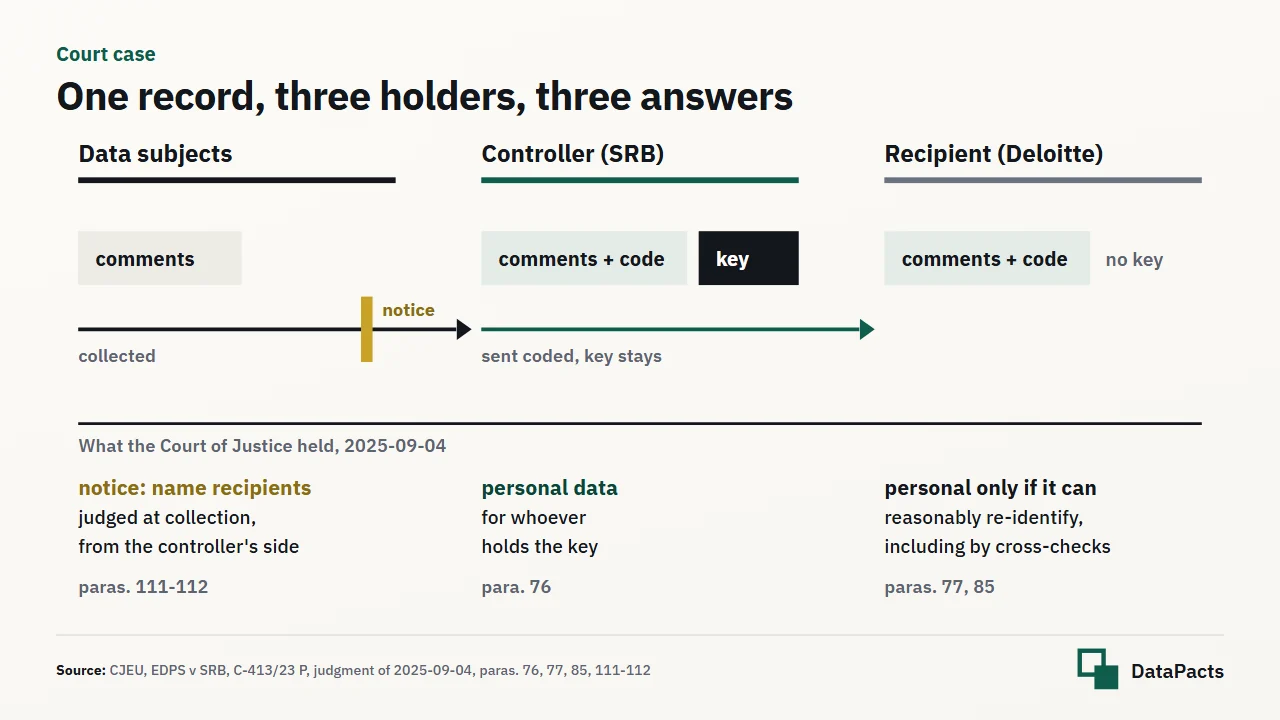
As of November 10, 2026, the judgment is decided and the General Court case T-557/20 has been referred back. For a company that shares coded records with a buyer, the record stays personal data for whoever holds the key.
This page belongs to the independent reference on AI training data licensing, is not legal advice, and DataPacts is not affiliated with either party.
The court texts were read on November 10, 2026, and how figures are sourced and dated is set out on the methodology page.
EDPS v SRB at a Glance: Court, Parties, Docket and Status
The First Chamber of the Court of Justice decided the appeal on September 4, 2025, set aside the General Court's judgment in T-557/20 and sent that case back to the General Court. The table gives the case facts as of 2026-11-10 with the source of each.
| Field | Value | Source |
|---|---|---|
| Case | European Data Protection Supervisor v Single Resolution Board | judgment C-413/23 P (EUR-Lex 62023CJ0413) |
| Court | Court of Justice of the European Union, First Chamber | judgment heading (checked 2026-11-10) |
| Docket | C-413/23 P (appeal); General Court T-557/20 | judgment |
| Appellant | European Data Protection Supervisor (EDPS) | judgment |
| Other party | Single Resolution Board (SRB) | judgment |
| Instrument | Regulation (EU) 2018/1725, Arts. 3(1), 3(6) and 15(1)(d) | judgment |
| Judgment | 2025-09-04 | judgment; press release No 107/25 |
| Status | decided; T-557/20 referred back to the General Court | judgment operative part; checked 2026-11-10 |
What the EDPS and the SRB Disputed About the Comments Sent to Deloitte
The dispute asked whether comments the Single Resolution Board passed to Deloitte in pseudonymized form were personal data, and whether the Board had to tell the people who wrote them that Deloitte would receive them.
The EDPS supervises the EU institutions and bodies under Regulation (EU) 2018/1725, which is why the case runs under that regulation and not under the GDPR.
Deloitte received the comments with a code but without access to the identification data, which only the SRB could link to the authors.
The EDPS treated Deloitte as a recipient of personal data and found the SRB in breach of its information duty, and the General Court annulled that decision on April 26, 2023 in T-557/20. The EDPS appealed to the Court of Justice, which is the judgment this page records.
The Court of Justice Ruling of September 4, 2025
The Court of Justice upheld the EDPS's appeal on its first ground, set aside the General Court judgment and gave final judgment itself on whether the comments were personal data.
The table lists both steps as of 2026-11-10; press release No 107/25 of the Court summarizes the outcome, and the costs of the appeal are reserved.
| Date | Court | Docket | Outcome | Source |
|---|---|---|---|---|
| 2023-04-26 | General Court | T-557/20 | EDPS decision annulled | judgment, para. 1 |
| 2025-09-04 | Court of Justice (First Chamber) | C-413/23 P | General Court judgment set aside; SRB's first plea rejected (comments are personal data for the information duty); T-557/20 referred back for the second plea; costs reserved | judgment; press release No 107/25 |
Later steps in T-557/20 are not recorded here as of 2026-11-10.
Pseudonymized Data Are Not Personal Data in All Cases and for Every Person
The Court held that pseudonymized data must not be regarded as personal data in all cases and for every person, because pseudonymization may, depending on the circumstances, effectively prevent persons other than the controller from identifying the data subject (para. 86).
Pseudonymization is a set of technical and organizational measures that reduces risk, not part of the definition of personal data. For the controller that keeps the additional information, the data stay personal (para. 76), and the comments, as personal opinions, related to their authors.
The contrary reading sits in the consultation version of the EDPB's Guidelines 01/2025 on pseudonymisation: data attributable with additional information are personal data even if another person holds that information, and no final version exists as of November 9, 2026.
The EDPB's Guidelines 02/2026 on anonymisation, a consultation draft, cite the judgment for their approach of assessing each relevant entity separately. The general comparison of the two statuses is set out under anonymization vs pseudonymization for AI training data.
The Recipient Perspective: Means Deloitte Was Reasonably Likely to Use
For a recipient such as Deloitte, pseudonymized data are not personal only if it cannot lift the pseudonymization measures during its own processing and the measures in fact stop it from attributing the data to a person, including by cross-checking with other information (para. 77).
Identifiability turns on all the means reasonably likely to be used, which is the wording of Recital 26 GDPR and of its counterpart in Regulation 2018/1725.
Onward transfer widens the test. Where it cannot be ruled out that a third party has means reasonably allowing it to attribute the data to a person, such as cross-checking with other data at its disposal, the person counts as identifiable for that transfer and for that party's processing (para. 85).
The Court did not decide whether Deloitte in fact could identify anyone, because for the information duty it judged identifiability from the SRB's side (para. 120). The test is therefore stated for any recipient, not as a finding about Deloitte's real capabilities.
The Duty to Name Recipients Is Judged at Collection, From the Controller's Side
The Court held that, for the duty to inform people about recipients, identifiability is assessed at the time the data are collected and from the controller's point of view, so the SRB had to name Deloitte whether or not the comments were personal data for Deloitte after pseudonymization (paras. 111 and 112).
The duty belongs to the relationship between the data subject and the controller and lets the person decide whether to provide the data.
On that basis the Court gave final judgment on the SRB's first plea: the SRB, as controller, held everything needed to identify the authors, so the information was personal data and the plea failed (para. 120).
The GDPR notice duties that matter before a data sale, Articles 13(3) and 14, are covered under GDPR notices before a data sale.
Referred Back to the General Court: What the Judgment Left Open
The Court of Justice sent case T-557/20 back to the General Court for the SRB's second plea, which needs factual findings the General Court had not made, and reserved the costs. The Court stated that the second plea involves factual assessments the General Court did not make.
The status this page records is "referred back" as of November 10, 2026. Any later outcome of T-557/20 is not stated here until a court record of it has been read, and the table above stops at the referral.
What the SRB Ruling Means for a Seller Sharing Pseudonymized Records With a Buyer
A company that pseudonymizes records and keeps the key still holds personal data, and the same records can be outside data protection law for a buyer only if the buyer has no means reasonably likely to re-identify them.
Removing identifiers before a license is a technique, and the result depends on who holds what; the methods are set out under PII removal and de-identification before licensing.
The judgment puts four points in issue for a seller, as a description of the reasoning and not as an instruction:
- Who holds the key, and whether the buyer can reach it (para. 77).
- What other data the buyer holds that allow cross-checking (para. 85).
- Whether the people in the records were told at collection that recipients such as a buyer would receive their data (paras. 111 and 112).
- Whether a new purpose such as licensing passes the compatibility test of Art. 6(4) GDPR, where pseudonymization counts as an appropriate safeguard.
The judgment was given under Regulation 2018/1725, and the EDPB's 2026 draft applies the same per-entity view to anonymization under the GDPR.
That draft was open for consultation from July 8 to October 30, 2026 and is not final, and the EDPB's 01/2025 draft reads the other way, so a buyer's legal view and a regulator's view can differ.
A seller reading the case should therefore treat it as a decided test for EU bodies and a signal for the GDPR, not as a finished rule for licensed records.
The same per-holder reasoning is applied to generated sets under synthetic data and privacy law, where the seller keeps the originals and the buyer receives output only.
This page is information, not legal advice.
Where EDPS v SRB Sits Among Privacy Proceedings Over Data Used for AI
EDPS v SRB is not a training-data case: the case tracker lists it among related proceedings because it sets the Court's test for pseudonymized data that sellers de-identify before licensing. The case tracker of AI copyright lawsuits over training data holds the related proceedings table and its parent page.
The regulator proceedings over AI training on personal data that the tracker lists concern legal basis and objections, not pseudonymization.
The duties around a training-data deal, meaning legal basis, notices and transfers, are set out under legal basis, notices and transfers in a deal.
More About EDPS v SRB
Decided Versus Still Open After C-413/23 P
The Court of Justice judgment is decided; the further course of T-557/20, the EDPB's pseudonymization and anonymization texts and the Commission's proposed GDPR changes are still open.
Decided
- Pseudonymized data are not personal data in all cases and for every person.
- A recipient's status turns on the means reasonably likely to be used.
- The duty to name recipients is judged at collection, from the controller's side.
Still open
- T-557/20 after the referral back.
- EDPB Guidelines 01/2025 and 02/2026, both without a final version.
- Commission proposal COM(2025) 837 of 2025-11-19 (procedure 2025/0360(COD), awaiting committee decision as of 2026-11-09), which would add an entity-relative sentence to Art. 4(1) and an Art. 41a on pseudonymized data; see the EU Digital Omnibus page.
Frequently Asked Questions About EDPS v SRB
Is pseudonymized data personal data after EDPS v SRB?
Always for the holder of the key; for a recipient only if it has means reasonably likely to re-identify the people. Paragraphs 76, 77 and 86 of the judgment set that split.
Does EDPS v SRB apply under the GDPR?
The judgment was decided under Regulation (EU) 2018/1725, which covers EU bodies. The EDPB's Guidelines 02/2026 draft cites its paragraphs for the GDPR.
Which chamber of the Court of Justice decided EDPS v SRB?
The First Chamber, in a judgment of September 4, 2025. The heading and the operative part of the judgment both name it.
Is an AI model trained on pseudonymized data anonymous?
A model is judged by a separate test, the one in the EDPB's Opinion 28/2024 of 2024-12-17, which asks whether extraction and obtaining personal data through queries are insignificant.
That test is set out under when an AI model is anonymous. This page is information, not legal advice.