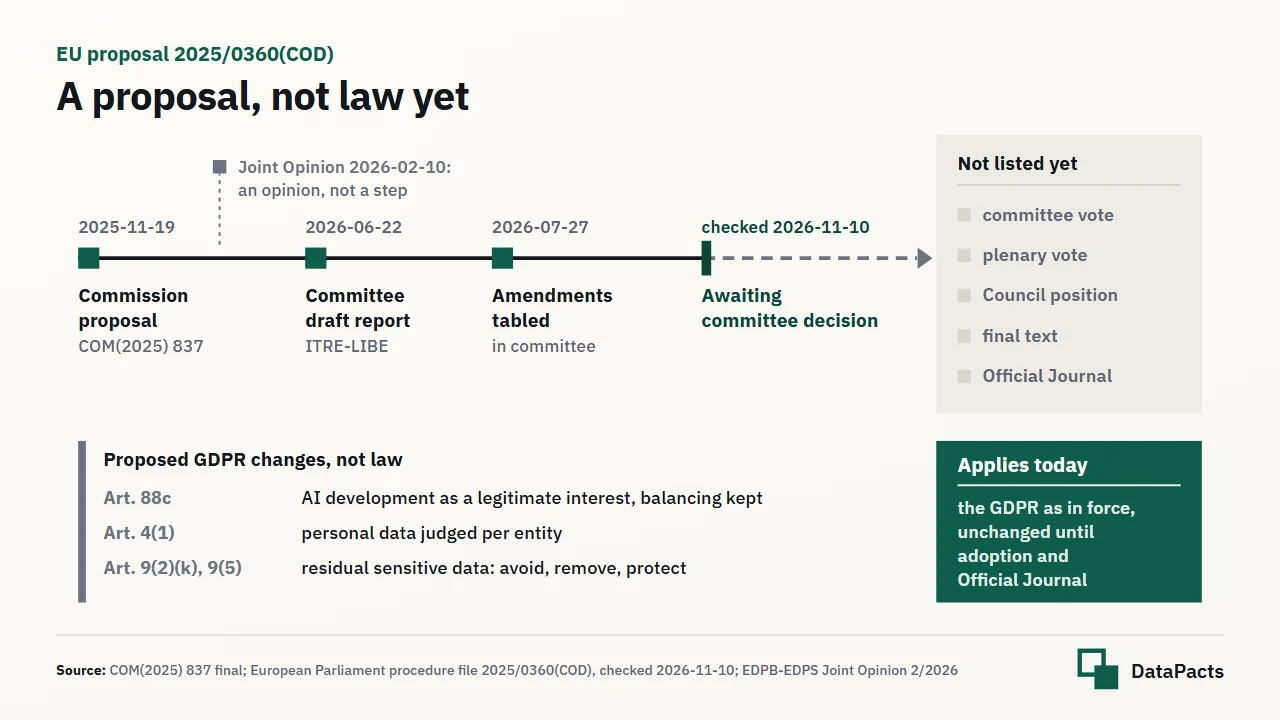
Every rule cited here is proposed wording that can change. The GDPR, applicable since May 25, 2018, governs every license signed today, which is the EU data protection layer of AI training data licensing.
The proposed articles are quoted from the Commission's text, and the status comes from the Parliament's procedure file; the method is described under how we source, date and check every figure.
What COM(2025) 837 Is and Where It Stands as of November 10, 2026
COM(2025) 837 is a proposal under the ordinary legislative procedure 2025/0360(COD), and the European Parliament's procedure file listed it as "Awaiting committee decision" when checked on November 10, 2026.
It would amend Regulations (EU) 2016/679, 2018/1724, 2018/1725 and 2023/2854 and several directives, and would repeal Regulations (EU) 2018/1807, 2019/1150 and 2022/868 and Directive (EU) 2019/1024. A joint ITRE-LIBE committee is responsible.
The table lists the steps taken, as of 2026-11-10, oldest first.
| Date | Step | Reference | Effect | Source |
|---|---|---|---|---|
| 2025-11-19 | Commission proposal published | COM(2025) 837 final, 2025/0360(COD) | starts first reading; no legal effect | publications.europa.eu; oeil.europarl.europa.eu |
| 2026-02-10 | EDPB-EDPS Joint Opinion 2/2026 adopted | Joint Opinion 2/2026 | opinion, not a procedural step that changes the text | edpb.europa.eu |
| 2026-06-22 | Joint ITRE-LIBE committee draft report | PE786.818 | rapporteurs' proposed amendments | oeil.europarl.europa.eu |
| 2026-07-27 | Amendments tabled in committee | nine documents, PE786.820 to PE791.883 | content not summarized here | oeil.europarl.europa.eu |
| 2026-11-09 | Status checked | OEIL stage | "Awaiting committee decision" | oeil.europarl.europa.eu |
| 2026-11-10 | Status re-checked | OEIL stage | "Awaiting committee decision", no committee vote, no Council event listed | oeil.europarl.europa.eu |
The Joint Opinion 2/2026 of February 10, 2026 is an opinion on the proposal, not a step that changes its text, and no Council position is stated on this page. Until adoption and publication in the Official Journal, the GDPR rules for AI training data as in force apply unchanged.
Three Proposed GDPR Changes for AI Training Beside the Rules in Force
Three of the proposed GDPR amendments name AI expressly or decide whether a training set holds personal data at all: a new Article 88c, two sentences added to Article 4(1) and a new Article 9(2)(k) with a paragraph 5. The table sets each proposed text beside the rule in force, as of 2026-11-10, and the sections below quote the conditions.
| Article | Proposed text in short | Rule in force (Reg. (EU) 2016/679, applies from 2018-05-25) | Status | Source |
|---|---|---|---|---|
| Art. 4(1), added sentences | information not personal for an entity that cannot identify the person with means reasonably likely to be used by that entity; not personal merely because a potential subsequent recipient can identify | definition without these sentences; C-413/23 P, 2025-09-04: pseudonymized data not personal in all cases | proposal | COM(2025) 837 final, Art. 3(1)(a); eur-lex.europa.eu |
| Art. 9(2)(k) and 9(5), new | processing in the context of developing and operating an AI system or model; avoid, remove, or protect from outputs and disclosure where removal needs disproportionate effort | Art. 9(1) prohibition unless an Art. 9(2)(a) to (j) exception applies | proposal | COM(2025) 837 final, Art. 3(3) |
| Art. 88c, new | processing necessary for AI development and operation may be pursued for legitimate interests under Art. 6(1)(f), where appropriate; consent carve-out; child clause; safeguards including an unconditional right to object | Art. 6(1)(f) three-step test; EDPB Opinion 28/2024 of 2024-12-17 | proposal | COM(2025) 837 final, Art. 3(15) (Art. 88c) |
Proposed Article 88c: Processing for the Development and Operation of AI
Proposed Article 88c would state that processing of personal data necessary for the controller's interests in developing and operating an AI system or AI model may be pursued for legitimate interests within the meaning of Article 6(1)(f), where appropriate.
The text excludes the case where "other Union or national laws explicitly require consent", and the interest is overridden where the data subject's interests or rights "require protection of personal data, in particular where the data subject is a child".
The article names the safeguards that any such processing would carry: data minimization "during the stage of selection of sources and the training and testing", a safeguard for "residually retained data" in the system or model, "enhanced transparency" and "an unconditional right to object".
Recital 30 adds that the article does not affect "all other conditions of Article 6(1)(f)", so the balancing test stays.
For a holder, the article names AI development as a possible legitimate-interest purpose but keeps the balancing test, so it is not a consent waiver. The current test and the rulings applying it are set out in the Article 6(1)(f) test for AI training data.
Proposed Article 4(1) Sentences: Identifiability Judged Per Entity
The proposal would add to the definition of personal data that information is not personal for an entity that cannot identify the person with means reasonably likely to be used by that entity.
The added text says information is not necessarily personal data for every other entity, and that it does not become personal for that entity "merely because a potential subsequent recipient has means reasonably likely to be used to identify" the person.
The Court of Justice held in C-413/23 P, EDPS v SRB, on September 4, 2025 that pseudonymized data are not personal data in all cases and are assessed from the entity's perspective.
Proposed Article 41a would also let the Commission adopt implementing acts on when pseudonymized data stop being personal for certain entities (see the table below).
No text states how a seller that holds the key is treated beyond these sentences. The judgment is covered at EDPS v SRB (C-413/23 P).
Proposed Article 9(2)(k) and 9(5): Residual Sensitive Data in Training Sets
Proposed Article 9(2)(k) would add an exception to the ban on processing special categories of data for processing in the context of developing and operating an AI system or AI model, subject to the conditions in a new Article 9(5). Article 9(1) in force prohibits such processing unless an Article 9(2) exception applies.
Article 9(5) sets three duties in order. The controller implements appropriate organizational and technical measures to avoid collecting such data. Where it identifies them in training, testing or validation sets or in the system or model, it removes them.
Where removal "requires disproportionate effort", it protects them without undue delay from being used to produce outputs or disclosed to third parties.
Recital 33 says the exception covers data that "residually exist" and are not necessary for the purpose; where special categories are necessary, the controller relies on Article 9(2)(a) to (j). The exceptions in force are covered under special category data in AI training.
Balancing Factors and Safeguards in the Proposal's Recitals
Recital 31 of the proposal lists what a controller should weigh when it balances its interest in AI development against the people in the data. The factors are:
- whether the interest benefits the data subject and society, for example bias detection or accurate and safe outputs;
- the reasonable expectations of the data subject based on the relationship with the controller;
- enhanced transparency and "an unconditional right to object";
- "respecting technical indications embedded in a service limiting the use of data for AI development by third parties";
- privacy-preserving techniques and measures against "regurgitation, data leakage".
Recitals are themselves proposed text and can change with the articles.
Further GDPR Amendments in COM(2025) 837 That Touch a Data Deal
Besides the three AI changes, the proposal would amend GDPR rules that a company licensing personal data meets in the same deal: notices, pseudonymization, research reuse and biometric verification. The table lists them, as of 2026-11-10.
| Proposed change | What it would do in a data deal | Status | Source |
|---|---|---|---|
| Art. 13(4), replaced | notice exemption for clear, circumscribed, non-data-intensive relationships; not where data go to recipients, third countries, automated decision-making or high-risk processing | proposal | COM(2025) 837 final, Art. 3(5) |
| Art. 41a, new | Commission implementing acts on when pseudonymised data no longer constitute personal data for certain entities; EDPB opinion within 8 weeks | proposal | COM(2025) 837 final, Art. 3(10) |
| Art. 4(38), new; Art. 5(1)(b), replaced | definition of scientific research that "does not exclude" a commercial interest; research reuse compatible "independent of the conditions of Article 6(4)" | proposal | COM(2025) 837 final, Art. 3(1)(b), 3(2) |
| Art. 9(2)(l), new | biometric verification where data or means are under the data subject's sole control | proposal | COM(2025) 837 final, Art. 3(3)(a) |
The list is limited to amendments that touch a training data deal; breach notification, cookies and terminal equipment are outside this page.
Two Instruments Called Digital Omnibus: The Pending Proposal and Regulation (EU) 2026/1744
Two different EU instruments carry the Digital Omnibus name: the Digital Omnibus on AI, Regulation (EU) 2026/1744, in force since July 27, 2026, and the GDPR and data proposal COM(2025) 837, which is pending. The AI Omnibus inserted AI Act Article 4a on special-category data for bias detection and correction, and left Article 53 unchanged.
Proposed GDPR Article 9(2)(k) is a separate, pending text and is not part of that regulation. The AI Act duties after the AI Omnibus are covered under EU AI Act Article 53 duties.
What Is Not Yet Decided: Committee Vote, Council, Final Text and Dates
No committee vote, plenary vote, Council position or final text of COM(2025) 837 was listed on the European Parliament's procedure file on November 10, 2026, so every article on this page can still change or be dropped. Four points stay open.
- Committee vote: none is listed on the joint draft report.
- Council position: no Council event appears on the procedure file, so none is stated.
- Final wording: the text of Articles 4(1), 9(2)(k) and 88c can change; the nine amendment documents of 2026-07-27 are not summarized here.
- Dates: the proposal's own Article 11 sets entry into force on the third day after publication in the Official Journal, so no date can be given before adoption.
Licensing Personal Data While the Omnibus Is Pending: Benefits, Risks, Downsides and Alternatives, Including Not Licensing
A pending proposal changes nothing a seller must do today, so a holder weighs a license under the GDPR in force, waiting for the final text, or not licensing at all. One route avoids the personal data question: anonymization versus pseudonymization for AI training data sets out what each achieves.
Benefits of deciding on the rules in force
- A decision rests on final rules and settled case law and guidance (C-413/23 P; EDPB Opinion 28/2024) rather than drafts.
- A contract can reopen data protection terms if the law changes.
- The safeguards the proposal names (minimisation, opt-out signals, removal of sensitive items) are also good practice under the current Article 6(1)(f) review, without any claim that they satisfy it.
Risks
- Relying on proposed Article 88c or 9(2)(k) now has no legal effect.
- The wording may change in committee or in Council.
- The "unconditional right to object" would, if adopted as proposed, apply to processing for AI and is not a current right in that form.
Downsides
- No adoption date exists, so waiting has no known end.
- The proposal does not settle the seller's own disclosure basis, which stays with the current GDPR test.
Alternatives
- License now under the GDPR in force.
- License only anonymized or non-personal data.
- Wait for adoption, without assuming an outcome.
- Do not license personal data at all.
The full decision, including not selling, is set out at should you sell or license your data to AI companies.
Beyond the Proposal: The GDPR in Force and Other EU Data Rules
This page covers the proposed GDPR text and its procedure; the rules that apply today and the other EU instruments sit on the pages below. Every EU instrument and its status is listed at European Union rules for AI training data.
- AI training data law by jurisdiction
- EU Data Act and AI training data, which the proposal would also amend
- EU Data Governance Act and data intermediation, which the proposal would repeal
- When is an AI model anonymous, the EDPB test for trained models
- Meta AI training on EU user data, legitimate interest in a live dispute
- Opting out of AI training, opt-out settings today
- Privacy law and AI training data by jurisdiction, rules outside the EU
- Alternatives to selling data to AI labs, including not selling
What This Page Does Not Cover
This page covers the proposal's GDPR changes that bear on personal data used to develop and operate AI, not its breach-notification, cookie, ePrivacy or cybersecurity reporting changes. It does not give legal advice or predict the final text.
How This Page Is Sourced and Dated
Every proposed article is quoted from the Commission's text COM(2025) 837 final, and the procedure status is taken from the European Parliament's procedure file with the date it was checked.
The rules on how we source, date and check every figure apply. This page is general information about a pending EU proposal, not legal advice for any specific deal.
Frequently Asked Questions
Is the Digital Omnibus GDPR proposal law yet?
No. As of November 10, 2026 procedure 2025/0360(COD) was awaiting a committee decision in the European Parliament, with no Council position or adopted text listed. Regulation (EU) 2026/1744, the Digital Omnibus on AI, is a different instrument that is in force.
Would proposed Article 88c remove the need for consent to train AI?
No, not as proposed. Article 88c would make AI development a possible legitimate interest but keeps the balancing test and yields where other Union or national law explicitly requires consent. It also names an unconditional right to object.
What would the Omnibus change in the definition of personal data?
It would add sentences making personal data relative to the entity holding it, judged by the means reasonably likely to be used by that entity. A potential subsequent recipient's means would not make the information personal for that entity, and the Court of Justice's C-413/23 P judgment of September 4, 2025 already assesses pseudonymised data from the entity's perspective.