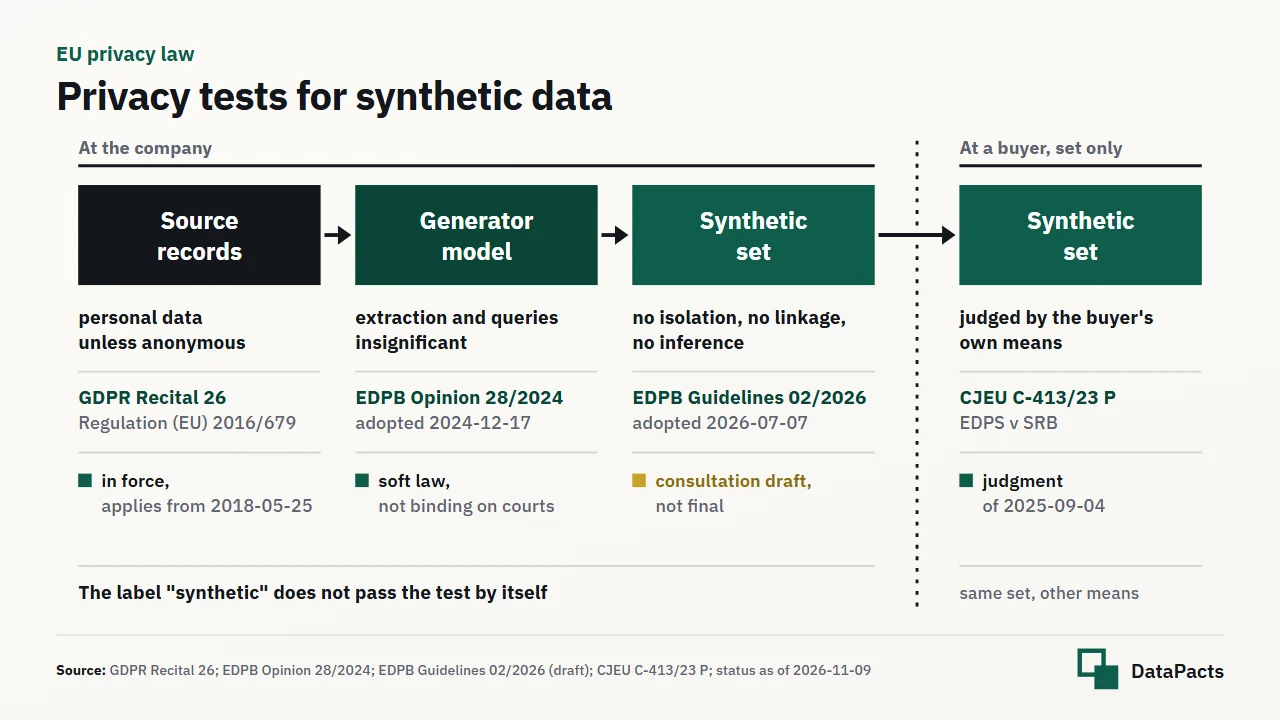
Recital 26 of Regulation (EU) 2016/679, which applies from 2018-05-25, excludes only anonymous information, and the EDPB's consultation draft of 2026-07-07 names synthetic data as a case where inference can survive.
This page applies the test to the source records, the generator and the synthetic set, then covers re-identification research, US deidentified rules and the steps for a company generating synthetic data from its own records. It sits within AI training data licensing and is information, not legal advice.
Every date, instrument and figure below is checked against the text named beside it, and how we source, date and check every figure is set out on the methodology page.
Three things to test: the source records, the generator and the synthetic set
Privacy law asks three separate questions when a company generates synthetic data: whether the source records are personal data, whether the trained generator is anonymous, and whether the synthetic set is anonymous for whoever holds it. The table lists the question, the text and its status for each object, as of 2026-11-09, with drafts marked.
| Object | Who holds it | Question | Text and date | Status | Source |
|---|---|---|---|---|---|
| Source records | the company | personal data unless anonymous | GDPR Recital 26, Regulation (EU) 2016/679, applies from 2018-05-25 | in force | eur-lex.europa.eu |
| Generator model | the company, or a buyer if it is shared | extraction and query likelihood insignificant | EDPB Opinion 28/2024, 2024-12-17 | adopted (soft law) | edpb.europa.eu |
| Synthetic set | the company | no record isolation, no linkage, no inference; synthetic data named in section 3.4 | EDPB Guidelines 02/2026, 2026-07-07 | consultation draft, not final | edpb.europa.eu |
| Synthetic set | a buyer without the source records | the buyer's own means reasonably likely to be used | CJEU C-413/23 P, 2025-09-04; EDPB Guidelines 02/2026 | decided; draft | eur-lex.europa.eu; edpb.europa.eu |
Three objects, four holders' questions; status as of 2026-11-09, drafts marked.
The hub explains synthetic data for AI training and how it is generated, so this page starts from the finished set.
Singling out, linkage and inference in generated records
A synthetic set is anonymous under Recital 26 only if no one can single out, link or infer a real person from it with the means reasonably likely to be used. The EDPB draft turns that into three criteria, and applied to generated records they ask:
- No record isolation: whether a generated record reproduces or closely mimics a rare real record, so that it isolates that person.
- No linkage: whether generated records can be matched with other data about the same person.
- No inference: whether anything meaningful about a person in the source data can be concluded from the set.
Section 3.4 (paragraphs 79 to 82) of the draft says inference from aggregated correlations "would, in particular, be the case for AI models or synthetic data".
The draft was adopted on 2026-07-07 for consultation, which ran to 2026-10-30, and it was not final as of 2026-11-09. Datasets already assessed as anonymous under WP29 Opinion 05/2014 need no new assessment under the draft.
The general test for licensed records, and how anonymity differs from pseudonymization, is set out in anonymization vs pseudonymization for AI training data.
Whose means count once a synthetic set leaves the company
The Court of Justice judges personal data from the perspective of each entity and the means it is reasonably likely to use, so a synthetic set can be personal data for the company that holds the source records and not for a buyer that holds only the synthetic set.
In C-413/23 P, European Data Protection Supervisor v Single Resolution Board, the Court held on 2025-09-04 that pseudonymized data are not personal data in all cases and for every person, set aside the General Court judgment T-557/20 and referred the case back.
Applied to a synthetic set, the seller keeps the originals and the generator and a buyer receives output only, so the means differ.
The Court judged the duty to inform data subjects about recipients at the time of collection, from the controller's perspective, and the EDPB draft likewise assesses each relevant entity's perspective. The judgment and its procedure are covered under EDPS v SRB and pseudonymised data.
A contrary reading exists. The EDPB Guidelines 01/2025 on pseudonymisation, in their consultation version of 2025-01, read pseudonymized data as personal data even if another person holds the additional information, and no final version is recorded as of 2026-11-09. The 2026 draft and the later judgment both follow the entity-relative approach.
The generator behind the data: extraction and query tests for a trained model
A generator trained on personal records is itself an AI model, and the EDPB treats a model as anonymous only when extracting personal data from it and obtaining personal data through queries are both insignificant.
EDPB Opinion 28/2024, adopted on 2024-12-17 under Article 64(2) GDPR at the request of the Irish authority, sets that test by all means reasonably likely to be used, and it is soft law, not binding on courts. It does not say that models are always or never anonymous.
The opinion addresses AI models trained on personal data, and a generator trained on personal records is such a model.
Among the corrective measures it lists is erasure of the whole dataset used to develop the model or of the model itself (paragraph 114), so a buyer that receives a generator rather than a synthetic set takes on that risk. The test is covered under when an AI model is anonymous.
What re-identification and membership-inference research shows
Research shows that a few attributes identify almost anyone, and the EDPB draft treats membership inference, learning that a person's record was in the source data, as an inference that can breach anonymity. Two sources carry that point:
- Rocher, Hendrickx and de Montjoye, Nature Communications 10:3069, published 2019-07-23, report that their model correctly re-identifies 99.98 % of Americans in any dataset using 15 demographic attributes. The study concerns de-identified datasets, not synthetic sets.
- EDPB Guidelines 02/2026, section 3.4, of 2026-07-07 (consultation draft) treat membership inference as inference that can breach the third criterion.
This page cites no paper on membership-inference or linkage attacks against synthetic data generators, because none has been checked against its publisher page for venue and date. Re-identification testing of a delivered copy belongs to PII removal and de-identification before licensing.
Privacy metrics and differential privacy: evidence for the test, not a legal result
A privacy metric or a differential privacy guarantee is evidence a company can put into its anonymity assessment, and no text cited on this page treats either as proof of anonymity.
Differential privacy limits how much any one source record can change what the generator produces. Similarity metrics compare synthetic records with their nearest source records.
Such evidence maps onto the tests above as an input. A similarity result speaks to record isolation, a guarantee on the generator speaks to how far one record shaped the output, and tests of extraction and queries speak to the model test of Opinion 28/2024.
Whether the evidence defeats linkage and inference for a given holder stays a legal judgment, and no text cited here sets a parameter or threshold.
US deidentified standards that name or reach synthetic data
US law uses "deidentified" rather than "anonymous", and Utah is the one statute on this page that writes synthetic data into its definition. The table compares four US statutes, as of 2026-11-09, ordered by statute.
| Statute | Section | What counts as deidentified | Names synthetic data | Conditions on recipients | Source |
|---|---|---|---|---|---|
| California CCPA | Cal. Civ. Code 1798.140(m) | reasonable measures against association with a consumer | no | public commitment not to reidentify; contractual obligations on recipients | cppa.ca.gov |
| FERPA (education records) | 34 CFR 99.31(b)(1) | all PII removed and a reasonable determination of non-identifiability | no | not stated | ecfr.gov |
| HIPAA Privacy Rule | 45 CFR 164.502(d)(2), 164.514(a)-(b) | Safe Harbor (18 identifiers) or expert determination; then outside the Privacy Rule | no | not stated | ecfr.gov |
| Utah UCPA | Utah Code 13-61-101 | "deidentified data" includes synthetic data | yes | public commitment; contractual flow-down | le.utah.gov |
Only Utah names synthetic data; the other three reach it when it is generated from covered records.
Utah and the CCPA both require a public commitment and contractual duties on recipients, so the license, not the generator, carries part of the standard.
Utah enforcement is by the Attorney General only, with up to USD 7,500 per violation as of 2026-11-09 (Utah Code 13-61-305 and 13-61-402). The state-by-state comparison is on privacy law and AI training data by jurisdiction.
What a seller generating synthetic data from its own records has to settle
A company that generates synthetic data from customer or employee records starts from personal data and has to settle five points before it offers the result. The steps run in this order:
- The source records stay personal data in the company's hands, with their legal basis and purpose limits.
- A new purpose is weighed with the Article 6(4) GDPR factors, among them appropriate safeguards, which may include encryption or pseudonymization.
- An impact assessment is carried out under Article 35(1) where processing, in particular using new technologies, is likely to result in a high risk.
- A written anonymity assessment covers the synthetic set against the three criteria of the EDPB draft, and any generator that leaves the company against the model test.
- The contract states the public commitment and flow-down where a US deidentified standard is relied on, and what the buyer may do with what it derives.
On the last point, micro1's Data License Master Terms s.2.2 give the licensee ownership of synthetic data it derives from licensed data, and s.4.4 sets no duty to delete or retrain Licensee Materials (checked 2026-11-09). micro1's research note of 2026-09-24 describes consistent synthetic identities, which reads like pseudonymization, not anonymization.
Ownership and what synthetic data keeps and loses sit on the page on synthetic vs real training data.
Generating a synthetic set, de-identifying real records or sharing neither: benefits, risks, downsides and alternatives
A company holding personal records can license a synthetic set made from them, license de-identified real records, keep synthetic data for internal use, or share nothing.
Benefits:
- A synthetic set that passes the Recital 26 test is outside data protection law.
- The originals stay in the company.
- US statutes give a defined route with conditions.
Risks:
- The set may stay personal data where inference survives, as section 3.4 of the EDPB draft describes.
- A shared generator carries the model test and the erasure remedy of Opinion 28/2024.
- GDPR fines reach EUR 20,000,000 or 4 % of total worldwide annual turnover, whichever is higher, under Article 83(5), as of 2026-11-09.
Downsides:
- The assessment and testing work falls on the company, and no cost figure is on record.
- What synthetic data keeps and loses against real records is a separate quality question.
Alternatives:
- License de-identified real records.
- License a narrower subset.
- Generate synthetic data for internal use only.
- Not licensing at all, which is covered under whether to sell or license a company's data at all.
Where synthetic data privacy meets anonymization, GDPR and US privacy pages
This page answers whether synthetic data is personal data, and the pages below hold the general anonymization test, the GDPR duties and the US statutes. The Digital Omnibus proposal COM(2025) 837 of 2025-11-19 would add an entity-relative sentence to Article 4(1) GDPR, and it was awaiting committee decision as of 2026-11-09.
- Synthetic data companies and their generators
- Legal basis and notices for the source records
- HIPAA de-identification for health records
- The CCPA deidentified standard in context
- UK GDPR rules for licensing data for AI training
- micro1's license terms on derived synthetic data
- The Utah statute that names synthetic data
- The pending entity-relative definition
- Quality limits of training on generated data
- How we source, date and check every figure
Frequently asked questions
Is synthetic data GDPR compliant?
Synthetic data falls outside the GDPR only if it is anonymous under Recital 26; otherwise the GDPR applies to it. The EDPB's 2026 consultation draft names synthetic data as a case where inference can breach anonymity.
Is synthetic data anonymous if no real person appears in it?
No; the test is whether anyone can single out, link or infer a real person, not whether one appears. A set that reproduces a rare record, or lets inference about a source person survive, is not anonymous under the EDPB draft.
Does differential privacy make synthetic data anonymous?
No; differential privacy is evidence in the anonymity assessment, not a legal result. No text cited on this page accepts a guarantee or a parameter value as proof of anonymity.
Can a buyer re-identify people from synthetic data?
It depends on the buyer's own means reasonably likely to be used. The Court of Justice judges identifiability per entity (C-413/23 P, 2025-09-04), and Rocher and colleagues (2019-07-23) show 15 attributes can re-identify de-identified datasets.