Anthropic's Form S-1 of 2026-10-26, xAI's Grok 4.7 summary of 2026-09-21 and Apple's 2025 technical report each name synthetic data next to real sources, and none states a share.
This page compares the two within AI training data licensing, need by need, and ends with what the comparison means for a company that holds real records. DataPacts treats not licensing as a valid outcome. Model collapse, as the research reports it, is cited here with its venue status and no more.
How synthetic and real training data compare, need by need
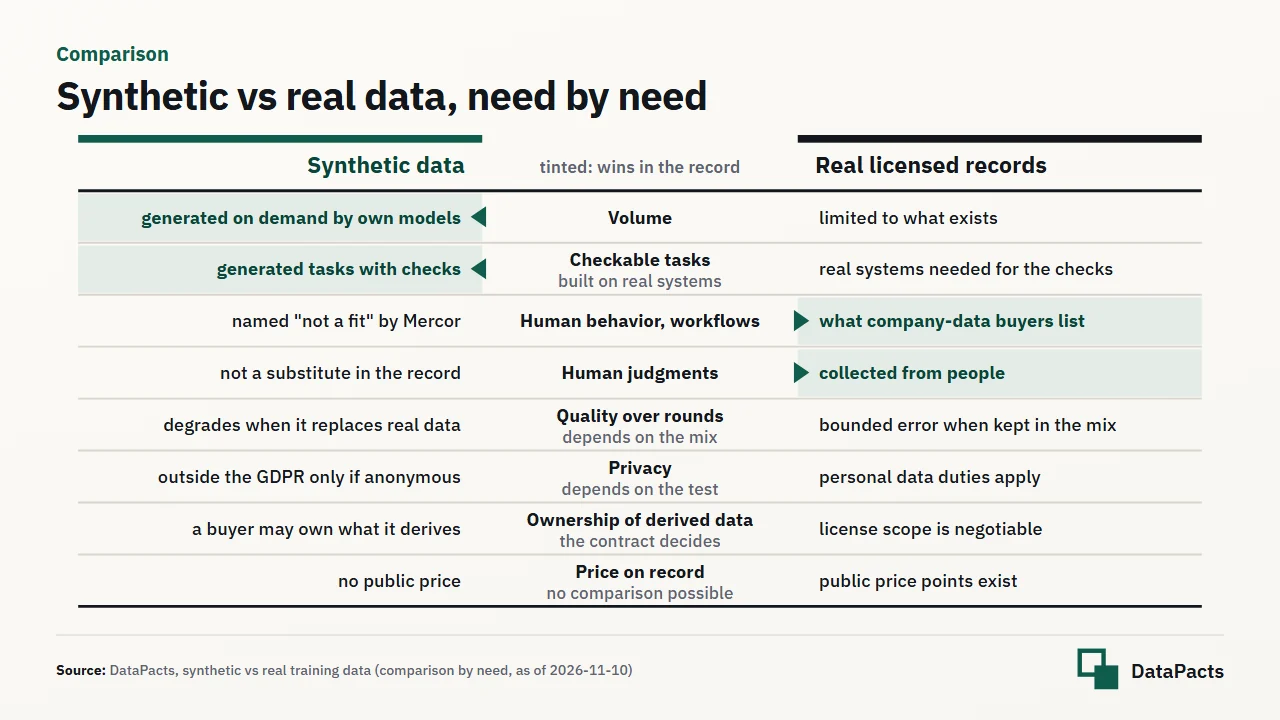
Synthetic and real training data differ on eight needs, and neither wins on all of them. The table compares them as of 2026-11-10, and the "who wins" column is the record, not a ranking.
| Need | Synthetic data | Real (licensed) records | Who wins in the record | Source |
|---|---|---|---|---|
| Volume | generated on demand by labs' own models | limited to what exists; Epoch AI estimates public human text is fully used between 2026 and 2032 | synthetic | sec.gov; media.x.ai; epoch.ai |
| Checkable tasks | generated tasks, such as 400 initial SETA terminal tasks | real systems are needed to build the checks | synthetic, built on real systems | camel-ai.org |
| Human behavior and workflows | named "not a fit" by Mercor | what company-data buyers list | real | api.data.mercor.com |
| Human judgments and preferences | not a substitute in the record | 1,418,091 Meta human preference comparisons for Llama 2 | real | arxiv.org |
| Training quality over repeated rounds | degradation when it replaces real data | bounded error when kept in the mix | depends on the mix | nature.com; arxiv.org |
| Privacy | outside the GDPR only if anonymous | personal data duties apply | depends on the anonymization test | eur-lex.europa.eu; edpb.europa.eu |
| Ownership of derived data | a buyer may own what it derives | license scope is negotiable | the contract decides | micro1.ai |
| Price on record | no public price | public price points exist, covered elsewhere | no comparison possible | n/a |
The definition of synthetic data and its generation methods sit on the hub, which explains what synthetic data is in AI training and where it reaches its limits.
Read the table row by row: a company deciding what to offer cares about the rows where the record names a winner, the rows where it depends, and the one row where nothing can be compared.
Where generated data wins: volume, rare cases and tasks that can be checked
Generated data wins when a developer needs more examples than exist, cases too rare or risky to record, or tasks whose answers a program can check. Three situations carry most of the record:
- Volume: labs generate data with their own models, as Anthropic and xAI state, and Epoch AI estimated on 2024-06-06 that the effective stock of public human-generated text is about 300 trillion tokens, fully used between 2026 and 2032 (an 80 % interval). That is Epoch AI's estimate, not a measured date.
- Checkable tasks: CAMEL-AI stated on 2026-01-09 that its SETA project for terminal agents started from 400 initial synthetic terminal tasks, generated for agent training rather than recorded from real use.
- Sharing without personal data: generated records can be shared more freely only if they are anonymous, a test covered under the section on synthetic data made from real records below.
Generation is not free of terms. Anthropic's Commercial Terms Section D.4 (effective 2025-06-17), its consumer terms (2025-10-08) and the Gemini API terms (effective 2026-03-23) each bar using those services to build or train competing models, so synthetic data produced with another lab's model carries that lab's terms.
Tasks that a program can check are also what RL environments sell to labs, and Recital 111 of Regulation (EU) 2024/1689 counts synthetic data generation among the activities in cumulative training compute. Terms on model outputs used as training data are covered further in the related pages below.
Where real records win: human behavior, real systems and buyer requirements
Real records win where the value lies in what real people did, and the buyers of company data say so in their own listings. Mercor states two cases, checked 2026-11-09:
- Its Medical Practice or Health System listing names "synthetic or sample charts" as not a fit, next to records without physician notes.
- Its AI Product Company listing names "synthetic or scripted traffic" as not a fit, next to logs that cannot be stripped of personal information.
Human feedback is collected, not generated: Meta's Llama 2 paper of 2023-07-19 reports 1,418,091 Meta human preference comparisons. The listings and their terms are set out in Mercor's data buyer profile, and this page states no buyer figure or payout.
Both listings ask for records of real work, and a generated look-alike of the same records does not meet either requirement as Mercor words it.
What AI labs disclose about mixing generated and real data
The three lab disclosures in this reference that name synthetic data each list it next to real data, not instead of it. The table lists them by date, as of 2026-11-09, and each row is the lab's own statement.
| Date | Lab | Document | Real data named | Synthetic data named | Source |
|---|---|---|---|---|---|
| 2025 | Apple | Apple Foundation Models tech report 2025 | responsible web crawling, licensed corpora | synthetic data | machinelearning.apple.com |
| 2026-09-21 | xAI (SpaceXAI) | Grok 4.7 public summary of training content | user data: Yes; private third-party datasets: Yes | synthetic data from own models such as Grok 4.6: Yes | media.x.ai |
| 2026-10-26 | Anthropic, PBC | Form S-1 | public web data; datasets licensed or commissioned from third parties | synthetic data generated by its own models | sec.gov |
None of the three states a share of synthetic data, so the table shows that both kinds are used and says nothing about the proportion.
The record also lacks things a reader might expect: no dated statement by a named lab executive on synthetic versus real data is recorded, so this page quotes none, and training-content summaries from other labs were not located.
No lab purchase of a synthetic dataset is recorded either. The routes by which labs obtain real data are set out in how frontier AI labs acquire data.
What peer-reviewed and preprint research says about replacing real data
Research agrees that replacing real data with generated data over repeated training rounds degrades models, and disagrees on whether keeping real data in the mix prevents it. Shumailov and colleagues published the peer-reviewed result in Nature, volume 631, pages 755 to 759, online on 2024-07-24, after a preprint of 2023-05-27 (arXiv 2305.17493).
Two preprints disagree on the dose. Dohmatob and colleagues (arXiv 2410.04840, 2024-10-07) report that as little as 1 % synthetic data can trigger collapse in a regression setting.
Gerstgrasser and colleagues (arXiv 2404.01413, 2024-04-01) report that when real and synthetic data accumulate rather than replace each other, test error stays under a finite upper bound however many iterations run. Neither is peer-reviewed in the record, the setups differ, and this page does not resolve them.
The mechanism and what it implies for human-made data belong to a separate page on model collapse and the value of human data. It is not repeated here.
Synthetic data made from real records: what it keeps, what it loses, who owns it
Synthetic data made from real records keeps their statistical patterns, can lose rare cases, and stays personal data under the GDPR unless it is anonymous. The table sets out six questions, as of 2026-11-09, in plain words and without a legal conclusion.
| Question | What the record says | Instrument or document | Date | Source |
|---|---|---|---|---|
| Is it still personal data? | principles do not apply to anonymous information; identifiability is judged by all means reasonably likely to be used, such as singling out | GDPR Recital 26, Regulation (EU) 2016/679 | applies from 2018-05-25 | eur-lex.europa.eu |
| Can inference from synthetic data breach anonymity? | inference "would, in particular, be the case for AI models or synthetic data" | EDPB Guidelines 02/2026, section 3.4, paras 79 to 82 | adopted 2026-07-07 for consultation, not final | edpb.europa.eu |
| Does US state law treat it as deidentified? | "deidentified data" includes synthetic data with a public commitment and contractual flow-down | Utah Code 13-61-101 | UCPA in force 2023-12-31 | le.utah.gov |
| Who owns synthetic data a buyer derives? | the licensee owns derivatives, models, outputs and synthetic data | micro1 Data License Master Terms s.2.2 | checked 2026-11-09 | micro1.ai |
| Must the buyer delete it later? | no duty to delete or retrain Licensee Materials | micro1 Data License Master Terms s.4.4 | checked 2026-11-09 | micro1.ai |
| Can names be replaced consistently? | consistent synthetic identities replace names and identifiers | micro1 PII research post | 2026-09-24 | micro1.ai |
Three points follow from the first three rows:
- GDPR Recital 26 puts the test on identifiability, not on the label "synthetic".
- The EDPB draft names synthetic data as a typical place where inference survives, and it was not final on 2026-11-09.
- Utah writes synthetic data into its deidentified category by definition, under conditions.
De-identification removes or replaces identifiers, while anonymization must also withstand singling out, linkage and inference, a difference set out in anonymization vs pseudonymization for AI training data. A generator that copies rare records closely does not add anonymity by being a generator.
On the contract side, micro1's s.2.2 gives the licensee ownership of synthetic data it derives from licensed data, and s.4.4 sets no duty to delete or retrain Licensee Materials. micro1 describes consistent synthetic identities as its method for personal data (2026-09-24); that reads like pseudonymization and is not a legal finding. This section is information, not legal advice.
What the comparison means for companies holding real records
Synthetic data lowers the value of real records that a generator can imitate and leaves untouched the value of records it cannot, such as real workflows, rare events and human judgments.
Mercor's two listings ask for real records and name synthetic ones as not a fit, Epoch AI's estimate frames why generation grows, and micro1's terms let a buyer keep what it derives.
No public price for a synthetic dataset is recorded, so no price comparison with real records is possible, and the holder should not read any ranking into the table above.
A holder who asks what a record type is worth should start from the public price points and ranges, which are covered under what company data is worth to AI companies.
Whether a generator can imitate a given record type is a question for the holder's own testing, not something this reference can answer. A record type that a buyer lists by name, such as complete session logs or physician notes, is a stronger case than a record type no buyer lists.
Offering real records or a synthetic version: benefits, risks, downsides and alternatives
A company can license its real records, offer a synthetic version made from them, do both, or do neither.
Benefits:
- Real records match what company-data buyers list, as Mercor's listings show.
- A synthetic version can carry less personal data if it is anonymous under the Recital 26 and EDPB tests.
- A synthetic version keeps the original records in-house.
Risks:
- The buyer may own and keep synthetic data it derives, under terms such as micro1's s.2.2 and s.4.4.
- A synthetic version made from personal records may stay personal data.
- A buyer may reject synthetic records outright, as Mercor's listings do.
Downsides:
- No public price for synthetic datasets is recorded.
- Generation and validation work falls on the holder, and no cost figure is on record.
Alternatives:
- License real records with a narrow derived-data clause.
- Sell de-identified records instead of synthetic ones.
- Generate synthetic data for internal use only.
- Do not license at all, as weighed in the guide on whether to sell or license your data at all.
Where this comparison meets the synthetic data hub, vendors, privacy law and human data
This page compares the two kinds of data; the hub, the vendor list, the privacy-law page and the human-data section each answer a neighboring question. Related pages:
- Synthetic data companies and generator software: who sells generation tools.
- Whether synthetic data is personal data: the privacy-law page.
- Provider terms on model outputs used as training data: terms on generated data.
- The Utah UCPA and synthetic data as deidentified data: the state statute.
- Human data for AI: the counterpart to generated data.
- PII removal before licensing real records: de-identification steps.
- GDPR rules for AI training data: legal basis, notices and transfers.
- Every route to training data, synthetic included: the full acquisition map.
Every figure was checked against its primary source, following how we source, date and check every figure.
Frequently asked questions
Can synthetic data be better than real data?
Synthetic data can be better for a given need, and the record depends on the mix. Gerstgrasser and colleagues report bounded error when real and synthetic data accumulate, while Dohmatob and colleagues report collapse from 1 % in a regression setting.
Can you create synthetic data from real data?
Yes, a company can create synthetic data from real records, and the legal result depends on the tests above. It stays personal data under the GDPR unless it is anonymous (Recital 26), and EDPB Guidelines 02/2026 are not final.
Do AI labs train on synthetic or real data?
AI labs state that they train on both. Anthropic (2026-10-26), xAI (2026-09-21) and Apple (2025) each list real sources next to synthetic data, and none states a share.
Does synthetic data make real company data less valuable?
Synthetic data lowers the value of real records a generator can imitate and not of those it cannot. Mercor's listings, checked 2026-11-09, name synthetic records as not a fit, and no synthetic dataset price is recorded.