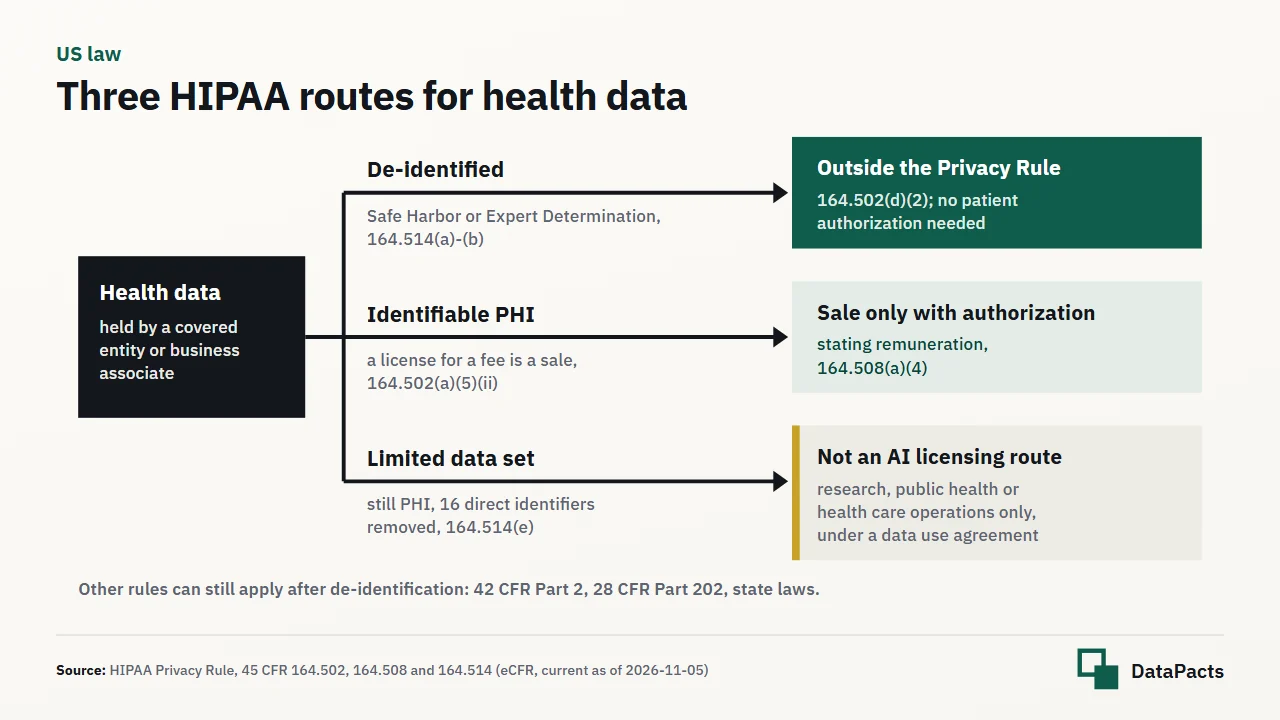
The other two routes carry conditions. Licensing identifiable protected health information (PHI) for a fee is a sale that needs an authorization stating the remuneration, and a limited data set is still PHI that serves only research, public health or health care operations under a data use agreement.
This is the HIPAA layer of AI training data licensing, and the sections below follow the order of a deal.
The figures and citations on this page were checked against the eCFR, the Federal Register agenda, court dockets and SEC filings, as described on the page on how we source, date and check every figure.
Five HIPAA Provisions That Decide a Health Data License
Five provisions of the HIPAA Privacy Rule decide whether a health data license needs patient authorization, and the table gives each one's citation, effect on a license and status as of 2026-11-05.
| Provision | Citation | Effect on a training data license | Status | Source |
|---|---|---|---|---|
| Sale of PHI prohibition | 45 CFR 164.502(a)(5)(ii) | no sale of PHI without authorization; research at a reasonable cost-based fee is not a sale; sale, transfer, merger or consolidation of all or part of the covered entity excluded | in force | ecfr.gov, 164.502 |
| Authorization for a sale | 45 CFR 164.508(a)(4) | the authorization must state that the disclosure results in remuneration | in force | ecfr.gov, 164.508 |
| De-identified data outside the rule | 45 CFR 164.502(d)(2); 164.514(a)-(b) | Safe Harbor or Expert Determination; data meeting either is outside the Privacy Rule | in force | ecfr.gov, 164.502 and 164.514 |
| Re-identification code | 45 CFR 164.514(c) | code allowed if not derived from information about the individual and not disclosed | in force | ecfr.gov, 164.514 |
| Limited data set | 45 CFR 164.514(e) | 16 direct identifiers removed; research, public health or health care operations only; data use agreement | in force | ecfr.gov, 164.514 |
The sections below follow the table's order, from the sale prohibition to the limited data set.
Who HIPAA Binds in a Training Data Deal: Covered Entities and Business Associates
The Privacy Rule's limits on licensing health data bind covered entities and business associates, so a company outside both groups is not restricted by HIPAA, though other federal and state rules may still apply. The statutory definitions sit in 45 CFR 160.103 and are not reproduced here, and this page does not list entity types.
The practice view, meaning what clinics hold, which routes they use and the program terms buyers state, is covered on the page for medical practices and healthcare providers licensing data to AI. This page stays with the rule itself.
A buyer's terms can carve HIPAA data out of a deal. Magma's terms, dated 2026-07-28 and checked 2026-11-09, admit regulated data (for example HIPAA data) only under a separate written agreement. The content of a business associate agreement is not described here.
The Sale of PHI Prohibition in 45 CFR 164.502(a)(5)(ii)
A covered entity or business associate may not sell protected health information without the individual's authorization (45 CFR 164.502(a)(5)(ii)), so licensing identifiable patient records to an AI developer for a fee needs a signed authorization from each patient.
That rule decides the form of the deal. Information de-identified under 164.514(a) and (b) is not individually identifiable health information and the Privacy Rule does not apply to it (164.502(d)(2)), so licensing it is not a sale of PHI.
HIPAA does not bar licensing de-identified data. It makes the standard, and not the label, the test.
What the Patient Authorization Must Say About Payment
An authorization that permits a sale of PHI must state that the disclosure will result in remuneration to the covered entity (45 CFR 164.508(a)(4)).
In a license, every patient whose identifiable record is in the set signs that statement, which is why Mercor's medical listing asks for de-identifiable records instead (Mercor's claim, checked 2026-11-09), as the deal records below show. The other required authorization elements are not listed here.
Exceptions: Research at Cost and the Sale or Merger of a Covered Entity
Two exceptions in 164.502(a)(5)(ii) matter to a data seller: a research disclosure is not a sale only where the payment is a reasonable cost-based fee to prepare and transmit the data, and the sale, transfer, merger or consolidation of all or part of the covered entity is excluded.
A license fee priced on the value of records is not a cost-based fee, so the research exception does not cover a commercial training license.
The merger exclusion covers the transfer of all or part of the covered entity, not a stand-alone dataset sale, and the remaining exclusions are not listed here. When a health business fails, the court-supervised route is covered under US bankruptcy data sales, which describes data sales when a health business fails.
HIPAA De-identification: The Two Methods in 45 CFR 164.514(b)
The Privacy Rule recognizes two ways to de-identify health information, Safe Harbor under 164.514(b)(2) and Expert Determination under 164.514(b)(1), and data meeting either is not individually identifiable health information (164.502(d)(2)).
The table compares the two methods as of 2026-11-05, with the buyer record that names each.
| Method | Citation | What the rule requires (as recorded) | Who names it in a deal | Source |
|---|---|---|---|---|
| Safe Harbor | 45 CFR 164.514(b)(2)(i)(A)-(R) | removal of 18 identifier types; three-digit ZIP only above 20,000 people; ages over 89 shown as 90 or older | Mercor medical listing (Mercor's claim, checked 2026-11-09) | ecfr.gov, 164.514 |
| Expert Determination | 45 CFR 164.514(b)(1) | a determination under paragraph (b)(1); see the eCFR text | Mercor medical listing (Mercor's claim, checked 2026-11-09) | ecfr.gov, 164.514 |
The choice between the methods is the seller's. Mercor's listing names both, and the techniques used to reach either standard are covered elsewhere on the site, with the link in the Safe Harbor section below.
Safe Harbor: 18 Identifier Types in 164.514(b)(2)
Safe Harbor requires removal of 18 identifier types, listed as (A) to (R) in 45 CFR 164.514(b)(2). The groups below are those recorded for this page and are not the full enumerated list:
- names;
- geographic subdivisions smaller than a state, with the three-digit ZIP code kept only where the area holds more than 20,000 people;
- date elements, with ages over 89 aggregated into 90 or older;
- contact numbers;
- record and account numbers;
- device identifiers;
- URLs and IP addresses;
- biometric identifiers;
- photographs.
Removal techniques, redaction tools and re-identification testing, including the question of de-identification software, are covered under PII removal and de-identification before licensing data, which describes techniques and tools for reaching Safe Harbor.
Expert Determination Under 164.514(b)(1)
Expert Determination is the second HIPAA de-identification method, set out in 45 CFR 164.514(b)(1), and buyers such as Mercor accept it alongside Safe Harbor for clinical records (Mercor's claim, checked 2026-11-09).
It is the route the rule provides where a seller does not remove every Safe Harbor identifier type, such as date elements. The paragraph's text on who makes the determination and what is documented is in the eCFR section, and this page does not paraphrase it.
Re-identification Codes Under 164.514(c)
A covered entity may assign a code to de-identified records so that it can re-identify them itself, provided the code is not derived from information about the individual and is not disclosed (45 CFR 164.514(c)).
For a license, the seller may keep a key but never delivers it or a derived token. A consistent-token scheme the buyer can reverse is pseudonymization, not HIPAA de-identification, and the legal comparison is on the page for anonymization vs pseudonymization for AI training data.
Limited Data Sets and Data Use Agreements Under 164.514(e)
A limited data set is protected health information with 16 direct identifiers removed, and a covered entity may disclose it only for research, public health or health care operations under a data use agreement (45 CFR 164.514(e)).
Because it stays PHI, licensing a limited data set for a fee to train a commercial model is a sale of PHI that needs an authorization stating the remuneration. The limited data set is therefore not an AI licensing route.
A data use agreement is a separate instrument from a training data license, and its required content is not described here. The license allocates who de-identifies the records and who holds any code, which is the subject of the page on AI data licensing agreements, covering where the license allocates de-identification.
What Buyers and Filed Deals Show About HIPAA-Standard Data
Buyers and filed deals treat HIPAA de-identification as the delivery standard for health data, and none of the records below licenses identifiable PHI. The rows are dated claims or filings, oldest first.
A seller outside HIPAA can adopt 164.514 by contract. The Spirit Airlines Bill of Sale does so for consumer health data although the seller is an airline, and the sale was not approved as of November 9, 2026, with a hearing set for 2026-11-17 (Dkt. 1779).
| Date | Record | What it says about HIPAA-standard data | Stated by / source | Page | Status |
|---|---|---|---|---|---|
| 2025-03-04 | Shaip datasets on the Protege platform | EHR and physician dictation datasets "de-identified and HIPAA-compliant per Shaip"; no pricing | Shaip press page | Protege | pending |
| 2025-04 and 2026-10-22 | Tempus AI licenses to Pathos AI | de-identified multimodal oncology dataset, USD 200 million license fees over three years (10-K FY2025, as of April 2025); 500,000 de-identified neurology records over five years, USD 50.0 million at USD 100 per delivered record plus USD 5.0 million for record updates, up to USD 55.0 million (10-Q Q3 2026, agreement of 2026-10-22) | SEC filings | Tempus AI | pending |
| 2026-08-14 | Spirit Airlines Form of Bill of Sale (Bankr. S.D.N.Y. 25-11897, Dkt. 1463) | CCPA de-identification standard, plus 45 CFR 164.514 for consumer health data; sale not approved as of 2026-11-09 | court docket | Spirit Airlines | pending |
| 2026-11-09 (checked) | Mercor listing: Medical Practice or Health System | records that can be de-identified to HIPAA Safe Harbor or Expert Determination (Mercor's claim) | Mercor listings feed | Mercor data buyer profile | live |
The Tempus price is a filed per-delivered-record value for one order, not a market rate.
Rules That Still Apply After HIPAA De-identification
HIPAA de-identification ends the Privacy Rule's limits, but it does not clear every other rule on health data. Substance use disorder records held by federally assisted programs follow the separate consent regime of 42 CFR Part 2.
The DOJ rule (28 CFR Part 202, in force since 2025-04-08) covers personal health data on more than 10,000 US persons even when anonymized or de-identified, and it prohibits selling that data to countries of concern or covered persons.
The thresholds are set out under the DOJ bulk sensitive data rule for health data thresholds even when de-identified.
State laws on consumer health data and the CCPA's own deidentification test apply on their own terms and are named in the list at the end of this page.
Pending Change: The 2025 HIPAA Security Rule Proposal
HHS proposed stronger Security Rule requirements for electronic PHI in a notice of proposed rulemaking published on January 6, 2025 (90 FR 898, RIN 0945-AA22), and the rule is not in force.
The HHS Unified Agenda lists final action for 07/2027 at the stage Long-Term Actions (HHS's claim, checked 2026-11-09). If adopted, it would raise security requirements for the data rooms and transfers used in a license. The content of the proposal is not described here.
Benefits, Risks, Downsides and Alternatives for a HIPAA-Regulated Seller, Including Not Licensing
HIPAA lets a covered entity or business associate license health data for AI training once it is de-identified, but identifiable records, limited data sets and other health rules each add a condition, and not licensing remains a valid choice.
Benefits
- De-identified data is outside the Privacy Rule (164.502(d)(2)).
- Mercor's medical listing names both methods as acceptable (Mercor's claim, checked 2026-11-09).
- The seller may keep a re-identification code (164.514(c)).
Risks
- A dataset that fails the standard is PHI, and licensing it for a fee is a sale without authorization.
- De-identified health data can still fall under the DOJ rule.
- Substance use disorder records need their own consent under 42 CFR Part 2.
Downsides
- Safe Harbor removes date and geographic detail that buyers may value.
- Identifiable data needs an authorization stating remuneration from each patient.
- A limited data set cannot serve a commercial license.
Alternatives
- License de-identified records only.
- Disclose for research at a cost-based fee.
- License a subset that excludes Part 2 records.
- Not license at all.
The wider range of options is covered under alternatives to selling data to AI labs, including not licensing.
Beyond HIPAA: Other US Rules and Health Data Pages
HIPAA is one federal layer among several that touch a health data license. The United States AI training data law page sets it beside copyright, the FTC, the DOJ rule and state laws, while the pages below cover health data by state, data type and region.
- AI training data law by jurisdiction: health data rules outside the US.
- California CCPA and AB 2013 rules: the CCPA deidentification test for health data.
- FTC rules on AI training data: health apps outside HIPAA and Section 5.
- Privacy law and AI training data compared: HIPAA beside the GDPR and state privacy acts.
- Should you sell or license your data to AI companies: the decision before any health data license.
- Washington My Health My Data Act: consumer health data outside HIPAA.
- Medical and clinical data for AI training: clinical records as a data type.
- Medical imaging and pathology data for AI training: DICOM and pathology data.
- European Health Data Space and AI training: the EU counterpart for health data.
How This Page Is Sourced and Dated
Every rule here cites the eCFR text of 45 CFR Part 164 or the Federal Register and HHS agenda entry, with the date it was checked. The methodology page explains how we source, date and check every figure. This page is general information about HIPAA, not legal advice for any specific deal.
Frequently Asked Questions
What are the two HIPAA de-identification methods?
Safe Harbor and Expert Determination. Safe Harbor removes 18 identifier types under 45 CFR 164.514(b)(2), and Expert Determination is set out in 164.514(b)(1). Data meeting either is outside the Privacy Rule.
Is de-identified health data still PHI?
No. Information de-identified under 164.514(a) and (b) is not individually identifiable health information, and the Privacy Rule does not apply to it (164.502(d)(2)).
Can a covered entity license de-identified data to an AI company?
Yes, HIPAA does not bar it. Other rules, such as 42 CFR Part 2 and the DOJ rule at 28 CFR Part 202, may still apply to the same data.
Can a limited data set be licensed for AI training?
Not for a commercial license. It stays PHI and serves only research, public health or operations under a data use agreement, and a fee makes it a sale needing authorization.
Does HIPAA apply to AI training data?
It applies when a covered entity or business associate licenses or discloses PHI for training. It does not cover staff HIPAA training courses, which are a different subject.