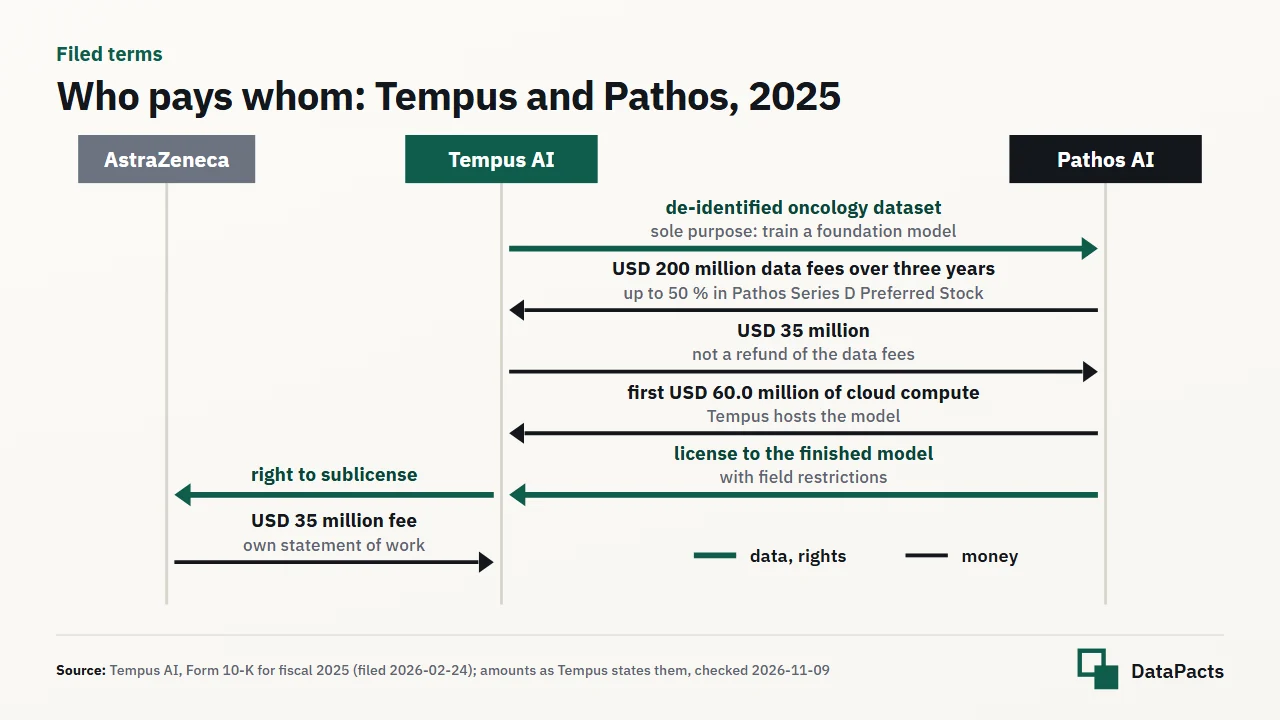
The filings state three different kinds of value: USD 200 million in data license fees over three years, USD 137.5 million in aggregate fixed payments through 2031 and up to USD 55.0 million for neurology records priced per delivered record.
The three contracts differ in payer, price form and stated use, and this page keeps them apart as one example of AI training data licensing in medicine. Every value is Tempus's own statement in a filing, checked 2026-11-09.
Dates, amounts and quotations below come from Tempus's 10-K and 10-Q, and the checking method is explained under how we source, date and check every figure.
Tempus AI's three filed licenses at a glance
Tempus's 10-K for fiscal 2025 and its 10-Q for the quarter ended 2026-09-30 record three licenses, listed below by date with the filing that states each value. The table compares them as of 2026-11-09.
| Date | Licensee | Data and access | Use as stated | Value as stated (stated by) | Filing |
|---|---|---|---|---|---|
| 2025-04 | Pathos AI, Inc. | comprehensive de-identified multimodal dataset for a foundation model in oncology | "for the sole purpose of" developing and training the Foundation Model (training stated) | USD 200 million data license fees over three years, incl. USD 50 million upfront paid as of April 2025 (Tempus) | 10-K FY2025, sec.gov |
| 2026-10-14 | Bristol-Myers Squibb Company (Onco SOW) | multimodal records from the de-identified oncology dataset; Lens access; analysis and research services | not stated; use with Pathos's drug development platform allowed | USD 137.5 million aggregate fixed payments through 2031-12-31 (Tempus) | 10-Q quarter ended 2026-09-30, sec.gov; 8-K, supporting |
| 2026-10-22 | Pathos AI, Inc. (Neuro Order Form; sublicense to BMS) | 500,000 de-identified neurology records, 100,000 a year over five years; Tempus Agent | not stated; Pathos's internal purposes and assisting BMS | up to USD 55.0 million: USD 50.0 million at USD 100 per delivered record plus USD 5.0 million for updates (Tempus) | 10-Q quarter ended 2026-09-30, sec.gov; 8-K, supporting |
The same three rows sit in the parent tracker. The table gives no total of the three contracts because Tempus's filings state none.
Pathos AI, 2025: a dataset licensed for one oncology foundation model
In April 2025 Tempus licensed Pathos AI, Inc. a comprehensive de-identified multimodal dataset "for the sole purpose of" assisting in the development and training of a foundation model in oncology.
Pathos is a drug development AI company. A sole-purpose grant is the clearest example in the filings of the field of use and scope limits in AI data licenses, because it names one use and no other.
What Pathos AI pays Tempus and in what form
Tempus's 10-K for fiscal 2025, filed 2026-02-24, states data license fees of USD 200 million over three years, including USD 50 million upfront paid as of April 2025. The USD 200 million is the fee Pathos owes Tempus for the data, and the filing states no split by year.
Pathos may pay up to 50 % of the data fees in Pathos Series D Preferred Stock, at its discretion. The fee is therefore not all cash, and the share of cash is not stated beyond that ceiling.
The structure matters for the question of when and how AI data buyers pay, covered under when and how AI data buyers pay: an upfront cash payment, a multi-year schedule and a part settled in the buyer's own shares are all present in this one filing.
What Tempus pays and receives in return
The same agreements, dated April 2025, run money in both directions: Tempus pays Pathos USD 35 million, and Pathos pays Tempus the first USD 60.0 million of cloud compute costs for hosting the model.
The 10-Q for the quarter ended 2026-09-30 states that the USD 35.0 million has been paid in full, USD 25.0 million in July 2025 and USD 10.0 million in October 2026, and that Pathos paid USD 8.8 million of the data fees in Series D Preferred Stock in each of June and August 2026, USD 17.5 million in total (checked 2026-11-16).
The payment to Pathos is not a refund of the data fees, and it is stated separately from them.
Tempus receives a license to the Foundation Model once it is complete, with field restrictions and a right to sublicense to AstraZeneca. Under the 10-K of 2026-02-24, AstraZeneca pays Tempus a USD 35 million fee under a separate statement of work, so that fee is not part of the USD 200 million.
The filing assigns each amount to one payer and one contract, so the USD 200 million is not one figure shared by Tempus, Pathos and AstraZeneca. The model license back to Tempus is described only as subject to field restrictions, and its other terms are not stated.
Bristol-Myers Squibb Onco SOW, 2026: oncology records and Lens access through 2031
On 2026-10-14 Tempus and Bristol-Myers Squibb Company signed an oncology statement of work under which BMS pays USD 137.5 million in aggregate fixed payments through 2031-12-31. It runs under an existing master services agreement, and the figure is Tempus's statement in its 10-Q for the quarter ended 2026-09-30.
The SOW licenses multimodal records from Tempus's de-identified oncology dataset and gives access to Tempus's Lens platform, together with data analysis and research services. BMS may use the data with Pathos's drug development platform.
The filing does not state a use such as model training for this SOW, and "not stated" is not the same as excluded. The contrast with the 2025 Pathos license is plain: that grant names training as its sole purpose, while the 2026 SOW lists records, platform access and services.
The payments are fixed, so the filing ties them to the SOW and not to a count of delivered records, and it states no per-record or per-year split.
The USD 137.5 million is a total over the term to 2031-12-31 and is not an annual amount. BMS may terminate on 12 months' notice, subject to a substantial termination fee.
Pathos AI Neuro Order Form, 2026: neurology records priced per delivered record
On 2026-10-22 Tempus agreed to license Pathos AI 500,000 de-identified records of patients with Alzheimer's disease or other neurological conditions, 100,000 a year over five years, for up to USD 55.0 million. The order also includes a license to the Tempus Agent.
As stated in Tempus's 10-Q for the quarter ended 2026-09-30, the USD 55.0 million is USD 50.0 million at USD 100 per delivered record plus USD 5.0 million for record updates.
Fees follow delivery, so the figure is a maximum that Tempus earns as records are delivered, and the filing does not state a use such as training.
As of 2026-11-09 the USD 100 is the only per-record price among the three Tempus licenses, and it sits with the other public figures in AI training data prices per record, where the unit of sale decides what a price means.
The side letter: sublicense to BMS and an 18-month restriction
A side letter among Tempus, Pathos and BMS of 2026-10-22 consents to Pathos sublicensing the records and the Tempus Agent to BMS. The letter is the reason the order form lists assisting BMS among the permitted uses.
In the same letter Tempus agrees not to license the records to third parties other than BMS, Pathos and certain subcontractors. The restriction runs from the first delivery of a record until 18 months after the later of that delivery and 2027-10-22.
This is a time-limited carve-out, not permanent exclusivity: the records can be licensed more widely once the window closes. The trade-offs of this kind of term are set out under exclusive vs non-exclusive data licenses.
What Tempus's filings state about each value
Each Tempus value is a different kind of number: a three-year fee total, a fixed multi-year total and a per-record maximum.
The table lists what each filing states and what the number is not, as of 2026-11-09. Reading the "what it is not" column first avoids the two common errors: attributing the Pathos fee to AstraZeneca and reading the BMS total as a yearly payment.
| Value | Amount as stated | Filing | What it is not |
|---|---|---|---|
| Pathos data license fees | USD 200 million over three years; USD 50 million upfront paid as of April 2025; up to 50 % payable in Series D Preferred Stock | 10-K FY2025 | not AstraZeneca's payment; not all cash |
| AstraZeneca fee (separate SOW) | USD 35 million | 10-K FY2025 | not part of the USD 200 million |
| Tempus payment to Pathos | USD 35.0 million, paid in full: USD 25.0 million July 2025, USD 10.0 million October 2026 | 10-Q Q3 2026 | not a refund of fees |
| Cloud compute paid by Pathos to Tempus | first USD 60.0 million (Tempus hosts the model) | 10-K FY2025 | not part of the USD 200 million data fees |
| BMS Onco SOW | USD 137.5 million aggregate fixed payments through 2031-12-31 | 10-Q quarter ended 2026-09-30 | not an annual amount; not a per-record price |
| Neuro Order Form | up to USD 55.0 million; USD 100 per delivered record plus USD 5.0 million for updates | 10-Q quarter ended 2026-09-30 | a maximum, earned as records are delivered |
The three figures cannot be added or annualized without inventing a number, so none appears on this page. Tempus's filings state contract fees rather than an AI licensing line, and how such figures appear across companies is compared under AI data licensing revenue in company filings.
What Tempus states it holds as a licensor
Tempus states that it holds more than 8.6 million de-identified patient records, over 1.6 billion pages of clinical text that it uses to train its own large language models and over 8 million records with imaging data, as of 2025-12-31. These are Tempus's own claims in its 10-K, not measured by DataPacts.
The holdings show why one licensor can serve several licensees from one dataset: the 2025 Pathos license and the 2026 BMS SOW both draw on its de-identified records, and the neurology records are a separate delivery.
Tempus also states that it uses its clinical text to train its own models, so it is at once a data holder, a model developer and a licensor, which is the position most operating companies reach only in part.
Consent, HIPAA and the buyers of health data are covered under medical and clinical data for AI training, so this page does not repeat them.
What the Tempus record shows a clinical data holder weighing a license
Tempus's filings show what one listed company with millions of de-identified records agreed, not what another holder will be offered. The lists below separate what the filings support.
Benefits
- An upfront payment: USD 50 million of the Pathos fees was paid as of April 2025.
- Fixed payments over a stated term: the BMS SOW states USD 137.5 million through 2031-12-31.
Risks
- A termination right on notice: BMS may end the SOW on 12 months' notice, with a substantial termination fee.
- Fees only for records delivered: the neurology maximum of USD 55.0 million (10-Q, 2026-10-22 order) is earned as delivery proceeds.
- Payment in a private company's stock: up to 50 % of the Pathos fees may be Series D Preferred Stock.
What a given dataset is worth depends on its records, rights and use, and the methods and public price points are set out under what company data is worth to AI companies.
Downsides
- A restriction on licensing the same records elsewhere during the side-letter window.
- A sole-purpose limit prices one use and narrows what the licensee can reuse.
Alternatives
- Not licensing at all and keeping the records for the holder's own research.
- A non-exclusive license without a side letter.
- Per-record pricing instead of a fixed fee, or the reverse.
- Contributing data to a model in return for a license to it, as Tempus did with the Foundation Model.
None of these lists advises a holder to license or to refrain, and the full weighing, including not selling as a valid outcome, is under should you sell or license your data to AI companies.
Where to read the tracker, clinical data rules and filed revenue around the Tempus licenses
This page covers the three licenses in Tempus's filings; the pages below cover every recorded deal, the rules for health data and other filed deals.
- AI data licensing deals with parties, dates and sources
- Reddit's AI data licensing deals
- Kopinor and the National Library of Norway
- Healthcare providers licensing data to AI
- HIPAA de-identification and AI training data
- Operating companies licensing their data to AI labs
Related pages cover medical imaging and pathology data for AI training and genetic and genomic data for AI training.
Frequently asked questions
How much does Pathos AI pay Tempus for data?
Tempus's 10-K states data license fees of USD 200 million over three years, including USD 50 million upfront paid as of April 2025. A separate neurology order of 2026-10-22 is for up to USD 55.0 million, as stated in Tempus's 10-Q.
Is the USD 200 million paid by AstraZeneca?
No, the USD 200 million is Pathos's data license fee to Tempus. In the 10-K filed 2026-02-24, AstraZeneca's fee is USD 35 million under a separate statement of work, and Tempus pays Pathos USD 35 million.
Does Bristol-Myers Squibb train AI models on Tempus data?
Tempus's 10-Q does not state a training use for the Onco SOW. It states multimodal records, Lens access, analysis and research services, and permitted use with Pathos's platform. "Not stated" does not mean no training.
Can Tempus license the neurology records to anyone else?
Not to third parties other than BMS, Pathos and certain subcontractors during the side-letter window. The window runs from first delivery of a record to 18 months after the later of delivery and 2027-10-22.
New filings that change the terms are collected in deal tracker updates by email.