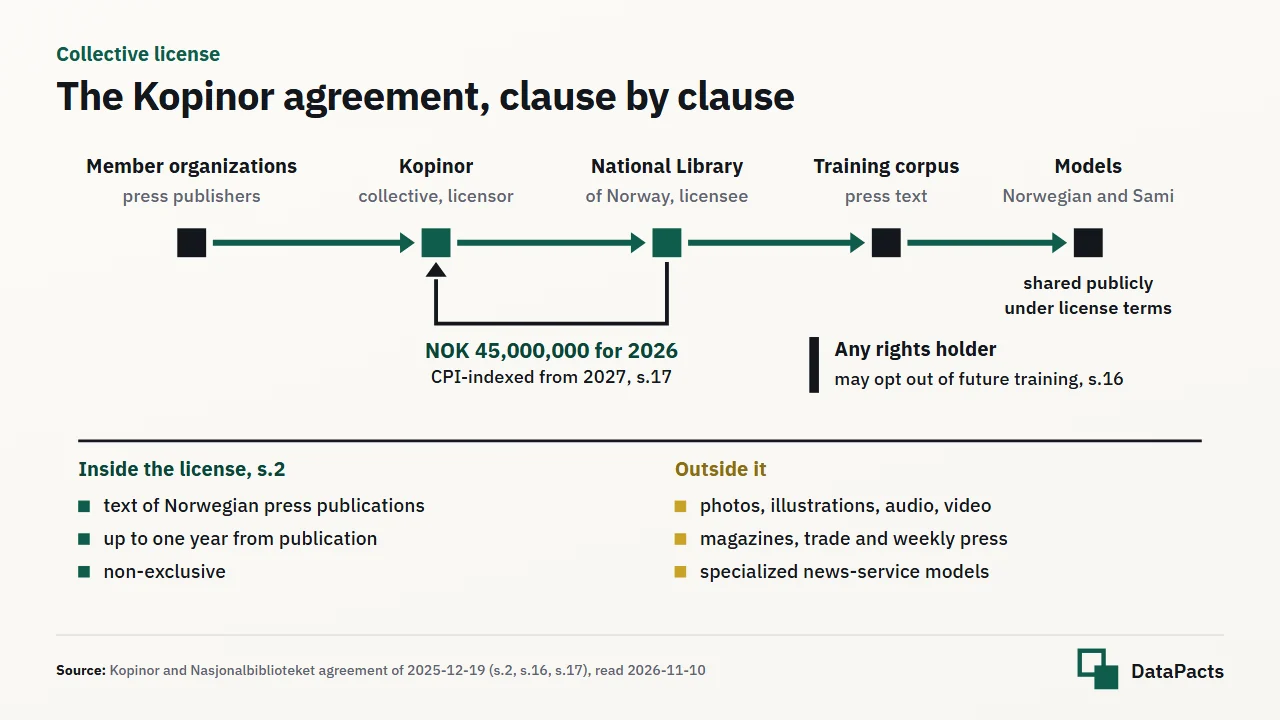
The licensee is a public library, not a commercial AI developer, so the sum is a public institution's payment to a collective.
The agreement is the one priced collective AI license on record in this reference as of 2026-11-09, and it is an example of AI training data licensing through a collective.
It covers text from press publications up to one year from publication, a yearly fee indexed from 2027, an opt-out for rights holders and a term whose first termination takes effect on 2028-01-01.
Each date, amount and clause below comes from the agreement text, the Norwegian company register or the statute, and each is checked as stated in how we source, date and check every figure.
The Kopinor agreement at a glance: parties, date, data and fee
The agreement has two parties, one data type and one stated annual fee, and the parent tracker records it as a deal that states training. The table lists the agreement's main fields as of 2026-11-09, with the source of each row.
| Field | Value as recorded | Source |
|---|---|---|
| Licensor | Kopinor (Brønnøysund 964250340, founded 1980-04-30), on behalf of member organizations including Mediebedriftenes Landsforening | data.brreg.no; agreement PDF |
| Licensee | Nasjonalbiblioteket (National Library of Norway), organization number 976 029 100; state library, research project Mimir | data.brreg.no; agreement PDF |
| Signed | 2025-12-19 | agreement PDF |
| Data | text of Norwegian press publications "up to one year from the date of publication" (s.2) | agreement PDF |
| Use | non-exclusive license to build training corpora and train Norwegian and Sami language models; models may be shared publicly under license terms | agreement PDF |
| Remuneration | NOK 45,000,000 annual total (2026), CPI-indexed from 2027, due no earlier than 30 June (s.17) | agreement PDF |
| Term | 2026, then yearly; first termination effective 2028-01-01 | agreement PDF |
The library trains the models under its research project Mimir, and Kopinor acts for member organizations rather than for itself as an owner of the articles.
Both parties are identified by their entries in the Norwegian company register, checked on 2026-11-09, which gives the organization numbers in the table. The same row appears in the parent tracker with the other recorded deals.
What the National Library may use: press publications under section 2
Section 2 licenses text from copyright-protected press publications published in Norway "up to one year from the date of publication". The Norwegian original, "opp til ett år fra publiseringstidspunktet", carries the same meaning as the English text.
Kopinor's announcement of 2025-12-19 describes the content as "eldre enn ett år", which reads as older than one year. This page quotes the agreement and treats the web wording as a summary, never as the scope.
A reader who sees both phrases on the open web should follow the agreement text, because only it states the clause.
The table sets out what falls inside and outside the license as of 2026-11-09, from section 2 and section 16 of the agreement.
| Inside the license | Outside the license |
|---|---|
| Text of press publications published in Norway, up to one year from publication | Photographs, illustrations, audio, moving images |
| Building one or more training corpora | Text from specialised (trade) press, magazines and weekly press |
| Training Norwegian and Sami language models | Works withheld by Mediebedriftenes Landsforening members under s.16 |
| Sharing trained models publicly under license terms | Specialised models delivering media and news services |
The grant is a non-exclusive license to build training corpora and to train the models, and the trained models may be shared publicly under license terms.
The exclusion of specialised models that deliver media and news services is a limit on the model type, a pattern that scope limits in AI data licenses describes for field-of-use clauses in general. The fee for this license, stated as of 2026-11-09, follows in the next section.
NOK 45,000,000 a year: how the remuneration is set, indexed and paid
Section 17 sets an annual total remuneration of NOK 45,000,000 for 2026, index-adjusted from the 2027 remuneration. The index is Statistics Norway's Consumer Price Index, so the 2026 figure is the base and later years move with inflation.
The remuneration is due no earlier than 30 June each year. The figure is a total for the year, stated in section 17 of the agreement as read on 2026-11-10, and it is paid to Kopinor, not an amount per publisher and not a multi-year sum.
No exchange rate is applied here, because the amount is stated in NOK in the agreement. As a price unit it is a fixed annual fee for a defined corpus, which differs from the per-work, per-hour or per-record units that buyers publish elsewhere, compared in what buyers pay for AI training data.
- Base amount: NOK 45,000,000 for 2026 (s.17).
- Indexation: Statistics Norway's Consumer Price Index, first for the 2027 remuneration.
- Payment date: no earlier than 30 June each year.
Who receives the money and whose works the agreement reaches
Kopinor receives the remuneration as the contracting party on behalf of its member organizations, including Mediebedriftenes Landsforening for Norwegian press publications. The agreement summary on record does not state how Kopinor divides the money between publishers and journalists, so this page gives no split.
Rights holders who are not represented by Kopinor are covered only if the Norwegian Industrial Property Office approves Kopinor under the second paragraph of section 63 of the Copyright Act, as section 3 of the agreement provides.
The page records no approval decision, and the agreement's reach beyond members depends on it. The agreement therefore rests on member mandates first and on the statutory extension second.
Rights holders may opt out with effect for future training under section 16. An opt-out does not reach back into a model that has already been trained, and works withheld by Mediebedriftenes Landsforening members under section 16 sit outside the license, as the scope table shows.
How long the agreement runs and what survives its end
The agreement entered into force on signature, applies for 2026 and rolls on one calendar year at a time. Each year therefore begins with a license that continues unless a party gives notice.
The earliest termination requires notice by the end of September 2027 and takes effect on 2028-01-01. Termination does not affect models that have already been trained and shared, which is a clear case of the model retention rights after a license ends that a holder meets in other contracts.
| Point | Date or rule |
|---|---|
| Entry into force | on signature, 2025-12-19 |
| First period | calendar year 2026 |
| Renewal | one calendar year at a time |
| Earliest termination | notice by end of September 2027, effect 2028-01-01 |
| Trained and shared models | not affected by termination |
The table gives the term as of 2026-11-09 from the agreement PDF. The shortest possible run is therefore about two years from signature, which makes 2026 and 2027 the two years the license is certain to cover, and the models trained within it stay in use afterwards.
Why Norwegian copyright makes a training license necessary here
Norway's Copyright Act (LOV-2018-06-15-40) contains no text and data mining provision in the consolidated text read on 2026-11-09, so training on protected press works needs permission. The act has been in force since 2018-07-01 and was last amended by LOV-2024-12-13-76 from 2025-01-01.
The legal position explains why the library asks for a license at all: a public institution that wants to train on protected text cannot rely on a statutory training exception in Norway, so it obtains permission from the rights holders' collective.
Section 63 of the act provides for extended collective licensing, which is the basis on which Kopinor's agreement can reach holders it does not represent, and section 65 provides mediation for disputes over such licenses. Information on other regimes sits in copyright and AI training across jurisdictions.
What the Kopinor agreement shows a rights holder weighing a collective route
The agreement shows what one collective obtained from one public licensee, not a rate another rights holder will be offered. The lists below weigh it as a model, in the four parts of the two-sided rule.
Benefits
- A stated annual fee with indexation and a payment date, which a single holder rarely obtains alone (s.17).
- An opt-out for future training that the rights holder keeps (s.16).
- A carve-out that protects news services from specialised models trained on the same text.
Risks
- Kopinor states that the 2027 state budget proposal has no funding for its separate books agreement with the library (Kopinor, 2026-10-26), which shows that public funding of a collective license can lapse.
- Trained models stay in use after termination.
- No distribution formula for the remuneration is published in the agreement summary on record.
Kopinor's agreement is one of the licenses compared in collective licensing for AI training through CMOs, where it is the only one with a published price.
Downsides
- The license is non-exclusive, so it carries no exclusivity premium.
- Photographs and magazine text earn nothing under it.
Alternatives
- Not licensing at all and leaving the works unused by the library.
- A direct publisher license with an AI developer.
- Opting out under section 16.
- Waiting for the library's or another licensee's published terms.
The fee is fixed for 2026 and indexed afterwards, so the arrangement trades upside for predictability. A holder that compares these routes finds the general decision framework in should you license your data to AI companies.
Where to read the tracker, collectives and publisher deals around this agreement
This page covers one Norwegian agreement; the pages below cover every recorded deal, publishers' other licensing routes and the contract clauses it touches.
- AI data licensing deals with parties, dates and sources
- News publishers licensing content to AI companies
- Google News AI pilot program payments
- License term in AI data deals
- Selling data to AI companies from outside the US
- Who sells data to AI companies
Related pages on Norway rules for licensing data for AI training, public institutions buying training data and news archives as AI training data follow the same agreement from the legal, buyer and data side.
Frequently asked questions
How much does the National Library of Norway pay Kopinor?
The National Library pays Kopinor NOK 45,000,000 for 2026, index-adjusted by Consumer Price Index from the 2027 remuneration (agreement s.17, as of 2026-11-09). The sum goes to Kopinor, not to each publisher. Changes are recorded in deal tracker updates by email.
Does the agreement cover newspaper photos and magazines?
No, the agreement excludes photographs, illustrations, audio, moving images and text from specialised press, magazines and weekly press. It covers text from press publications published in Norway up to one year from publication.
Can a Norwegian publisher take its articles out?
Yes, rights holders may opt out with effect for future training under section 16. The opt-out applies to future training, and termination of the agreement does not affect models that have already been trained and shared.
Can companies use the language models trained under the agreement?
The library may share the trained models publicly under license terms, but it may not train specialised models that deliver media and news services. This page is information about a contract and a statute, not legal advice.