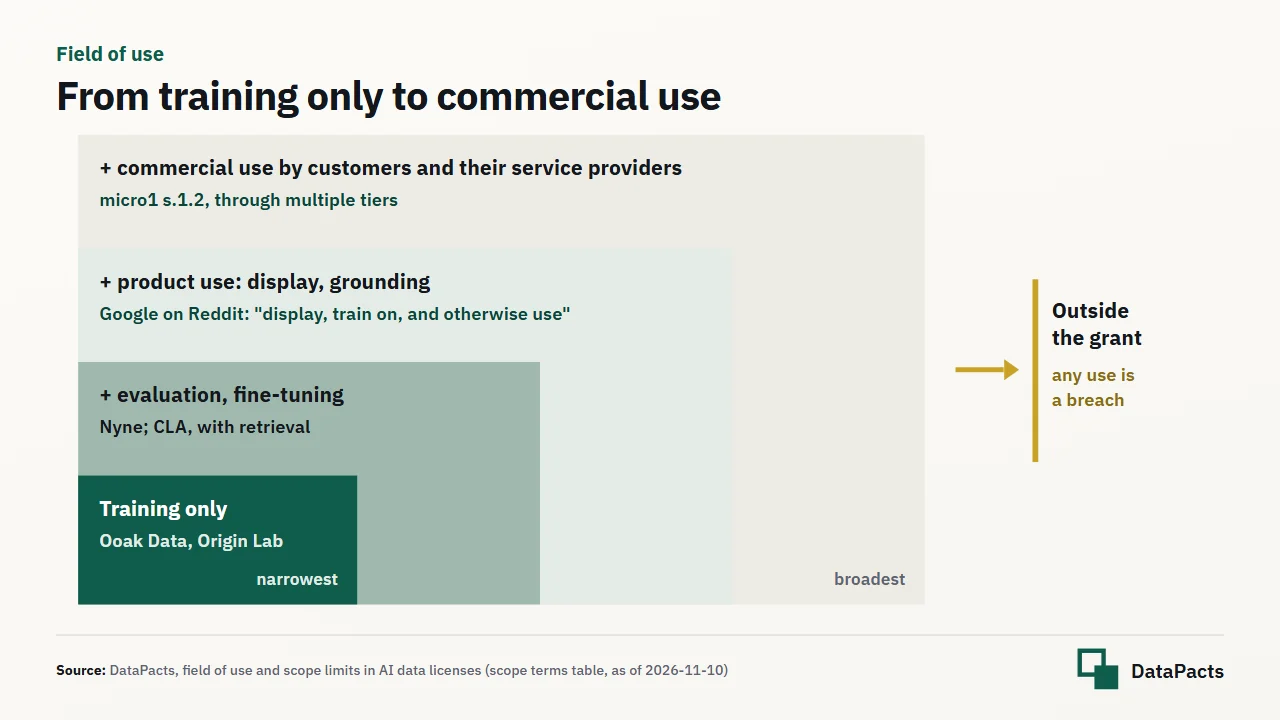
Published grants range from a license "for the sole purpose of" developing and training one foundation model (Tempus to Pathos AI, Tempus 10-K filed 2026-02-24) to micro1's grant to develop, train, fine-tune, evaluate and test AI and to commercially exploit models and their outputs "without restriction" (Data License Master Terms, updated 2026-11-08, re-read 2026-11-10).
A seller weighing AI training data licensing can decline a wider grant, a valid outcome.
Each term names its source and date; see how we source, date and check every figure.
What a Field of Use Clause Decides in an AI Data License
A field of use clause answers five questions: which uses, which models, which users, which places and which outputs.
- Uses: train, evaluate, fine-tune, retrieve or deploy.
- Models: any, one, a type or a language.
- Users: licensee, affiliates, customers, service providers.
- Place: worldwide or named recipients.
- Outputs and resale.
A point left silent falls to the grant's general wording, a drafting point rather than a legal rule. Whether other buyers may receive the same scope is covered in exclusive vs non-exclusive data licenses.
Training, Evaluation, Fine-Tuning and Product Use: Four Uses a Grant Can Separate
Published AI data terms name four kinds of use, and a grant can allow one, several or all of them.
Training Only
A training-only grant lets the buyer use the data to train models and nothing else, the narrowest scope buyers publish. Ooak Data states training use only, and Origin Lab states a license for AI training data only, not for reselling or republishing (both checked November 9, 2026).
Evaluation and Testing
Evaluation means measuring a trained model against the data rather than training on it, and several terms name it beside training. Nyne states that data is used for training and evaluation only.
Data Licensing Advisors, a seller-side adviser, states that licenses are typically limited to training and evaluation, and Patronus AI states that its samples are used only for evaluation (all checked November 9, 2026). micro1's grant names "evaluate and test".
Fine-Tuning and Retrieval
Fine-tuning adapts an existing model with the licensed data, and retrieval feeds data to a model at answer time, so a grant naming only training may cover neither.
Stack Exchange states access for training and fine-tuning, and the Copyright Licensing Agency (CLA) states that its Generative AI Solution covers training, fine-tuning and retrieval-augmented generation (both checked November 9, 2026). The drafting point is to name each use the grant covers.
Product Use: Display, Grounding and Commercial Models
Product use covers showing the data to end users, grounding answers in it and selling the models trained on it, and published deals treat it apart from training. Google's post of 2024-02-22 says its Reddit access is "to display, train on, and otherwise use" content.
Axel Springer's release of 2023-12-13 covers ChatGPT summaries and training. TIME's announcement of 2024-06-27 and Microsoft's post of 2026-02-03 describe product enhancement, display and grounding scenarios and do not mention training. See Reddit's AI data licensing deals for the first of these.
micro1 allows commercial use of models and outputs "without restriction" (s.1.2). Defined.ai's Data License Agreement, effective 2022-11-30, allows commercial exploitation of trained models only if the data is not made available and outputs hold no recognisable contributor content (1(c)) (checked November 9, 2026).
Scope Terms in Published AI Data Licenses and Deals
Published scope terms differ more in who may use the data than in which uses are allowed, and several program pages publish no scope at all.
The table compares published scope terms as of 2026-11-10, alphabetically, with role and source.
| Party (role) | Document and date | Uses allowed | Who may use | Territory or recipients | Other limits stated | Source and check date |
|---|---|---|---|---|---|---|
| Aba Compute (intermediary) | data-licensing page | set in the agreement | more than one buyer if allowed | not stated | holder can exclude named buyers, competitors, customers or uses | abacompute.com/data-licensing, 2026-11-09 |
| Axel Springer and OpenAI (deal) | Axel Springer release, 2023-12-13 | ChatGPT summaries; training | OpenAI | not stated | attribution and links | axelspringer.com, 2026-11-09 |
| CLA (collective licensor) | Generative AI Solution page | training, fine-tuning, retrieval-augmented generation | licensees | not stated | opted-in content only | cla.co.uk/ai-solution, 2026-11-09 |
| Defined.ai (licensor of its datasets) | Data License Agreement, effective 2022-11-30 | train; commercial exploitation of models (1(c)) | licensee only: non-sublicensable, non-transferable (1(a)) | not stated | data not made available; no recognisable contributor content | defined.ai/data-license-agreement, 2026-11-09 |
| Google and Reddit (deal) | Google post, 2024-02-22 | "display, train on, and otherwise use" | not stated | not stated | blog.google, 2026-11-09 | |
| Kopinor and National Library of Norway (deal) | agreement, 2025-12-19 | training corpora; Norwegian and Sami language models | National Library; models shared publicly under license terms | not stated | no specialised media and news models | kopinor.no, 2026-11-09 |
| Labelbox Prism (buyer) | Prism FAQ | not stated | not stated | not stated | after revocation no further training, transfer or sublicensing | prism.labelbox.com/faq, 2026-11-09 |
| micro1 (buyer) | Data License Master Terms, updated 2026-11-08 | develop, train, fine-tune, evaluate, test; commercial use of models and outputs (s.1.2) | licensee, affiliates, customers and their affiliates and service providers; multi-tier | worldwide (s.1.2); marketing: U.S. and allied-country recipients | s.1.4: no resale as standalone product, no competing products, no re-identification, redact before customer training | micro1.ai, re-read 2026-11-10 |
| Microsoft (publisher content marketplace) | Microsoft Advertising post, 2026-02-03 | grounding scenarios; training not mentioned | AI builders | not stated | publishers set usage terms | about.ads.microsoft.com, 2026-11-09 |
| Nyne (buyer) | program page | training and evaluation only | not stated | not stated | not published | nyne.ai/data-partnerships, 2026-11-09 |
| Ooak Data (buyer) | partner page | training use only | buyers, dataset under a code name | not stated | not stated | ooakdata.com/partner, 2026-11-09 |
| Origin Lab (buyer) | IP holders page | AI training only | not stated | not stated | no reselling or republishing | originlab.ai/ip-holders, 2026-11-09 |
| Protege (licensee that passes access on) | Provider Terms | not stated | Protege and its licensees | worldwide (s.1.1) | licensees keep access 12 months, academic 3 years (s.7.2) | withprotege.ai/provider-terms, 2026-11-09 |
| Proximal (service provider) | MSA, last updated 2026-07-06 | internal business use (s.8.2) | customer only: non-transferable, non-sublicensable | worldwide | during the Term | proximal.ai/msa, 2026-11-09 |
| Stack Exchange (licensor) | data licensing page | training and fine-tuning | licensees | not stated | attribution expected | stackoverflow.co/data-licensing, 2026-11-09 |
| Tempus and Pathos AI (deal) | Tempus 10-K FY2025, filed 2026-02-24 | sole purpose: develop and train a foundation model | Pathos | not stated | not stated | sec.gov, 2026-11-09 |
| TIME and OpenAI (deal) | TIME announcement, 2024-06-27 | enhance products, display; training not mentioned | OpenAI | not stated | not stated | time.com, 2026-11-09 |
| Not published: Handshake AI (review of recipients and uses promised), Mercor, Scale AI | program pages | not stated | not stated | not stated | not stated | each page, 2026-11-09 |
Each term is the stating party's own wording, and a signed order form can change it.
Handshake AI promises a review of who may receive the data and how it may be used but publishes no terms, and Mercor and Scale AI state no scope term (all checked November 9, 2026). The license clause matrix sets these terms beside the other clauses.
Which Models the Data May Train
A model limit ties the license to one model, one model type or one language, and two published agreements show how.
Tempus's 10-K for fiscal 2025 describes its license to Pathos AI as "for the sole purpose of" developing and training a foundation model.
Kopinor's agreement with the National Library of Norway, dated 2025-12-19, licenses non-exclusively the training of Norwegian and Sami language models, which may be shared publicly under license terms, and bars specialised models that deliver media and news services (checked November 9, 2026).
None of the published terms cited here names a model by product name. Labelbox states that after a revocation the buyer may do no further training, transfer or sublicensing, but that trained models "cannot be unlearned". Models already trained are covered in retraining and model retention rights.
Who May Use the Data: Licensee, Affiliates and Customers
The user scope names who besides the signing buyer may touch the data, and published grants run from the licensee alone to customers' service providers.
- Broad: micro1's license runs to the licensee and its affiliates, and the licensee may give its customers, with their affiliates and service providers, the same rights through multiple tiers (s.1.2), but only for data accepted and paid for.
- Condition: micro1 bars sublicensing to customers for AI training unless personal information is first redacted or pseudonymized (s.1.4).
- Narrow: Defined.ai's customer agreement is non-sublicensable and non-transferable (1(a)), and Proximal's service contract grants internal business use only (s.8.2).
micro1 allows assignment in a merger or sale of substantially all assets with written notice, and assignment to a competitor needs consent (s.9.1). Passing access on has its own page, sublicensing and onward transfer in AI data licenses.
Where the Data May Go: Worldwide Grants and Recipient Limits
Published AI data grants are worldwide, so the practical limits name recipients or follow from law rather than drawing a map.
micro1 (s.1.2), Protege (s.1.1) and Proximal (s.8.2) grant worldwide licenses. micro1's data partnerships page says it licenses data "exclusively to labs and enterprises based in the U.S. and allied countries", a limit on recipients and not an exclusive grant, and The Corner, its referral partner, states that micro1 licenses data only to buyers in the U.S. and allied countries (checked November 10, 2026). None of the published terms cited here sets another territory.
The law adds a limit of its own. 28 CFR Part 202, in force since 2025-04-08, prohibits selling or licensing bulk U.S. sensitive personal data to buyers in or linked to China, Cuba, Iran, North Korea, Russia or Venezuela and requires a contractual bar on onward transfer to them in brokerage with other foreign persons (202.302). See the DOJ bulk sensitive data rule.
Output and Resale Limits Inside the Grant
Output and resale limits restrict what may leave the buyer's systems, even when the uses themselves are broad.
- Output caps: the Authors Guild states (2024-11-19) that a HarperCollins deal limits outputs to 200 consecutive words and/or 5 % of a book's text; the buyer is not named.
- Resale: micro1 bars resale as a standalone product (s.1.4), Origin Lab bars reselling or republishing, and The Corner states no resale until anonymized.
- Recognisable content: Defined.ai conditions model use on none in outputs (1(c)).
- Re-identification: micro1 bars re-identifying individuals (s.1.4).
When a Buyer Uses Data Outside the Licensed Scope
Use outside the field of use is a breach of the license, and published terms answer it with an indemnity, a revocation or nothing specific.
micro1's licensee indemnifies third-party claims arising from use or sublicensing outside the license scope (s.8.2, re-read 2026-11-10). Labelbox states a kill clause forcing deletion within 30 days for material breach (checked November 9, 2026).
A seller learns of out-of-scope use only through reports, audits or claims, and none of the published terms cited here gives the seller a right to inspect the buyer's use. Defined.ai holds the reverse right over its own customers (9(i)). See audit rights in AI data licenses.
Purpose Limits That Apply Whatever the License Says
Data protection law sets its own purpose limits, so a broad grant cannot authorize a use the law does not allow.
Article 6(4) of Regulation (EU) 2016/679, applicable since 2018-05-25, requires a compatibility assessment before personal data is reused for another purpose unless the reuse rests on consent or law. Support tickets collected for service do not become training data by a clause alone; see GDPR and AI training data.
micro1's terms limit California personal information to "the limited and specified purpose of training, fine-tuning, testing" AI models (s.2.7(a), read 2026-11-10).
Health data has a statutory list of purposes: Article 53(1) of Regulation (EU) 2025/327 includes training, testing and evaluation of algorithms among permitted secondary uses, and Chapter IV applies from 2029-03-26 (European Health Data Space).
Narrow or Broad Scope: Benefits, Risks, Downsides and Alternatives
A narrow field of use keeps control over what the data trains, and the broadest published buyer grant leaves the use open. Whether to license at all is the earlier decision, covered in should you sell or license your data.
Benefits of a narrow scope
- Fewer uses outside the seller's view: Ooak Data and Origin Lab state training only.
- Other uses stay licensable, as Kopinor's carve-out of news models shows.
- A clearer basis under purpose rules (GDPR Art. 6(4)).
Risks of a broad scope
- Commercial use "without restriction", multi-tier sublicensing and customers' service providers (micro1, s.1.2).
Downsides of a narrow scope
- Buyers on standard terms may decline, and there is no public figure for a price difference.
- Trained models stay with the buyer either way (Labelbox).
Alternatives
- Negotiate named uses and users.
- Offer evaluation-only access first (Patronus AI).
- License de-identified subsets.
- Use a collective license with a stated field (CLA, CCC).
- Not license at all.
The full list of options is in alternatives to selling data to AI labs.
How the Field of Use Works With the Other Clauses of the License
The field of use is read with the grant's exclusivity, term, model and deletion rules, because together they set how far the license reaches. The parent page covers every clause of an AI data licensing agreement.
Related clauses:
- Exclusivity: exclusive vs non-exclusive data licenses.
- Term: license term and perpetual licenses.
- Deletion: deletion, return and machine unlearning clauses.
- Indemnity: indemnities and warranties in AI data licenses.
- Derivatives: ownership of derivatives and models trained on licensed data.
Process steps: evaluating an offer for your data, negotiating price, scope and protections and reuse limits after the sale.
Purpose Limits in Collective and Open Licenses
Collective and open licenses state their field of use in advance, which gives sellers a reference point.
The Copyright Clearance Center states that its AI Systems Training License is a voluntary, non-exclusive collective license for training AI systems for uses external to the licensee's organisation, and ELRA states that some providers allow product development while others allow research only, with no redistribution (both checked November 9, 2026).
See collective licensing for AI training. Non-commercial open licenses are covered in dataset licenses for AI training.
Information, Not Legal Advice
This page explains published terms and public rules for information and is not legal advice for a specific agreement.
Terms, Programs and Deals Cited on This Page
The terms above come from each party's own documents, checked on November 9, 2026, unless another date is shown.
- Aba Compute (intermediary), CCC and CLA (collective licensors), Data Licensing Advisors (seller-side adviser)
- Defined.ai profile (licensor of its own datasets)
- Kopinor and the National Library of Norway
- micro1 data buyer profile and micro1 Data License Master Terms clause by clause
- Pewter intermediary profile (intermediary)
- Proximal (service provider), Sureform (intermediary), The Corner (referral partner of micro1)
- Tempus AI clinical data licensing deals
- The wider field: company data partnership programs
Frequently Asked Questions
What does scope mean in a data license?
Scope is the uses, users, models, places and outputs the license allows, and anything outside them is a breach. micro1's terms make the licensee indemnify claims from such use (s.8.2).
Can I license data for AI training but not for commercial products?
Yes, if the grant says so. Ooak Data and Origin Lab state training-only use, while micro1's grant allows commercial use of models without restriction.
Can an AI buyer share licensed data with its affiliates and customers?
Only if the grant allows it. micro1's does, through multiple tiers, while Defined.ai's customer agreement is non-sublicensable.
Do AI data licenses limit where the data can be used?
Published grants are worldwide, and limits name recipients instead. micro1 states a U.S. and allied-country line, and 28 CFR Part 202 bars bulk sensitive data sales to buyers in or linked to six countries of concern.