The clause belongs in any decision about AI training data licensing, and declining a license whose deletion terms are unacceptable is a valid outcome.
Each term names its source and date; see how DataPacts sources, dates and checks every figure.
What a Deletion Clause Covers in an AI Data License
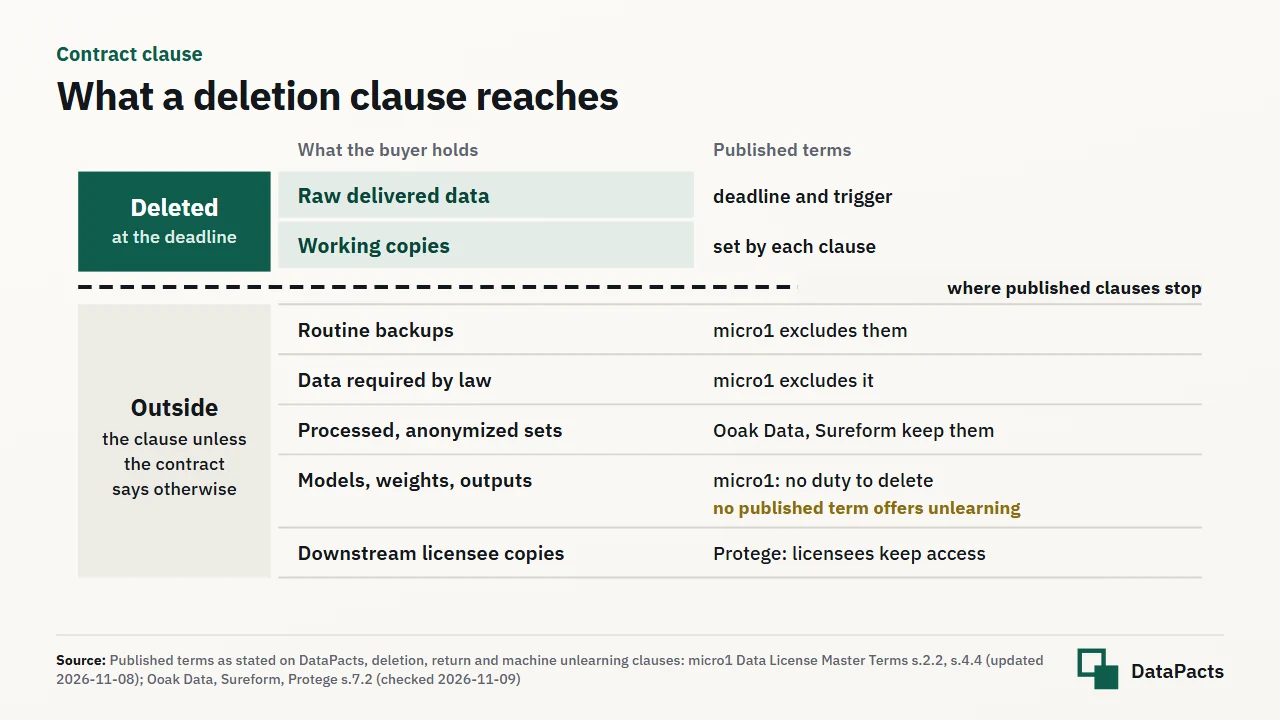
A deletion clause names what must go, and the answer differs for the delivered data, its copies, processed versions and what the buyer built from it.
- Raw delivered data and its copies, including working copies.
- Backups, which micro1 excludes (s.4.4).
- Processed or anonymized datasets: Ooak Data keeps its anonymized dataset for the license term, and Sureform keeps processed data as long as the signed agreement defines.
- Derivatives and models: micro1 treats derivatives, datasets, models with weights, outputs and synthetic data as Licensee Materials owned by the licensee (s.2.2).
Ownership of those last items is covered in ownership of derivatives and models trained on licensed data.
Deletion Terms in Published AI Data Contracts
Published deletion terms differ in trigger, deadline, exclusions and proof, and most buyer program pages publish none.
The table compares published deletion terms as of 2026-11-10, in alphabetical order, with each party's role and source.
| Party (role) | Document | Trigger and deadline | Excluded or kept | Proof | Source and check date |
|---|---|---|---|---|---|
| Aba Compute (intermediary) | data-licensing page | date set in the agreement | completed training not reversed | not stated | abacompute.com/data-licensing, 2026-11-09 |
| Defined.ai (licensor of its datasets) | Data License Agreement, effective 2022-11-30 | termination: delete, destroy or return all copies (8(c)) | models usable commercially under 1(c) conditions | certify in writing | defined.ai/data-license-agreement, 2026-11-09 |
| Endless (aggregator, licenses on to labs) | home page | end of agreed term | not stated | not stated | endless-data.com, 2026-11-09 |
| Labelbox Prism (buyer) | Prism FAQ | kill clause: 30 days after material breach, regulatory change or seller-defined change of control | trained models ("cannot be unlearned") | not stated | prism.labelbox.com/faq, 2026-11-09 |
| micro1 (buyer) | Data License Master Terms, updated 2026-11-08 | earlier of 120 days after delivery completes or termination (s.4.4) | Licensee Materials from accepted, paid-for Data; routine backups; data required by law | written confirmation on request | micro1.ai, re-read 2026-11-10 |
| Ooak Data (buyer) | partner page | raw archive within 30 days of delivery | anonymized dataset kept for the license term | written confirmation | ooakdata.com/partner, 2026-11-09 |
| Protege (licensee that passes access on) | Provider Terms | termination (s.7.2) | licensees keep access 12 months, academic licensees 3 years | not stated | withprotege.ai/provider-terms, 2026-11-09 |
| SuperAnnotate (licenses to buyers the seller approves) | program page | end of agreed period; on request | not stated | not stated | superannotate.com/data-partnerships, 2026-11-09 |
| Sureform (intermediary) | home page | raw data after processing | processed data for the period in the signed agreement | not stated | sureformhq.com, 2026-11-09 |
| The Corner (referral partner of micro1) | landing page | raw data kept at most 180 days | not stated | not stated | thecorner.ai/data/partnerships, 2026-11-09 |
| Not published: Abaka AI, Centific, Claru, Handshake AI, HUMXN, Mercor, Scale AI | program pages | not stated | not stated | not stated | each page, 2026-11-09 |
Each term is the stating party's own wording, and the signed order form can change it.
The seven parties in the last row publish no deletion term (checked 2026-11-09). The Corner, which refers sellers to micro1, states that raw data is kept at most 180 days, while micro1's own terms say the earlier of 120 days after delivery or termination, so the two published claims differ. The license clause matrix sets every other published clause beside deletion.
When Deletion Falls Due: Deadlines, Termination, Revocation and No Deal
Five triggers start the deletion clock in published terms, and a clause can combine them.
- Fixed period after delivery: micro1 120 days, Ooak Data 30 days for the raw archive.
- Termination: micro1 deletes at the earlier of the deadline or termination, and it can terminate for convenience on 30 days' notice (s.4.1); Defined.ai requires deletion on termination (8(c)).
- Revocation under a kill clause: Labelbox states deletion within 30 days.
- End of an agreed term or retention period: Endless, SuperAnnotate and Aba Compute state this.
- Request: SuperAnnotate states that deletion is honored on request.
Delete, Destroy or Return: Which Duty the Clause Imposes
Deletion removes copies, destruction covers media and copies alike, and return hands material back, which for digital data still leaves the recipient's copies unless deletion is also required.
Defined.ai's agreement, with Defined.ai as licensor to dataset customers, requires delete, destroy or return of all copies and written certification (8(c), checked 2026-11-09).
Two service contracts, not data licenses, show other patterns. Proximal's MSA, in which the customer pays Proximal, provides return, not deletion, of customer materials (s.6.4, last updated 2026-07-06). AIChamp's service terms, effective 2026-10-22, delete within 30 days after project end except legally required records.
What Published Deletion Clauses Leave Out
The exclusions decide more than the deadline, because what is carved out stays with the buyer after the clock runs out.
- Licensee Materials built from accepted, paid-for Data: micro1 has no duty to delete or retrain them (s.4.4 with s.2.2).
- Routine backups, excluded by micro1.
- Data required by law, excluded by micro1; AIChamp keeps legally required records.
- Processed or anonymized datasets, kept by Ooak Data and Sureform as described above.
- Copies held by downstream licensees: Protege's licensees keep access 12 months and academic licensees 3 years after termination (s.7.2).
- Data already licensed on, on the contributor side: Asimov states that deletion does not recall data already licensed, sold or shared, Human Archive does not recall approved submissions, and Kled may but need not delete (checked 2026-11-09).
Proof of Deletion: Written Confirmations and Certificates
Proof of deletion is a written statement by the buyer that named data and copies were deleted on a stated date, and published terms offer it in three strengths.
Defined.ai requires certification in writing on termination (8(c)). micro1 gives written confirmation on request (s.4.4). Ooak Data confirms in writing for its raw archive, and Origin Lab and Patronus AI confirm for working copies if no deal follows (all checked 2026-11-09).
No published standard form of a deletion certificate for AI data deals exists. A certificate can only state what the clause covers, so backups and Licensee Materials excluded from the clause stay excluded from the certificate, and checking one is the subject of audit rights in AI data licenses.
Machine Unlearning: What a Deletion Clause Cannot Promise
Machine unlearning means removing the influence of specific training data from a model that has already been trained, and no published AI data term promises it.
Why Deleting the Dataset Leaves Its Influence in the Model
A trained model keeps what it learned after the files are gone, and the parties say so themselves.
Labelbox states that "Models already trained on the data cannot be unlearned" (Prism FAQ, checked 2026-11-09), and Aba Compute states that deletion does not reverse completed training. The research literature measures unlearning against retraining without the data: Bourtoule et al.
(IEEE S&P 2021, arXiv 1912.03817) report speedups over retraining from scratch of 4.63 times on Purchase, 2.45 times on SVHN and 1.36 times on ImageNet with transfer learning, with a small accuracy drop on ImageNet.
Liu et al. (arXiv 2402.08787, revised 2024-12-06) name scope, data-model interaction and efficacy assessment as overlooked issues for large language models (both read 2026-11-10).
The Landgericht München I held on 2025-11-11 that memorisation of song lyrics in model parameters is reproduction (42 O 14139/24, not final as of 2026-11-09). The EDPB states that models trained on personal data cannot in all cases be considered anonymous (Opinion 28/2024), which when an AI model is anonymous examines.
No Published Buyer Term Offers Unlearning
None of the published terms cited here offers an unlearning or retraining commitment, and micro1's terms expressly exclude one.
micro1 states no duty to delete or retrain Licensee Materials (s.4.4). Labelbox states that after revocation there is no further training, transfer or sublicensing, which leaves existing models in place.
Under the Kopinor agreement of 2025-12-19, termination does not affect models already trained and shared. What the buyer keeps and may do with models is covered in retraining and model retention rights after a license ends.
Survival: Which Deletion Duties Outlast the Contract
A survival clause lists the duties that continue after the agreement ends, and a deletion duty without one can lapse with the contract it belongs to, a drafting point and not a legal rule.
- micro1's s.4.2, headed "Survival", lists sections 1, 2.3, 2.7, 3, 4.2, 4.3, 4.4 and 5 through 9, plus the Order Form's exclusivity and audit provisions, so its deletion section survives (re-read 2026-11-10).
- Confidentiality under micro1 survives 3 years after termination and trade secrets indefinitely (s.2.3).
- Access on the buyer's side survives: Protege's licensees keep it 12 months, academic licensees 3 years; a DataVendor buyer's entitlement survives unpublishing; completed Pangea.ai licenses survive (checked 2026-11-09).
What Sellers Ask For and What Buyers Have Accepted in Writing
Sellers ask for more deletion than published terms give, and the table separates asks that have a written precedent from asks that none of the published terms grants.
The table compares ten asks with published precedents as of 2026-11-10.
| Seller ask | Published precedent | Source |
|---|---|---|
| fixed deletion deadline | yes: micro1 120 days or termination; Ooak Data 30 days | micro1.ai; ooakdata.com |
| deletion at revocation | yes: Labelbox kill clause, 30 days | prism.labelbox.com/faq |
| written certification | yes: Defined.ai 8(c) on termination; micro1 on request | defined.ai; micro1.ai |
| deletion if no deal | yes: Origin Lab, Patronus AI | originlab.ai; data.patronus.ai |
| deletion on request during the term | yes: SuperAnnotate | superannotate.com |
| backups purged | none: micro1 excludes routine backups | micro1.ai |
| derivatives and processed datasets deleted | none: micro1 excludes Licensee Materials; Ooak Data keeps the anonymized set | micro1.ai; ooakdata.com |
| downstream licensees delete at termination | none: Protege tail of 12 months, academic 3 years | withprotege.ai |
| unlearning or retraining without the data | none in the published terms cited here | all sources above |
| deletion duty that survives termination | yes: micro1 s.4.2 lists s.4.4 | micro1.ai |
No public figure exists for their price; see negotiating an AI data licensing deal.
Deletion Duties That Apply Whatever the License Says
Data protection law can require deletion that no license can waive: under the GDPR, erasure and the duty to tell recipients sit in Articles 17 and 19, and processor deletion in Article 28(3)(g).
Regulation (EU) 2016/679 applies from 2018-05-25. Erasure in the Article 17 sense means a controller deletes personal data on a listed ground, which differs from a contract deadline. See GDPR and AI training data.
The EDPB's Opinion 28/2024, adopted 2024-12-17, lists erasure of the dataset and/or the model itself as a possible corrective measure (para. 114); it is soft law.
In the US, the FTC's final Everalbum settlement of 2021-05-07 required deletion of "the models and algorithms it developed by using the photos and videos uploaded by its users" (FTC release; order text not checked).
FTC staff wrote on 2024-01-09 that the FTC has required businesses that unlawfully obtain consumer data to delete products developed with it, including models. These remedies are covered in FTC rules on AI training data.
Accepting a Deletion Clause: Benefits, Risks, Downsides and Alternatives
Accepting a published deletion clause gets raw data off the buyer's systems on a date, and what it leaves behind is the price of accepting it. Whether to license at all is covered in should you sell or license your data.
Benefits
- A dated deadline (micro1 120 days, Ooak Data 30 days).
- Written confirmation or certification (micro1, Defined.ai).
- Deletion on revocation (Labelbox kill clause).
Risks
- Backups, legally required data and Licensee Materials stay with the buyer.
- Downstream licensees keep access (Protege).
- A trained model can still reflect the data.
Downsides
- No unlearning remedy exists in the published terms cited here.
- A confirmation is the buyer's own statement unless audit rights back it.
Alternatives
- Negotiate the asks in the table above.
- License only de-identified or less sensitive subsets.
- Evaluate inside the seller's environment without a copy.
- Do not license at all.
More routes appear in alternatives to selling data to AI labs.
How the Deletion Clause Works With the Other Clauses of the License
Deletion is read with the term, the grant, derivative ownership and model retention, because each decides what the deletion clause can reach. See every clause of an AI data licensing agreement.
Deletion When No Deal Is Signed
Before a license exists, deletion rests on the sample terms and the NDA, and two programs state that material is deleted with written confirmation if no deal follows.
Origin Lab states this for working copies and Patronus AI for shared material (checked 2026-11-09); Ooak Data's raw archive deletion is a license term, not a no-deal term. See samples, clean rooms and proving data quality.
Confidentiality is covered in NDAs before sharing data with an AI buyer.
Information, Not Legal Advice
This page explains published terms and public rules for information and is not legal advice for a specific agreement.
Terms, Programs and Records Cited on This Page
The terms above come from each party's own documents, checked on November 9, 2026, unless another date is shown.
- Aba Compute (intermediary that places data with buyers)
- AIChamp (service provider)
- Asimov (contributor side)
- Defined.ai (licensor of its own datasets)
- Endless (aggregator that licenses on to labs)
- GEMA v. OpenAI
- Handshake AI
- Human Archive (contributor side)
- Kled (contributor side)
- Labelbox Prism
- micro1, with its Data License Master Terms clause by clause
- Ooak Data
- Proximal (service provider)
- Sureform (intermediary that places data with buyers)
- The Corner (referral partner of micro1)
Other programs are listed under company data partnership programs.
Frequently Asked Questions
What is a data deletion clause in an AI data license?
A clause that sets when the buyer must delete, destroy or return licensed data and its copies, and what is excluded, such as backups or models.
Can an AI company remove my data from a model it already trained?
None of the published terms cited here promises it. Labelbox states trained models cannot be unlearned, and micro1 states no duty to retrain.
What is a certificate of deletion in an AI data deal?
A written statement by the buyer that named data and copies were deleted. Defined.ai's agreement requires one on termination, and micro1 gives written confirmation on request.
Does the duty to delete survive the end of the license?
Only if the contract says so. micro1's survival clause, s.4.2, keeps its deletion section 4.4 in force after the agreement ends (re-read November 10, 2026).