This page reads the introduction and all 45 numbered sections, checked November 10, 2026, and compares the archived versions of September 30, October 7 and October 30, 2026. General contract concepts sit in the guides to AI training data licensing agreements, listed near the end.
How the Master Terms Bind: Order Form, Effective Date and Archived Versions
The master terms bind only when a company and micro1 sign an Order Form that references them, and each signed Order Form forms a separate agreement. Such an agreement lets a buyer use data on stated terms without ownership passing.
The version posted on the Effective Date governs that agreement for its whole duration, a later version applies only through a signed amendment, and s.9.6 says posting a revised version does not amend an executed Order Form. The Order Form controls where it conflicts with the terms, and micro1 does not publish it.
Every Section of micro1's Master Terms at a Glance
The table lists every numbered section of the November 8, 2026 version with its rule in one line and a jump link to its reading below. "Changed" marks text that differs from the September 30, 2026 version, with the date of the first archived or live change.
| Section | Heading | Rule in one line | Changed | Reading |
|---|---|---|---|---|
| Intro | Binding, versions, precedence | Binds on a signed Order Form; Effective Date version governs; Order Form controls | Yes (archive line, 2026-10-07) | #how-they-bind |
| 1.1 | Data Collection and Delivery | Deliver per Data Manifest by deadline; micro1 pays export and delivery | No | #s1-1 |
| 1.2 | License Grant; Non-Exclusive | Worldwide, royalty-free, nonexclusive, irrevocable, perpetual, multi-tier; after acceptance and payment | Yes (2026-10-30) | #s1-2 |
| 1.3 | Review and Approval Rights | 30 business days, deemed acceptance; 60-day latent defects; partial rejection may end the deal | Yes (2026-11-08) | #s1-3 |
| 1.4 | Data Use Restrictions | Five limits, including redaction before customer training and no standalone resale | Yes (2026-10-07) | #s1-4 |
| 2.1 | Licensor's Rights | Licensor keeps title to the data | Yes (2026-10-30, wording) | #s2-1 |
| 2.2 | Licensee's Rights | micro1 owns Licensee Materials, including models, weights, outputs | Yes (2026-10-30) | #s2-1 |
| 2.3 | Confidentiality | 3 years after termination; trade secrets indefinitely; source anonymity | Yes (2026-10-30, wording) | #s2-3 |
| 2.4 | Data Security | Encryption in transit and at rest | No | #s2-4 |
| 2.5 | Security Incident | Notice within 2 business days | No | #s2-4 |
| 2.6 | Flow-Down Obligations | Equivalent duties for affiliates and customers | No | #s2-4 |
| 2.7 | CCPA | Training purpose only; requests honored without retraining | No | #s2-7 |
| 3 | Consideration | License Price only; invoice after acceptance; taxes extra | No | #s3 |
| 4.1 | Term; Termination | Until terminated; 30 days' notice; 10-day cure | No | #s4-1 |
| 4.2 | Survival | Lists surviving sections and Order Form exclusivity and audit | Yes (2026-10-07) | #s4-1 |
| 4.3 | Data Manifest Accuracy | Immediate termination and full refund | No | #s4-3 |
| 4.4 | Data Deletion | Earlier of 120 days or termination; Licensee Materials kept | Yes (new 2026-10-07; 2026-10-30) | #s4-4 |
| 5.1 | Due Authority | Authority; no prior grant on similar terms | No | #s5-1 |
| 5.2 | All Necessary Rights | All rights; pre-signing review of policies | Yes (2026-10-30, 2026-11-08) | #s5-1 |
| 5.3 | Data Subject Consents | Consents or legal basis, including AI training | No | #s5-1 |
| 5.4 | Depicted Individuals | Releases; records kept at least 7 years | No | #s5-1 |
| 5.5 | Non-Infringement | To licensor's knowledge; no liens | No | #s5-5 |
| 5.6 | No Third-Party Terms Obligations | No breach of binding terms | No | #s5-5 |
| 5.7 | No PHI; No Prohibited Data | Seven excluded categories unless the Order Form allows | Yes (2026-10-30, notice) | #s5-5 |
| 5.8 | Compliance with Laws | Material compliance, including privacy and security | Yes (2026-10-30, narrowed) | #s5-5 |
| 5.9 | No Remote Access or Disablement | No kill switch in the data | No | #s5-5 |
| 5.10 | No Litigation | No known claims; notice duty | No | #s5-5 |
| 5.11 | Data Sourcing Practices | No unauthorized scraping | No | #s5-5 |
| 5.12 | No Synthetic Content | To knowledge, none unless disclosed | No | #s5-5 |
| 6.1 | Due Authority (licensee) | micro1's authority | No | #s6 |
| 6.2 | Compliance with Laws (licensee) | Privacy, data protection and AI laws | No | #s6 |
| 7.1 | Consequential Damages | Excluded, except fraud, gross negligence, misconduct, indemnities | No | #s7 |
| 7.2 | Liability Cap | Each party 3x fees under the Order Form | No | #s7 |
| 8.1 | Licensor Indemnification | Data, IP, privacy, publicity, data protection claims | No | #s8 |
| 8.2 | Licensee Indemnification | Use outside the license | No | #s8 |
| 8.3 | Procedure | Notice, control, settlement consent | No | #s8 |
| 9.1 | Assignment | Mutual M&A assignment, not to a competitor | No | #s9 |
| 9.2 | Severability | Minimum limitation | No | #s9 |
| 9.3 | Governing Law | California and US law; no CISG | No | #s9 |
| 9.4 | Dispute Resolution | 30-day talks, then JAMS arbitration in California | Yes (2026-10-30) | #s9 |
| 9.5 | Notices | Addresses in the Order Form; email notice given when sent | Yes (2026-11-08) | #s9 |
| 9.6 | Amendments; Waivers | Signed only; posting is no amendment | No | #s9 |
| 9.7 | Independent Contractors | No partnership or agency | No | #s9 |
| 9.8 | Entire Agreement | Order Form, terms as of Effective Date, attachments | No | #s9 |
| 9.9 | Counterparts; E-Signature | Electronic signatures valid | No | #s9 |
| 9.10 | Headings; Construction | No third-party beneficiaries except affiliates and indemnitees | No | #s9 |
Source: micro1 Data License Master Terms, micro1.ai/legal/data-license-master-terms, last updated 2026-11-08, read 2026-11-10; "Changed" is DataPacts' comparison with the archived PDFs and omits minor drafting edits.
Section 1: Delivery, Grant, Review and Use Restrictions
Section 1 defines the license, the review period and the uses micro1 may not make.
Section 1.1: Collection, Delivery and the Data Manifest
The company collects and delivers the data described in the Data Manifest by the Order Form's deadline, and micro1 pays the cost of export and delivery. A guide to describing a dataset in a data manifest covers how sellers prepare one.
Section 1.2: The Nonexclusive, Perpetual Grant to micro1
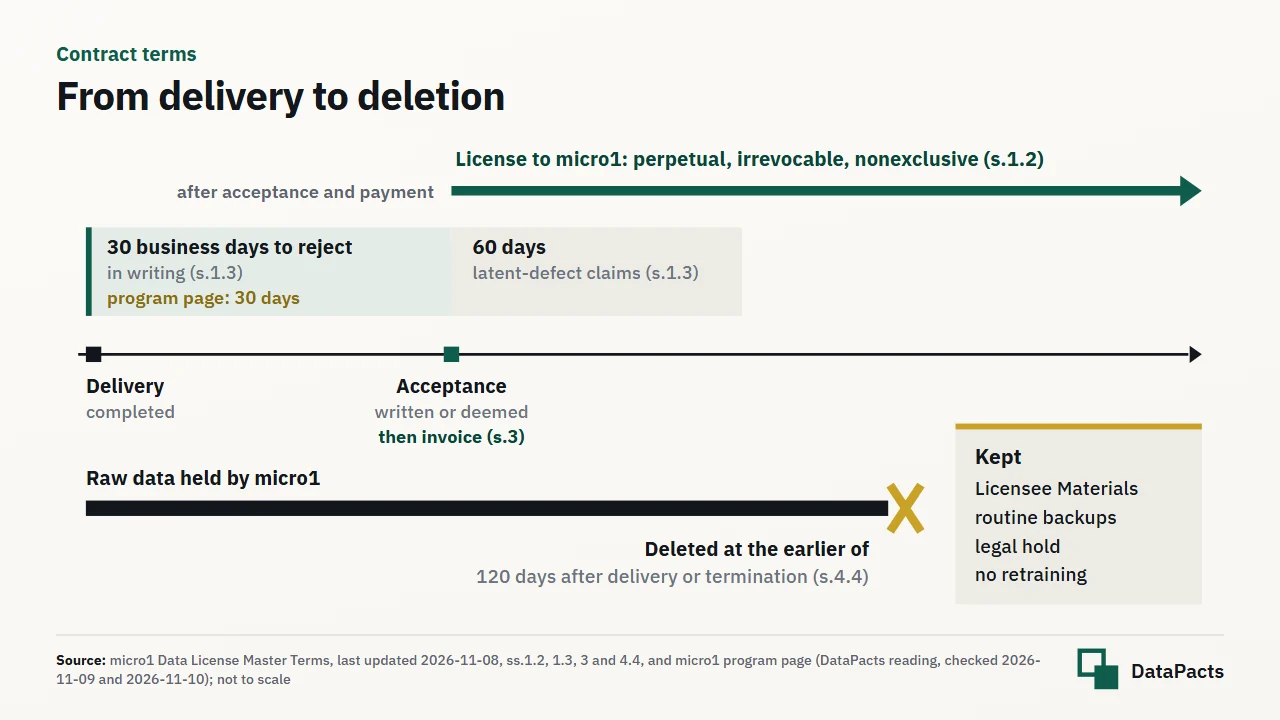
Section 1.2 grants micro1 and its affiliates a worldwide, royalty-free, fully paid-up, nonexclusive, irrevocable and perpetual license, sublicensable through multiple tiers, to develop, train, fine-tune, evaluate and test; customers, their affiliates and service providers receive the same rights. Models and outputs may be exploited "without restriction".
The grant attaches only to accepted and paid-for data; the "exclusively" wording on micro1's pages is addressed under program pages versus the contract.
Section 1.3: Review, Rejection and Deemed Acceptance
micro1 has 30 business days after delivery to reject data in whole or in part by written notice, and data it does not reject in time is deemed accepted.
Rejected data is not paid for. Latent-defect claims run for 60 days after acceptance, with correction, replacement or refund as the sole remedy, except for IP, privacy, consent, provenance and fraud claims.
The version of November 8, 2026 adds a termination right: if the remainder after a partial rejection is no longer reasonably usable for AI training or is materially less valuable, micro1 may reject everything and terminate, with nothing payable and s.4.4 applying.
Section 1.4: What micro1 and Its Customers May Not Do
Section 1.4 limits the grant with five restrictions that bind micro1, its affiliates, service providers and customers.
- (a) Personal information is redacted or anonymized before sublicensing to customers for AI training.
- (b) No competing product.
- (c) No re-identification.
- (d) No reverse-engineering.
- (e) No standalone resale.
Clause (a) applies before onward sublicensing, not before delivery to micro1, which matters for de-identification before licensing data.
Section 2: Ownership, Confidentiality, Security and CCPA
Section 2 splits ownership, sets confidentiality and security duties and adds California privacy terms.
Sections 2.1 and 2.2: Who Owns the Data and the Licensee Materials
The company keeps ownership of the data, and micro1 owns everything it builds from it, which the terms call Licensee Materials: derivatives, models including weights, outputs and synthetic data.
Section 2.3: Confidentiality and Source Anonymity
Both parties keep the other's non-public information confidential, including the existence and terms of the Order Form, for three years after termination and indefinitely for trade secrets.
Sections 2.4 to 2.6: Security, Incident Notice and Flow-Down
micro1 must encrypt the data in transit and at rest, report a material security incident within two business days and bind affiliates and customers to equivalent duties.
Section 2.7: Terms for California Personal Information
Where the data includes California residents' personal information, s.2.7 limits its use to training, fine-tuning, testing and improving AI models, and forwarded opt-out and deletion requests are honored "without any obligation to retrain existing models". It is the contract side of California's CCPA/CPRA rules for AI training data.
Sections 3 and 4: Price, Term, Refund and Deletion
Sections 3 and 4 set the price mechanics, how the agreement ends and what happens to the data afterwards.
Section 3: License Price, Invoice and Taxes
The License Price in the Order Form is the only payment, and the company may invoice only after written acceptance or deemed acceptance. The master terms set no number of payment days, and sales, use and VAT are extra; see VAT and sales tax on data licensing.
Sections 4.1 and 4.2: Term, Termination and Survival
The agreement runs until terminated, either party may end it for any reason on 30 days' written notice, and a material breach allows immediate termination after a 10-day cure period. Section 4.2 lists the surviving sections and keeps alive any exclusivity and audit provisions an Order Form adds; the terms contain neither.
Section 4.3: Refund for an Inaccurate Data Manifest
If micro1 decides in good faith that the Data Manifest was materially inaccurate or misleading, or that the company made another material misrepresentation, it may terminate at once and the company refunds everything paid.
Section 4.4: Deletion and What micro1 Keeps
micro1 deletes the data at the earlier of 120 days after delivery is completed or the termination date, and confirms deletion in writing on request; a voided Order Form triggers prompt deletion.
Licensee Materials, routine backups and data under legal hold stay; no retraining or model deletion is required.
Section 5: The Twelve Licensor Warranties
The company gives twelve warranties in s.5, several limited to what it knows.
Sections 5.1 to 5.4: Authority, Rights, Consents and Releases
The company warrants its authority, that it has not granted the same data on the same or substantially similar terms before, and that it holds every right, consent and release the license needs.
The sentence added to s.5.2 on November 8, 2026 requires a reasonable pre-signing review of privacy policies and data agreements. Section 5.4 requires releases for likeness and voice, with records kept at least seven years.
Sections 5.5 to 5.12: Infringement, Excluded Data, Sourcing and Synthetic Content
The remaining warranties cover infringement, excluded data, compliance, litigation, sourcing and generated content.
- Sections 5.5 and 5.6: no infringement, liens or breach of third-party terms, to the licensor's knowledge.
- Section 5.7: none of seven categories unless the Order Form allows: health data and biometrics, libelous or unlawful material, obscene material, malware, payment card or financial account data, children's data, and export-controlled or classified data.
- Sections 5.8 to 5.11: legal compliance, no remote disablement mechanism, no known claims, no unauthorized scraping.
- Section 5.12: no synthetic content unless disclosed, to the licensor's knowledge.
Sections 6 to 8: micro1's Warranties, Damages and Defense of Claims
Sections 6 to 8 set micro1's own promises, the damages either side can claim and who defends third-party claims.
Section 6: What micro1 Warrants
micro1 warrants only its authority and that its use of the data, including training and deploying models, complies with privacy, data protection and AI laws where it operates.
Section 7: Excluded Damages and the 3x Cap
Neither party is liable for indirect or consequential losses, and each party's total liability is capped at three times the fees paid or payable under the Order Form under which the claim arose. Indemnification obligations escape the consequential-damages exclusion but count toward the cap.
Section 8: Who Defends Which Third-Party Claims
The company defends micro1 against third-party claims arising from the data or from breach of its warranties, and micro1 defends the company against claims from use outside the license. Under s.8.3 the indemnitor controls the defense.
Section 9: Assignment, California Law, Arbitration and Boilerplate
Either party may assign the agreement without consent in a merger, acquisition or sale of substantially all assets, with written notice, but not to a competitor of the other party without consent.
California and US law govern. A dispute starts with 30 days of good-faith talks, then goes to individual JAMS arbitration in California. The rest is boilerplate: severability, notices, signed amendments only, entire agreement and e-signature.
Version History: Four Dated Versions Compared
micro1 archives three earlier versions of the master terms, dated September 30, October 7 and October 30, 2026, and publishes no list of what changed. The table compares them with the live text, all opened November 10, 2026, as of 2026-11-10.
| Version | Governs orders dated | Main changes | Source |
|---|---|---|---|
| 2026-09-30 | 2026-09-30 to 2026-10-06 (by last-updated date) | Earliest version reviewed: grant to "train, fine-tune and test"; s.2.2 derivatives, modifications and improvements only; deletion inside s.4.2 (120 days after final delivery or termination; no duty to delete or retrain models, weights or derivative works); s.1.4 (a) to (d); arbitration without a negotiation step; no archive line | Archived PDF |
| 2026-10-07 | 2026-10-07 to 2026-10-29 | Archive line added; s.1.4(e) no standalone resale, service-provider proviso; deletion moved to new s.4.4 with prompt deletion of voided orders; s.4.4 added to survival | Archived PDF |
| 2026-10-30 | 2026-10-30 to 2026-11-07 | s.1.2 adds develop and evaluate, commercial use of models and outputs "without restriction", customers' affiliates and service providers; s.2.2 Licensee Materials defined; s.4.4 exempts Licensee Materials; s.5.2 rewritten; s.5.7 written notice; s.5.8 narrowed; s.9.4 30-day good-faith discussion and JAMS administration | Archived PDF |
| 2026-11-08 | From 2026-11-08 (live, checked 2026-11-10) | s.1.3 rejection in whole or in part and termination on a total rejection; s.5.2 pre-signing review of privacy policies, notices and data agreements; s.9.5 email notice given when sent unless a non-delivery notice returns | Live page |
Date ranges assume each version was posted on its last-updated date; the posting dates themselves were not verified.
The largest shift is ownership and deletion: the September 30 version gave micro1 derivatives only, while the October 30 version defines Licensee Materials broadly and exempts them from deletion.
The Effective Date, not the reading date, fixes the governing version. No earlier version than September 30, 2026 was reviewed, micro1 posts no change log, and the comparison is DataPacts' own reading.
Where micro1's Program Pages Differ From the Contract
micro1's program pages describe some terms differently from the master terms, and the signed Order Form and master terms are what bind. The AI data partnership payouts and program terms compared table sets the program pages side by side.
- Review period: micro1 states "30 days to review and approve", while s.1.3 gives 30 business days (checked November 9, 2026).
- Payment: micro1 states payment "in full within 30 days of acceptance" and, in its FAQ, within 30 days of invoicing (checked November 9, 2026); s.3 sets no period.
- "Exclusively": micro1 states data is licensed "exclusively to labs and enterprises based in the U.S. and allied countries" (checked November 9, 2026), which describes recipients; s.1.2 is nonexclusive.
- De-identification: micro1 states it de-identifies sensitive information itself (checked November 9, 2026), while s.1.4(a) requires redaction before onward sublicensing.
- Retention: The Corner states it keeps raw data at most 180 days (checked November 10, 2026), while s.4.4 sets micro1's deadline at 120 days after delivery.
The contradictions are shown, not resolved. The Corner is an intermediary, an independent referral partner of micro1 and not a buyer, covered in The Corner referral partner profile.
Reading the Terms as a Seller: Benefits, Risks, Downsides and Alternatives
The master terms favor the licensee on duration, model ownership and remedies, and give the company a fixed cap, a deletion date and a nonexclusive grant.
Benefits
- Data ownership stays with the company (s.2.1).
- The grant is nonexclusive (s.1.2), though s.5.1 bars a prior similar grant.
- Deletion by a fixed date (s.4.4).
- Either party may exit on 30 days' notice (s.4.1).
Risks
- The perpetual, multi-tier license is irrevocable (s.1.2).
- The company indemnifies micro1 for data claims (s.8.1).
- A refund can follow acceptance (s.4.3).
- Partial rejection can become total (s.1.3).
Downsides
- Models and outputs stay after deletion (s.2.2, s.4.4).
- Deemed acceptance after 30 business days (s.1.3).
- Price, payment period, exclusivity and audit sit in an unpublished Order Form.
Alternatives
- Negotiate the Order Form, which controls.
- Choose another buyer or structure, or do not license at all.
The decision about micro1 sits on the profile; a license clause matrix sets these clauses beside other buyers' contracts.
micro1's Clauses Next to the General Clause Guides
Each clause above has a general guide covering how AI data licenses handle it across buyers. The guide to every clause of an AI data licensing agreement runs in order; program terms sit on the micro1 data buyer profile.
- s.1.2, 5.1: exclusive vs non-exclusive data licenses.
- s.1.2, 4.1: perpetual licenses in AI data deals.
- s.1.2, 1.4: field of use and scope limits.
- s.1.2, 2.6: sublicensing and onward transfer.
- s.1.3: deemed acceptance of delivered data.
- s.2.2: ownership of derivatives and trained models.
- s.2.2, 2.7, 4.4: model retention after a license ends.
- s.4.2: audit rights in AI data licenses.
- s.4.4: deletion and machine unlearning clauses.
- s.5, 8: indemnities and warranties.
- s.7: liability caps.
- s.9.3, 9.4: governing law, arbitration and disputes.
Not Legal Advice, Sources and Check Dates
This page describes micro1's published terms for information and is not legal advice; a lawyer should review any Order Form before signing. Read on November 10, 2026; how DataPacts sources, dates and checks every figure is set out in the methodology.
Frequently Asked Questions
Which version of micro1's master terms applies to my order?
The version posted on your Order Form's Effective Date governs that order for its whole duration. A later version applies only through a signed amendment.
Can micro1 change the master terms after I sign?
micro1 can post new versions, but s.9.6 says posting a revised version does not amend an executed Order Form.
Does micro1 have to delete models trained on my data?
No. Section 4.4 requires deletion of the data itself but not of Licensee Materials, which include models, weights, outputs and synthetic data.
Where are earlier versions of micro1's master terms?
micro1 links an archive page with PDFs dated September 30, October 7 and October 30, 2026. No earlier version was reviewed.